Watches
Christie’s Geneva 2026: Three Watches Beyond the Headlines
Christie’s Geneva Rare Watches sale on 11 and 12 May 2026 was a major commercial result, but the most useful way to revisit it is not another league table. Three quieter lots — an F.P. Journe wall clock, a tantalum Chronomètre Bleu and an Eska cloisonné wristwatch — show how collectors respond to format, material and decorative craft. None should be treated as a price forecast. Together, they explain why a sale catalogue rewards slow looking after the headline lots have moved on.
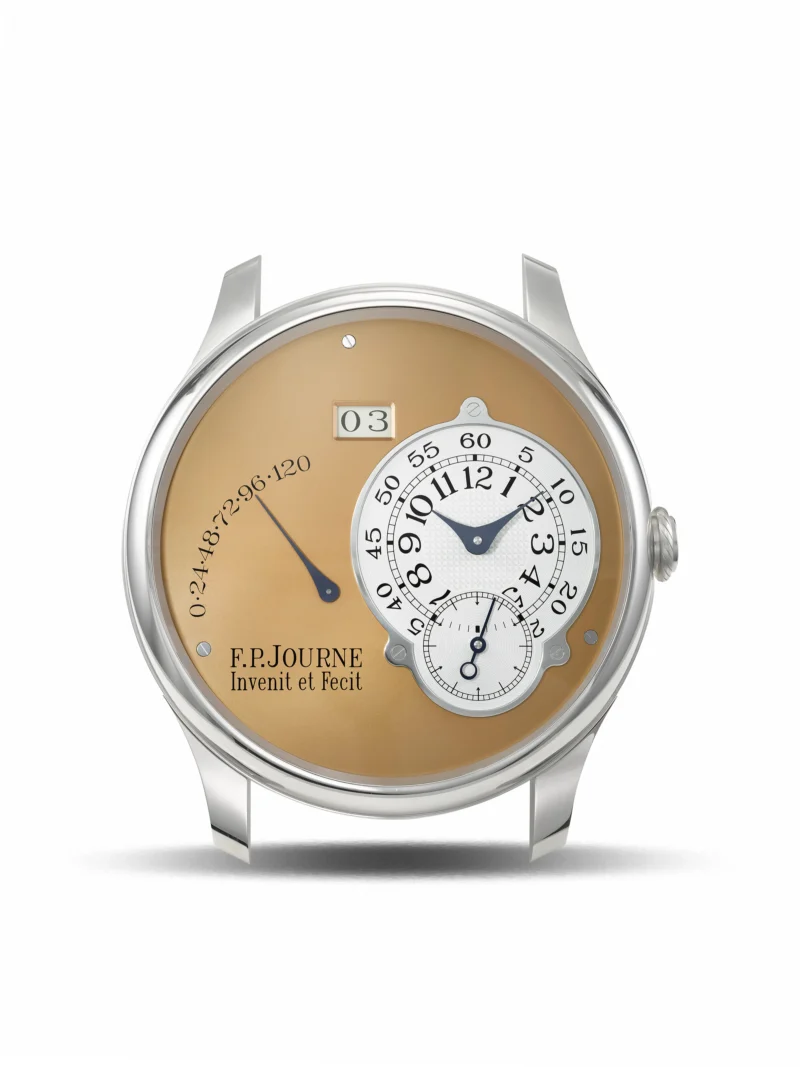
F.P. Journe wall clock, circa 2003, offered as lot 1 in Christie’s Geneva Rare Watches sale. CHRISTIE’S IMAGES LTD. 2025.
Answer first
Christie’s Geneva Rare Watches sale on 11 and 12 May 2026 was a major commercial result, but the most useful way to revisit it is not another league table. Three quieter lots — an F.P. Journe wall clock, a tantalum Chronomètre Bleu and an Eska cloisonné wristwatch — show how collectors respond to format, material and decorative craft. None should be treated as a price forecast. Together, they explain why a sale catalogue rewards slow looking after the headline lots have moved on.
Key takeaways
- Christie’s reported CHF 33,054,441 for the sale and a 99 per cent sell-through rate by lot.
- This article is an object-led companion, not a second market report; TheTimeo’s separate results analysis examines the sale-level figures.
- A large F.P. Journe wall clock carried the maker’s visual language into a format rarely seen at auction.
- The Chronomètre Bleu made tantalum and a difficult-to-produce blue dial the centre of its identity.
- The Eska demonstrated that a less famous name can become compelling when the object and its craft are specific.
The sale, without turning it into a scoreboard
Christie’s official post-sale release records CHF 33,054,441, or US$42,309,684, for Rare Watches in Geneva. It describes the result as the auction house’s highest total for a various-owner watch sale and reports 99 per cent sold by lot, with the aggregate result at 188 per cent of the low estimate. Those figures establish the scale of the event. They do not explain every individual bid.
The top results understandably dominated the first reports: an early F.P. Journe Tourbillon Souverain, a vintage Audemars Piguet chronograph, a Cartier Crash and major Patek Philippe references. Repeating that ranking would add little. The catalogue becomes more revealing when attention shifts to objects whose interest was not based solely on their position in the results table.
Auction prices are also records of a particular transaction. They include a date, currency, sale room, condition, buyer competition and premium structure. They are evidence, but not an automatic valuation for the next example bearing the same name.
A closer look
Details worth keeping.
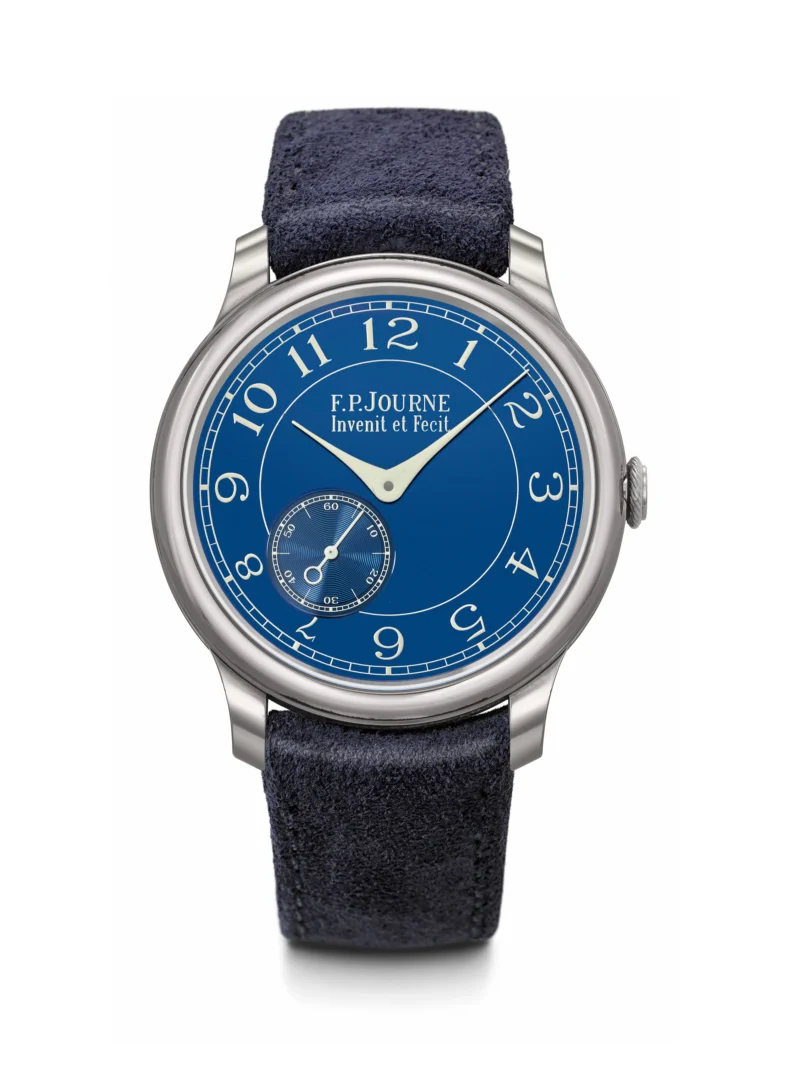
Chronomètre Bleu number 816-CB, circa 2015, offered as lot 4. CHRISTIE’S IMAGES LTD. 2025.
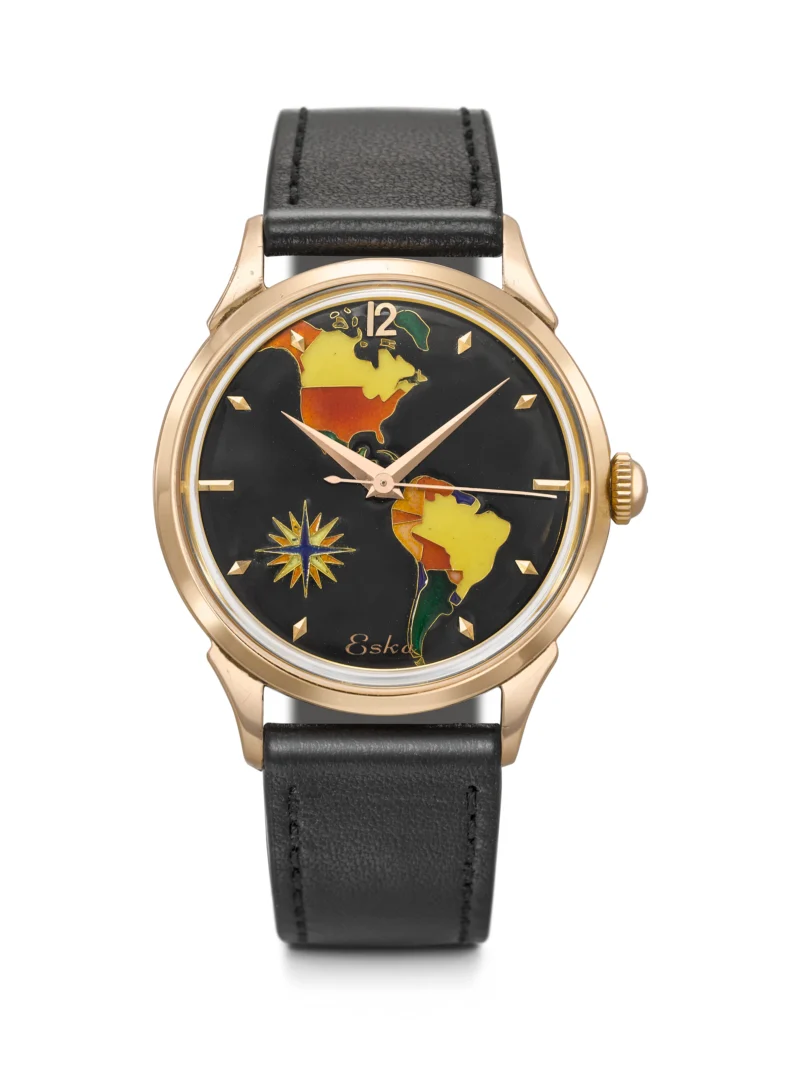
Eska cloisonné enamel watch depicting the Americas, circa 1950, offered as lot 9. CHRISTIE’S IMAGES LTD. 2025.
1. F.P. Journe’s wall clock changed the scale
Lot 1 was a stainless-steel F.P. Journe wall clock dated circa 2003. Christie’s estimated it at CHF 10,000–20,000 and records a price realised of CHF 158,750. The numerical gap is striking, yet the object itself explains why a standard wristwatch comparison is inadequate.
The clock enlarges a familiar visual vocabulary: off-centred indications, a restrained metal frame and an emphatic numerical display. At architectural scale, the proportions that seem intimate on the wrist become graphic. It is connected to Journe’s watchmaking, but it is not simply a wristwatch made larger. Its function, production context and likely survival rate form a separate collecting question.
That distinction is worth preserving. A result far above estimate may reflect the scarcity of the format, the condition of this example, the strength of the maker’s following or several determined bidders. The public lot record does not allow those causes to be separated with certainty. It does allow the clock to be identified precisely and compared with any later appearance of the same type.
2. The Chronomètre Bleu made material visible
Lot 4 was an F.P. Journe Chronomètre Bleu, number 816-CB, dated circa 2015. Christie’s catalogued its tantalum case and chrome-blue dial, estimated it at CHF 50,000–100,000 and records CHF 127,000 realised.
The appeal is unusually easy to see. Tantalum gives the case a dark, cool tone, while the dial changes character with the light. Neither feature is merely decorative: the difficult material and the dial finish are integral to the reference’s identity. A catalogue reader should still move beyond the frontal photograph. Case marks, dial surface, movement images, service history and the written condition report determine how closely the object matches the ideal suggested by its name.
This is where the sale page and condition request do different jobs. The public page establishes reference, approximate date, material, estimate and outcome. A condition report addresses the physical watch offered. One cannot replace the other, and an attractive studio image cannot resolve questions about intervention or mechanical state.
3. Eska proved that recognition is not the same as quality
Lot 9 was an Eska automatic wristwatch in pink gold, dated circa 1950, with a cloisonné enamel dial depicting the Americas. Christie’s estimated it at CHF 10,000–20,000 and records CHF 76,200 realised.
The dial is the reason to stop. Fine wires establish the borders of the map, while enamel supplies colour and depth. The watch asks to be judged as a complete decorative object rather than through brand hierarchy alone. That does not make every enamel world-map dial equivalent. Subject, execution, state of preservation, case pairing and evidence of originality all matter.
The Eska also exposes a useful collecting bias. Familiar signatures make objects easier to classify, but familiarity is not proof of rarity, quality or importance. Conversely, a less widely recognised signature does not excuse weak documentation. The strongest case comes from agreement between the physical watch, the catalogue description and reliable comparative evidence.
How to read the three results
These lots reward three separate questions. For the wall clock: how many comparable objects are documented, and is the format original to the maker? For the Chronomètre Bleu: do material, reference, serial context and condition cohere? For the Eska: is the enamel dial original, correctly attributed and well preserved?
Only after those questions should price enter the discussion. Estimate, hammer price and price realised are not interchangeable. The auction house’s buyer guidance explains that a buyer’s premium is added to the hammer price, while taxes, payment and shipping can add further costs. TheTimeo’s guide to auction estimates and buyer’s premium sets out that arithmetic in detail.
A single sale can sharpen judgement without becoming a universal market proxy. It shows what bidders accepted for particular objects under stated conditions. It cannot establish future demand, the number of undisclosed examples or the price of a watch whose condition and history differ.
What survives the sale-room noise
The three objects endure because each makes a clear proposition. The clock changes scale. The Chronomètre Bleu turns material and colour into identity. The Eska concentrates decorative craft into a small, legible surface. Their results are useful, but the objects remain more interesting than the ranking.
That is the productive way to revisit a strong auction: keep the verified numbers, discard the investment shorthand and return to the evidence visible in each lot. A catalogue is not only a list of prices. At its best, it is a temporary archive of design, manufacture and survival.
Sources & further reading
Sale dates, total, sell-through and aggregate performance were checked on 9 September 2026 against Christie’s official post-sale release. Object descriptions, estimates and prices realised were checked against the official Christie’s pages for lot 1, the F.P. Journe wall clock, lot 4, the Chronomètre Bleu and lot 9, the Eska cloisonné watch. Auction-fee distinctions were checked against Christie’s official fees guide. Images are the corresponding official Christie’s lot photographs and are credited in their captions. No resale forecast, investment return or inferred bidder identity is included.
Last verified: 9 September 2026.