

Watchmaking Intelligence / Flagship
Watches
Audemars Piguet Royal Oak Malachite: When a Watch Becomes Geology
A TheTimeo collector reading of the 2026 Audemars Piguet Royal Oak Selfwinding in yellow gold with malachite stone dial: Ref. 15513BA and Ref. 15553BA.
TheTimeo view
Material intelligence, cut into the Royal Oak
The Royal Oak Malachite 2026 is the most visually distinctive entry in the Royal Oak family since the turquoise dial in 2023. Audemars Piguet replaces the familiar tapisserie surface with a geological object formed over millions of years, making every dial a singular green landscape.
The Royal Oak Malachite is not a coloured dial. It is a geological event cut to 41 millimetres. Every example that leaves Le Brassus is the only one of its kind.
TheTimeo editorial desk
The visual edit
The object, frame by frame.

Malachite dial detail with Audemars Piguet signature. Image courtesy of Audemars Piguet.
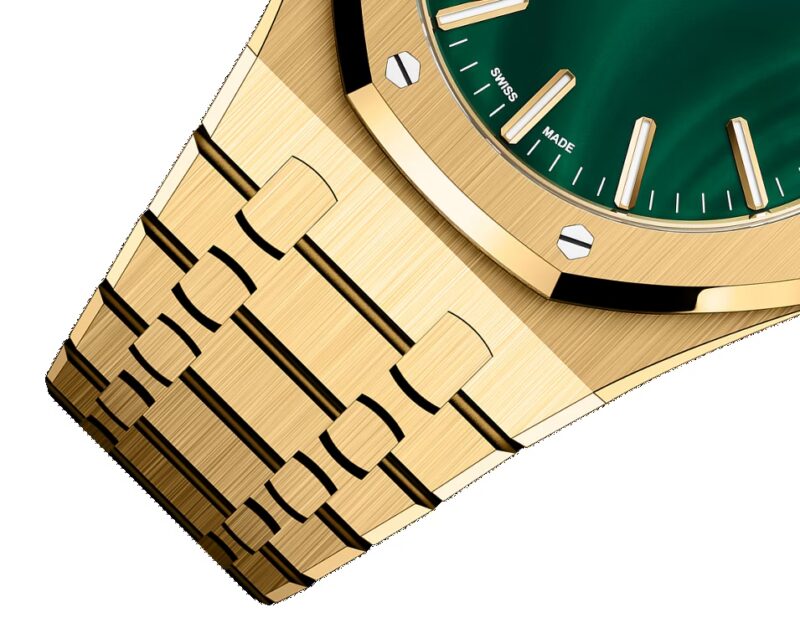
Royal Oak integrated yellow gold bracelet and malachite dial edge. Image courtesy of Audemars Piguet.

Audemars Piguet Royal Oak Malachite in 37mm yellow gold execution. Image courtesy of Audemars Piguet.
The signature mechanism
One command.
Three registers.
Move through the sequence to see how one split-second command changes character across seconds, minutes and hours.
The material — What malachite is and why it matters for watches
Malachite is a secondary copper carbonate mineral — Cu₂(CO₃)(OH)₂ in chemical notation — formed near the earth's surface through the oxidative weathering of primary copper sulphide minerals such as chalcopyrite, the most commercially significant copper ore. The process requires the presence of copper, carbonate ions, water and time: geological time, measured in millions of years rather than centuries.
The green colour that defines malachite is a direct consequence of its copper content. Copper ions absorb light in the red and yellow wavelengths and reflect green, producing the vivid, saturated colour that has made the mineral prized for decorative use since antiquity. The variation in intensity — from pale, almost translucent jade to deep forest green — corresponds to fluctuations in copper concentration within individual specimens. Where copper content is higher, the green deepens. Where it is lower, the stone lightens. These fluctuations occur within the same piece of rough material, which is why a single polished malachite dial can show multiple greens in proximity.
The banding — the feature that makes malachite immediately identifiable — is formed during the crystallisation process. As the mineral grows outward from a central nucleation point, variations in the rate of growth and in the chemical environment produce alternating layers of lighter and darker green. In section, cut and polished, these layers appear as concentric bands or, more commonly, as flowing undulating lines that read like a topographic map of a surface that no cartographer has ever visited.
The Congo Basin connection. The world's most significant deposits of gemstone-quality malachite are found in the Copperbelt region spanning the Democratic Republic of Congo and Zambia — an area that contains one of the largest concentrations of copper mineralisation on earth. The Kolwezi district of the DRC in particular has produced exceptional malachite specimens, including the stalactitic forms with concentric banding that are most sought after for decorative cutting. The mines that produce the copper also produce the malachite as a secondary mineral: where there is copper, there is malachite.
For Audemars Piguet, this means that the raw material for the Royal Oak Malachite dials comes from one of the most geologically rich and geologically young copper-producing regions in the world. The stone used for dial-cutting is selected for colour consistency, banding character and structural integrity — criteria that are evaluated stone by stone, not batch by batch.
The dial — From rough mineral to finished surface
The manufacture of a malachite dial for the Royal Oak is not a straightforward industrial process. Malachite presents specific challenges that separate it from the more commonly used hardstones in watchmaking.
Brittleness. Malachite has a Mohs hardness of 3.5 to 4 — significantly softer than quartz (7), onyx (6.5–7) or lapis lazuli (5–6). This means the stone can crack, chip or fracture during cutting and shaping operations if the process is not carefully controlled. The dial blank must be cut from rough material using precision diamond-tipped instruments, then progressively reduced to the correct thickness — measured in fractions of a millimetre — without introducing stress fractures into the stone.
The copper base. Once cut and polished to the final specification, the malachite slice is adhered to a copper dial base. This base serves two functions: it provides structural support for the relatively brittle stone, and it acts as a conductor for any static charge that might otherwise accumulate on the polished surface. The copper base also means that the dial is, quite literally, built on the same metal that created the malachite in the first place — a material continuity that has no precise parallel in watchmaking.
The absence of date and tapisserie. Unlike a standard Royal Oak Selfwinding — which carries the Grande Tapisserie pattern and a date window at 3 o'clock — the Malachite references have neither. The malachite replaces the tapisserie entirely: the stone's natural banding provides the textural complexity that the guilloché pattern would otherwise supply. And the date window is removed because cutting a rectangular aperture into a polished malachite dial would interrupt the banding in a way that no skilled watchmaker could control. The stone decides where the lines run. Audemars Piguet decided not to argue with it.
The pattern selection. Audemars Piguet made a deliberate choice in the character of malachite used for the Royal Oak dials. Rather than selecting stones with sharp, geometric, regimented banding — the kind that reads as almost artificial in its regularity, and which other manufacturers have favoured for stone-dial executions — AP chose specimens with a softer, more undulating pattern. The dark green striations flow rather than march. The result reads as more natural, more organic, and less like a design element applied to a watch than a landscape observed through it.

Royal Oak Malachite in yellow gold, angled case and integrated bracelet. Image courtesy of Audemars Piguet.
The two references — A size strategy with collector logic
Ref. 15513BA.OO.1320BA.01 — 41mm, the full statement
Case 41mm diameter · 10.5mm thickness · 18-carat yellow gold Crystal Glareproofed sapphire · sapphire caseback Dial Polished natural malachite · yellow gold applied hour markers · luminescent coating · yellow gold inner bezel · no date · no Grande Tapisserie Bracelet 18-carat yellow gold integrated bracelet · three-blade folding clasp Movement Calibre 4309 · automatic · 4Hz (28,800 vph) · 70-hour power reserve Water resistance 50 metres Price USD 81,900
The 41mm is the version that commands a room. At full Royal Oak scale in yellow gold with a malachite dial, it makes the geological argument as loudly as the format allows. The integrated yellow gold bracelet — with its alternating polished and satin-brushed surfaces, a design language that dates back to Gérald Genta's original 1972 specification — gives the watch a tonal coherence: the warm yellow of the gold reads alongside the warm greens of the malachite in a way that white gold or steel would not achieve. The choice to use yellow gold is not arbitrary. It is the correct choice, and Audemars Piguet knew it.
The Calibre 4309 is the current generation Royal Oak movement for the 41mm format. Self-winding, operating at 4Hz with 70 hours of power reserve, visible through the sapphire caseback — it is a contemporary manufacture movement with good power reserve figures and finishing appropriate to the reference. At this price point, collectors may note that the 41mm Jumbo (ref. 16202) uses the Cal. 7121, a more historically prestigious and mechanically admired movement. The Malachite 41mm is not positioned as a Jumbo equivalent — it is a Selfwinding reference with stone-dial individuality, not a Jumbo with green.
On the wrist: The 41mm malachite Royal Oak in yellow gold is one of the most immediately striking watches available from any manufacture in 2026. The combination of the octagonal bezel, the yellow gold case edges and the flowing green surface produces an effect that photographs cannot fully reproduce. In daylight, the polished malachite catches light at angles that the standard tapisserie cannot, producing brief, brilliant reflections that move across the dial as the wrist moves.
Ref. 15553BA.OO.1356BA.04 — 37mm, the more intimate argument
Case 37mm diameter · 9.3mm thickness · 18-carat yellow gold Crystal Glareproofed sapphire · sapphire caseback Dial Polished natural malachite · yellow gold applied hour markers · luminescent coating · yellow gold inner bezel · no date Bracelet 18-carat yellow gold integrated bracelet · AP folding clasp Movement Calibre 5909 · automatic · 4Hz (28,800 vph) · 60-hour power reserve Water resistance 50 metres Price USD 75,700
The 37mm is the more nuanced proposition. At 9.3mm in thickness and 37mm in diameter, it sits closer to the original Royal Oak proportions — closer, in spirit if not in mechanism, to the ref. 15202 Jumbo that remains the purist's choice. The thinner profile means the watch wears differently from its larger sibling: lighter, flatter against the wrist, less architecturally dominant.
The Calibre 5909 delivers 60 hours of power reserve in the smaller format — a reduction of ten hours relative to the 41mm's 4309, which is the expected consequence of housing a movement in a smaller case with a smaller mainspring. The automatic winding efficiency remains identical at 4Hz.
The cultural context: this is the reference that Bad Bunny wore during the Apple Music Super Bowl LX halftime show in February 2026, in front of more than 100 million viewers. The stylist Storm Pablo sourced it within days of the watch's announcement. The moment was not arranged by Audemars Piguet — it was a stylist's choice, which makes it a more credible cultural signal than a formal partnership. The 37mm malachite Royal Oak entered the broader cultural conversation before it entered most AP boutiques.
The collector case for 37mm: The 37mm Royal Oak has historically attracted a different buyer profile from the 41mm — one that values proportion over presence, restraint over statement. The malachite dial does not change that profile but intensifies it: the stone's visual complexity reads as more personal and less declarative on the smaller format. It is the correct version for someone who wants the geological argument on their terms.
The cultural moment — Stone dials, the 2026 trend and why AP did it differently
The stone dial trend in horology reached peak visibility between 2022 and 2025, producing turquoise, lapis lazuli, meteorite, onyx and malachite executions from brands across every price tier. By 2026, the trend had stratified: the lower end of the market was saturated with stone-dial novelties that used geological material as marketing strategy without design consequence. The upper end — Patek Philippe, AP, Vacheron — had the credibility and the restraint to use stone dials correctly.
Audemars Piguet's advantage is its history with the format. The manufacture offered stone-dial dress watches as early as the 1960s, using lapis lazuli, tiger's eye, coral and onyx as dial materials decades before the current trend. The 2023 turquoise Royal Oak 37mm (ref. 15550BA) was the modern revival of that tradition — a single size, yellow gold, copper-based mineral, undulating pattern. The 2026 malachite editions follow the same logic, expand it to two sizes, and do it in yellow gold for the same coherence argument.
The stone the manufacture chose, and the way it was cut, distinguishes the Royal Oak Malachite from competitor executions. The flowing, undulating banding of the AP dials — softer and more organic than the sharp geometric striations of other manufacturers — makes the Royal Oak version read as a natural object rather than a design exercise. That distinction is subtle in a photograph. On the wrist, in daylight, it is not subtle at all.
Calibre L132.1
The command becomes architecture.

Royal Oak Malachite sapphire caseback and automatic calibre. Image courtesy of Audemars Piguet.

Polished natural malachite dial with yellow gold applied hour markers. Image courtesy of Audemars Piguet.

Royal Oak Malachite yellow gold case and green hardstone dial detail. Image courtesy of Audemars Piguet.
Mechanical context
The architecture, in two acts.
Ref. 15513BA · 41mm, the full statement
The 41mm version gives the malachite argument maximum presence: yellow gold architecture, green hardstone surface and a Royal Oak format that commands the room.
- Range
- 41mm
- Display
- 10.5mm
- Control
- Calibre 4309
- Isolation
- USD 81,900
- Flyback
- 70 hours
Ref. 15553BA · 37mm, the intimate argument
The 37mm version is the more nuanced proposition: closer to historic Royal Oak proportion, less declarative on the wrist, and culturally amplified by its 2026 Super Bowl moment.
- Range
- 37mm
- Display
- 9.3mm
- Control
- Calibre 5909
- Isolation
- USD 75,700
- Flyback
- 60 hours
The movement intelligence — Calibres 4309 and 5909
Neither the Calibre 4309 nor the 5909 is new to the Royal Oak in 2026 — both are current-generation manufacture movements introduced in previous references. Their presence in the Malachite editions is a deliberate choice: the stone is the story, and the movement's job is to deliver reliable automatic winding with visible finishing quality through the sapphire caseback without competing for attention with the dial.
Calibre 4309 (41mm)
- Self-winding · 4Hz (28,800 vph) · 39 jewels
- 70-hour power reserve
- Côtes de Genève finishing · chamfered bridges
- AP folding clasp with AP logo
- Visible through sapphire caseback
Calibre 5909 (37mm)
- Self-winding · 4Hz (28,800 vph) · 40 jewels
- 60-hour power reserve
- Côtes de Genève finishing
- Visible through sapphire caseback
Both movements are water-resistant to 50 metres — a specification that reinforces Audemars Piguet's positioning of these as full Royal Oak wearers' pieces, not display objects. The stone dial does not make the watch fragile. Malachite at 3.5–4 Mohs is softer than sapphire crystal but harder than many lacquer dials, and the copper base provides structural support that a stone dial without backing would not have. Normal wrist use does not threaten the dial.
Collector relevance — How to read the Malachite as a long-term proposition
The Royal Oak Malachite 2026 is not a limited edition. Both the 37mm and 41mm references are open production — available at AP boutiques and AP Houses without the allocation constraints that define the most sought-after Royal Oak references. This distinction matters.
The uniqueness argument without the scarcity premium. Every malachite dial is unique by definition — the stone's geology guarantees it. A buyer who acquires the 41mm Malachite is getting a watch that cannot be exactly replicated, even by the same manufacture with the same specifications, because the next dial will come from a different piece of rough material with different copper distribution and different crystallisation history. This is the collectibility argument of stone dials made explicit: you are not buying one of a numbered series. You are buying the only example of this particular geological surface.
The yellow gold position. Yellow gold Royal Oaks occupy a specific position in the secondary market — they are less liquid than steel references at the collector entry level, but they carry inherent material value that steel does not. The Malachite adds dial uniqueness on top of metal rarity. A yellow gold Royal Oak with a specific malachite pattern — particularly one with an unusual banding character or exceptional colour — has a collector case that goes beyond production specifications.
The 37mm vs 41mm choice. For a collector who can only choose one: the 37mm is the more historically proportioned piece, and the cultural moment of the Super Bowl makes it the more discussed reference. The 41mm is the more visually dominant piece and the one that carries the stone's character most clearly at normal viewing distance. Both are correct — they serve different wearing contexts and different collecting arguments.
Key specifications — Reference table
Explore the comparison
| Reference | Diameter | Thickness | Movement | Power reserve | Price (USD) |
|---|---|---|---|---|---|
| 15513BA.OO.1320BA.01 | 41mm | 10.5mm | Cal. 4309 | 70 hours | 81,900 |
| 15553BA.OO.1356BA.04 | 37mm | 9.3mm | Cal. 5909 | 60 hours | 75,700 |
Both references: 18k yellow gold · polished malachite stone dial · yellow gold applied markers · luminescent hands · integrated yellow gold bracelet · sapphire crystal · sapphire caseback · 50m water resistance · no date · no Grande Tapisserie pattern
TheTimeo view
The Royal Oak Malachite 2026 is Audemars Piguet doing what the Royal Oak does best: taking an already complete design and discovering that it had one more register available. The malachite dial does not improve the Royal Oak, because the Royal Oak does not need improvement. It reveals something else — a different conversation between the watch and the light, a different relationship between the case architecture and the surface inside it, a different reason to look at a watch you thought you already understood.
The geological argument is real and not merely poetic. Each dial is a cross-section of a mineral that formed over millions of years in conditions that no manufacture can replicate. The copper that created the green is the same copper that defines the Copperbelt that defines a region that defines an industry. Wearing a Royal Oak Malachite means wearing a piece of that chain.
That is either the most elevated way to think about a watch, or a very elegant sales pitch. At $75,700 to $81,900 in yellow gold, with a malachite dial that belongs to no other watch in existence, TheTimeo would argue it is both.
Sources & credits
Official sources and further reading
- Royal Oak Malachite 41mm — Official AP page
- Royal Oak Malachite 37mm — Official AP page
- Audemars Piguet Royal Oak collection
TheTimeo is an independent editorial magazine dedicated to fine watchmaking, high jewellery and the culture of enduring luxury. All specifications verified against official Audemars Piguet sources and independent hands-on reviews at time of publication. Prices are USD retail at time of introduction.
The Edit
Stories selected by TheTimeo
Audemars Piguet Neo Frame Jumping Hour: Why the New Calibre Matters More Than the Vintage Shape
Audemars Piguet returns to a two-window jumping-hour format from the late 1920s, reversing its
A Horse in Crystal: Hermès Arceau Samarcande
On the Arceau Samarcande W408546WW00, Hermès cuts a horse into a Saint-Louis crystal dial

Blancpain Lady B: What Does 19 Millimetres Require?
Blancpain’s 19 mm Lady B is best understood as an exercise in mechanical volume:

When Is a Revived Watch Brand Still the Same Brand? Testing the New Gallet Against the Archive
The archive is real and the manufacturing system is new. We test Flying Officer,
Ferdinand Berthoud FB 3SPC.4-1: Why Bend a Balance Spring into a Cylinder?
The black titanium case is new. The harder achievement is regulating a cylindrical spring

MING 57.05 Comet: The One-Click DST Fix and the Time-Zone Problem It Cannot Fully Solve
One click moves DST-observing cities by an hour. The harder problem is that civil-time