
Watch & Jewellery / Object Study
Watches
Chopard Happy Diamonds at 50: The Stone Is Fixed. The Setting Moves.
The diamond is secured. Its gold carrier is free to travel between sapphire surfaces. Fifty years after Happy Diamonds began, Chopard returns to the architecture that made instability precious.
TheTimeo view
Controlled instability, framed in gold
Happy Diamonds is not a story about removing the setting. The diamond remains secured; Chopard gives the gold carrier controlled freedom inside a precisely bounded transparent field.
The stone is fixed. The setting is not. Everything interesting happens between those two facts.
TheTimeo technical reading
The visual edit
Gold, onyx and a field that never stays still.
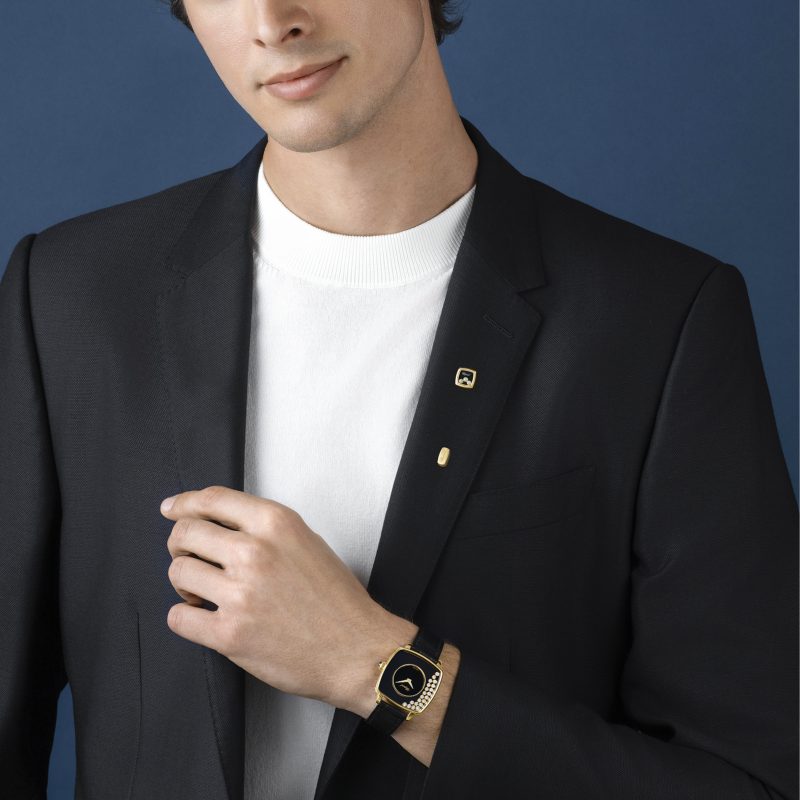
On the wrist, gravity and gesture continually rewrite the arrangement of the mobile carriers. Courtesy of Chopard.
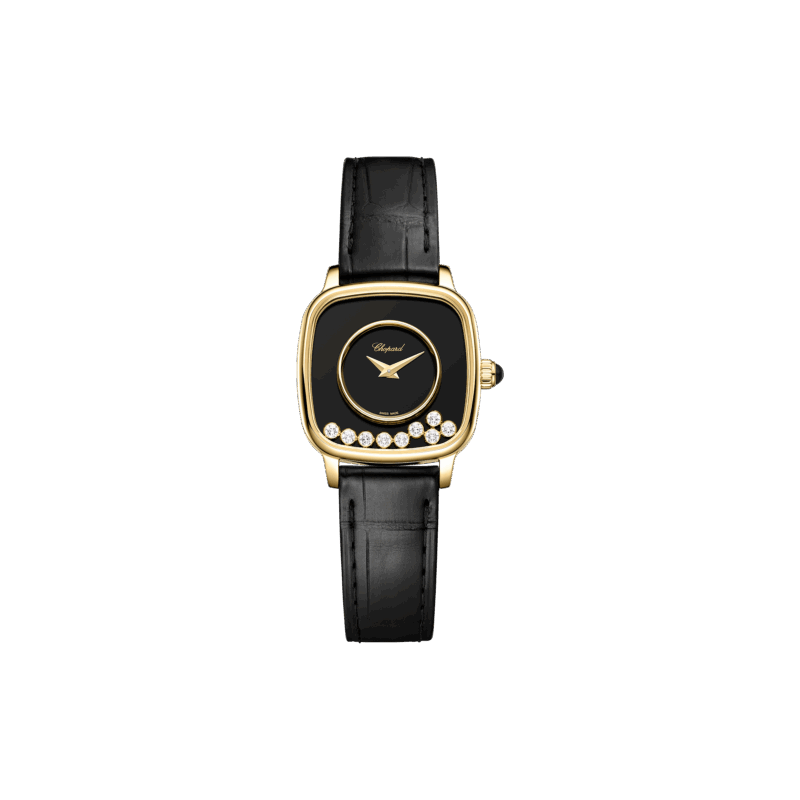
The 24 mm reference reduces the field to nine moving elements and uses a quartz movement. Courtesy of Chopard.
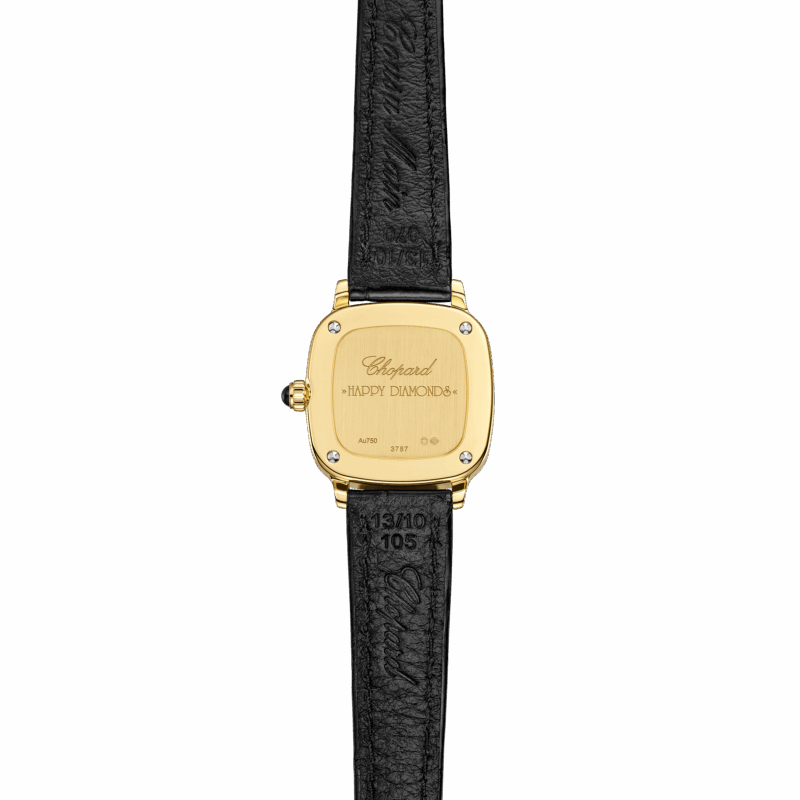
The closed back distinguishes the quartz 24 mm architecture from the hand-wound 34 mm watch. Courtesy of Chopard.
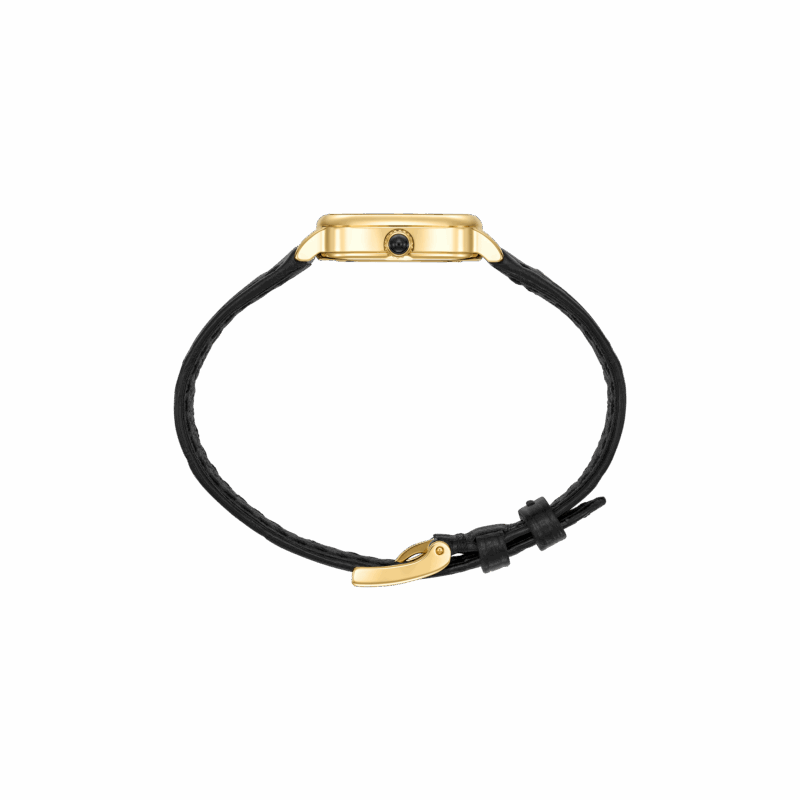
At 6.72 mm thick, the smaller watch changes both scale and the available field of motion. Courtesy of Chopard.
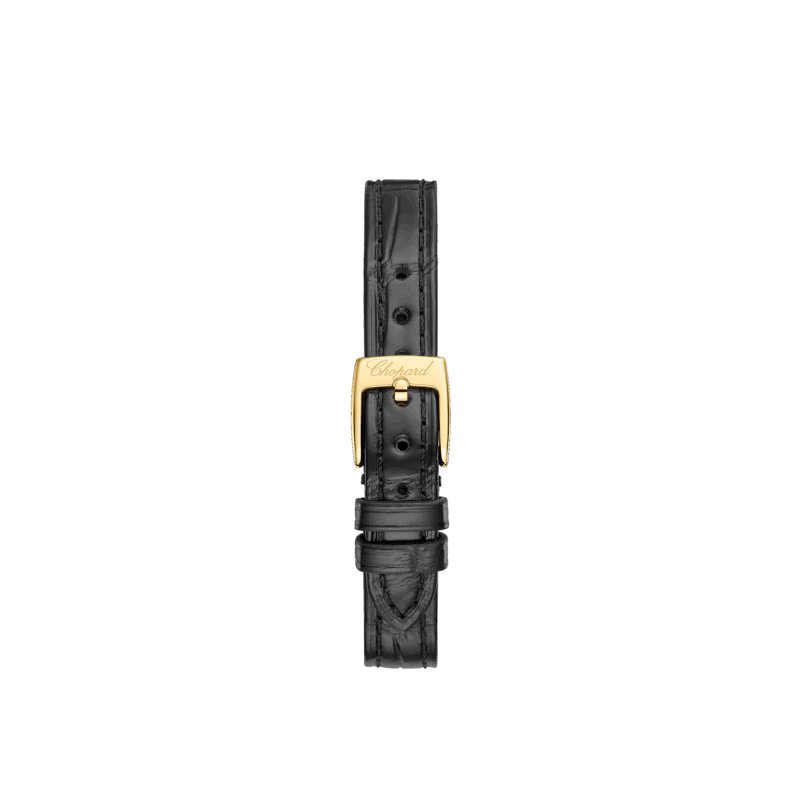
The clasp and strap show how the 24 mm watch preserves the same material discipline at a smaller scale. Courtesy of Chopard.
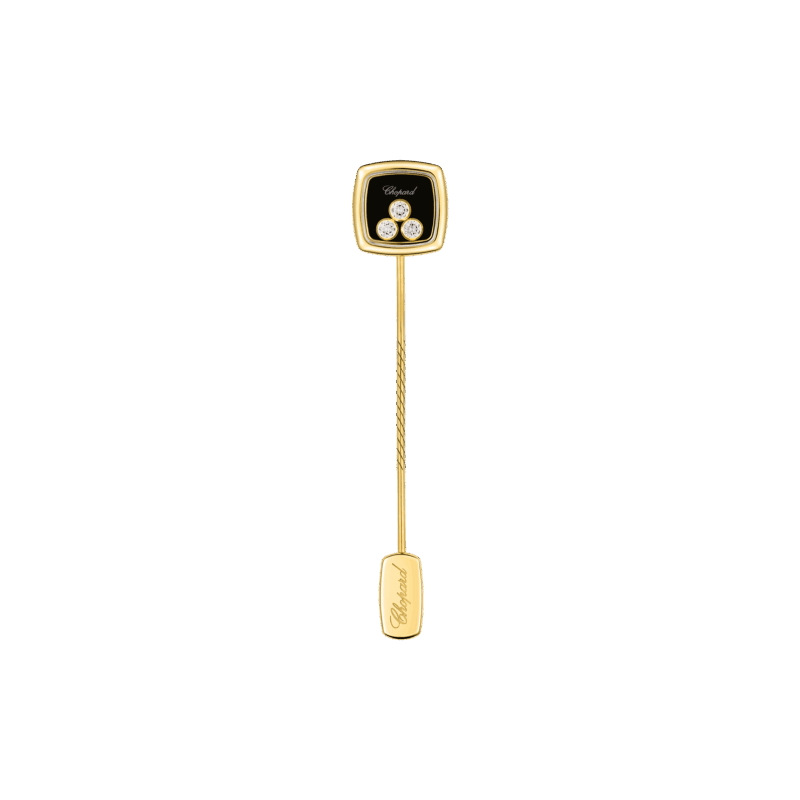
The brooch proves that the moving-diamond system belongs to the jewel itself, not to a watch calibre. Courtesy of Chopard.
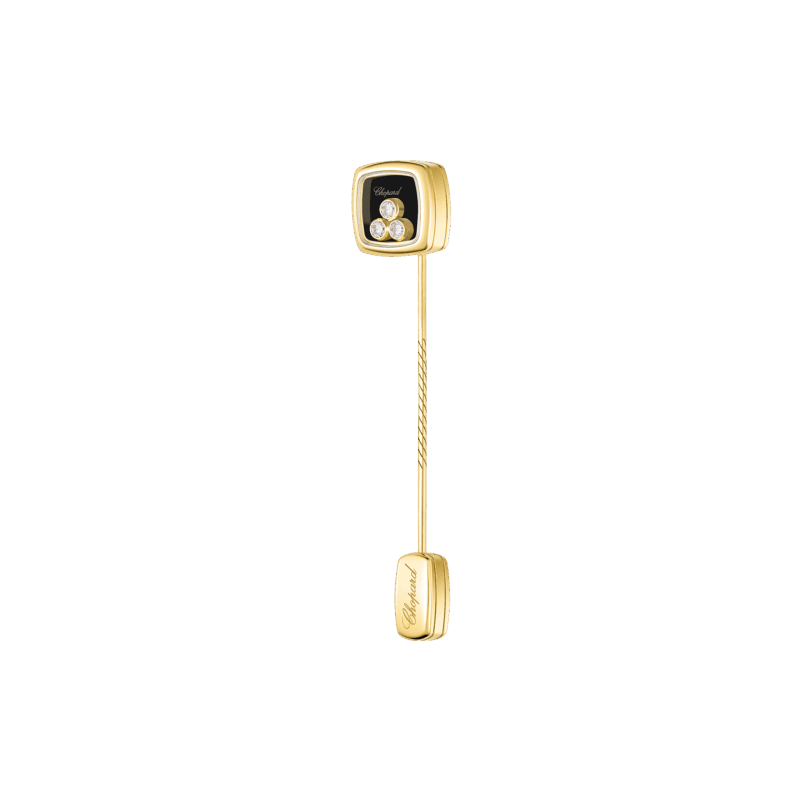
The reverse exposes the pin construction behind the onyx and sapphire-set head. Courtesy of Chopard.
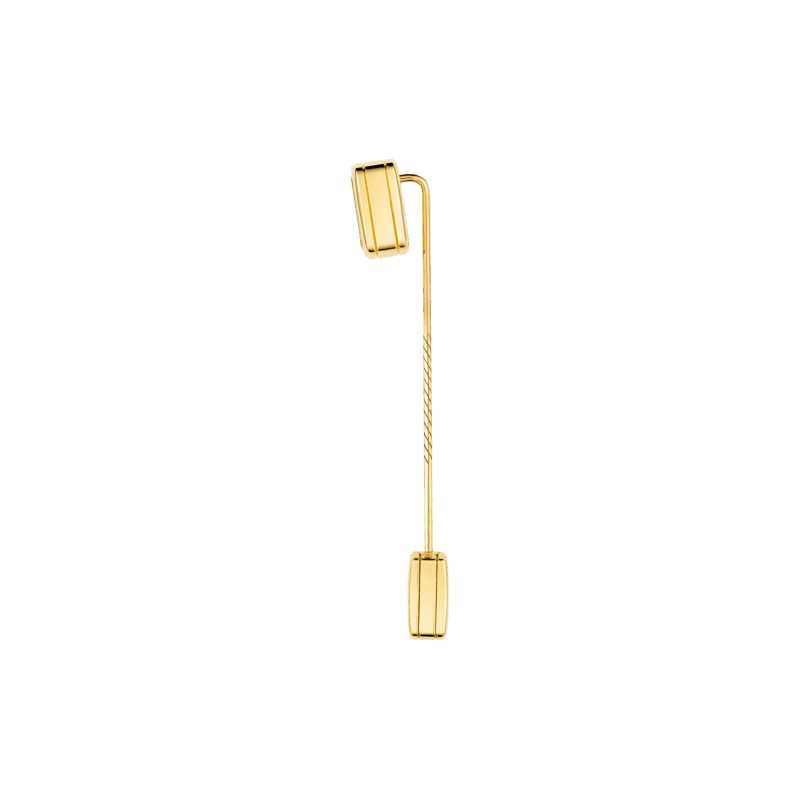
The side profile makes the brooch’s layered enclosure and gold setting legible. Courtesy of Chopard.
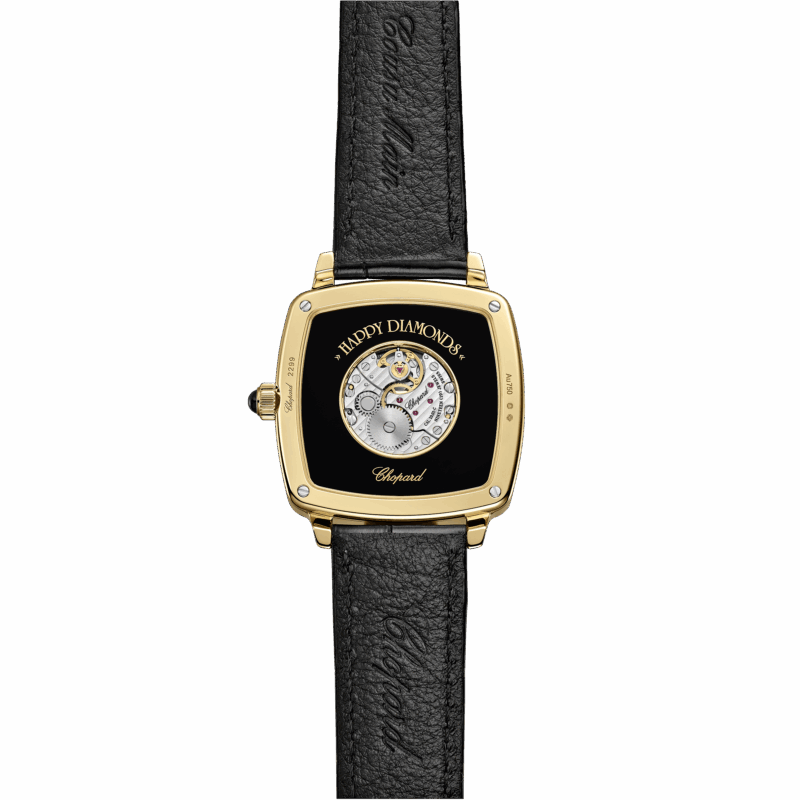
The sapphire caseback reveals calibre 10.01-C, mechanically separate from the moving-diamond display. Courtesy of Chopard.
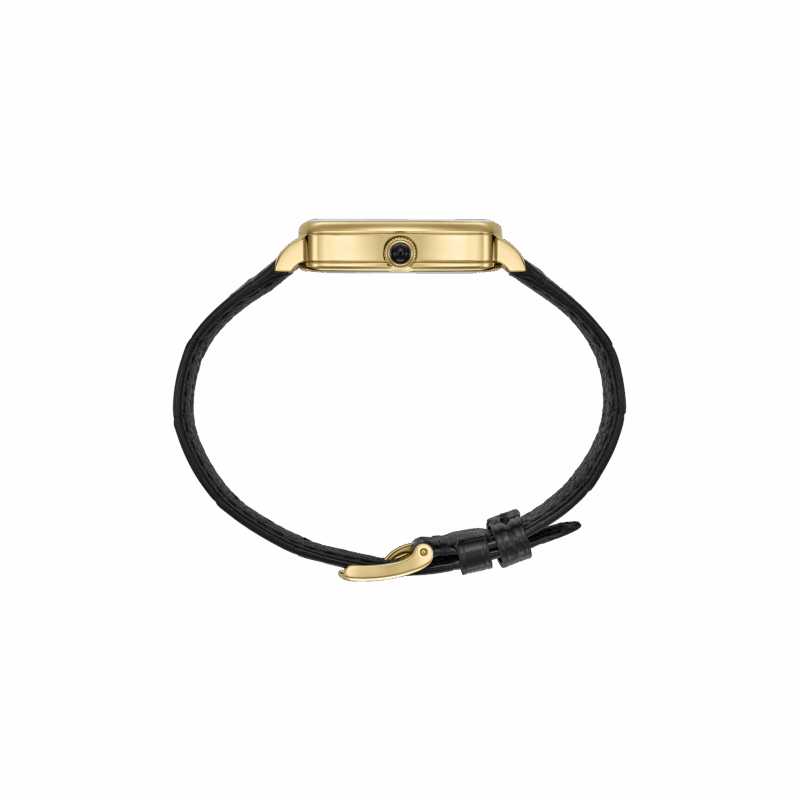
The side view places the sapphire cavity, gold case and 8.53 mm overall thickness in proportion. Courtesy of Chopard.
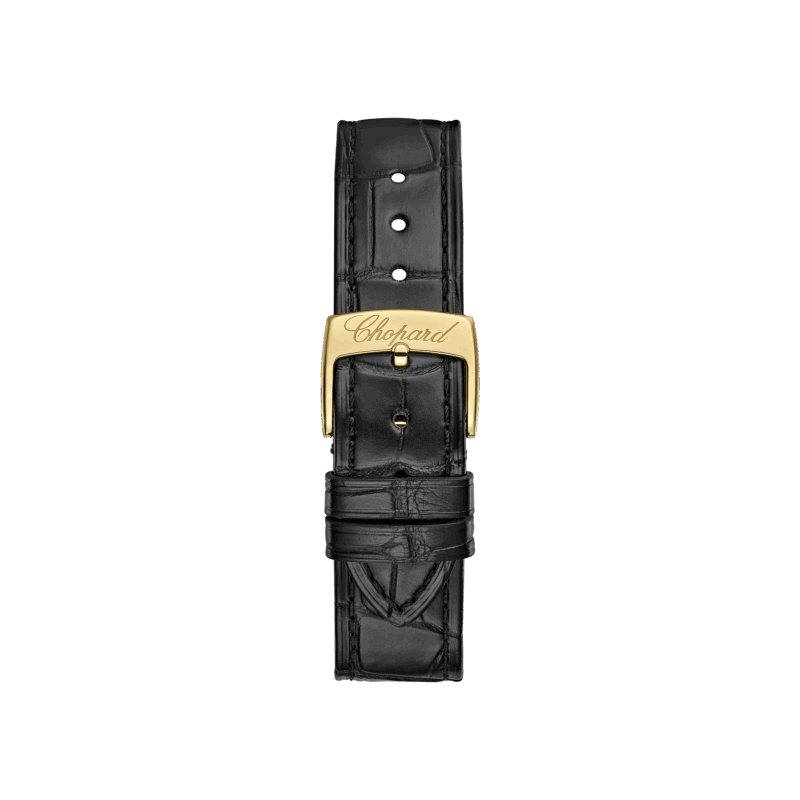
The yellow-gold pin buckle continues the restrained black-and-gold material language. Courtesy of Chopard.
The signature mechanism
The stone is fixed.
Freedom is engineered.
Read the construction in three layers: a set diamond, a mobile gold carrier and a shallow sapphire enclosure that defines every possible movement.
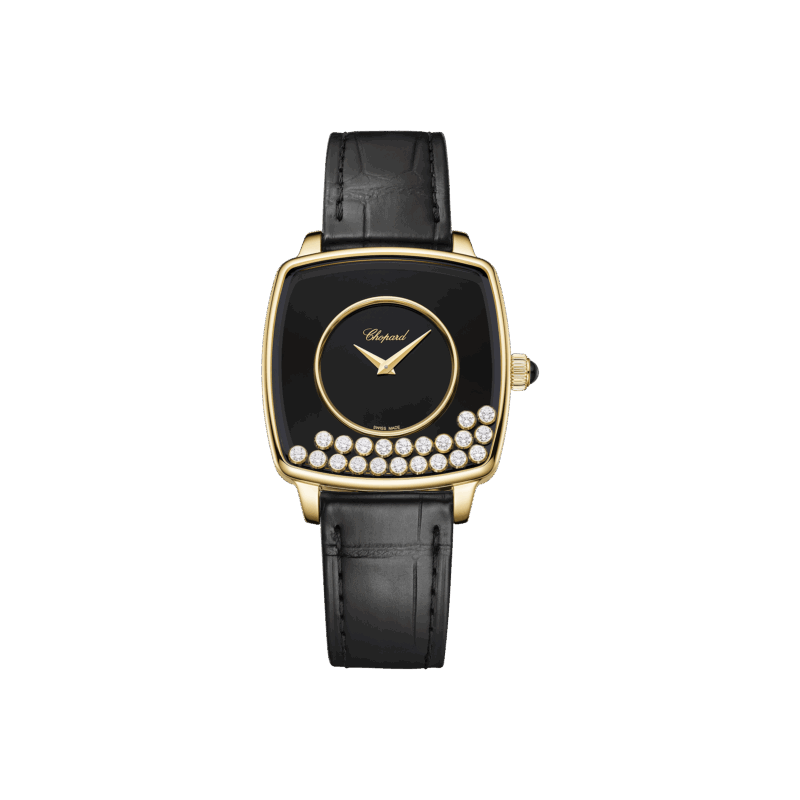
Chopard’s Happy Diamonds idea is often described as setting diamonds free. That description is memorable, but technically incomplete. The stones are still set. What changed in 1976 was the status of the setting itself: each diamond could travel as part of a small mobile gold carrier between transparent surfaces. Fifty years later, the Happy Diamonds Heritage watches return to that architecture with black onyx, ethical yellow gold and, in the 34 mm model, a modern hand-wound manufacture calibre.
Key takeaways
- A Happy Diamond is not a loose, unmounted gemstone. The diamond is secured in a mobile gold element that can move between transparent plates.
- Chopard dates the concept to 1976. Independent watchmaking histories and the Fondation de la Haute Horlogerie identify designer Ronald Kurowski and the waterfall story behind the idea.
- The first Happy Diamonds watch was made for men and is documented by the FHH with 30 moving diamonds. The 2026 Heritage 34 mm uses 21 moving diamond elements, so it is not a literal component-for-component reproduction.
- The 34 mm Ref. 202299-0001 pairs 21 moving diamonds totalling 1.05 carats with black onyx and the hand-wound Chopard 10.01-C calibre. The 24 mm Ref. 203787-0001 uses nine moving diamonds and a quartz movement.
- The key mechanical fact is simple: the movement does not animate the diamonds. The wearer does. Gravity, acceleration and changes of wrist angle supply the energy for the visible motion.
On the wrist, gravity and gesture continually rewrite the arrangement of the mobile carriers. Courtesy of Chopard.
The setting is the part that moves
The most useful way to understand Happy Diamonds is to begin with a contradiction.
A diamond cannot simply be dropped into a watch case and expected to behave politely. It is hard enough to damage surrounding surfaces, it can strike the dial, and it can jam if the available space is poorly controlled. Leave several stones completely loose and the problem multiplies. They can collide, turn unpredictably and collect at the lowest point of the cavity.
Yet the effect Chopard wanted in 1976 depended on apparent freedom. The diamond had to change position and orientation with the wrist. It had to catch light differently from one moment to the next. A fixed setting would defeat the idea before the first prototype left the bench.
The solution was not to remove the setting. It was to make the setting mobile.
The Fondation de la Haute Horlogerie describes the principle as a diamond secured in a capsule with a bevelled base, placed between sapphire crystals so that the complete element can spin and travel. WorldTempus similarly describes a gold bezel with a bevelled underside, shaped rather like a spinning top. A later German patent, filed by an unrelated applicant in 1996, is useful as independent technical evidence because its prior-art section explicitly describes Chopard Happy Sport and Happy Diamonds watches as using brilliant-cut diamonds in ring-shaped settings moving inside a disc-shaped cavity above the dial and hands.
That distinction matters. Chopard’s phrase “diamonds are happier when they are free” is a design statement. The engineering reality is more precise: the gemstone is restrained inside a carrier, while the carrier is given controlled freedom inside the watch or jewel.
Once that is understood, Happy Diamonds stops being a decorative trick. It becomes a problem of clearances, surfaces, mass and motion.
What Ronald Kurowski was trying to reproduce
Chopard’s current collection pages date Happy Diamonds to 1976 and describe the image that has remained attached to the concept ever since: sunlight breaking into points of light through the spray of a waterfall. The Maison’s public pages today speak broadly about its workshops rather than naming a single inventor.
The historical record is more specific. The Fondation de la Haute Horlogerie identifies Ronald Kurowski, then a Chopard designer, as the person who translated that visual observation into a watch. WorldTempus and several specialist histories give the same attribution. The story places Kurowski in Germany’s Black Forest, watching light scatter through moving water.
The important part is not the romance of the waterfall. It is the visual problem it created.
Water droplets never hold the same orientation for long. Their appearance is produced by movement as much as by material. Kurowski’s task was therefore not to make diamonds look like water. It was to reproduce irregular flashes generated by many small elements that do not remain still.
A conventional pavé surface would produce brilliance, but the pattern of the brilliance would be fixed by the setter. Happy Diamonds changed the source of variation. The setter determines the diamond and its carrier; the wearer determines the next composition.
The first watch was also not conceived as a women’s jewellery watch in the way the name is often remembered today. The FHH records the first Happy Diamonds as a cushion-shaped men’s watch with 30 dancing diamonds. It won the Golden Rose of Baden-Baden in 1976. Karl-Friedrich Scheufele has separately recalled that the drawing won the prize before the technical problem of producing the design had been fully solved, and that the workshop then had to devise a sheath that allowed the stones to move without scratching the dial or crystal.
That recollection explains the idea more clearly than the anniversary language does. The decisive object was not the diamond by itself. It was the interface between diamond, carrier and enclosure.
Carrier / sapphire / gravity
Freedom is built from restraint.
The sapphire caseback reveals calibre 10.01-C, mechanically separate from the moving-diamond display. Courtesy of Chopard.
The side view places the sapphire cavity, gold case and 8.53 mm overall thickness in proportion. Courtesy of Chopard.
The yellow-gold pin buckle continues the restrained black-and-gold material language. Courtesy of Chopard.
Mechanical context
The same principle, at two scales.
Heritage 34 mm
Twenty-one mobile diamond elements meet black onyx and Chopard's compact hand-wound manufacture calibre.
- Case
- 34 × 8.53 mm
- Moving elements
- 21
- Movement
- 10.01-C, hand-wound
- Water resistance
- 30 metres
- Diamond weight
- 1.05 ct
Heritage 24 mm
Nine mobile elements preserve the same governing idea while the smaller field and quartz architecture create a different rhythm.
- Case
- 24 × 6.72 mm
- Moving elements
- 9
- Movement
- Quartz
- Water resistance
- 30 metres
Freedom has boundaries
There is no useful movement without boundaries.
The diamond carrier needs enough clearance to slide and rotate. Give it too little and friction wins. Give it too much and impacts become more violent, visual control weakens and the element can tilt in ways the construction may not tolerate. The transparent surfaces need to remain close enough to define a shallow field of motion, but far enough apart to permit the carrier to pass freely.
Chopard does not publish the operating clearances, the carrier mass, the sapphire spacing or the tolerance stack of the 2026 Heritage watches. Those details should therefore not be guessed.
What can be established is the geometry of the system. The official 2026 product pages say the diamonds move between two sapphire crystals. The FHH describes the individual stone as being set in a capsule with a bevelled base. The bevel matters because a broad, flat underside would increase the contact area. A reduced or shaped contact surface can make turning easier and allows the element to change orientation as the wrist changes direction.
The visual result depends on three motions at once. The carrier can translate across the cavity, rotate around its own centre and tilt within the small amount of vertical freedom available to it. Each motion changes the facets presented to incoming light.
This is why the system can appear more animated than a fixed arrangement using the same stones. Nothing about the diamond’s optical physics has changed. What changes from second to second is its orientation.
The phrase “dancing diamonds” is therefore unusually literal. The dance is not programmed by the movement. It is a stochastic response to the wearer.
The black onyx is doing structural visual work
The 2026 Happy Diamonds Heritage watches return to a deep black onyx field framed by yellow gold. It would be easy to describe that as a period colour scheme and stop there. The onyx does more work than that.
A moving diamond needs visual separation from its background. Black onyx removes most of the competing information. The eye sees a dark, continuous plane; the moving gold carriers and white diamonds become isolated points of contrast.
That matters especially when the mobile elements accumulate under gravity at the lower edge of the display. A cluster of 21 stones can easily turn into visual noise. Against patterned metal, guilloché or a highly reflective dial, the outlines would compete with the surface below them. Onyx reduces that competition.
It also makes motion legible when the elements are not widely separated. Gold against black defines the edge of each carrier. White diamond against black sharpens the flashes produced as individual stones turn.
The 2026 34 mm watch, Ref. 202299-0001, is specified by Chopard in 18-carat ethical yellow gold with a 34 mm case, 8.53 mm thickness, 30 metres of water resistance and a black onyx dial formed as inner and outer rings. The Maison lists 21 moving diamond elements and 1.05 carats of white diamonds.
This is close enough to the historical language to be recognisable immediately, but the numbers show why “reissue” should be used carefully. The FHH records 30 moving diamonds on the first men’s Happy Diamonds. The 2026 34 mm has 21. Caroline Scheufele told WorldTempus that 21 was chosen for visual balance and to evoke the movement of falling water droplets. That is a contemporary compositional decision, not an attempt to reproduce the historical count.
The new watch preserves the system. It does not freeze 1976 in place.
The 34 mm watch adds a movement that does not move the diamonds
There is an appealing mechanical irony in the 34 mm anniversary watch.
Behind a display built around motion sits a hand-wound movement that has no mechanical connection to the moving diamonds at all.
Chopard specifies the calibre 10.01-C, a manufacture movement measuring 2.90 mm thick, with 101 components, 19 jewels, a frequency of 3 Hz and approximately 45 hours of power reserve. The caseback is sapphire, so the movement is visible from the reverse.
The separation of systems is important. The calibre drives hours and minutes. It does not wind a rotor for the diamonds, actuate them with cams or release them on springs. Their movement comes from the body.
That makes the watch an unusual combination of deterministic and non-deterministic motion. The gear train is designed to deliver time at a controlled rate. The diamond field is deliberately uncontrolled within its physical limits. One system reduces variation; the other depends on it.
The manual winding is also a meaningful choice for proportion. Chopard describes the 10.01-C as one of its compact manufacture movements, and its 2.90 mm thickness helps keep the complete watch to 8.53 mm. The movement was already in Chopard’s repertoire before this anniversary model, so its presence should not be presented as a calibre invented specifically for Happy Diamonds.
The anniversary work is in the integration: fitting a modern manufacture calibre behind an architecture whose front surface still needs enough depth for 21 mobile elements, sapphire confinement and onyx rings.
The 24 mm model changes the equation again
The smaller Ref. 203787-0001 uses the same broad visual language but is not simply the 34 mm watch scaled down.
Its case measures 24 mm across and 6.72 mm thick. It uses nine moving diamond elements and a quartz movement. Chopard again specifies 30 metres of water resistance and ethical yellow gold.
The reduction from 21 moving elements to nine matters more than the diameter figure alone suggests. Each mobile carrier requires usable area. Shrinking the case while preserving 21 elements would reduce the available travel around each one and could make the lower cluster overly dense. Nine gives the smaller display a different rhythm.
There is, however, a data problem on Chopard’s current international product page. The specification table lists “White Diamonds Carat” as 0.27 ct and “Gemstone(s)” as 0.25 ct. The page does not explain why the two figures differ. Some localised Chopard pages show only the 0.27 ct value. Without a technical sheet that reconciles the numbers, the total should be treated as unresolved rather than silently normalised.
That discrepancy is small, but it is exactly the kind of detail that matters in a reference article. A published product page is evidence. It is not immune to inconsistency.
A 1990s patent helps explain what the original idea solved
No original 1976 Chopard patent number was located in the public patent records checked for this article. That does not establish that none existed. It establishes only that a specific filing could not be responsibly tied to the 1976 invention from the material reviewed here.
A later German patent is still useful because it describes the Chopard system as prior art.
DE19621479, filed in 1996 by Iris Bonnet, concerns a different jewellery concept in which stones would move inside a liquid-filled cavity. Its description refers to Happy Sport and the Happy Diamonds concept by name. It says those watches use brilliant-cut diamonds in ring-shaped settings within a disc-shaped, gas-filled cavity above the dial and hands. It also identifies the practical consequence of gravity: when the watch stops changing orientation, the mobile elements settle at the lowest point.
The patent was proposing a different solution, not documenting Chopard on Chopard’s behalf. That makes it useful in a narrow way. It confirms that, by the mid-1990s, the defining technical idea was understood externally as a set stone moving inside a confined cavity.
It also corrects a common visual misconception. Happy Diamonds do not float. They slide, turn and settle. Gravity is part of the design.
The jewellery pieces prove that this is an architecture, not a dial effect
The 50th-anniversary Heritage programme extends the same vocabulary beyond the two watches. Chopard’s current catalogue includes a yellow-gold and onyx signet ring. An official brooch, Ref. 90A210-0001, uses three moving diamond elements totalling 0.15 carat between sapphire surfaces. Contemporary coverage also documents cufflinks, a pendant and a tie pin or brooch as part of the Heritage family.
This is useful because it removes the watch movement from the argument entirely.
A ring has no gear train. A brooch has no escapement. Yet the Happy Diamonds principle survives because its mechanism is contained within the jewellery architecture itself: mobile gold-set stones, transparent boundaries and enough internal space for the elements to move.
The signet ring is especially revealing. Its broad onyx face turns the same black-and-gold contrast into an object that does not need to display time. The moving diamonds remain the event.
That is why Happy Diamonds belongs equally to watchmaking and jewellery. The technical signature is not a calibre. It is a way of permitting a gemstone setting to behave.
What actually changed in fifty years
The easiest anniversary story would be to say that the 2026 watches bring back the originals. The more accurate answer is that they bring back the governing idea while changing the infrastructure around it.
The historical watch established the cushion form, black field, yellow-gold framing and mobile diamond carriers. The 2026 Heritage watches preserve that visual grammar. They also retain the core physical relationship between diamond carrier and sapphire enclosure.
But the modern 34 mm watch has 21 moving elements rather than the 30 recorded on the first men’s model. It uses Chopard’s current ethical-gold standard and an in-house hand-wound calibre. The 24 mm version uses nine moving elements and quartz. The current products are water-resistant to 30 metres and are specified with contemporary sapphire and case construction.
The Maison has also had fifty years to turn a watch mechanism into a broader jewellery code. Happy Diamonds jewellery formally followed in the 1980s; Happy Sport arrived in 1993 and placed moving diamonds into a steel watch context. The 2026 Heritage pieces now travel in the other direction, back toward the darker, more graphic dress-watch language associated with the beginning.
What has not changed is the dependency on the wearer. Put the watch flat on a table and the diamonds eventually gather where gravity tells them to. Lift the wrist, rotate it and walk, and the composition starts again.
That is not a limitation hidden by the design. It is the design.
What is established, and what is not
The evidence checked for this article supports several firm conclusions.
Chopard created Happy Diamonds in 1976. Current Chopard pages state that the stones move between sapphire crystals. The FHH and multiple specialist histories identify Ronald Kurowski as the designer behind the original concept and connect the idea to sunlight on a waterfall in the Black Forest. The FHH records the first model as a men’s watch with 30 moving diamonds and documents its Golden Rose of Baden-Baden award.
The 2026 34 mm Heritage watch is Ref. 202299-0001. Chopard specifies 21 moving diamonds, 1.05 carats, 18-carat ethical yellow gold, black onyx, the hand-wound 10.01-C movement, 3 Hz, approximately 45 hours of power reserve and a case thickness of 8.53 mm.
The 24 mm Ref. 203787-0001 uses nine moving elements, quartz and a 6.72 mm case. Its current international product page contains an unresolved 0.27 ct versus 0.25 ct discrepancy.
Several details remain unpublished or unresolved: the exact tolerances around each carrier, the spacing between the sapphire surfaces, the mass of each carrier, the precise tribological treatment of contact surfaces, and a verified original 1976 patent number. They should remain outside the article’s factual claims until stronger documentation appears.
There is also an important linguistic limit. Saying that Chopard “freed diamonds from settings” works as brand language, but it is not a literal technical description. The stones are still held. The invention is that the holding element is allowed to move.
The real invention is controlled instability
Most jewellery setting is an exercise in eliminating movement. The stone is positioned, secured and protected so that the designer can decide exactly where it will remain.
Happy Diamonds reverses only the final part of that logic.
The diamond is still secured. The carrier is still engineered. The surrounding surfaces still impose limits. Nothing about the construction is casual. But within those limits, the final composition is surrendered to gravity and gesture.
That is why the concept has lasted. It does not depend on a particular case size, calibre or gender category. It can move from a men’s watch to a women’s watch, from gold to steel, from a dial to a ring, and back to a 34 mm hand-wound watch without losing the basic idea.
Fifty years later, the useful question is therefore not whether Chopard has once again “set the diamonds free”. It is how carefully the Maison continues to define the boundary between security and movement.
The stone is fixed. The setting is not. Everything interesting happens in the space between those two facts.
Sources & credits
Sources & methodology
- Chopard, Happy Diamonds Heritage 34 mm Ref. 202299-0001, specifications and official imagery checked 21 September 2026.
- Chopard, Happy Diamonds Heritage 24 mm Ref. 203787-0001, specifications checked 21 September 2026; the page retains an unresolved carat-field discrepancy.
- Fondation de la Haute Horlogerie, Happy Diamonds, used for the Ronald Kurowski attribution, first-watch context and carrier principle.
- German patent DE19621479C2, used only as an independent prior-art description, not as Chopard’s original patent.
- TheTimeo distinguishes current official specifications, historical cross-checks and editorial interpretation; no hands-on inspection is claimed.
Continue the Chopard story
For maison context, read TheTimeo’s Chopard house guide. For a different expression of Chopard’s jewellery language, explore the 2026 Miracles high-jewellery collection.
The Edit
Stories selected by TheTimeo
MB&F SP One Pavée: Where Do You Put 255 Diamonds on a Watch That Has No Bezel?
The bezel-free SP One leaves its three mechanical circles untouched and distributes 255 diamonds
When Is a Revived Watch Brand Still the Same Brand? Testing the New Gallet Against the Archive
The archive is real and the manufacturing system is new. We test Flying Officer,
Ferdinand Berthoud FB 3SPC.4-1: Why Bend a Balance Spring into a Cylinder?
The black titanium case is new. The harder achievement is regulating a cylindrical spring