
TheTimeo / TheTimeo Encyclopedia
CHOPARD:
mechanics in motion
An evergreen guide to Chopard: its Sonvilier watchmaking origin, Scheufele stewardship, Happy Diamonds, L.U.C, Mille Miglia and Alpine Eagle.
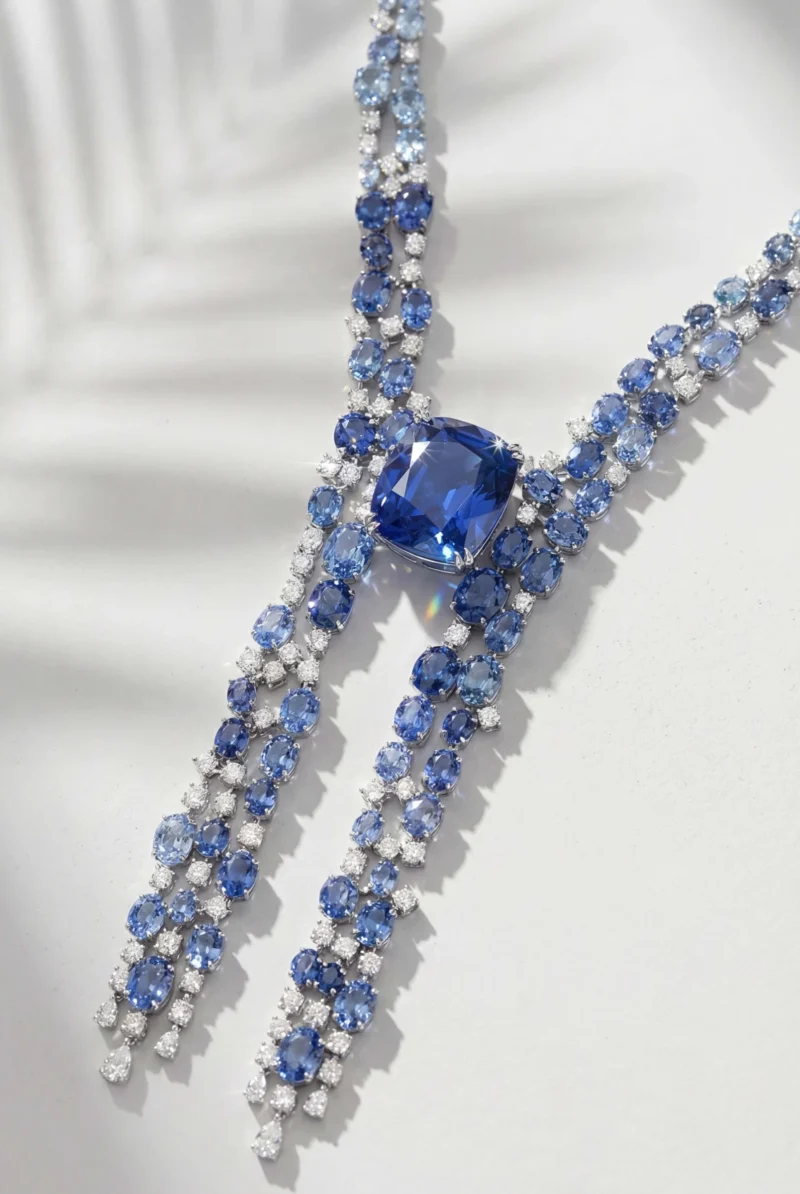
The 88-carat sapphire establishes the centre of gravity for a necklace that carries blue outward through sapphires, aquamarines and diamonds. Courtesy of Chopard.
Explore the story
Chopard is a Swiss watch and jewellery house founded by Louis-Ulysse Chopard in Sonvilier in 1860 and owned by the Scheufele family since 1963. Its identity spans two disciplines: precision watchmaking, now centred on the L.U.C manufacture, and jewellery that often makes movement visible, most clearly through Happy Diamonds.
This guide follows the connection between those disciplines. It treats a collection name as a map, then returns to calibre, case, setting, articulation, marks and documented configuration.
Definition and scope
Chopard produces watches, jewellery and high jewellery. The historical line begins with a watchmaking workshop, while the modern house developed after Karl Scheufele III acquired it in 1963. That dual history matters: jewellery is not an accessory to the watches, and contemporary mechanical manufacture is not explained by decorative identity alone.
Movement is the useful connecting principle. A calibre controls time; mobile diamonds move between transparent surfaces; articulated bracelets organise motion on the wrist. In each case, visual effect depends on underlying tolerances and construction.
Foundation and historical development
- 1860: Louis-Ulysse Chopard founded a precision-watch manufactory in Sonvilier, Switzerland.
- 1937: the company moved its headquarters to Geneva.
- 1963: Karl Scheufele III acquired Chopard, beginning the Scheufele family’s stewardship.
- 1976: Happy Diamonds introduced freely moving diamonds between transparent sapphire crystals.
- 1980: the St. Moritz watch introduced an integrated-bracelet sports-watch idea later revisited by Alpine Eagle.
- 1988: the Mille Miglia watch partnership began.
- 1996: Chopard established its Fleurier manufacture and introduced the L.U.C watchmaking line.
- 2019: Alpine Eagle reinterpreted the St. Moritz concept.
These milestones explain the catalogue’s branches. They do not establish the date or originality of a particular object without reference-specific evidence.
Aesthetic and design identity
Visible movement
Happy Diamonds creates an image that changes with the wearer: the stones are not fixed into a conventional setting but move within a transparent chamber. The principle also makes condition legible. A stone should travel freely without the chamber or surrounding structure appearing compromised.
Sporting geometry
Mille Miglia draws on motor-racing instruments, while Alpine Eagle uses an integrated bracelet, textured dial and pronounced bezel. Neither family is defined by a single diameter or calibre. Case-to-bracelet transition, dial treatment and reference specification are the reliable comparisons.
Classical watchmaking
L.U.C watches tend towards restrained cases and legible dials, leaving movement architecture and finishing to carry much of the technical identity. Complications and certification vary, so the L.U.C name should lead to the exact calibre rather than substitute for it.
Technical and manufacturing ideas
- Free-moving diamond construction
In Happy Diamonds, diamonds move between sapphire-crystal surfaces instead of being fixed in a stationary mount. The chamber, crystal condition and freedom of movement belong to the design. Dust, moisture, chips or restricted travel require specialist assessment rather than forceful handling.
- Integrated mechanical manufacture
The Fleurier manufacture supports the development and production of L.U.C movements. Architecture differs widely across automatic, manual-winding and complicated calibres. Record calibre number, winding system, power reserve and certifications only from the exact reference documentation.
- Cases and bracelets as one system
St. Moritz and Alpine Eagle make the bracelet part of the case architecture. Link geometry, screws, clasp and taper determine fit and visual continuity. Polishing or replacement parts can disturb alternating surfaces and the designed transition around the wrist.
Fundamental collections and models
Happy Diamonds and Happy Sport
Happy Diamonds established the mobile-stone idea in 1976. Happy Sport later placed moving diamonds in a watch context. Count, chamber shape, case material, dial and movement vary by reference and should be recorded separately.
L.U.C
The manufacture watchmaking line introduced after the Fleurier facility was established in 1996. It ranges from simple time-only watches to complications; the shared signature does not imply one level of movement construction.
Mille Miglia
A motorsport-linked watch family dating from 1988. Chronographs, time-only models, case sizes and strap treatments differ. Event or edition language should be supported by the reference and its documentation.
Alpine Eagle
A contemporary integrated-bracelet family introduced in 2019 as a reinterpretation of St. Moritz. The bezel, textured dial, bracelet links and manufacture calibres provide the main points of comparison.
Jewellery signatures
Happy Hearts, Ice Cube and high-jewellery creations extend the house through heart forms, geometric repetition and gemstones. Each requires its own material, setting and construction description.
What matters to a collector
- Test motion without forcing it
Observe whether mobile diamonds, bracelet links, clasps and winding components behave normally under gentle use. Resistance is information, not an invitation to apply pressure. Complex or sealed constructions belong with an appropriately qualified specialist.
- Match watch, movement and reference
Record case dimensions, metal, dial, calibre, bracelet or strap, case and movement numbers where applicable, and accompanying documents. Similar external designs can contain different calibres or certifications.
- Preserve mixed finishing
Integrated bracelets and shaped cases often combine polished and brushed surfaces. Refinishing can blur their boundary and soften edges. Jewellery chambers and settings require equally cautious intervention; obtain a written scope and retain service records.
Terminology and related references
- Happy Diamonds: diamonds designed to move freely between transparent sapphire-crystal surfaces.
- L.U.C: Chopard’s manufacture-watchmaking line, named for Louis-Ulysse Chopard.
- Integrated bracelet: a bracelet whose first links form a continuous design with the case.
- Calibre: the specific movement design inside a watch.
- Articulation: the controlled movement between linked parts.
- Related reading: automatic movements, chronographs, bracelet construction, sapphire crystal, stone setting and conservation.
Sources & further reading
This evergreen guide was rechecked on 11 September 2026 against Chopard’s official historical chronology and its Happy Diamonds and Alpine Eagle pages. A former legal-page citation has been removed because it did not support the substantive editorial claims. The text does not authenticate or grade an individual object.
Media: official Chopard photography retained as WordPress media 7038 and reverified against its governed source article and file record.
The Edit
TheTimeo Encyclopedia stories
Selected stories from the same editorial universe.
Tudor: tool-watch clarity and modern manufacture
An evergreen guide to Tudor: its 1926 origins, Oyster Prince and diving-watch history, Black
TAG Heuer: chronographs, instruments and design systems
An evergreen guide to TAG Heuer: its 1860 origins, timing instruments, Carrera and Monaco
Girard-Perregaux: architecture, Three Bridges and the Laureato
An evergreen guide to Girard-Perregaux: the Bautte and Girard-Perregaux lineages, Three Bridges, movement manufacture,
Hublot: material fusion, Big Bang and Unico
An evergreen guide to Hublot: the 1980 gold-and-rubber premise, Big Bang architecture, Unico chronographs,