
TheTimeo / Maisons & Heritage
The shape
of gold.
From ultra-thin movements in La Côte-aux-Fées to goldsmithing in Plan-les-Ouates: two manufactures help explain how a Piaget watch becomes a jewel.
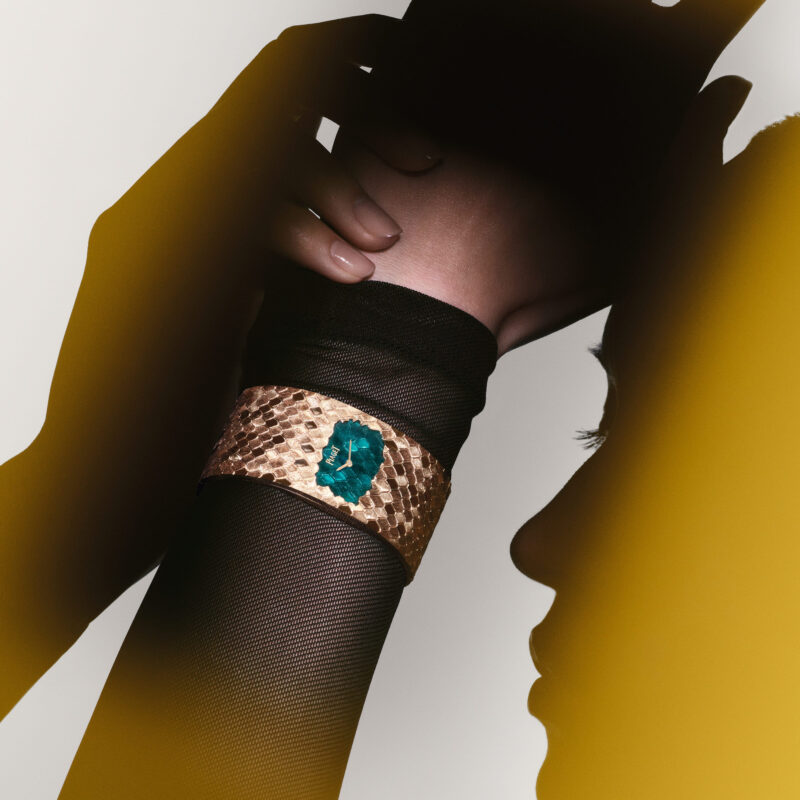
A gold cuff watch in the maison’s worn photograph: the bracelet gives the dial a broad patterned frame. Courtesy of Piaget.
Explore the story
A gold cuff can make a watch seem almost to disappear. In Piaget’s photograph, a blue-green dial sits inside a broad, patterned bracelet; the surface around it has as much presence as the time display. Elsewhere in the same atelier series, an uncased movement rests beneath a watchmaker’s tools. These are two very different views of the same house.
Piaget’s identity becomes clearer when you put them together. La Côte-aux-Fées is the home of its ultra-thin movements. Plan-les-Ouates, near Geneva, specialises in goldsmithing and jewellery. One gives the mechanism room to work within a small thickness; the other gives the finished object its surface, colour and shape. Their relationship helps explain how a Piaget watch can be read as a jewel before you notice its hands.
Between the surface and the movement
01 / 04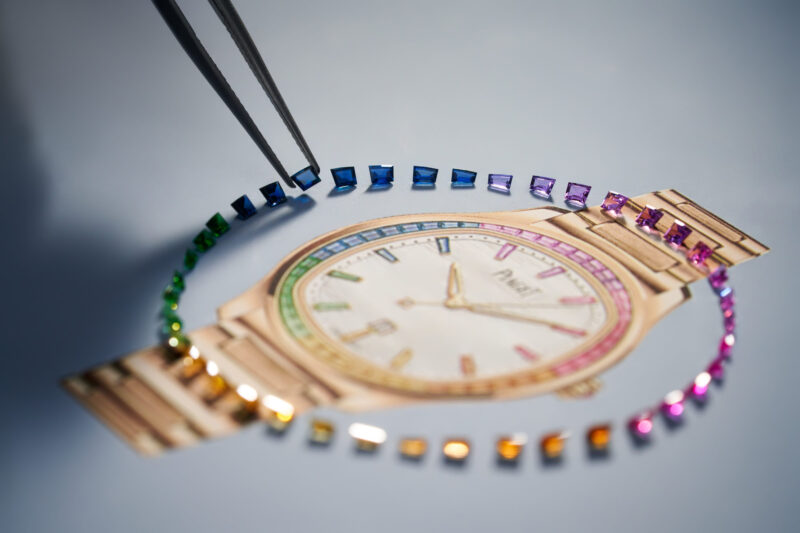
Separate stones and the outline of a watch dial in Piaget’s gem-setting series. Courtesy of Piaget.
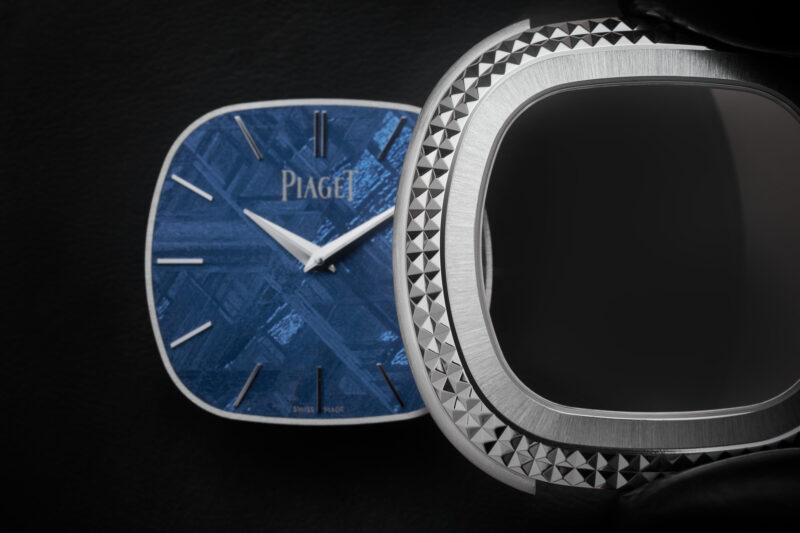
Dial and enclosure, separated during assembly: two parts of one visual composition. Courtesy of Piaget.
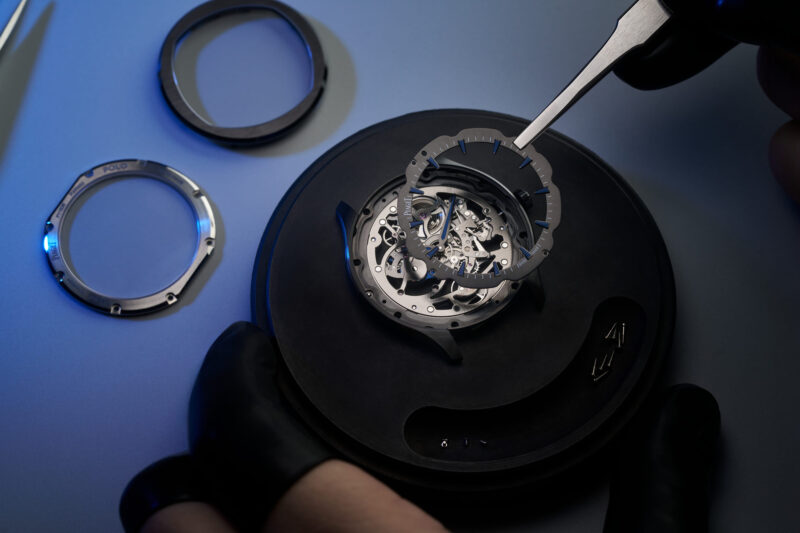
The compact field of an uncased watch movement during assembly. Courtesy of Piaget.
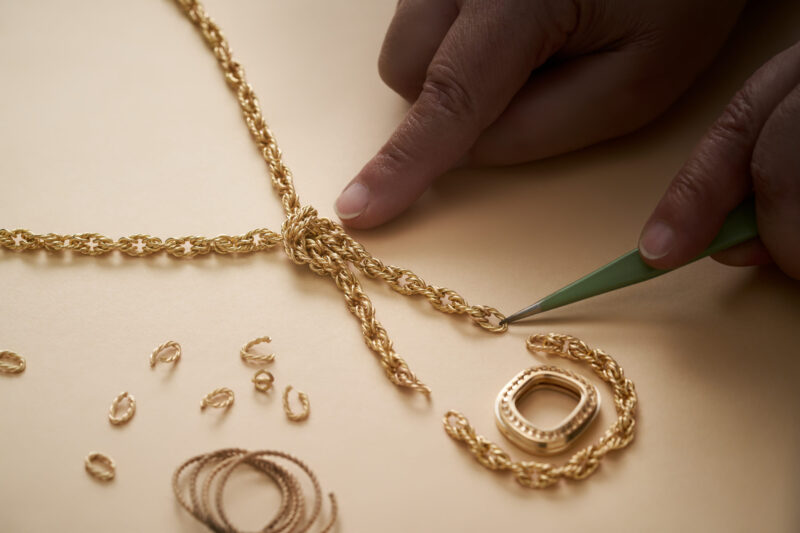
Individual elements and the chain they form, shown together at the bench. Courtesy of Piaget.
The workshop photographs change the scale of the conversation. A completed jewel becomes a set of individual decisions: where a stone will sit, how a link will turn, which part is polished and which part keeps a texture. Tools and unfinished components make the distances between those decisions visible.
In the setting image, a coloured stone is held above a line of others beside a watch dial. Before the stones form a continuous border, they remain separate objects, with intervals and edges to resolve. On the finished watch, colour can be taken in at a glance. At the bench, that impression is assembled one position at a time.
Another photograph shows a blue dial beside its case, with tweezers approaching from above. The familiar face of a watch has been separated from its enclosure. It is an inviting way to look again at something usually seen complete: the case supplies the perimeter, while the dial establishes a smaller field within it.
The gold chain provides a different kind of drawing. Loose elements lie beside the length already assembled. Repetition brings them into a line, but the small spaces between them remain part of its character. Look along the chain rather than at a single link. The rhythm is made by the relationship between one unit and the next.
Two places, different questions
La Côte-aux-Fées
Piaget began in this Swiss village in 1874. Today, the maison identifies its manufacture there with movements, particularly ultra-thin calibres. A movement has to coordinate components whose relationships are exact: a small alteration in one place affects the space available elsewhere. Thinness belongs to that whole arrangement.
The photograph of an open movement makes this work tangible without turning it into a diagram. Wheels, bridges and openings occupy a compact circular field. The tool entering from its edge draws attention to the scale at which the watchmaker works. What eventually becomes a calm display of hours and minutes begins with a much more concentrated landscape beneath it.
Plan-les-Ouates
Near Geneva, Piaget locates its goldsmithing and jewellery workshops. The maison also describes its own gold foundry as part of this practice. Gold enters the story as material to be shaped, worked and finished, before it becomes the reflective surface that meets the wearer’s eye.
The distinction between the two places is useful because it keeps both kinds of expertise visible. A fine case or supple-looking bracelet has its own demands, just as a thin movement does. In a jewellery watch, those demands meet within one object. The watch has to make room for a mechanism while sustaining a convincing line around the wrist.
A place for the work

The Plan-les-Ouates manufacture, in the maison’s exterior view. Courtesy of Piaget.
The exterior of Plan-les-Ouates introduces a different scale: a broad approach, a projecting roof and a glazed entrance. Piaget uses this image to open its account of the ateliers. After the close workshop views, the building places those individual gestures within a larger setting. The finished jewels bring their results back to the much smaller space of the body.
Gold with a pattern
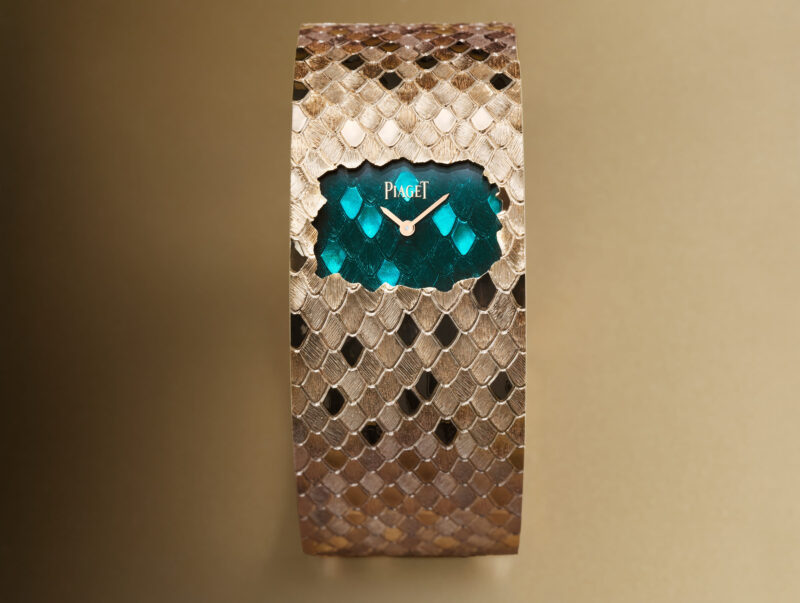
The complete cuff watch: pattern, open intervals and a concentrated field of colour. Courtesy of Piaget.
The cuff in the maison’s finished portrait is particularly revealing. Its wide surface is broken into a repeated pattern, with dark intervals that make the brighter elements easier to distinguish. The dial introduces another texture and a change of colour. Even before reading the time, you can follow the contrast between the broad gold field and the smaller opening within it.
In the worn photograph, black fabric gives that pattern a strong outline. The bracelet takes up a substantial part of the wrist, while the dial remains a concentrated accent. Jewellery and watchmaking have different visual weights here. Their balance comes from allowing the surrounding gold to speak as clearly as the display.
This is a rewarding way to approach Piaget beyond a list of references. Begin with the surface: its pattern, the direction of its lines, the way light alternates with shadow. Then find the dial and consider how much space it occupies. A broad bracelet can frame a small face; a restrained case can give a textured dial greater prominence. Proportion changes the relationship each time.
A shared language
Piaget’s two manufactures offer two entrances into the finished piece. You can begin with the movement and work outwards, towards its enclosure and bracelet. Or begin with a jewel’s outline and discover the time display inside it.
Return to the photographs in that second order. Follow the links into a chain, the separate stones into a border, the dial into its case. Then look again at the cuff on a wrist. The object feels more particular when its broad impression can be connected to the small decisions that give it form.
Sources & further reading
The Edit
Maisons & Heritage stories
Selected stories from the same editorial universe.
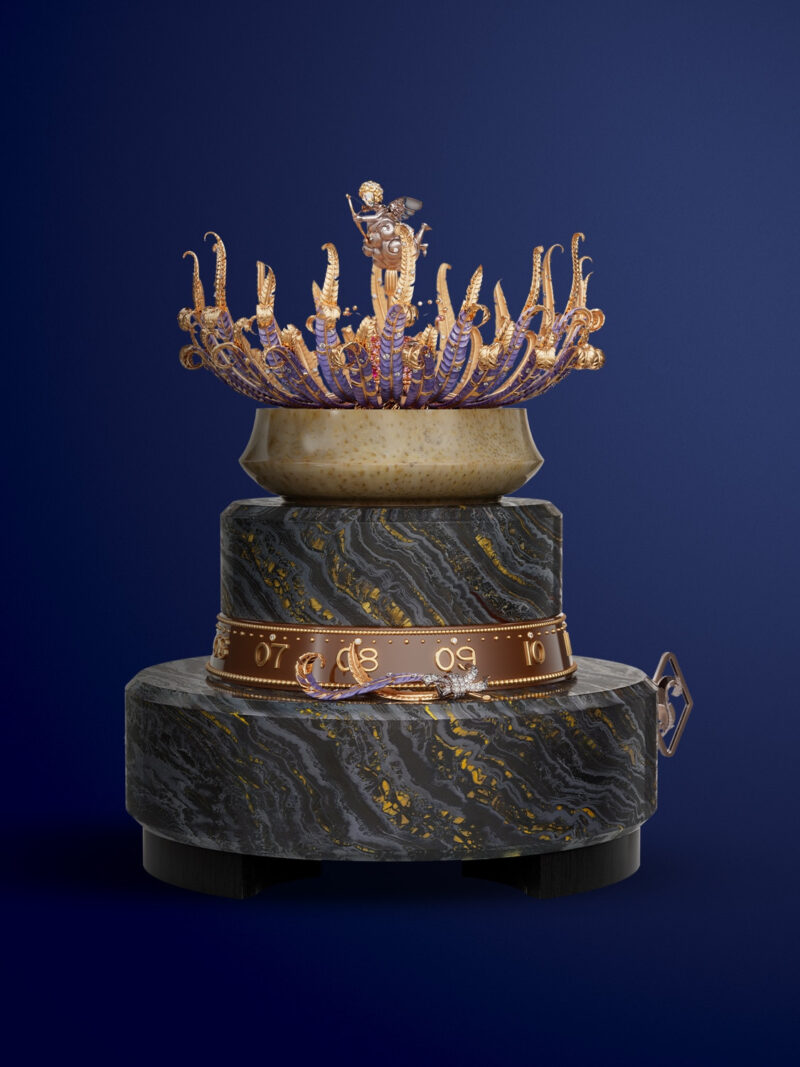
Van Cleef & Arpels Naissance de l’Amour: From Wax to Wingbeats
Green wax, a drawn gesture and a Cupid emerging from feathers. The making of
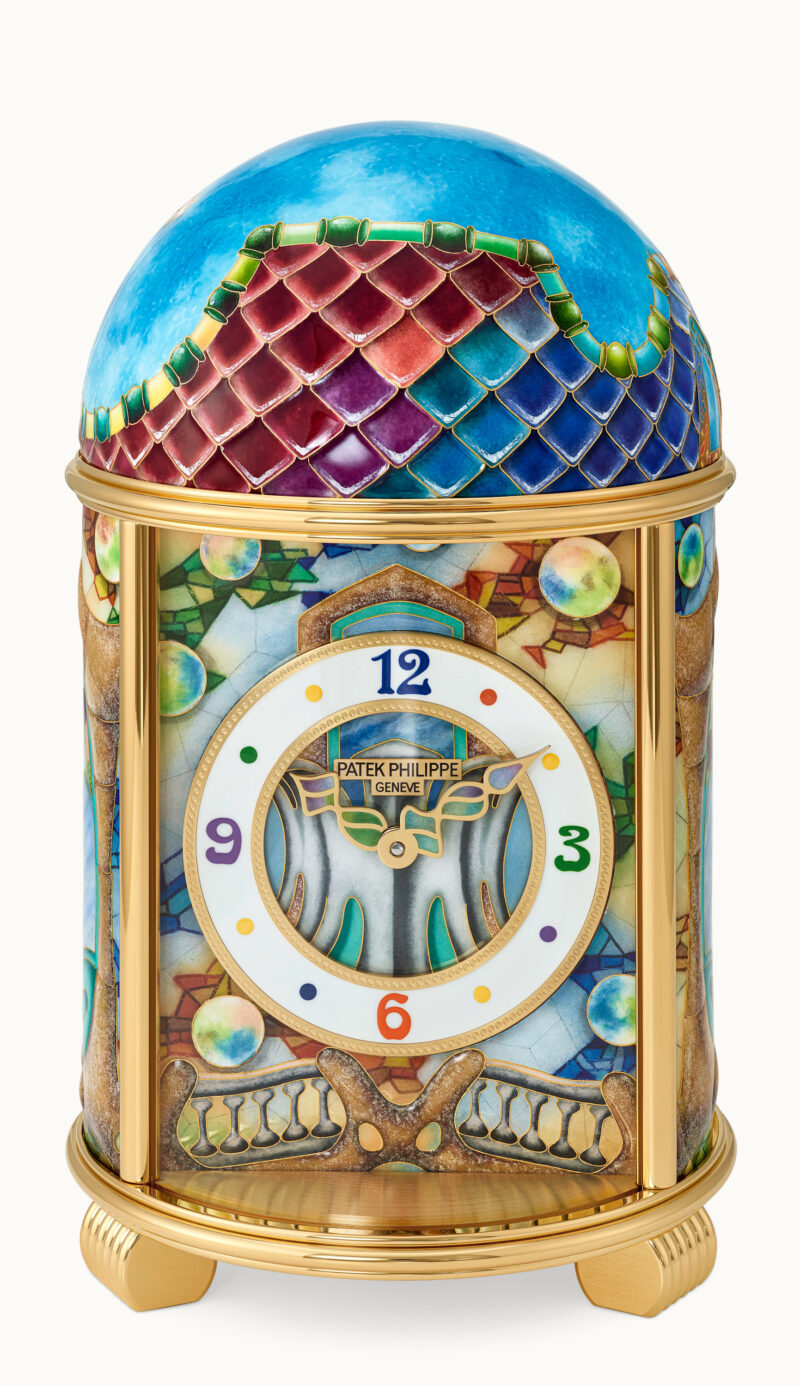
Patek Philippe The House of the Dragon: A Façade in Enamel
Gaudí’s architectural language becomes a dome table clock. Patek Philippe’s The House of the
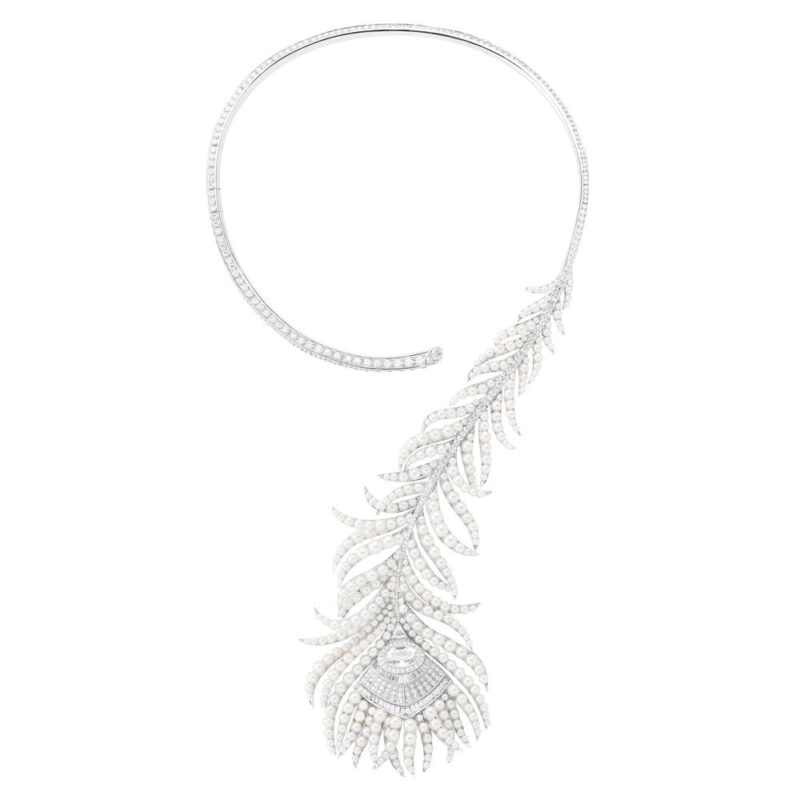
Boucheron Question Mark: The Freedom of an Open Line
A clasp-free curve and a feather that changes with the wearer. Boucheron’s Question Mark
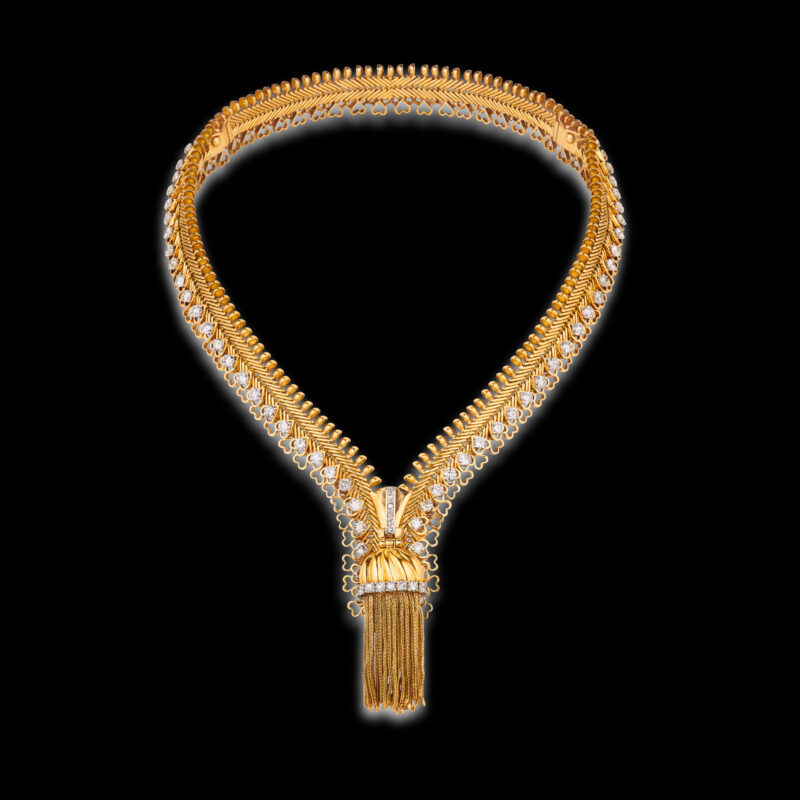
Van Cleef & Arpels Zip: One Jewel, Two Lives
A working zipper becomes a precious line. The Van Cleef & Arpels Zip changes
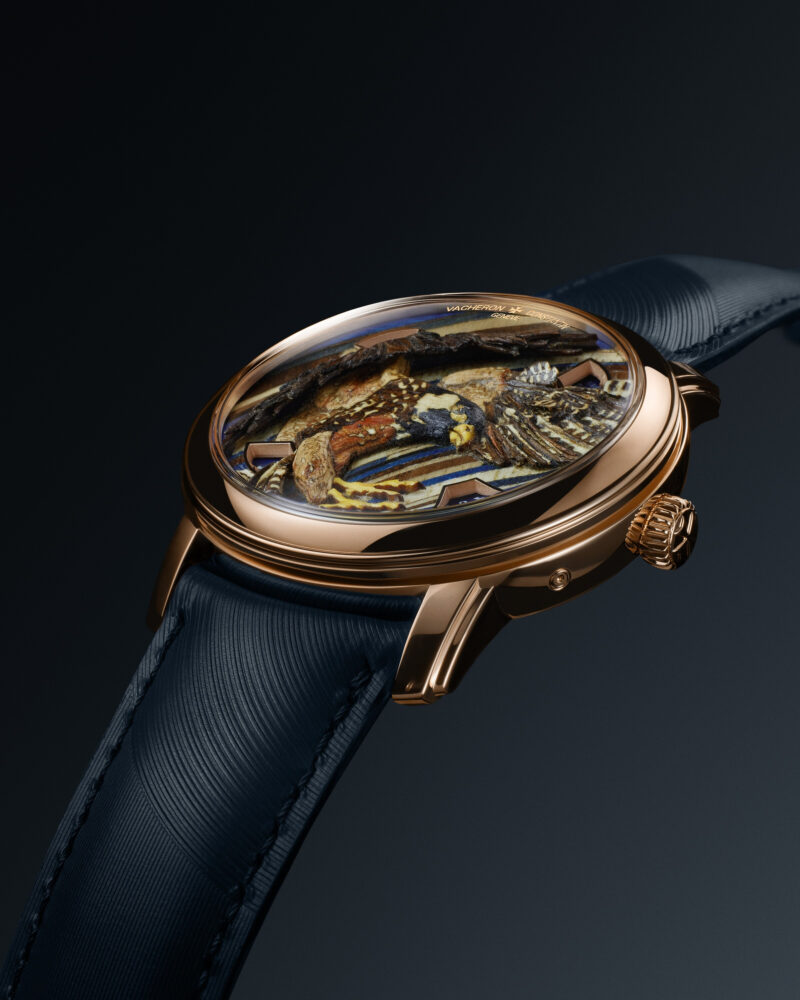
Vacheron Constantin Woodenwings: A Falcon Carved in Wood
A raised wing, a patterned ground and four small windows for the time. Anna
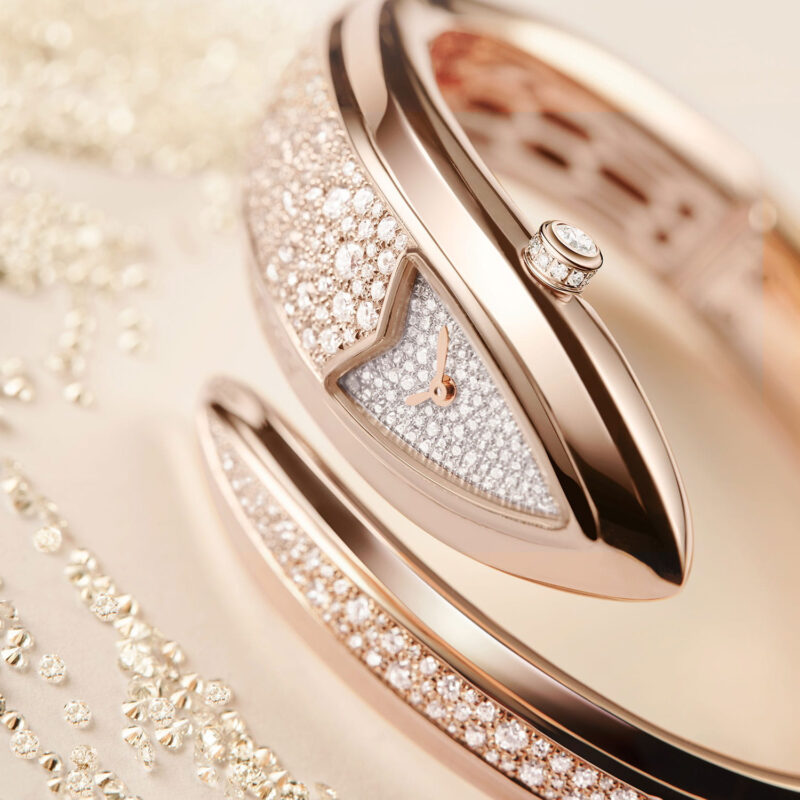
Bvlgari Serpenti Aeterna: The Snake Becomes a Line
A pointed head, an open coil and a fine seam of light. Serpenti Aeterna