
TheTimeo / Maisons & Heritage
An open line.
A free gesture.
A clasp-free curve and a feather that changes with the wearer. Boucheron’s Question Mark connects an 1879 idea with Plume de Paon jewels from 1883 and 2020.
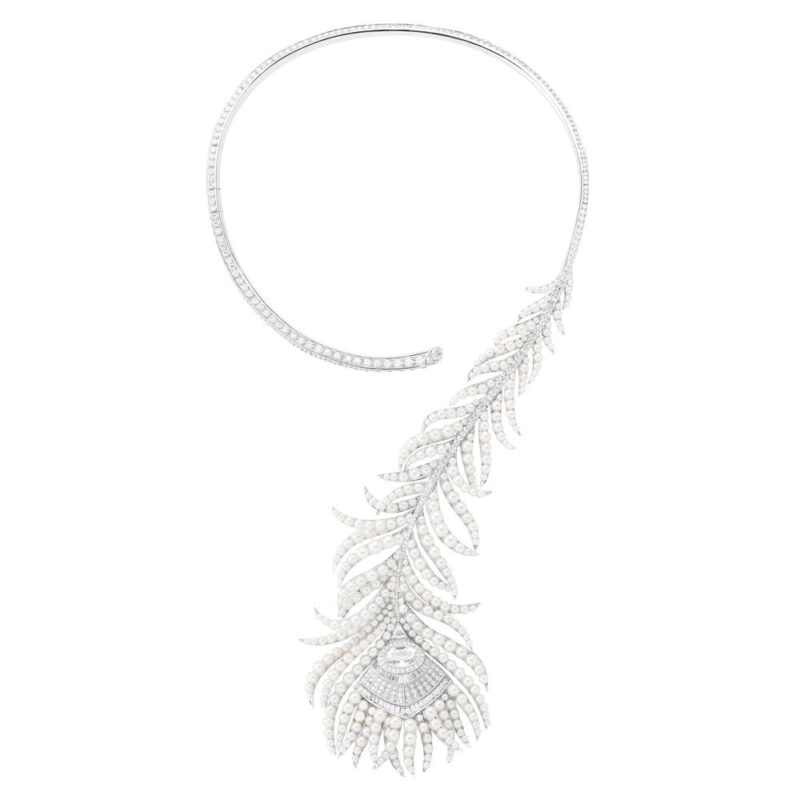
Plume de Paon Question Mark necklace, 2020, in the maison’s complete-object view. Courtesy of Boucheron.
Explore the story
One side circles the neck; the other becomes a feather. Boucheron’s Question Mark leaves an opening where a conventional necklace would complete its loop. That interruption gives the jewel its distinctive direction. The eye follows a quiet upper curve, then descends through a much more elaborate drawing.
The idea dates to an archive design of 1879. Boucheron developed a clasp-free construction that could be slipped around the neck, joining an unusual silhouette to a different way of putting jewellery on. The Plume de Paon versions shown here, from 1883 and 2020, make the continuity especially clear. The feather changes its proportions and detail while the open line keeps the design recognisable.
The jewel and the gesture
01 / 02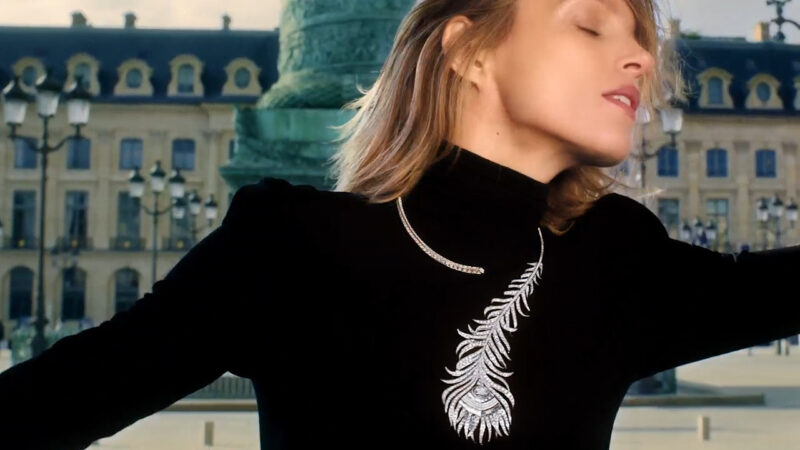
The feather against a black neckline, from Boucheron’s official Question Mark film. Courtesy of Boucheron.
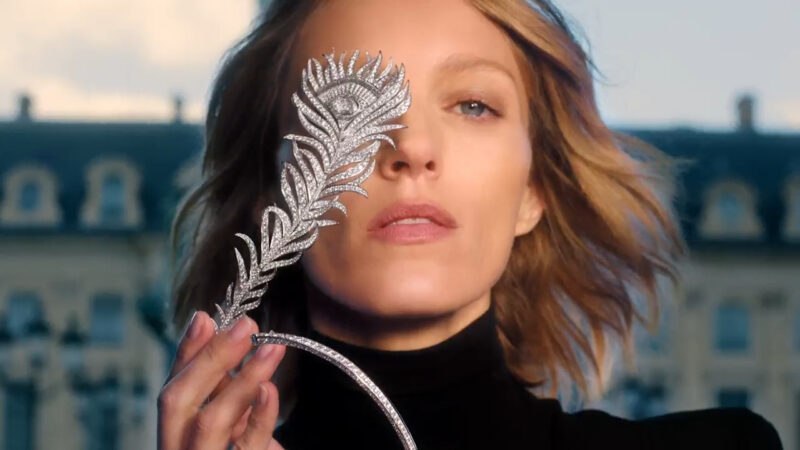
Lifted away from the neckline, the open curve becomes easier to follow. Still from the maison’s film. Courtesy of Boucheron.
In the maison’s film, the feather lies against a black high neckline. The clothing gives the bright outline a clear field, while the jewel travels down one side of the body. The curve above it remains comparatively bare. That difference in density is a large part of the composition: a fine line makes room for an expansive ending.
The second still lifts the necklace away from the neck. Held beside the face, it becomes an object with a silhouette of its own. You can see the separation between the end of the circular section and the descending feather. The film offers two ways of reading it, first as part of dress, then as an independent form.
Neither view needs a matching ornament on the other side. The opening supplies a pause, and the feather supplies the weight. This is what makes asymmetry interesting here: the two sides have different jobs within one balanced drawing. A simple neckline allows that relationship to remain visible.
Look especially at the feather’s outer edge. Its individual strands bend away from the centre and leave narrow intervals between them. The outline is easy to recognise from a distance, but it becomes less regular as you approach. Those interruptions give the ornament a livelier boundary than a solid pendant would have.
A feather across two eras
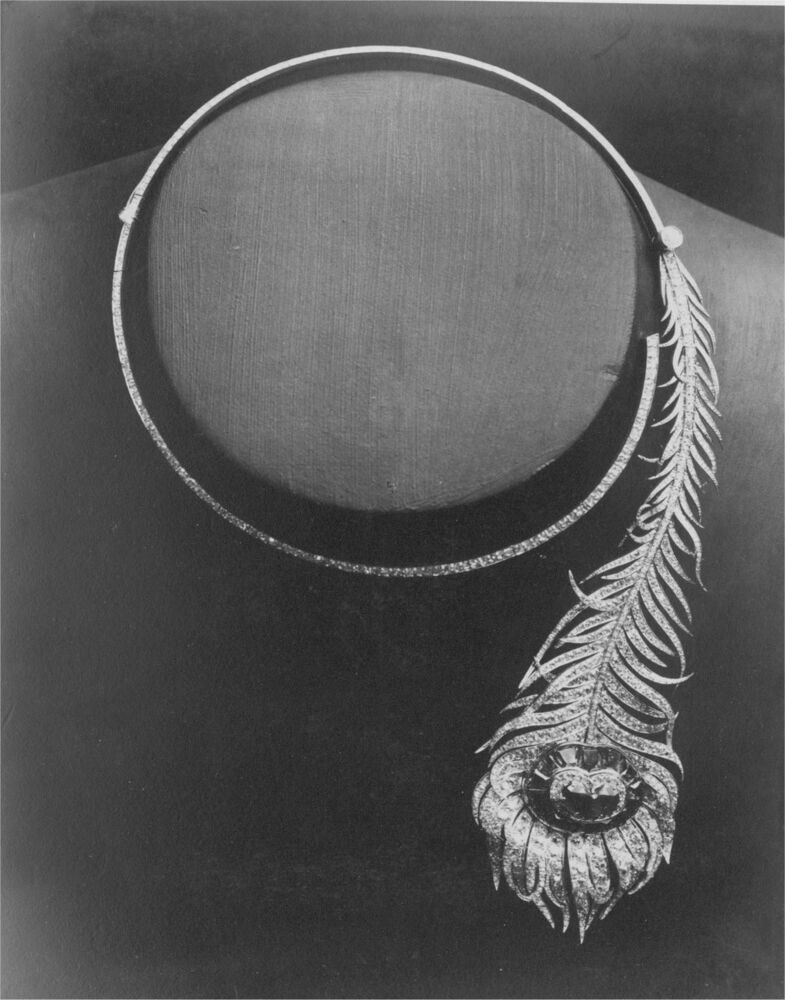
Plume de Paon Question Mark necklace, 1883, in the maison’s archive photograph. Courtesy of Boucheron.
The archive photograph identifies a Plume de Paon Question Mark necklace from 1883. Its circular upper section leads into a long feather that turns towards a pronounced eye at the lower end. The monochrome image makes the contrast between the slender collar and the denser ornament particularly legible.
Boucheron dates the first recorded drawing of the Question Mark to 1879 and places its first production period between 1881 and 1893. These dates describe different parts of the story: the initial idea, the making of the early necklaces, and the particular jewel preserved in this photograph. The 1883 example gives that history a specific physical outline.
The 2020 Plume de Paon keeps the same broad relationship while changing the feather’s drawing. In the maison’s isolated portrait, pale rounded elements trace its branching strands. The lower eye gathers those strands into a more concentrated centre, then lets the tips extend beyond it. The open upper curve leaves the composition room to breathe.
Comparing the two images is more revealing than treating either as a fixed emblem. The archive feather turns inward around its eye; the later example stretches the branching rhythm over a broader field. What survives is a way of organising the jewel around a deliberate gap and a descending motif.
The feather is one interpretation of that structure. Boucheron’s account of the early necklaces also records floral, plant, animal and figurative motifs. This variety helps explain the design’s endurance: the open curve offers an underlying construction without prescribing a single ornament. A different motif can change the necklace’s character while retaining the relationship between a restrained collar and an expressive ending.
The visible line, the hidden work
An opening with a purpose
The absence of a clasp belongs to the design’s original appeal. Boucheron presents the necklace as something a woman could put on herself, without the assistance associated with fastening a traditional high-jewellery necklace. The open shape is therefore both a visible signature and part of the wearing gesture.
That idea remains easy to understand in the photographs. Your eye can find where the curve ends and where the ornament begins. The jewel’s identity is carried by an interruption, rather than by a closed circle repeated evenly around the neck.
Flexibility within the curve
The maison describes a leaf-spring system and numerous small interlocking components as the basis of the necklace’s flexibility. The construction allows a continuous-looking line to have movement within it. Its complexity is intended to recede from the finished appearance.
This distinction matters when looking at a sculptural jewel. A strong outline may suggest a rigid object, yet the internal construction can serve another purpose. The Question Mark brings those two readings together: a recognisable shape for the eye and an articulated structure that makes its clasp-free gesture possible.
Begin with the gap
The most useful first detail is also the least elaborate. Find the opening, then follow the curve towards the feather. Notice where the line becomes fuller, where the strands separate and where the eye gathers the composition again.
In a worn view, consider what the neckline contributes. Here, black cloth keeps the feather readable and lets the open curve remain distinct. The jewel brings its own direction to the body. More than a century apart, the two Plume de Paon examples show how much freedom can remain inside a recognisable line.
Sources & further reading
The Edit
Maisons & Heritage stories
Selected stories from the same editorial universe.
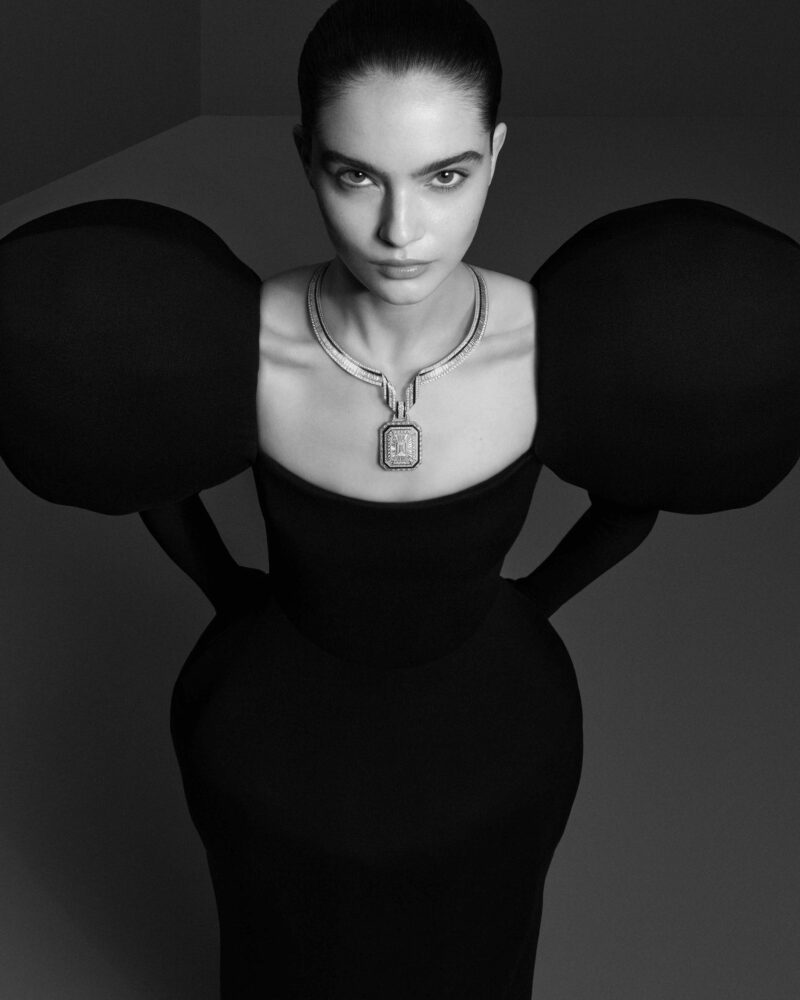
Boucheron, Through Frédéric: Four Jewels, One Point of View
An architectural pendant, an open curve, diamonds over the shoulders and a branch of
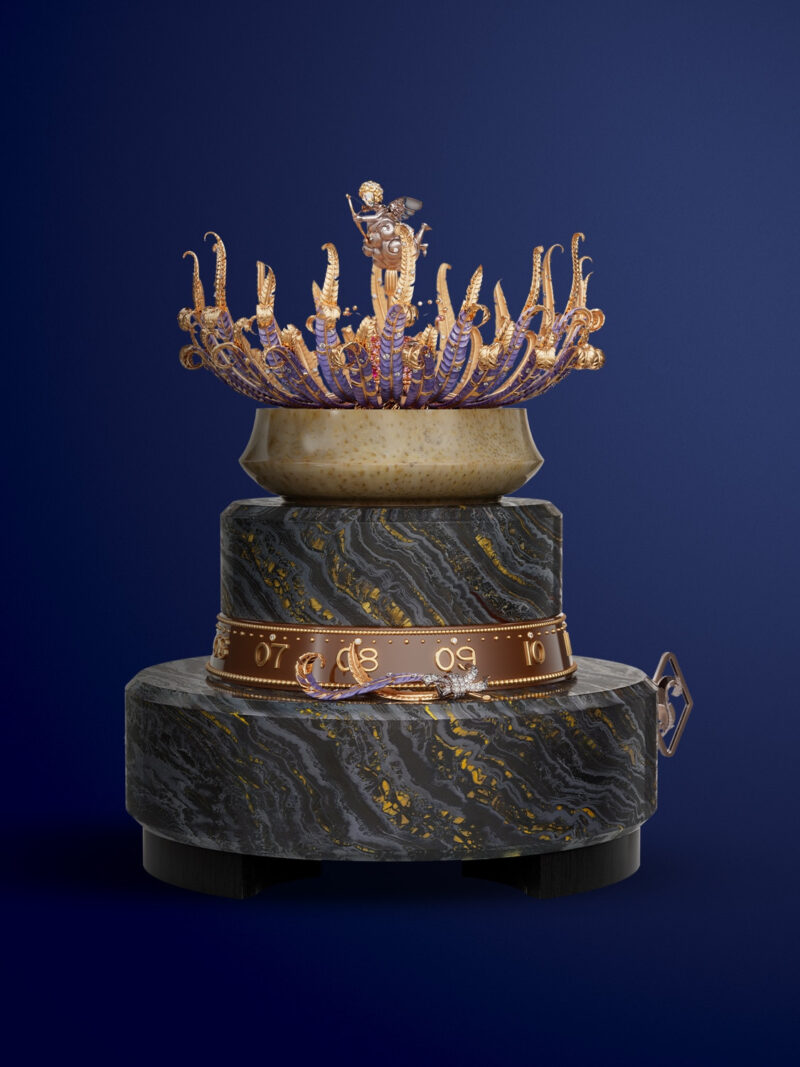
Van Cleef & Arpels Naissance de l’Amour: From Wax to Wingbeats
Green wax, a drawn gesture and a Cupid emerging from feathers. The making of
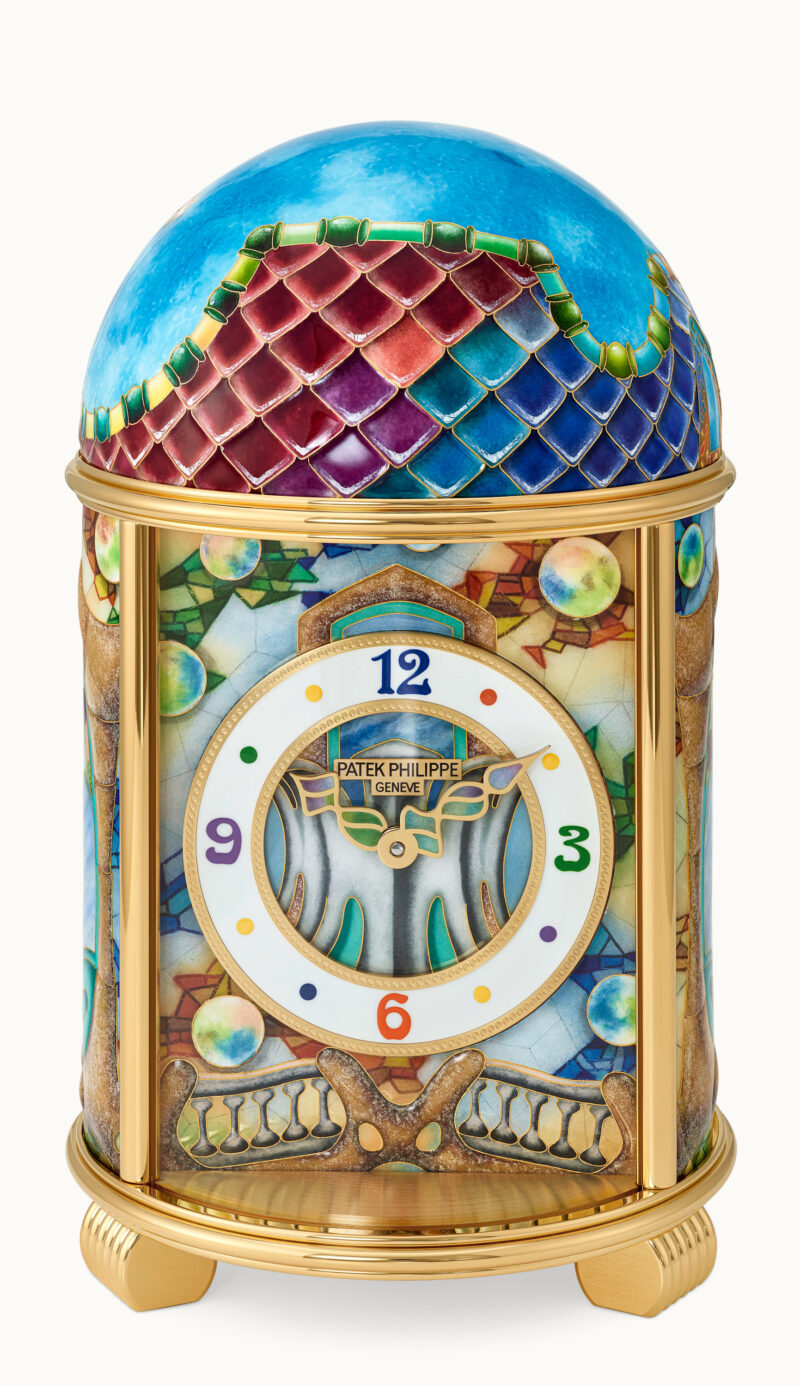
Patek Philippe The House of the Dragon: A Façade in Enamel
Gaudí’s architectural language becomes a dome table clock. Patek Philippe’s The House of the
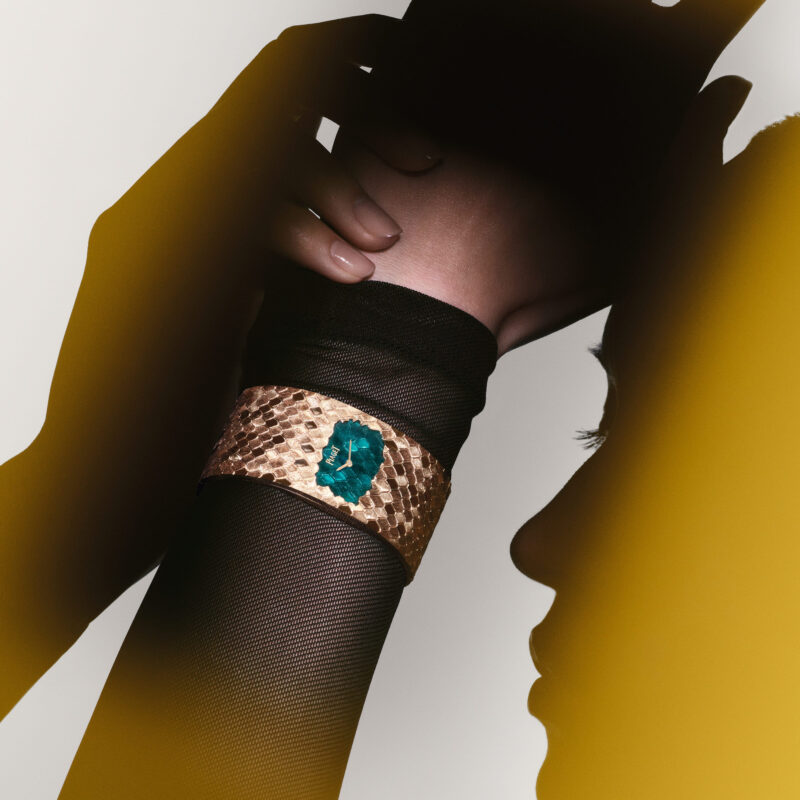
Piaget: Two Manufactures, One Language of Gold
From ultra-thin movements in La Côte-aux-Fées to goldsmithing in Plan-les-Ouates: two manufactures help explain
Van Cleef & Arpels Zip: One Jewel, Two Lives
A working zipper becomes a precious line. The Van Cleef & Arpels Zip changes
Vacheron Constantin Woodenwings: A Falcon Carved in Wood
A raised wing, a patterned ground and four small windows for the time. Anna