
TheTimeo / Luxury Living
A garden,
with a life
inside.
A butterfly waits among purple flowers. In Van Cleef & Arpels’ Brassée de Lavande, colour, enamel and a concealed mechanism turn a precious object into a small theatre.
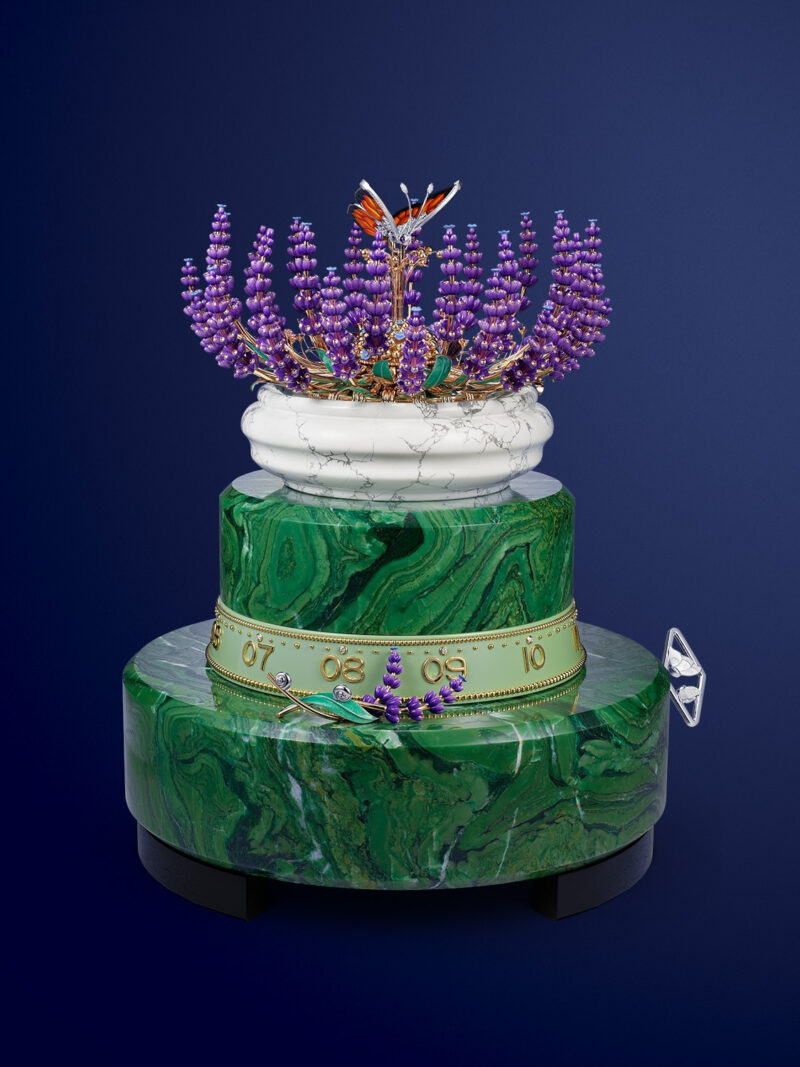
Brassée de Lavande, seen complete in the house’s official portrait. Courtesy of Van Cleef & Arpels.
Explore the story
A purple flower head rises above a green stone base. Look closer and the bouquet opens around an orange butterfly, its wings held above a tangle of golden stems. Brassée de Lavande places a small garden on a pedestal, then gives that garden a secret life. Its appeal begins with the scene; the clock becomes another reason to stay with it.
A bouquet with an opening
01 / 02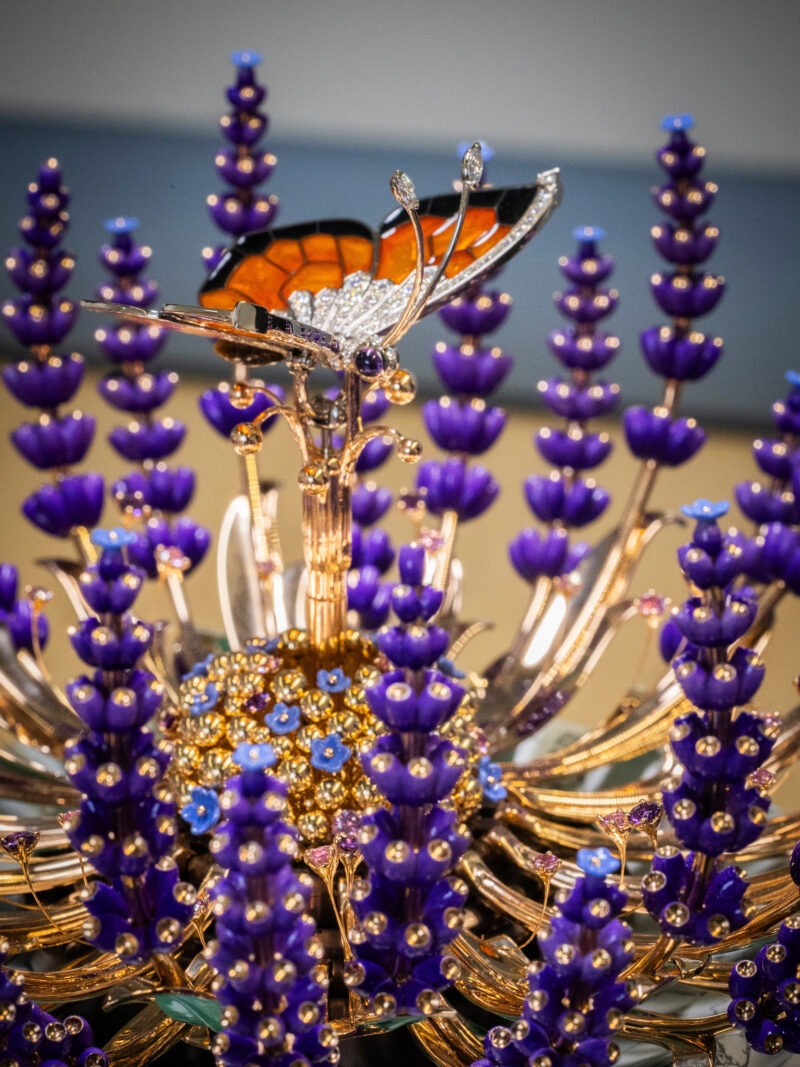
The butterfly and the open centre of the bouquet. Courtesy of Van Cleef & Arpels.
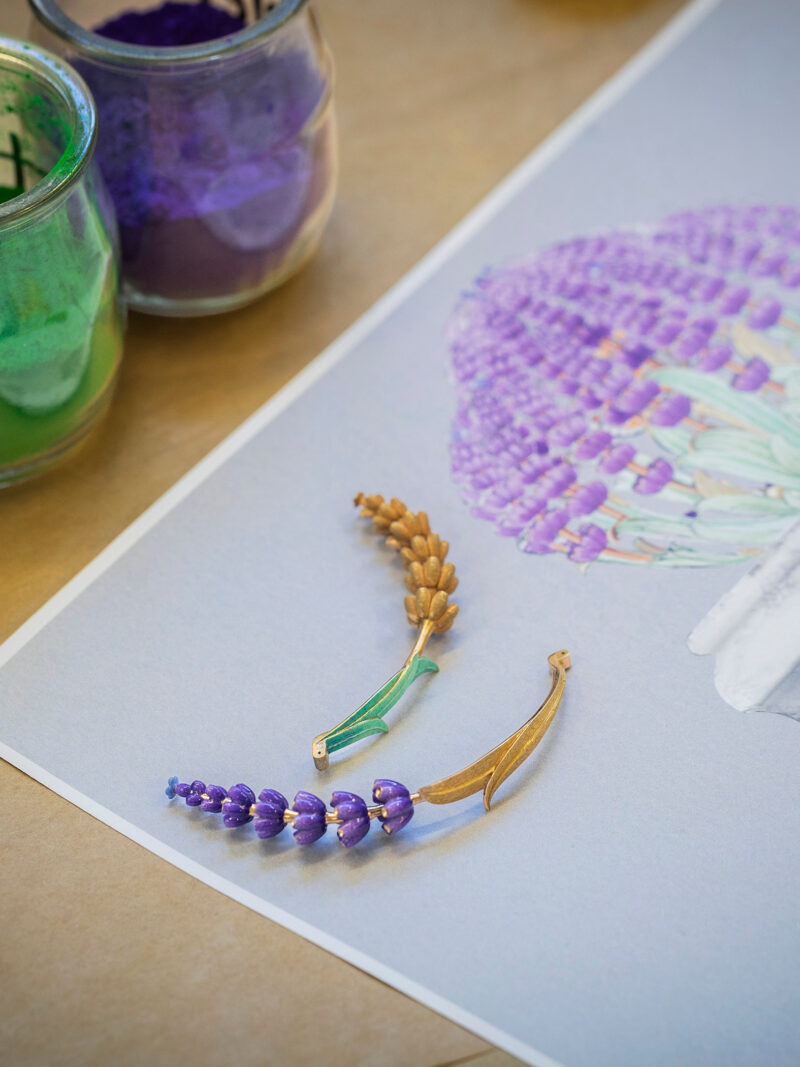
A lavender sprig compared with the original drawing, in the house’s craftsmanship sequence. Courtesy of Van Cleef & Arpels.
The complete object has the balance of a little pavilion. Broad green tiers establish its base, a pale band lifts the flowers clear of that weight, and the bouquet gathers into a rounded crown. Purple, green and white make three distinct registers. The orange butterfly introduces a fourth colour at the very point towards which the stems appear to lean.
Van Cleef & Arpels describes an on-demand animation in which the lavender opens, the butterfly rises and the bouquet eventually closes around it again, accompanied by a melody. The photographs offer a different pleasure: enough stillness to follow the spacing of the flowers and the construction behind the surprise. The apparent softness of the scene comes from many sharply defined parts.
In the close view, each purple head stands at a slightly different height. Light catches its rounded surface while the gold below becomes a much thinner line. Repetition holds the bouquet together, but the uneven skyline keeps it from reading like a rigid grille. The butterfly interrupts that pattern with a broad, almost horizontal surface.
The drawing beside a finished sprig makes this shift of scale especially clear. A mark on paper becomes a small object with thickness, shine and a casting shadow. The painted curve and the gold stem belong to the same idea, yet the finished part must occupy real space. That is where an ornamental picture begins to acquire the presence of a mechanism.
It is tempting to look only for the moment of revelation. The quieter reward is the bouquet itself: how little gaps separate its branches, how a line of gold remains visible between the coloured heads, and how the pale stone underneath gives the composition a place to pause. The concealed performance has a convincing setting before it starts.
Three ways to give gold a colour
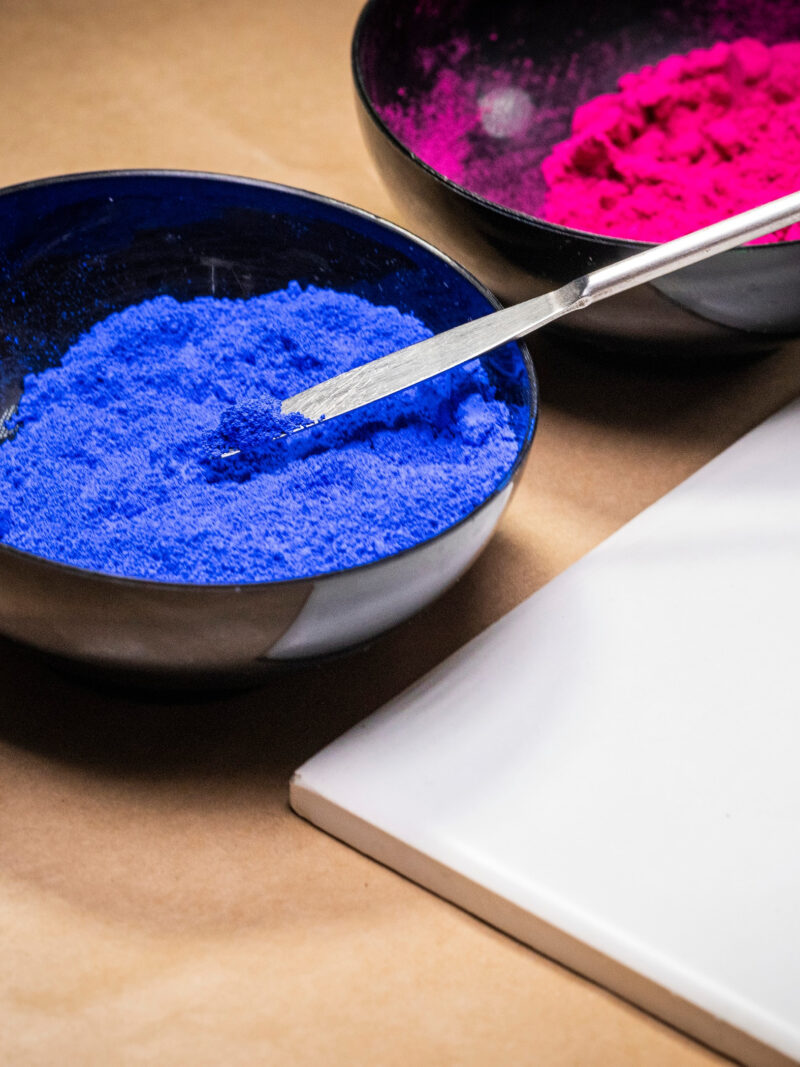
Pigments prepared for the bouquet’s lacquer. Courtesy of Van Cleef & Arpels.
In the pigment photograph, saturated blue and magenta sit in shallow metal dishes. Their loose, granular appearance is far removed from the smooth flowers of the finished object. Against the white work surface, colour becomes a material that can be moved and combined. The contrast helps explain why the bouquet feels designed rather than simply painted a naturalistic purple: the shade participates in the whole arrangement of blue, green, orange and gold.
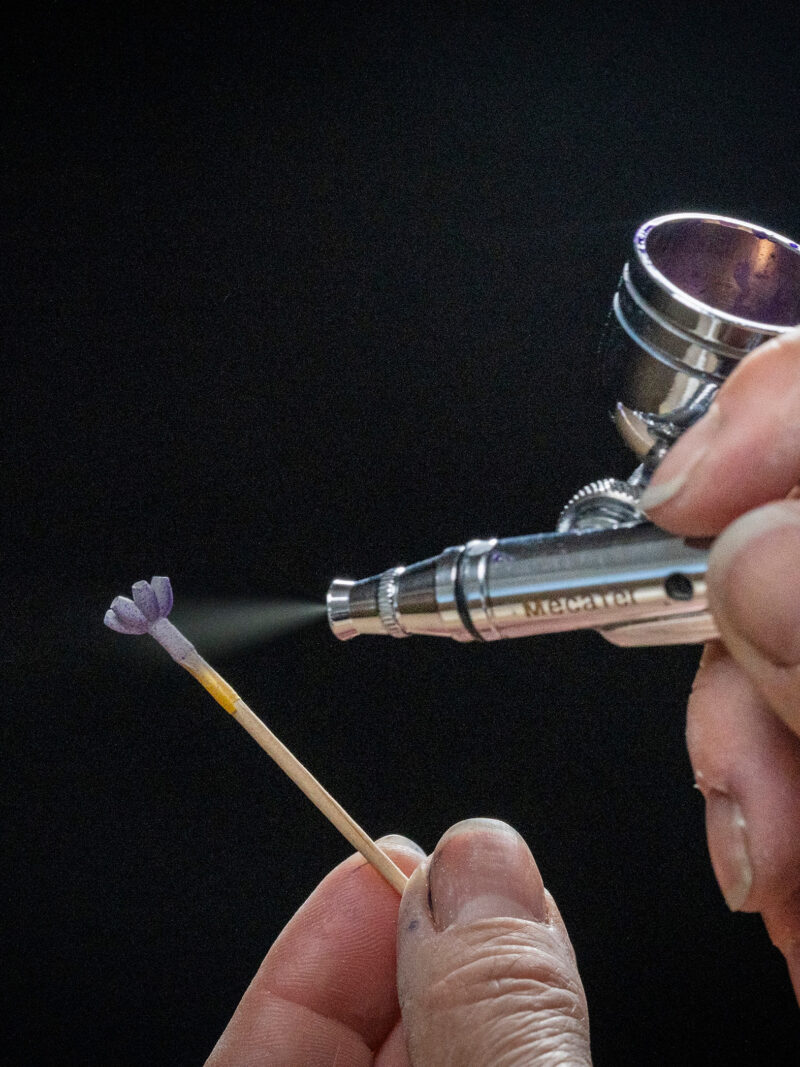
Applying lacquer to a rose-gold corolla with an airbrush. Courtesy of Van Cleef & Arpels.
The airbrush photograph changes the scale again. A hand supports a tiny corolla beneath a tool much larger than the flower itself. The surrounding darkness isolates the pale stem and the point at which colour meets metal. Van Cleef & Arpels identifies this as lacquer applied to a rose-gold corolla. What matters visually is the transition from a reflective structure to a coloured surface that can belong among dozens of related forms.
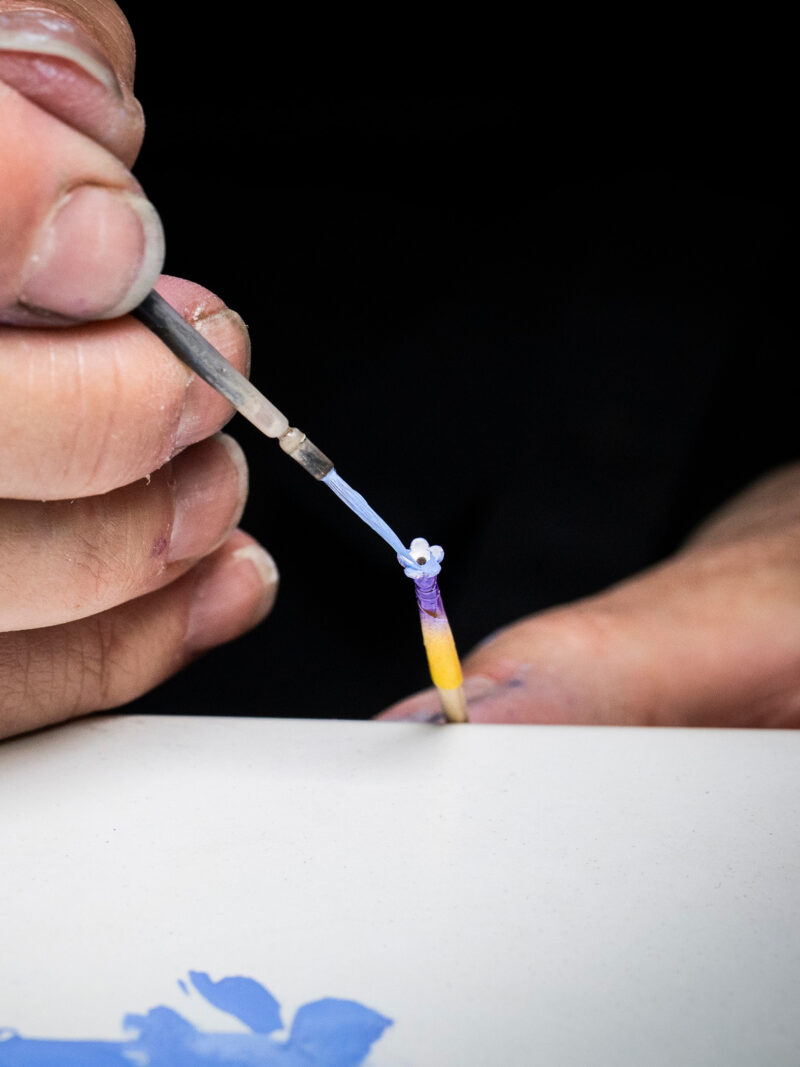
A brush brings colour to an individual flower. Courtesy of Van Cleef & Arpels.
A fine brush brings the process closer still. The hand, the brush tip and the small flower establish three different scales within one photograph. A little pool of colour on the white surface gives the scene its practical setting. Seen after the airbrush, the image suggests a different kind of attention: an individual point of colour within a composition that will eventually be read as a mass. The finished bouquet depends on both distances.
Light caught in a wing
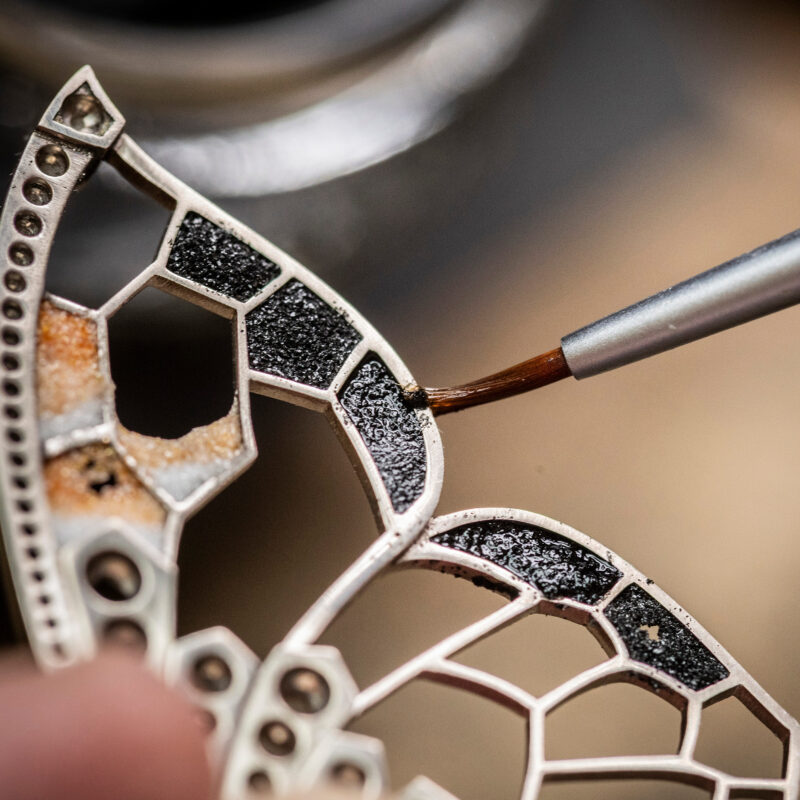
Applying plique-à-jour enamel to the butterfly’s wing. Official craftsmanship photograph, courtesy of Van Cleef & Arpels.
The wing photograph has a more open geometry than the flowers. Dark contours divide it into irregular cells, some carrying orange while others remain transparent to the space behind them. The fine tool approaches one of those bounded areas. Even at this enlarged scale, the shape keeps something of an insect wing’s lightness: a network of edges holding a fragile-looking field.
The house identifies the technique as plique-à-jour enamel. In the finished butterfly, the orange cells sit beside darker outlines and bright stone-set edges. The colour therefore appears to have two kinds of boundary, one absorbing light and another catching it. Against the purple flower heads, the wing becomes a little illuminated plane rather than another rounded element in the bouquet.
This distinction gives the scene much of its clarity. The lavender repeats small, compact volumes; the butterfly spreads a single broad shape above them. Gold links the two. Following that relationship is more rewarding than counting the precious materials, because it reveals how the scene directs attention towards its central character.
The complete portrait adds the clock to this reading. Numerals travel around a band below the flowers, placing measured time beneath a scene of imagined natural life. The official specification describes a rotating time ring and a mechanical reserve of eight days. Those functions have a visible position in the object, contained within the layered base rather than competing with the butterfly for the centre of the composition.
At roughly thirty centimetres tall according to the house, Brassée de Lavande is also an object with room around it. It belongs to a scale at which a viewer can notice the whole silhouette, then move attention towards a single wing or flower. Its richness is organised across those distances. The more closely it is examined, the less the initial scene feels like a flat decorative picture.
Two ways of spending time
Following the hours
The numbered ring offers an orderly path around the base. Its repetition is different from the branching flowers above: a continuous circuit, evenly divided, held within the green stone architecture. It gives the eye a practical route through an object whose upper half is full of irregular forms. A clock can be legible while remaining part of a larger decorative scene.
Waiting for the garden
The butterfly offers another rhythm. Its place in the bouquet creates anticipation even in a still photograph, because the surrounding branches describe an opening and a shelter. The pleasure is in that possibility as much as in the abundance of detail. Brassée de Lavande makes the passage of time something to look at, with a small garden that rewards both a quick glance and a much longer one.
Sources & further reading
The Edit
Luxury Living stories
Selected stories from the same editorial universe.
Schiaparelli: The Body as a Jewel
A necklace shaped like lungs, a ribbon hung with pine cones, an earring beside
Lalique’s Dragonfly-Woman: A Jewel at the Scale of the Body
A carved green face, hinged wings and a silhouette 26.5 centimetres across. Lalique’s Dragonfly-Woman
CHANEL Première Galon: When a Braid Becomes Gold
A gold braid, a small octagonal face and the edge of a sleeve. Première
Piaget Swinging Pebbles: Time Away from the Wrist
A long gold chain, a smooth stone and two hands. Swinging Pebbles gives time
Diorissima: A Garden Composed in Gemstones
A green flower beside blue, a jewel above an open back, a brush at
Hermès Horsescape: The Horse in the Line
A saddle at the wrist, a stirrup held against the sky, bright lines beside