
TheTimeo / Luxury Living
Lalique:
A creature
in gold.
A carved green face, hinged wings and a silhouette 26.5 centimetres across. Lalique’s Dragonfly-Woman brings the scale of sculpture into a jewel.
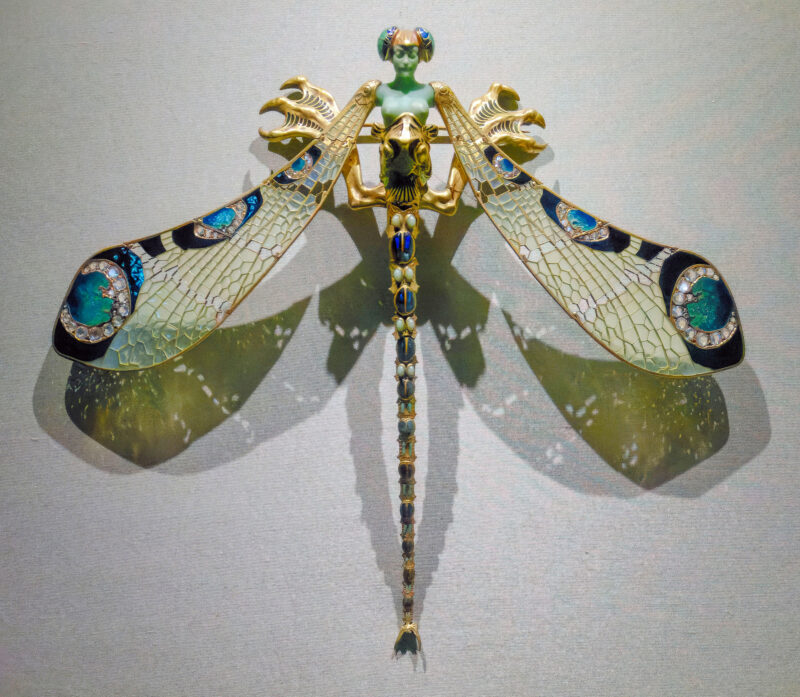
The complete ornament, c.1897–98. Calouste Gulbenkian Museum. Photo: Ángel M. Felicísimo (CC BY 2.0).
Explore the story
The wings arrive before the face. Spread across a pale background, they carry fine gold divisions, translucent-looking panels and deep blue-green accents near their tips. Then the small green figure at the centre comes into focus. A woman seems to emerge from another creature, her smooth shoulders held within an elaborate gold outline.
René Lalique’s Dragonfly corsage ornament, made in Paris around 1897–98, measures 26.5 centimetres across. Its scale is part of its character. This is a jewel to imagine across the body, where a pair of wings could establish the whole composition of an outfit. The photographs bring it closer, revealing how sculpture, colour and an intricate surface work together.
A face within a pair of wings
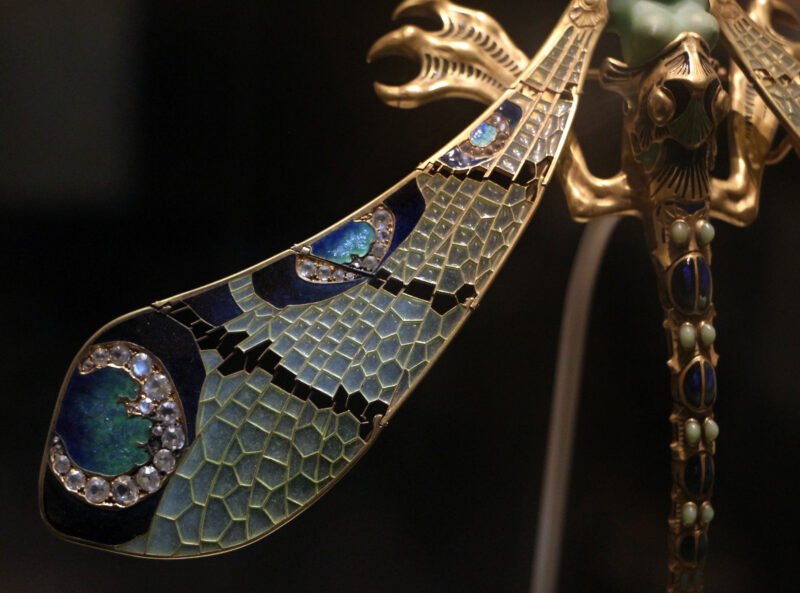
A separate detail photograph of the wing. Photo: Sailko (CC BY 3.0).
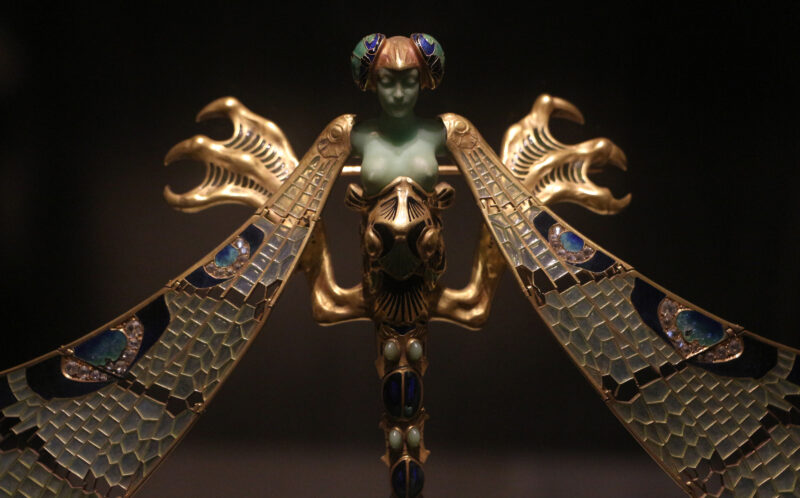
The carved chrysoprase figure within the gold structure. Photo: Sailko (CC BY 3.0).
In the wing detail, a fine network divides the surface into small, irregular compartments. The pattern changes direction as it approaches the edge. Larger blue areas interrupt that network, while bright stones trace parts of their borders. Several kinds of light sit close together: a long reflection along gold, a softer glow within enamel and sharper points around the coloured accents.
The wing is persuasive because it remains recognisable through all that elaboration. Its outer contour has the breadth and taper of something extended in flight. Within it, the pattern becomes more intricate. The eye can move between the overall shape and the small divisions without losing its sense of where it is.
The central detail changes the pace. The woman’s face is calm, her shoulders rounded and comparatively smooth. The museum identifies the carved green figure as chrysoprase. That quiet surface gives the surrounding goldwork a different presence: the open mouths, curved projections and patterned borders seem more animated beside it.
Lalique brings these contrasting surfaces into a single creature. A recognisable face is held within an unfamiliar body. The green figure draws us towards a human scale, while the broad wings and long lower section extend beyond it. The jewel remains compelling partly because the transformation is never reduced to one simple decorative motif.
A sculpture seen from the side
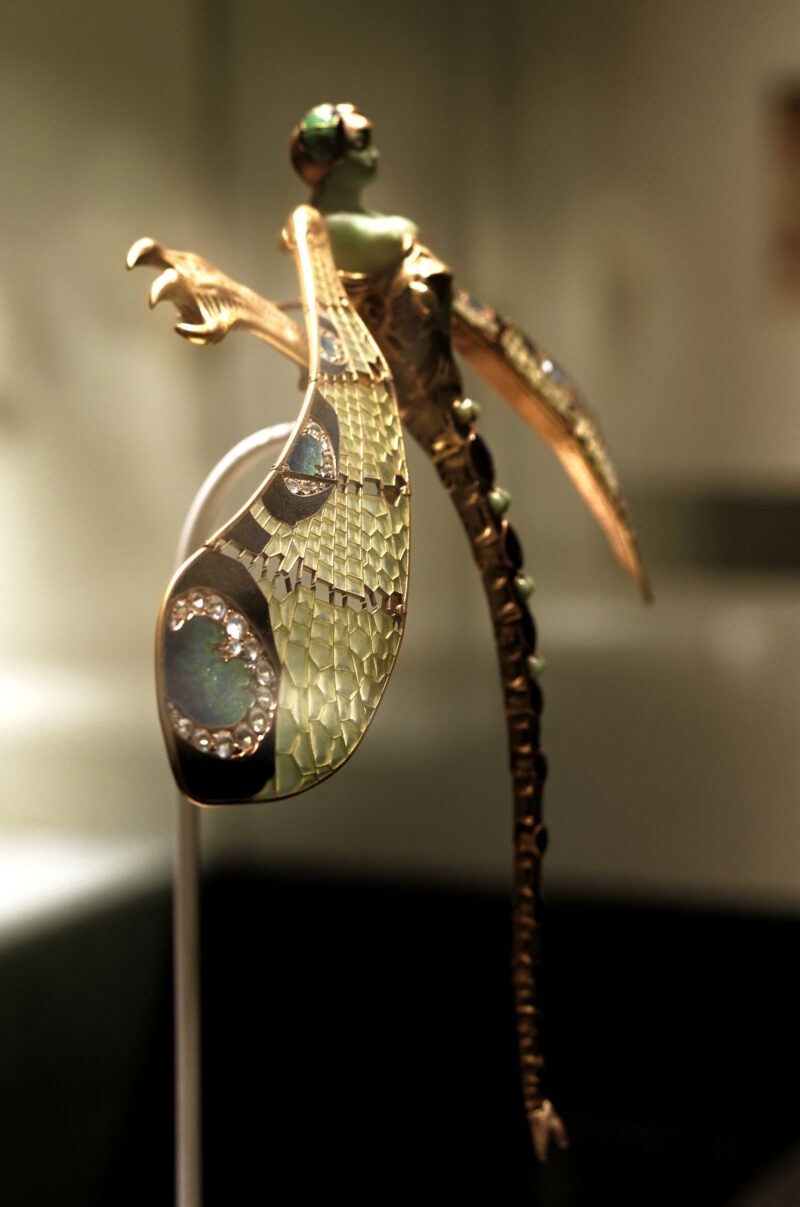
An oblique view, with the museum display support visible. Photo: Yelkrokoyade (CC BY-SA 4.0).
The oblique photograph makes the object feel less like an image and more like a volume. One wing approaches the camera while the other recedes. The figure rises above the surrounding structure, and the long lower section curves through space. The display support is visible too, helping to separate the jewel’s own lines from the means used to present it.
The Calouste Gulbenkian Museum describes the wings as articulated. A still photograph cannot show their movement, but this angle gives a clearer sense of how separate elements meet. The front view organises the ornament into a striking outline; the side view reveals distances between its parts.
That change of viewpoint is useful with any sculptural jewel. A frontal portrait can explain symmetry, pattern and colour while leaving depth almost hidden. From an angle, the projection of a setting, the curve of a body or the space behind an ornament becomes more apparent. An important part of the design may lie in those intervals.
Here, the green figure has a physical presence within the gold structure. The wings appear to spread from a shared centre, while the lower section carries attention away from the face. Seen obliquely, those directions become separate movements rather than a single flat drawing.
The image continues around the back
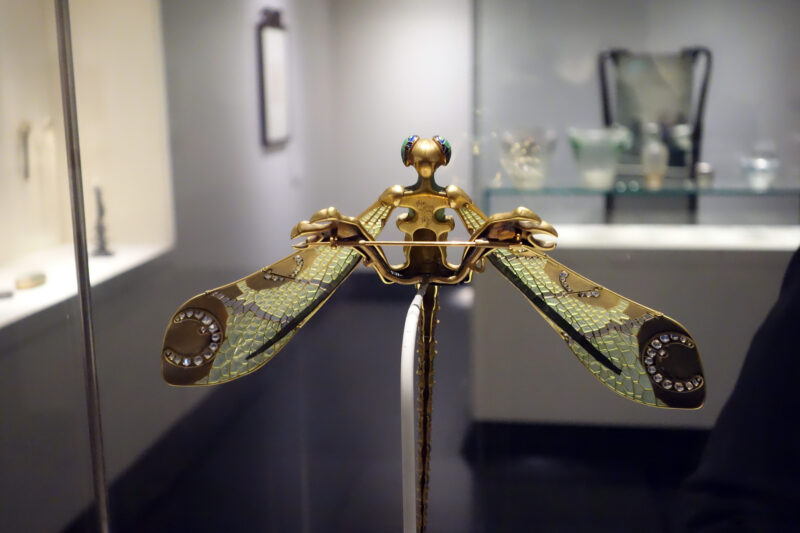
Reverse detail: the supporting structure and long horizontal pin. Photo: Mike Steele (CC BY 2.0).
The reverse detail offers another surprise. The head becomes a rounded gold form, with coloured elements at either side. Small joints and the long horizontal pin are visible. The pattern within the wings remains legible from this direction, giving the reverse its own relationship between colour, metal and open space.
This photograph has a different purpose from the first. It allows the structure to enter the story. The pin belongs to the practical question of attachment; the joints belong to the way parts have been brought together. Those details make the transformation into a wearable object more understandable, even though the ornament’s dramatic outline still dominates the imagination.
There is pleasure in following the same shape around its edges. A familiar front can become unfamiliar again when the face disappears and the supporting construction takes its place. With Lalique’s dragonfly-woman, the reverse keeps the work of the goldsmith close to the sculptural idea.
Twenty-six centimetres of presence
The museum records a height of 23 centimetres as well as the 26.5-centimetre width. Consider those dimensions against the front of a jacket, rather than against a photograph on a phone. The wings begin to establish a territory of their own. Jewellery at this scale can help determine the shape of a look, with fabric becoming the field around it.
The long lower section is important to that balance. It gives the ornament a downward direction beneath the broad wings. Rounded blue accents repeat along its length, drawing the eye back towards the richer colour near the wing tips. Breadth and length hold one another in check, so the jewel has a clear centre as well as an expansive outline.
Gulbenkian acquired the piece in 1903. In the museum’s account of Lalique, the female figure and the insect form part of a wider imagination of metamorphosis. This object gives that idea an unusually complete physical expression: the wing’s fine divisions, the carved face and the animated gold contours all contribute to the creature.
The most revealing way to return to the full photograph is to keep the other views in mind. The wings now have depth as well as pattern. The face has a reverse; the imagined movement has a visible construction. A spectacular silhouette becomes a closely considered object, capable of holding attention long after its first impression.
Sources & further reading
- Calouste Gulbenkian Museum — Dragonfly corsage ornament, inventory1197
- Calouste Gulbenkian Museum — René Lalique room, Ideal and Metamorphoses
- René Lalique, 1898 (53403680198).jpg — Ángel M. Felicísimo, CC BY 2.0. Display copy resized and converted to sRGB; original composition retained.
- René lalique, pettorale libellula, in oro, smalti, crisoprazio, calcedonio, pietre lunari e diamanti, 1897-98 ca. 02.jpg — Sailko, CC BY 3.0. Display copy resized and converted to sRGB; original composition retained.
- René lalique, pettorale libellula, in oro, smalti, crisoprazio, calcedonio, pietre lunari e diamanti, 1897-98 ca. 03.jpg — Sailko, CC BY 3.0. Display copy resized and converted to sRGB; original composition retained.
- Pectoral à la libellule René Lalique in Calouste Gulbenkian Museum.jpg — Yelkrokoyade, CC BY-SA 4.0. Display copy resized and converted to sRGB; original composition retained.
- The Gulbenkian Museum (41564864175).jpg — Mike Steele, CC BY 2.0. Display copy resized and converted to sRGB; original composition retained.
The Edit
Luxury Living stories
Selected stories from the same editorial universe.
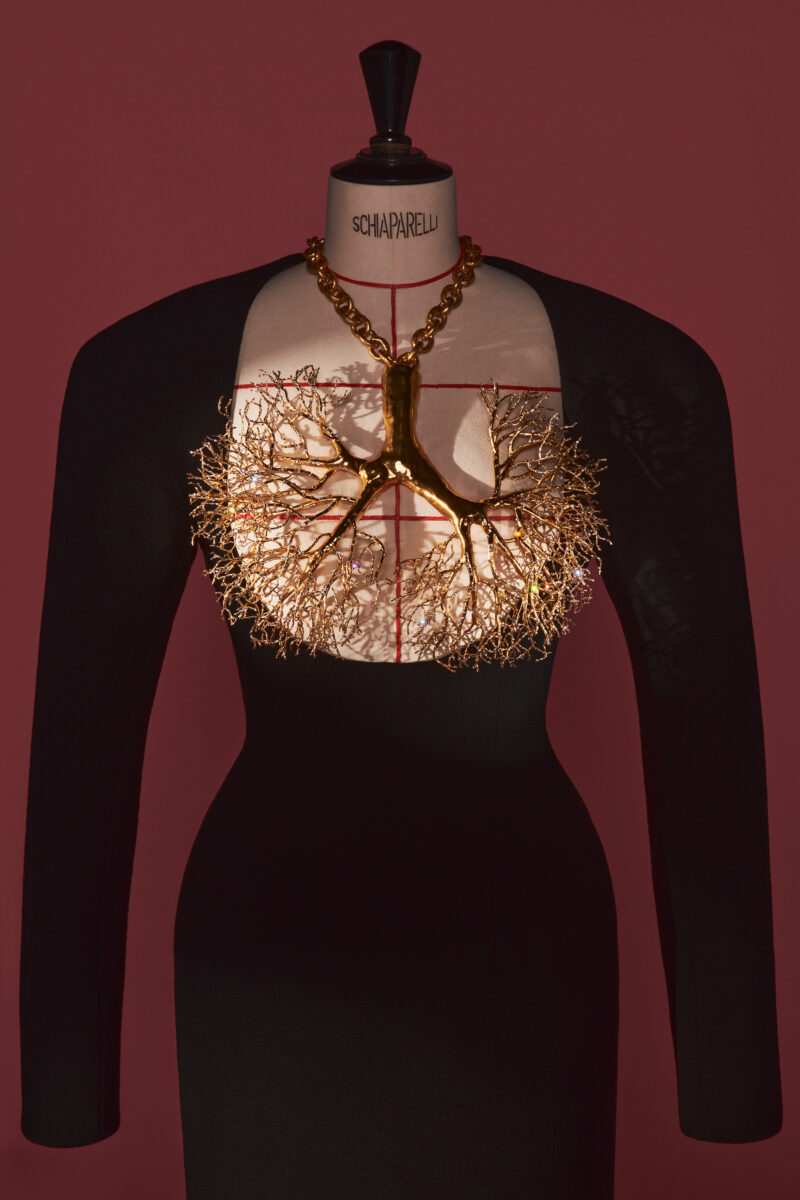
Schiaparelli: The Body as a Jewel
A necklace shaped like lungs, a ribbon hung with pine cones, an earring beside
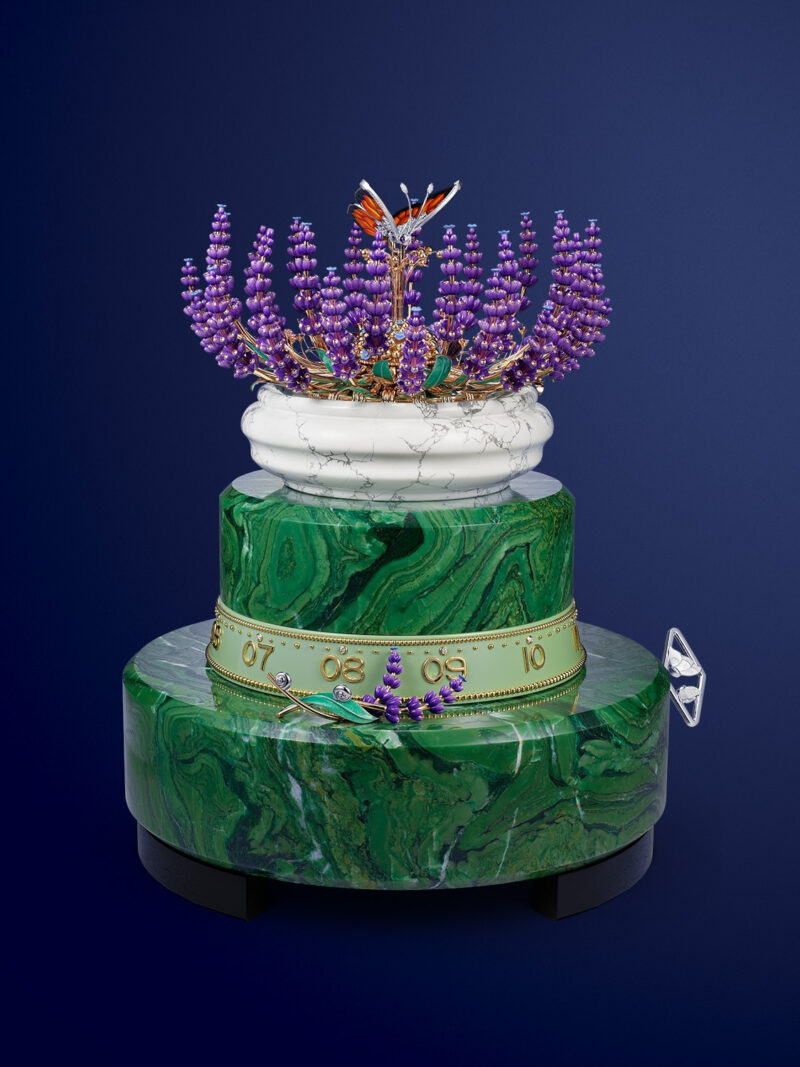
Brassée de Lavande: A Garden That Keeps Time
A butterfly waits among purple flowers. In Van Cleef & Arpels’ Brassée de Lavande,
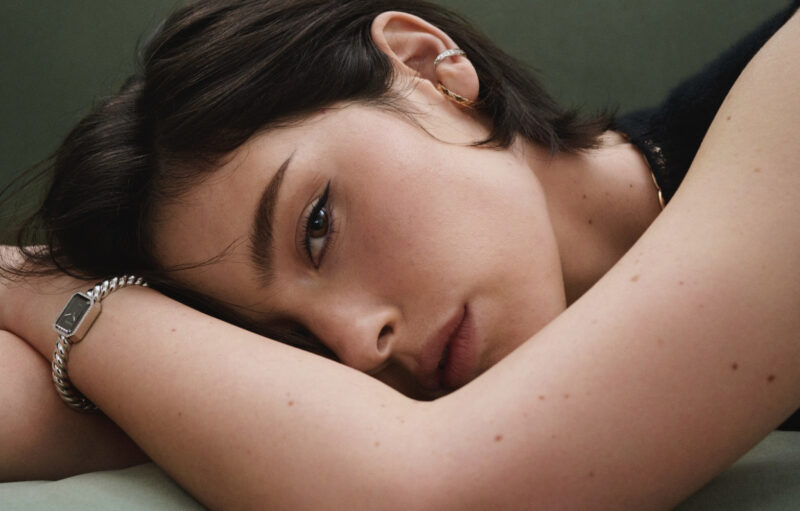
CHANEL Première Galon: When a Braid Becomes Gold
A gold braid, a small octagonal face and the edge of a sleeve. Première
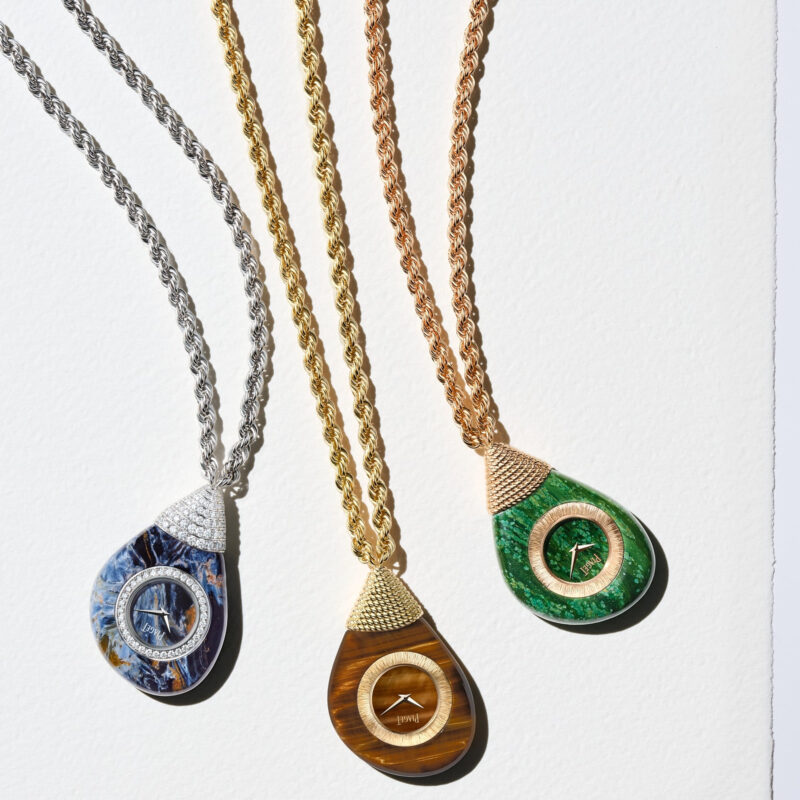
Piaget Swinging Pebbles: Time Away from the Wrist
A long gold chain, a smooth stone and two hands. Swinging Pebbles gives time
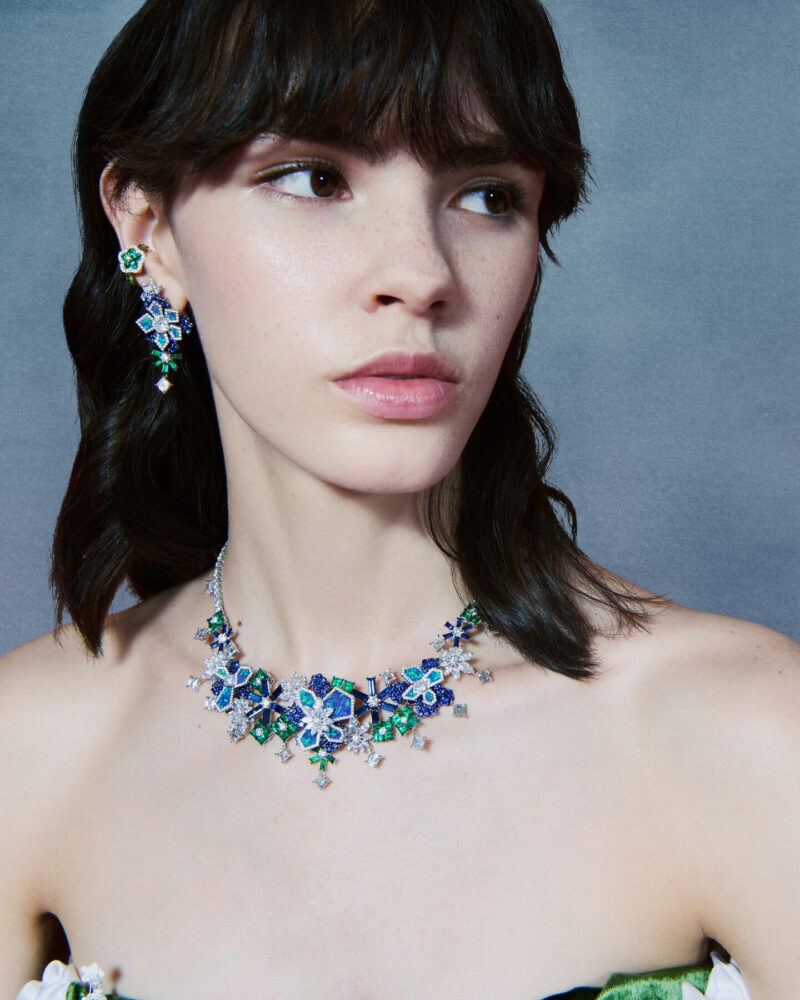
Diorissima: A Garden Composed in Gemstones
A green flower beside blue, a jewel above an open back, a brush at
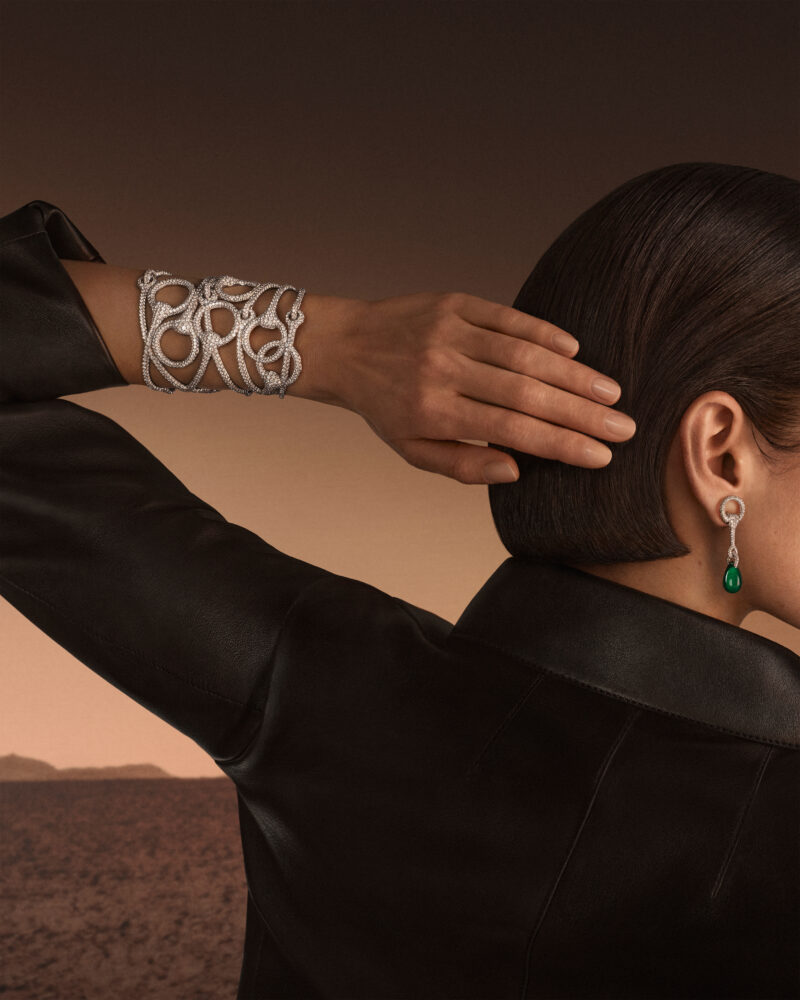
Hermès Horsescape: The Horse in the Line
A saddle at the wrist, a stirrup held against the sky, bright lines beside