
TheTimeo / Luxury Living
Diorissima:
A garden
composed.
A green flower beside blue, a jewel above an open back, a brush at the workbench: Diorissima brings collage into the way jewellery is made and worn.
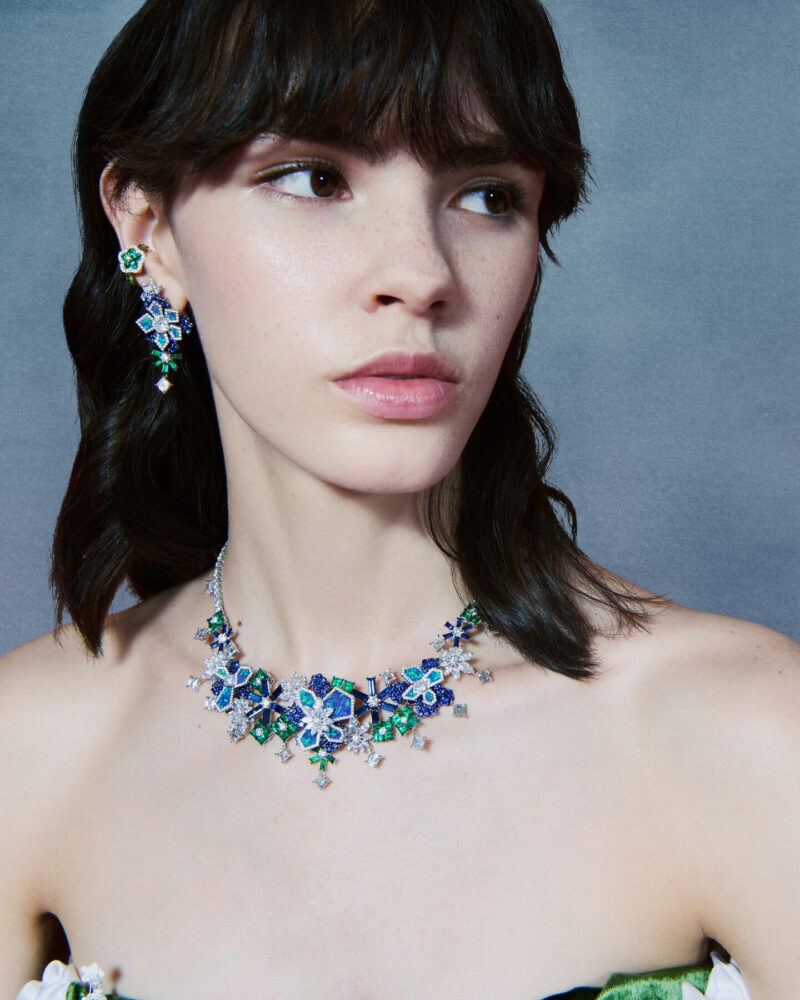
Diorissima: a floral necklace and earrings give colour a place around the face and collarbones. Courtesy of Dior.
Explore the story
Green and blue flowers gather along a bare neckline. Some sit close together, others open towards the shoulder; small bright drops extend the drawing below. In this Diorissima portrait, the necklace seems to find its shape as it moves across the body. The ear carries another cluster, held apart by a clear space of skin.
Victoire de Castellane brings the idea of collage to Dior’s high jewellery: elements cut, layered and placed in new relationships. Looking across the collection photographs, that idea extends beyond the individual jewel. The dress, the position of a hand and even an open back become part of the arrangement.
The garden reaches the hands
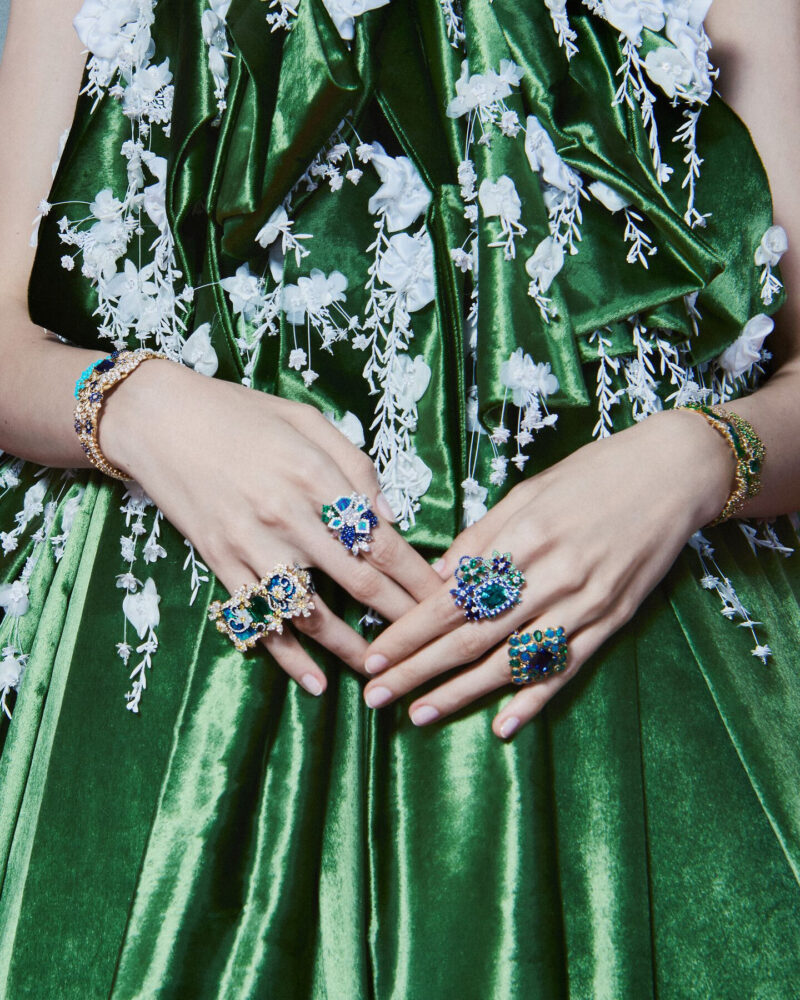
Rings and the floral surface of the dress form two different scales of detail. Courtesy of Dior.
Against green fabric, several rings make blue centres conspicuous. The hands rest close together, creating a broad, pale shape across the darker dress. Flower-like forms move from one finger to another. Their different sizes give the composition an uneven rhythm, while the repeated colour keeps the eye moving between them.
The photograph shows why a jewellery image needs the surrounding cloth. White floral details fall down the dress, finer and more widely spaced than the rings. One surface appears soft and folded; the other is made from small, defined shapes. Their closeness makes each easier to see.
To look at an arrangement like this, begin with the area between the objects. Follow the open spaces around the fingers before returning to the coloured centres. A larger ring can become the point of entry, with the smaller forms carrying attention across the hand. You can enjoy the picture as a composition without needing every flower to have a botanical name.
Dior describes a collection moving through vegetation, underwater life and celestial imagery. The garden is one way into that larger imaginary world. In this frame, its abundance is held within a simple human gesture: two hands resting against fabric.
A different colour changes the company
01 / 02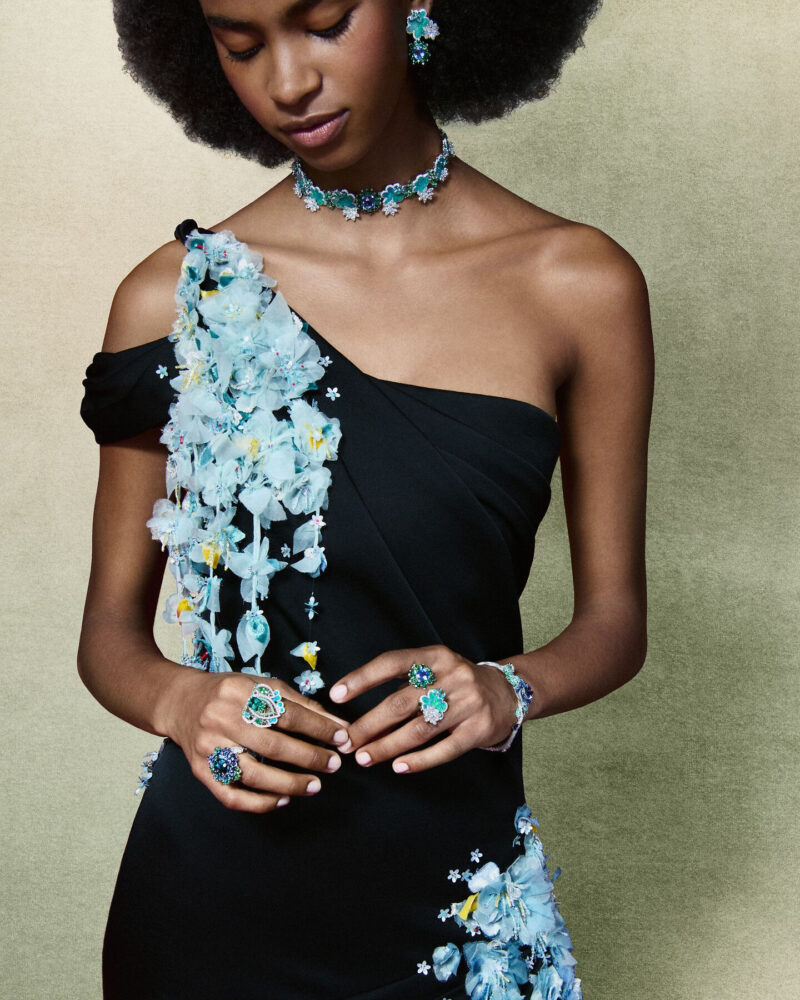
A pale blue line at the neck accompanies a larger floral trail on black fabric. Courtesy of Dior.
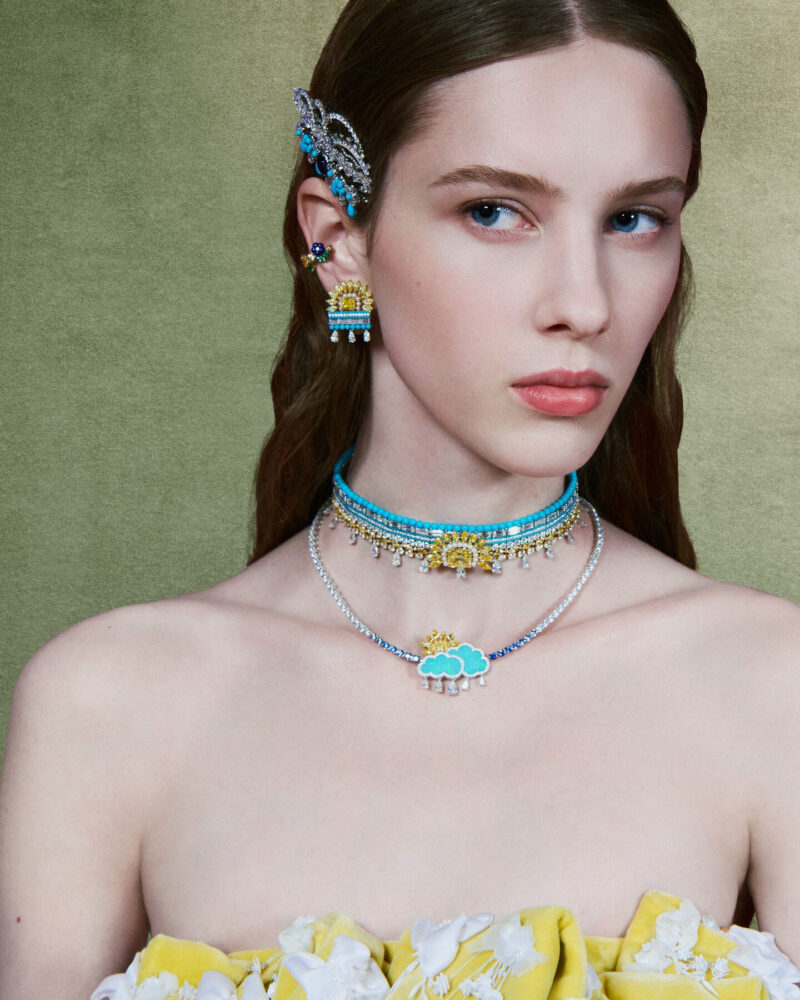
Colour is arranged at different heights, from the hair to the lower pendant. Courtesy of Dior.
Two portraits offer a change of atmosphere. In one, a pale blue floral trail crosses a black dress. The necklace sits high, leaving a broad area of skin between it and the fabric. The flowers on the dress pass down the body at a much larger scale, allowing the jewel to keep its own, more concentrated rhythm.
In the other portrait, layered necklaces bring turquoise-like blue and yellow accents close to the throat. A small cloud-shaped element hangs lower down, separate from the upper bands. A sculptural ornament beside the hair adds another point of interest. The space below the chin stays important: it lets several small lines remain readable at once.
Colour organises the two looks differently. The first portrait gathers similar pale blues into one vertical journey. The second gives separate bright notes different heights on the body.
Both approaches are useful beyond the photograph. Lay a coloured jewel beside the neckline you want to wear, then look at the distance between them. A repeated hue can connect two objects. A clear interval can give each its own presence. The decision belongs to the complete look, including the skin and cloth around the stones.
A small brush, an expansive world
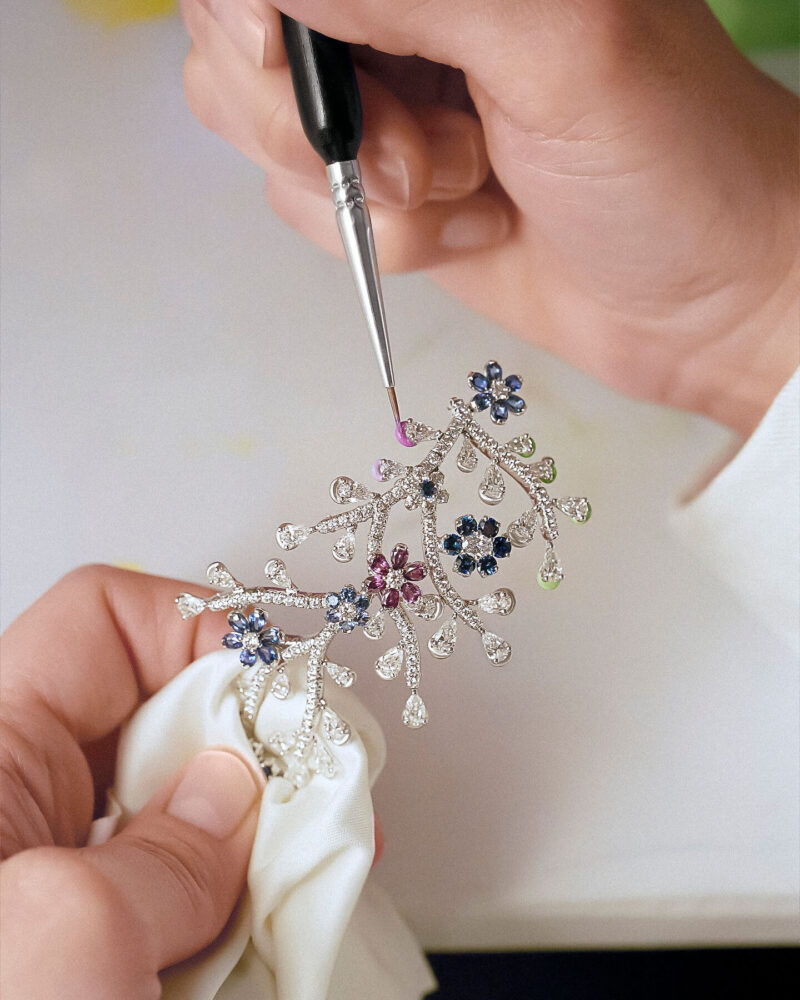
At the ateliers: a fine brush works beside the small coloured forms of a branching jewel. Courtesy of Dior.
At the workbench, the scale contracts. A hand steadies a delicate branching jewel while a fine brush approaches a small pink area. The surrounding forms spread into leaves and flowers, some bright, some coloured, with open spaces between them. White cloth cushions the piece and makes the thin lines easier to follow.
Dior identifies lacquer and doublets among the collection’s techniques. A doublet layers two stones to create subtle colour effects; lacquer introduces another kind of surface. Together, these methods broaden the palette available to a design. The workbench photograph gives that large idea a precise scale: the width of a brush and the small area at its tip.
Look at the way the branches divide before they reach the coloured forms. There is a larger drawing beneath the individual details. Even a minute accent has a position within that structure, helping one flower stand apart from another. The image invites attention to the intervals as well as to what fills them.
Before the flowers meet the body
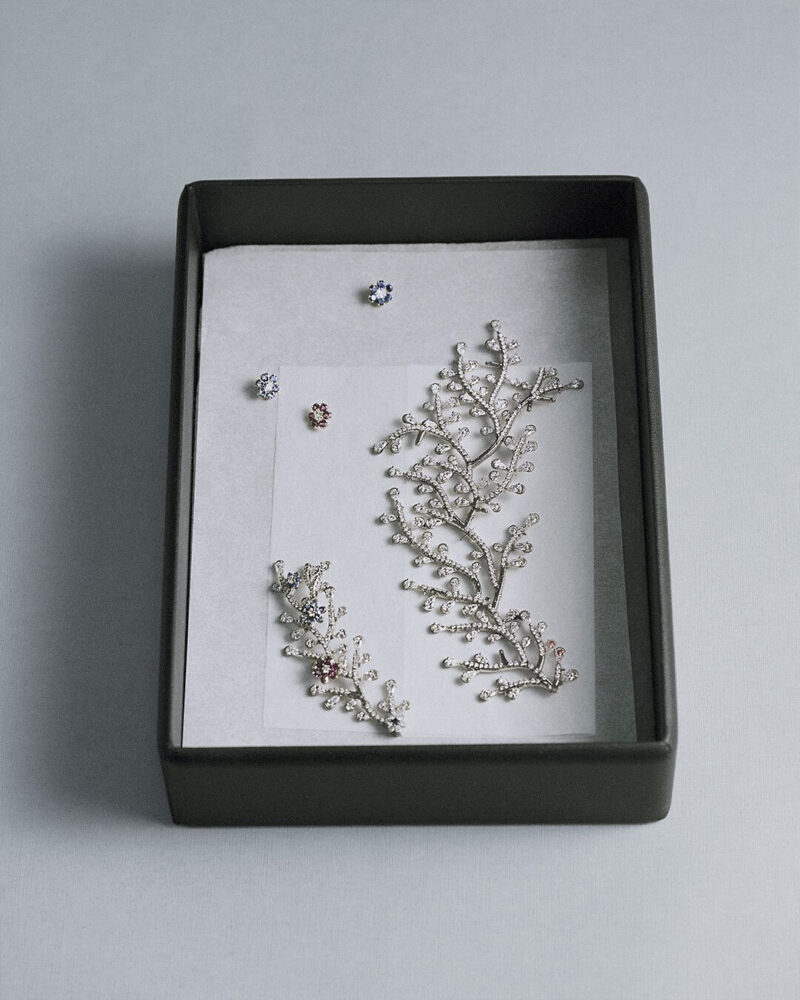
The open outline can be followed before it meets skin and fabric. Courtesy of Dior.
A presentation tray holds a branching jewel alongside smaller components. Without skin or fabric, the open outline becomes easier to read. One stem divides into several directions; round flower-like clusters punctuate the ends. The empty space inside the branch belongs to the design as clearly as the material around it.
The contrast with the portraits is revealing. On the tray, you can follow the route from one part to the next. On the body, that route has to share attention with a face, a shoulder and a moving garment. A jewel gains another dimension when its outline answers the person wearing it.
This is also where collage becomes a useful way of looking. Notice which elements repeat and which interrupt the pattern. A familiar flower can appear larger, turn to a different angle or sit beside an unexpected colour. The pleasure comes from recognising a form and then discovering how differently it can behave.
Look close, then step back
Within the jewel
Follow one stem or band until it reaches a coloured shape. Notice whether the edge is sharp, softly rounded or interrupted by smaller bright points. Then look for the same gesture elsewhere in the piece. Repetition gives the eye a route; a change in scale gives it a reason to pause.
Within the silhouette
Return to the whole photograph. Find the first point you notice, then see where your eye goes next. A neckline, a hair ornament or a ring may continue the same idea at a different height. Keep enough space around each to see what its placement contributes.
The last flower belongs to the back
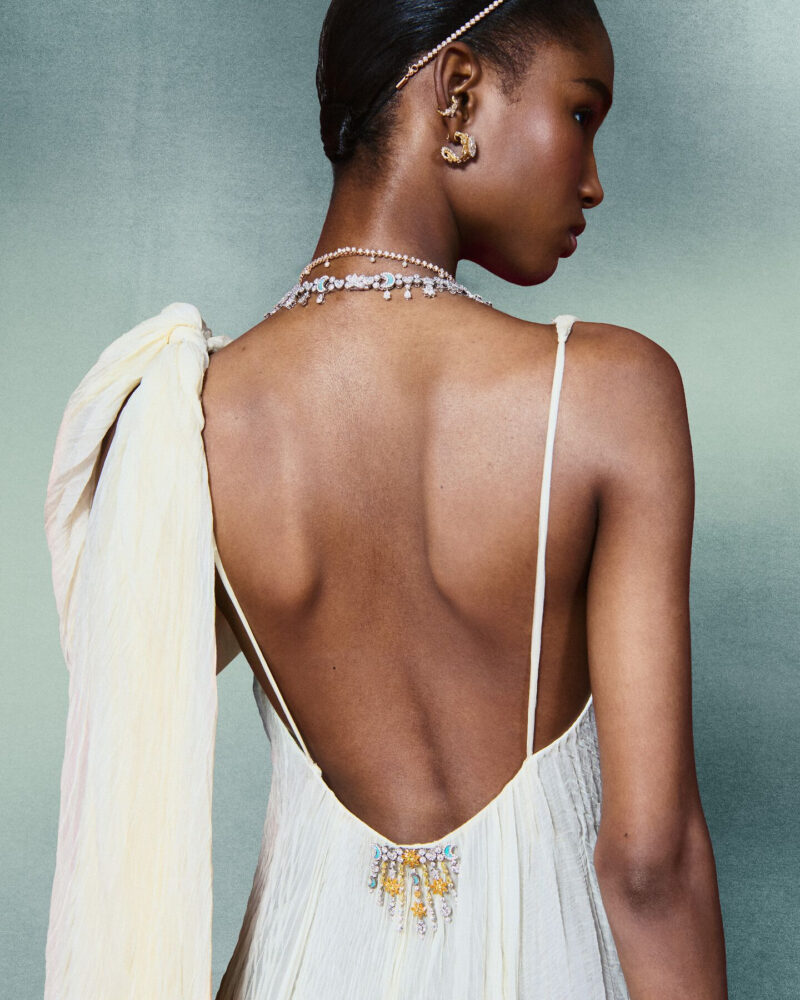
A different point of view: jewellery marks two positions around an open back. Courtesy of Dior.
A white dress opens deeply at the back. Along the neckline, a short bright line follows the shoulders, while a small coloured ornament appears lower down where the fabric gathers. The photograph rewards the turn away from a conventional frontal portrait: the back carries a separate, quieter composition.
Jonathan Anderson designed the couture silhouettes accompanying Diorissima’s presentation at the Palazzo del Casinò on the Venice Lido. Here, dress and jewel have distinct tasks. Cloth establishes a long, open shape. Small areas of ornament mark its upper edge and lower meeting point. Their distance gives the eye room to move.
That last placement stays with you because it is so specific. A jewel can be chosen for the part of a look that appears only when you turn. Diorissima’s garden makes that possibility tangible: colour and form finding their place around a body, one considered arrangement at a time.
Sources & further reading
The Edit
Luxury Living stories
Selected stories from the same editorial universe.
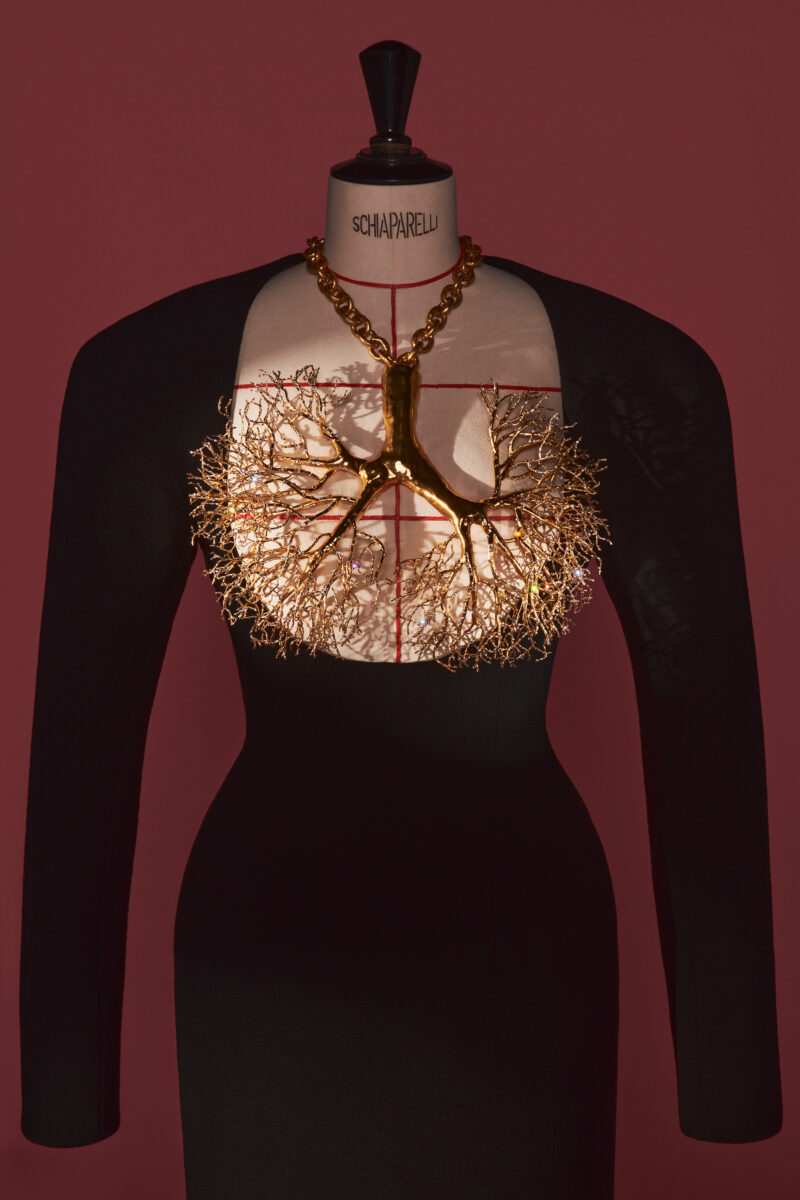
Schiaparelli: The Body as a Jewel
A necklace shaped like lungs, a ribbon hung with pine cones, an earring beside
Hermès Horsescape: The Horse in the Line
A saddle at the wrist, a stirrup held against the sky, bright lines beside
Louis Vuitton Mythica: Colour in Command
Victory’s changing colours, Conquest’s red pulse and Fortitude’s blue centre: three ways Mythica gives

CHANEL COCO CRUSH: Choosing the Mix
CHANEL’s Style Guide shows how COCO CRUSH changes when rings, bracelets, earrings and a
Elsa Peretti’s Bone Cuff: When Jewellery Follows the Body
Elsa Peretti’s Bone cuff begins with anatomy: a side-specific, asymmetric silver form whose surface
The Cartier Tank: A Rectangle in Conversation with Dress
A close reading of the Cartier Tank through proportion, brancards, strap, bracelet and the