
TheTimeo / Luxury Living
Hermès:
The horse
in the line.
A saddle at the wrist, a stirrup held against the sky, bright lines beside the face. Into the Horsescape turns an equestrian vocabulary into personal style.
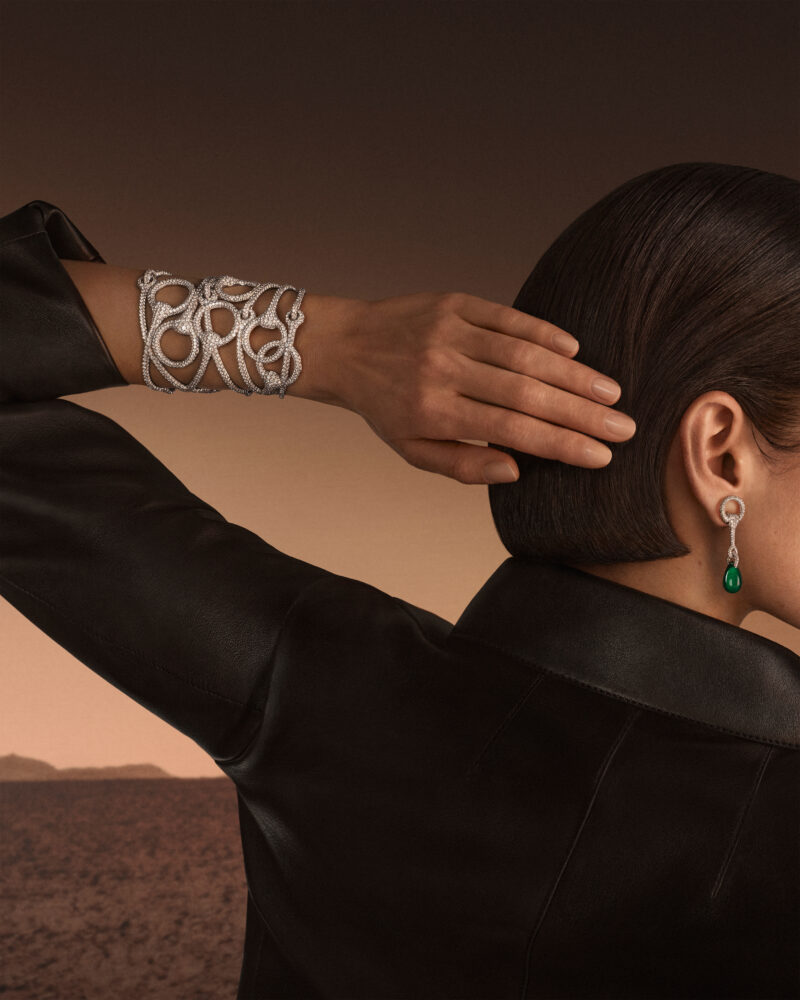
Étreintes cuff and earrings: open curves meet the gesture of a raised hand. © Julien Martinez Leclerc. Courtesy of Hermès.
Explore the story
A hand rests across the back of a head. Around the wrist, bright loops overlap and open into generous spaces. Beside them, an earring drops towards a raised collar. The pose gives the cuff a place in the portrait as decisive as the face itself.
Into the Horsescape, Hermès’ ninth high jewellery collection, was unveiled in Paris in July 2026. Its equestrian world is especially interesting when approached through the body: a curve against an arm, a descending line beside an ear, an object held in the air. Follow those relationships and the horse becomes a way of drawing.
A saddle, a wrist, a horizon
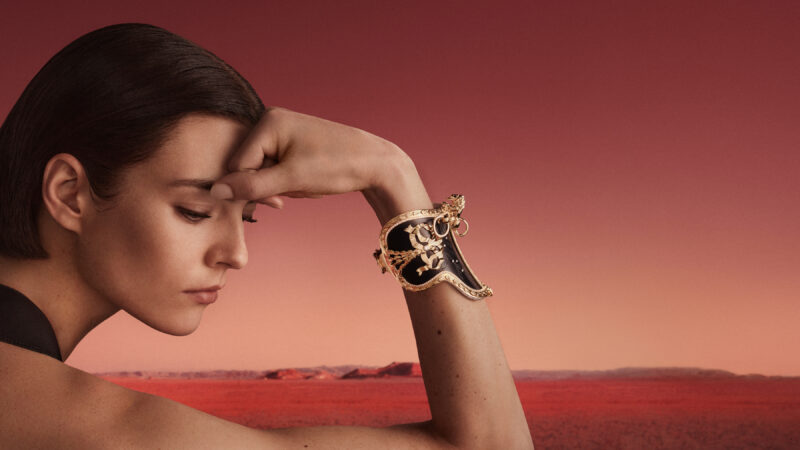
Sellette bracelet, photographed where the line of the forearm turns towards the hand. © Julien Martinez Leclerc. Courtesy of Hermès.
A red landscape stretches behind a woman leaning towards her raised hand. The bracelet occupies the bend between hand and forearm. Its dark centre and gold-coloured border make a small, elaborate shape against the open sky. The image gives it room without separating it from the person wearing it.
The photograph identifies the bracelet as Sellette. Seen from this angle, its saddle-like outline makes the wrist an unexpectedly convincing home for the object. A projecting edge follows the direction of the hand; ornament gathers around the dark central area. Small bright details remain legible because the larger silhouette is so clear.
The position of the elbow matters as much as the position of the jewel. It creates a long horizontal across the photograph, answered by the horizon behind. The bracelet sits where that line turns. Instead of looking only for a matching accessory, consider what a piece does to the gesture of an arm.
There is a practical pleasure in that way of looking. Bring a favourite sleeve into the decision and see where it ends in relation to the wrist. A cuff can stand immediately beside fabric or occupy the bare interval beyond it. Each arrangement gives the same object a different amount of room in the silhouette.
Two ways to draw with light
01 / 02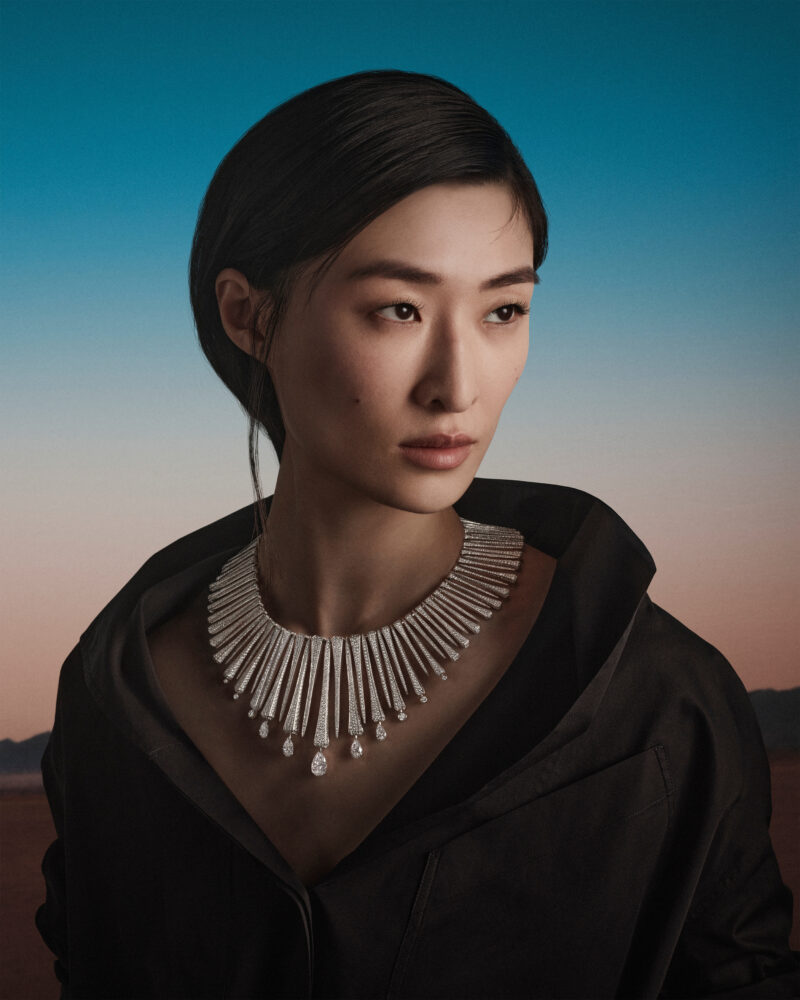
Clou de Forge Lumière necklace: repeated lines spread around the base of the neck. © Julien Martinez Leclerc. Courtesy of Hermès.
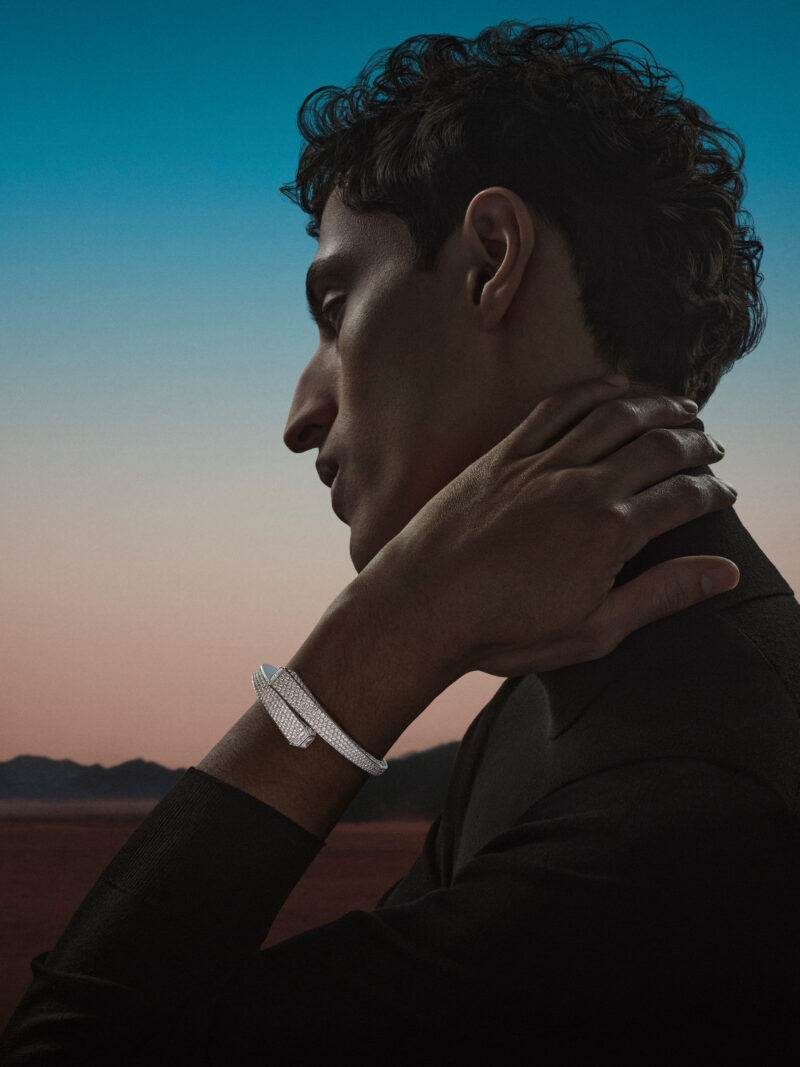
Clou de Forge Lumière bracelet within a gesture close to the face. © Julien Martinez Leclerc. Courtesy of Hermès.
In one portrait, long bright elements spread around the base of the neck. Their ends establish a firm lower contour above the dark folds of a coat. In the other, a much smaller bright band circles a wrist raised towards the face. Scale changes; the deliberate contrast with dark clothing remains.
These are two Clou de Forge Lumière creations, shown in separate photographs. The necklace makes a broad field of repeated lines. The bracelet concentrates that rhythm into a narrow interval beside the sleeve. Follow the spaces between the elements and you begin to see how repetition can produce a shape as distinct as a single large stone.
The portraits also offer two answers to the question of emphasis. The necklace directs attention across the upper chest, then towards the face. The bracelet appears within a gesture: a hand close to the cheek, a turned head, an open collar. One is read across the body, the other along an arm.
Neither picture needs another dominant accessory to complete its composition. The dark surfaces around the jewellery give the eye a clear route. If you are drawn to a strong repeated pattern, try it against one of the simplest garments you own. Notice whether the jewel introduces a direction that the garment already suggests, or makes the whole look move differently.
The stirrup leaves the saddle
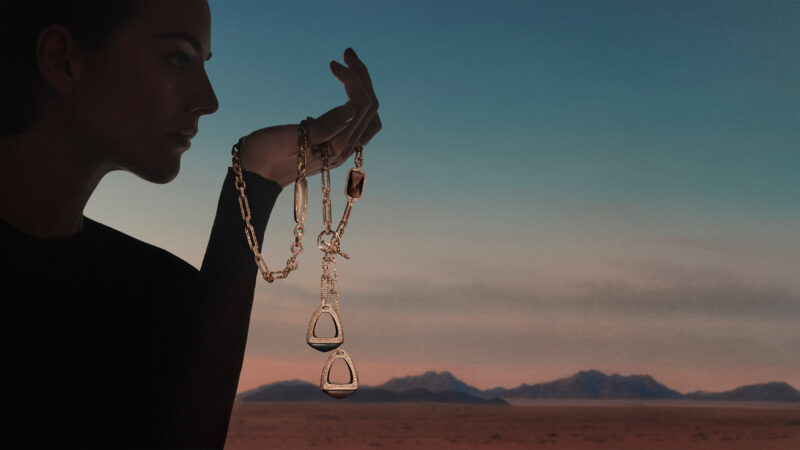
Étriers necklace, held clear of the body so its suspended forms can be followed. © Julien Martinez Leclerc. Courtesy of Hermès.
Held up by a hand, the Étriers necklace hangs against a pale sky. Several rounded triangular forms descend at different heights. Fine lines connect them, while the dark sleeve provides a clear starting point at the edge of the frame. Below, the landscape stays low enough to leave the outline uninterrupted.
There is a useful shift here from adornment to object. Away from the neck, the necklace can be read from top to bottom as an arrangement of lengths and open shapes. Some elements turn slightly towards the camera; others show more of their edge. The small differences prevent repetition from becoming rigid.
Hermès describes its wider jewellery language as a transformation of harnesses, buckles and bits through Pierre Hardy’s drawing. This photograph makes that approach easy to grasp. A familiar functional silhouette can retain its identity while acquiring a new scale, surface and relationship with the body.
Look again after the worn portraits. The empty centres of the suspended forms answer the open loops of the cuff, even though the two objects have different outlines. A collection begins to feel coherent through such relationships. You can carry that idea into a personal collection: different pieces may belong together because they share a particular kind of space.
Find the gesture that belongs to you
The wrist
Turn the hand, bend the elbow and let the sleeve fall where it naturally rests. See when the outline becomes visible and when it disappears beneath cloth. The most persuasive view may arrive within a small habitual movement, rather than a carefully held pose. That is a useful detail to notice when trying on a piece.
The neckline
Look at the whole upper body before moving closer to the setting. A broad collar, an open shirt and a high neck give a jewel different edges to meet. Consider the amount of bare skin around its lowest point. The interval between jewellery and clothing helps establish whether the composition feels generous, compact or deliberately graphic.
A line around the collar
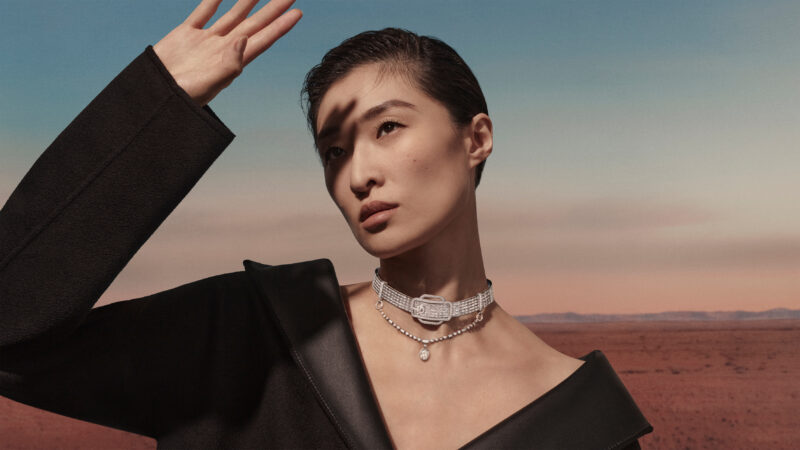
Attelage choker: a compact line within an expansive pose. © Julien Martinez Leclerc. Courtesy of Hermès.
A raised arm opens a triangle above the head. Below it, the Attelage choker forms a compact bright band around the neck, just above a sharply opened black shirt. The two shapes work at different scales: the arm establishes the expansive gesture, while the jewel marks its precise centre.
The photograph is wide, with a low landscape and a soft passage from blue to pink in the sky. Dark cloth holds the figure together. The choker is small within that broader field, yet its position makes it immediately visible. Size alone does not determine the force of a jewel; placement can do much of the work.
That thought connects the entire sequence. A saddle-like bracelet finds the turning point of a wrist. A broad necklace follows the chest. A suspended stirrup becomes a shape to contemplate before it returns to the body. Each gives an ordinary gesture a more particular outline.
This is the appeal of Into the Horsescape as a way of dressing. You can recognise the equestrian vocabulary, then discover which part feels personal: an open curve, a strong border, a repeated bright line. The pleasure continues when that form becomes part of a gesture you make without thinking.
Sources & further reading
The Edit
Luxury Living stories
Selected stories from the same editorial universe.
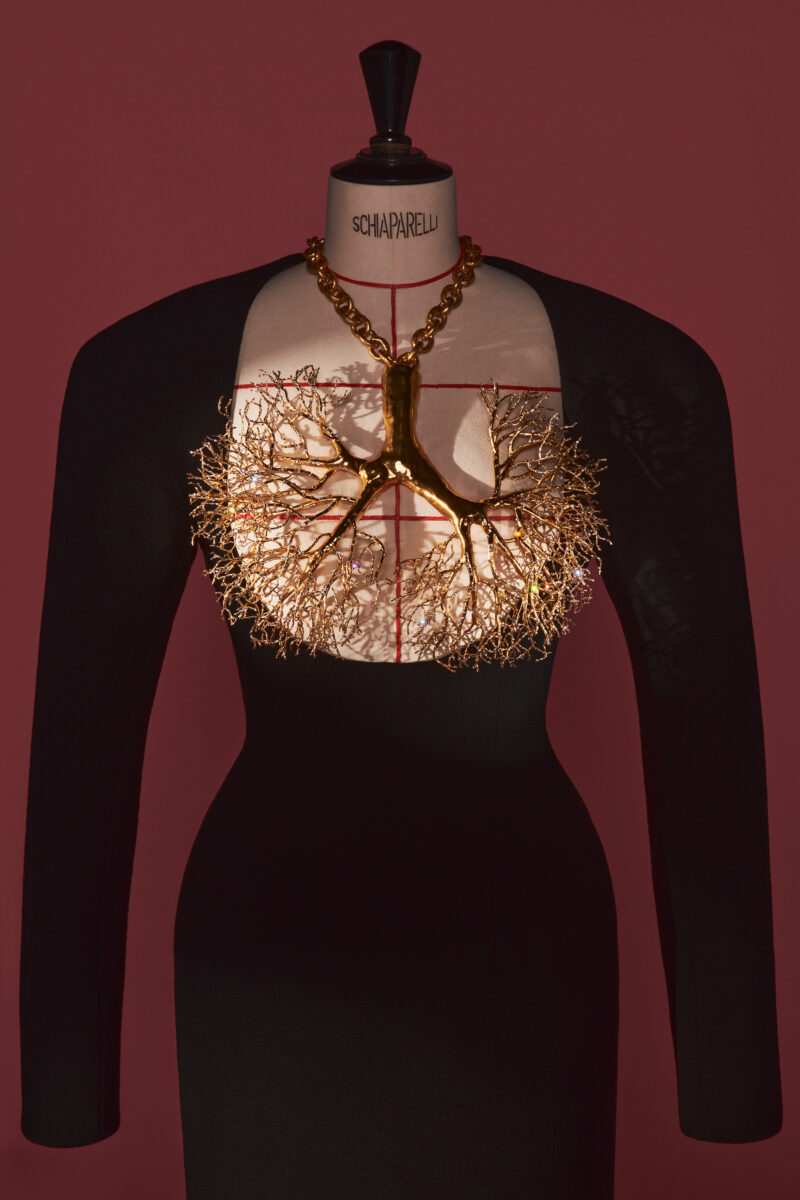
Schiaparelli: The Body as a Jewel
A necklace shaped like lungs, a ribbon hung with pine cones, an earring beside
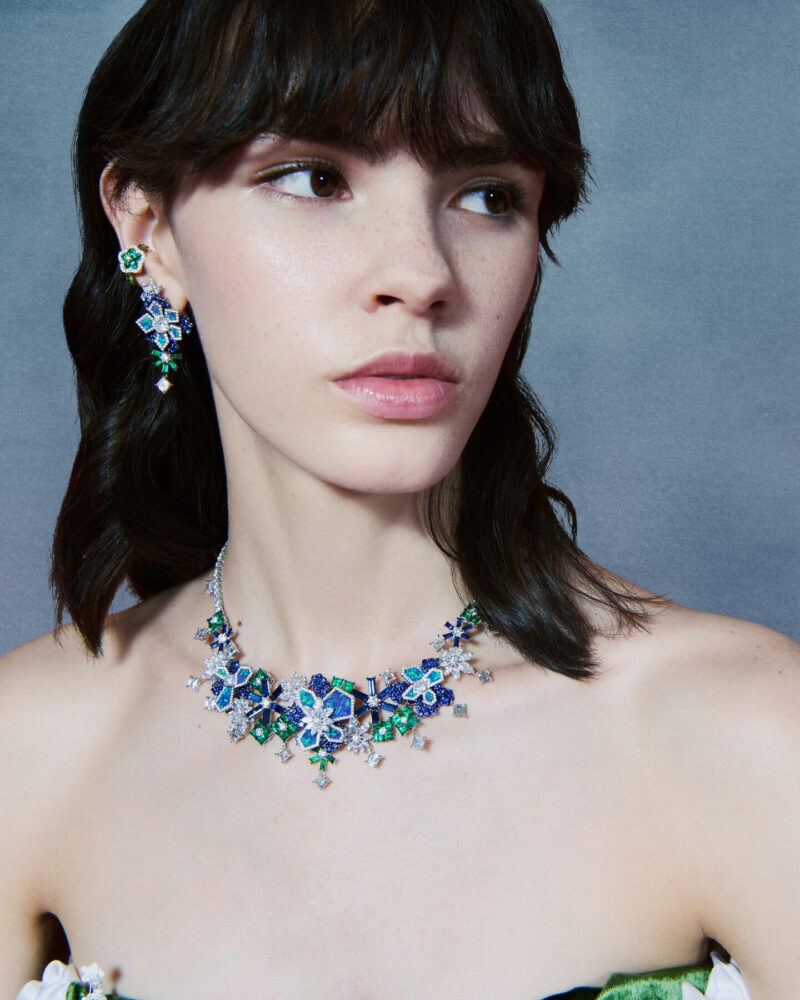
Diorissima: A Garden Composed in Gemstones
A green flower beside blue, a jewel above an open back, a brush at
Louis Vuitton Mythica: Colour in Command
Victory’s changing colours, Conquest’s red pulse and Fortitude’s blue centre: three ways Mythica gives

CHANEL COCO CRUSH: Choosing the Mix
CHANEL’s Style Guide shows how COCO CRUSH changes when rings, bracelets, earrings and a
Elsa Peretti’s Bone Cuff: When Jewellery Follows the Body
Elsa Peretti’s Bone cuff begins with anatomy: a side-specific, asymmetric silver form whose surface
The Cartier Tank: A Rectangle in Conversation with Dress
A close reading of the Cartier Tank through proportion, brancards, strap, bracelet and the