
TheTimeo / Luxury Living
Schiaparelli:
The body
as a jewel.
A necklace shaped like lungs, a ribbon hung with pine cones, an earring beside a sculpted cape: Schiaparelli changes the way ornament meets the body.
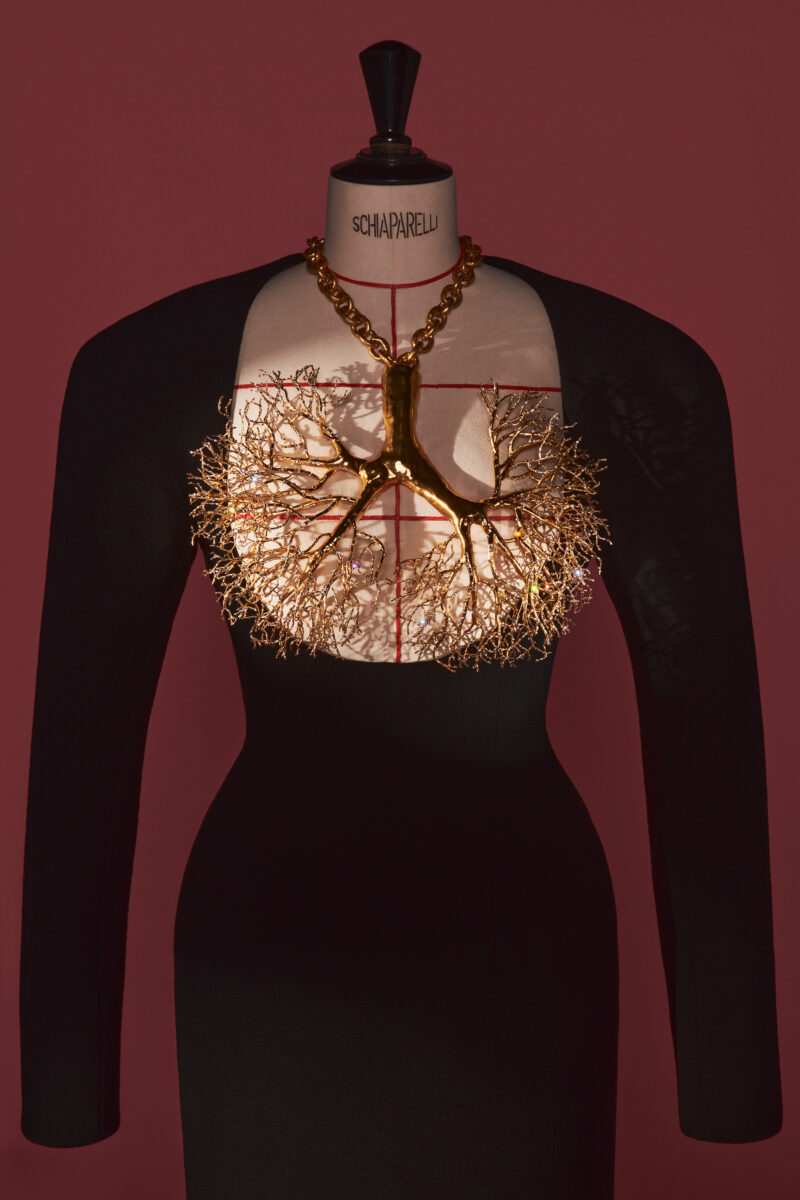
Schiaparelli by Daniel Roseberry, Matador Couture, autumn/winter 2021–22. Wool-crêpe gown; gilded brass and rhinestone lungs necklace. Courtesy of Patrimoine Schiaparelli, Paris, via the V&A.
Explore the story
A pair of branching golden lungs rests outside a black dress. The neckline opens around them; a heavy chain turns anatomy into a necklace. In this Schiaparelli ensemble by Daniel Roseberry, the jewel does much more than finish the look. It gives the body an imagined inner structure, brought into view.
The V&A’s Schiaparelli: Fashion Becomes Art offers a timely reason to look at that relationship. The exhibition follows the house from Elsa Schiaparelli’s work to its present incarnation under Roseberry. Through a few objects and photographs, a particular question emerges: where does a jewel end when an entire garment can behave like ornament?
An inner shape, worn outside
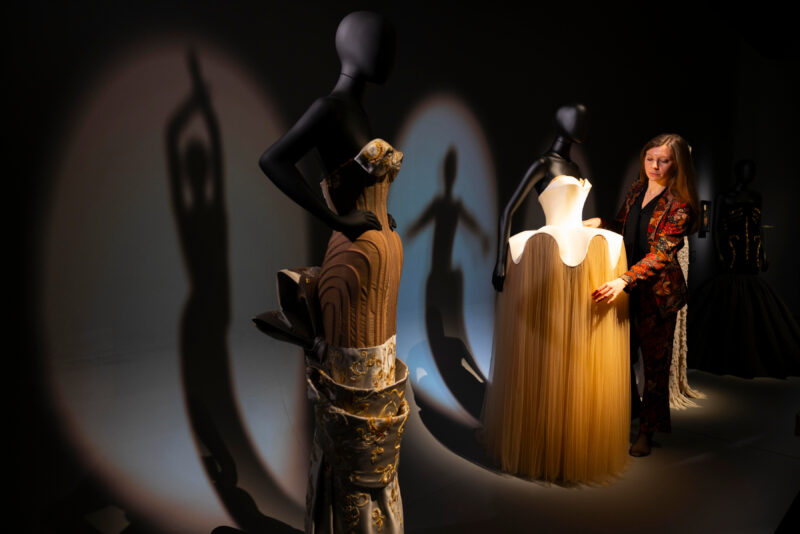
Garments on display at Schiaparelli: Fashion Becomes Art, V&A South Kensington. Photograph: David Parry / PA Media Assignments.
The lungs necklace accompanies a black wool-crêpe gown from the autumn/winter 2021–22 Matador Couture collection. The V&A identifies gilded brass and rhinestones in the necklace. Its richness is a matter of construction and image as well as material: the branching form spreads across the chest, while the dark garment gives each fine line a clear field.
In the exhibition photograph, a black-and-gold sculptural dress occupies the foreground while another pale gown stands further behind. The distance between them helps separate two ways of drawing attention to a body. One concentrates the eye in a hard, shaped surface; the other lets fabric extend downwards. Even without a wearer, the silhouettes suggest where a shoulder, waist or chest would be.
For someone accustomed to considering jewellery one object at a time, the useful shift is to look at the whole outline first. Notice what has already been shaped by the dress before asking what a necklace adds. An opening, a strong shoulder or a defined waist can be as decisive to the composition as the ornament itself.
Pine cones at the throat
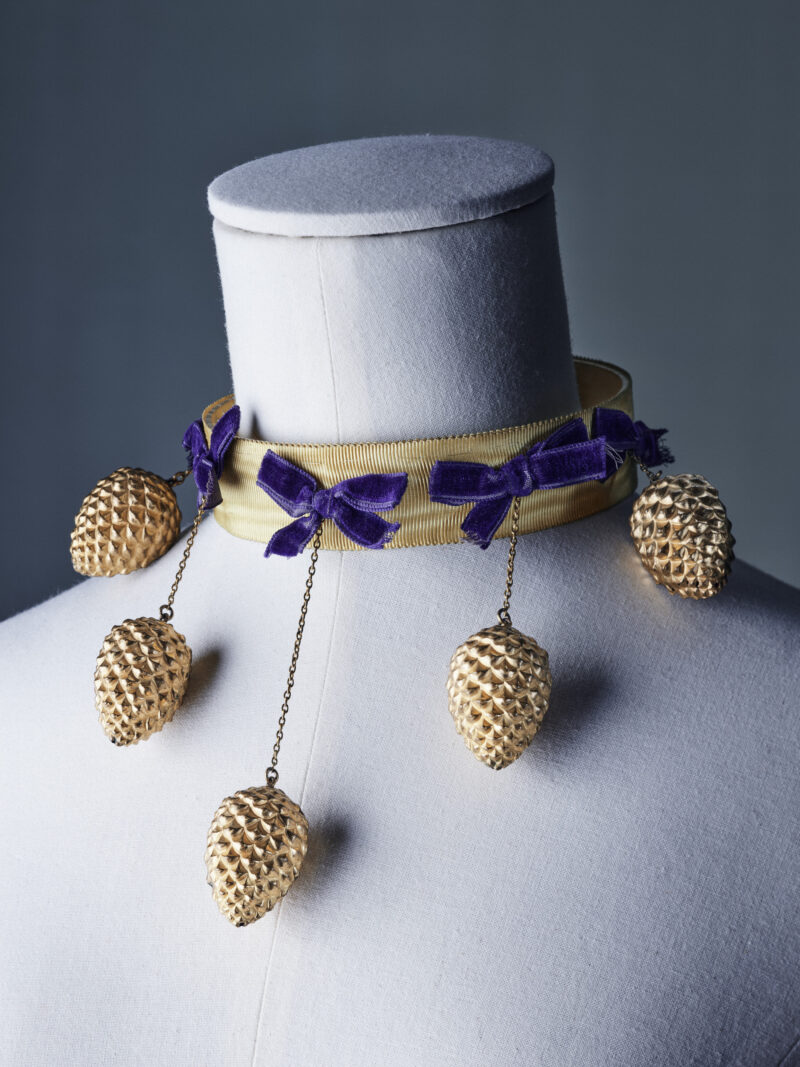
Choker, Pagan collection, autumn 1938. Silk and velvet ribbons with gilt pine cones. V&A, T.413-1974. Photograph © Emil Larsson.
The choker from Schiaparelli’s autumn 1938 Pagan collection brings the same question close to the skin. Gilt pine cones hang from silk and velvet ribbons. Purple bows punctuate the pale band, while thin chains let some of the cones sit lower than others. The familiar woodland form acquires the formality of a necklace without losing its uneven, scaled surface.
The photograph rewards a slow look. Begin at the ribbon, where the soft bows interrupt the horizontal line. Move down to the suspended cones and the different lengths of chain. The arrangement has a clear centre, yet its interest comes from the small changes around it. Texture provides the detail that a polished stone might supply in another kind of jewel.
Try mentally placing the choker against two surfaces: a bare neckline and a high, plain collar. The same hanging shapes would find a different background in each. That simple exercise makes the object feel less remote. Its theatrical character begins with a very practical relationship between a band, a body and the space below the throat.
When the silhouette becomes ornament
01 / 02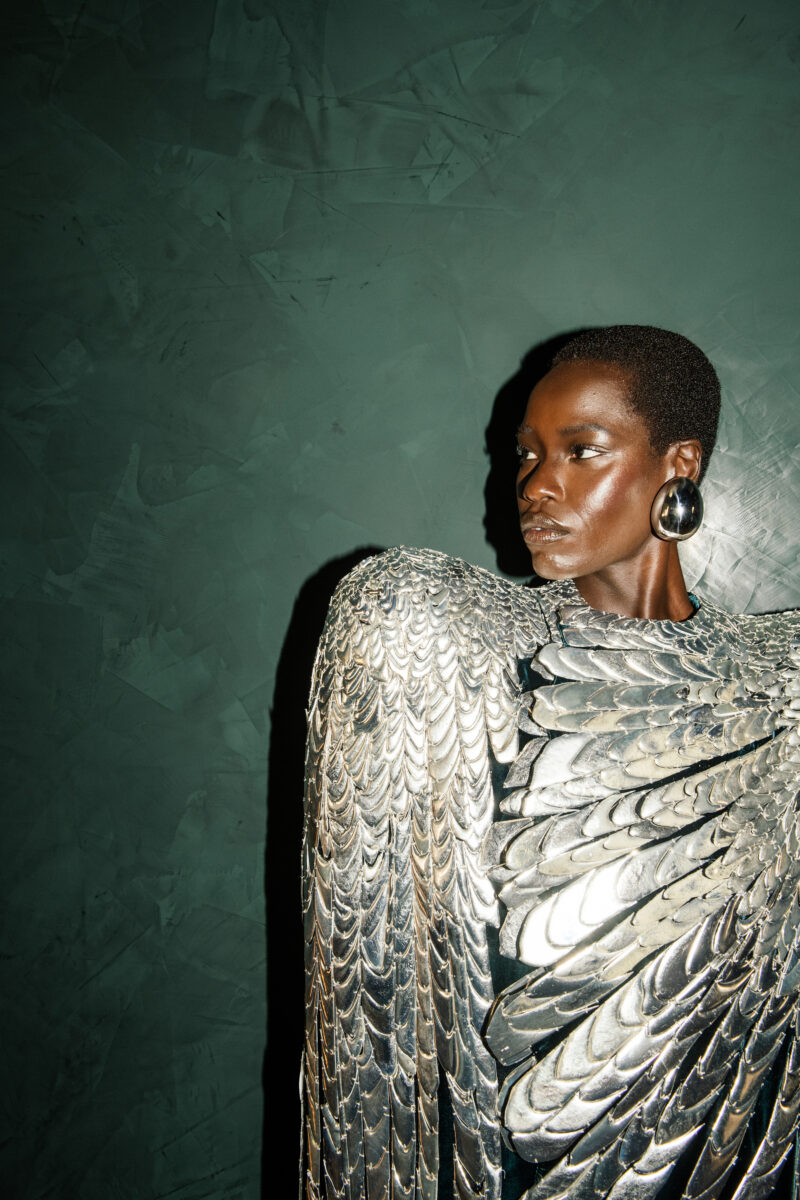
Awar Odhiang, Paris, 2025, wearing Schiaparelli by Daniel Roseberry, haute couture autumn/winter 2024. Photograph © Kuba Dabrowski. Courtesy of Patrimoine Schiaparelli, Paris.
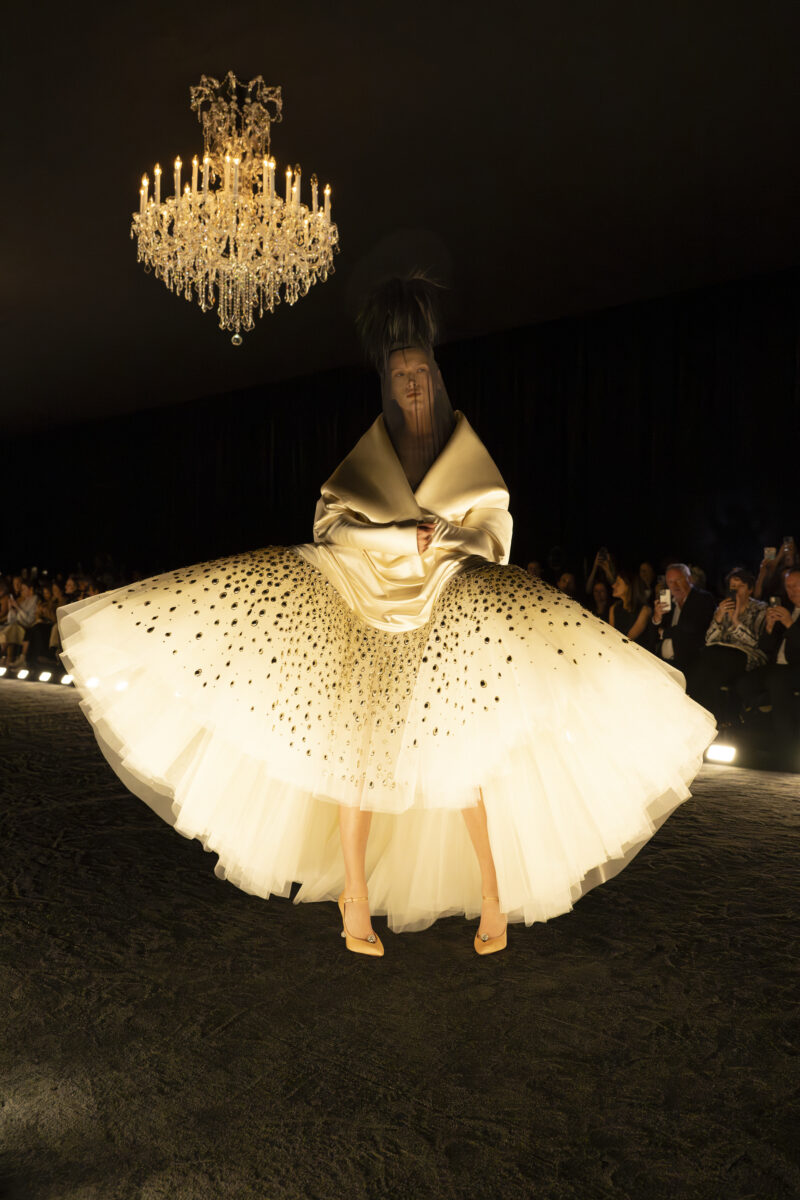
Schiaparelli haute couture autumn/winter 2024, look 30. Photograph © Giovanni Giannoni. Courtesy of Patrimoine Schiaparelli, Paris.
Kuba Dabrowski’s portrait of Awar Odhiang brings the conversation back to a living face. A large circular earring sits beside the jaw; the surrounding couture builds a broad, textured shoulder and a surface of overlapping, pale shapes. The earring remains immediately legible because its smooth circle gives the eye somewhere to rest.
Alongside it, Giovanni Giannoni’s runway photograph of autumn/winter 2024 look 30 shows a pale silhouette expanding into a wide skirt. Dark marks travel across the light surface, and the upper part of the garment rises around the head. The complete photograph matters: reducing it to a decorative detail would lose the relationship between the small human figure and the breadth of the clothes.
These are two very different scales of attention. In the portrait, look from earring to cheek to shoulder. In the runway view, take in the whole silhouette before returning to the marks on its surface. The change of distance is part of the pleasure. A jewel can be a concentrated point within a composition, while a garment can carry that intensity across a much larger area.
For your own way of dressing, the comparison need not lead to a theatrical outfit. It can simply sharpen a choice. A broad collar may ask for a clear, compact earring. A spare neckline may leave more space for a necklace with an unusual shape. Look for the place where your eye settles, then decide whether another object strengthens it or makes you look elsewhere.
Two ways to look
Follow the body
Trace the outline from the face down towards the shoulders and neckline. Notice where cloth stops, skin appears or a hard surface takes over. This reveals how the jewel is positioned within the whole look. A small shift in placement can change which part of the body you notice first.
Follow the material
Then look at what catches the light: a smooth metal curve, a rough gilt surface, a ribbon or a spread of embroidery. Each asks for a different kind of attention. Schiaparelli makes that variety especially visible, inviting a reading of ornament that goes beyond counting precious stones.
A wardrobe for the imagination
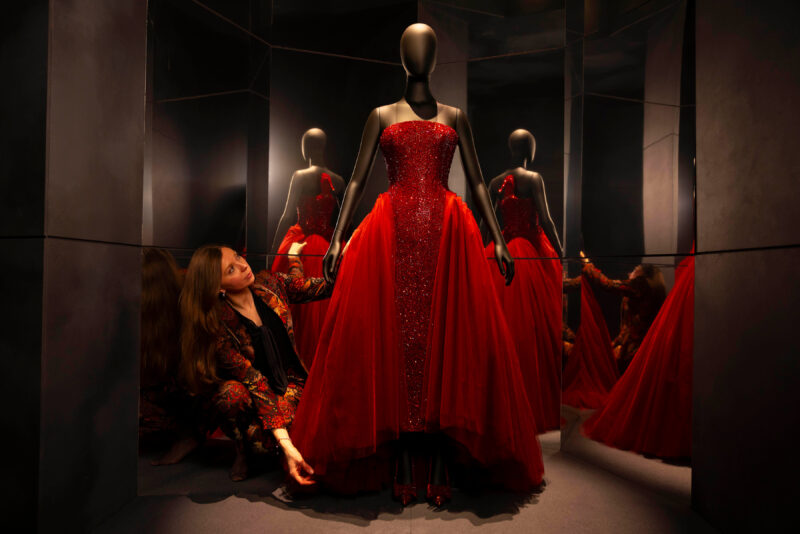
A red dress on display at Schiaparelli: Fashion Becomes Art, V&A South Kensington. Photograph: David Parry / PA Media Assignments.
The exhibition photographs make another relationship visible: the scale of a garment beside a person. Next to a red dress, a figure crouches beside the lower part of the display. The image places the scale of the skirt beside a person, restoring a sense of the body even when the clothes are supported by a mannequin.
The V&A brings together more than 400 objects, including clothing, accessories, jewellery and works of art. That breadth suits a house whose visual ideas move across categories. A necklace, a button and a dress can each direct the eye; their meanings become richer when you consider the company they keep.
Schiaparelli: Fashion Becomes Art is at V&A South Kensington. The museum currently lists its closing date as 15 November 2026; see the exhibition page for current admission information. Beyond the exhibition, the invitation lasts: look at a familiar jewel beside the clothes you love, and notice what changes when the two meet.
Sources & further reading
The Edit
Luxury Living stories
Selected stories from the same editorial universe.
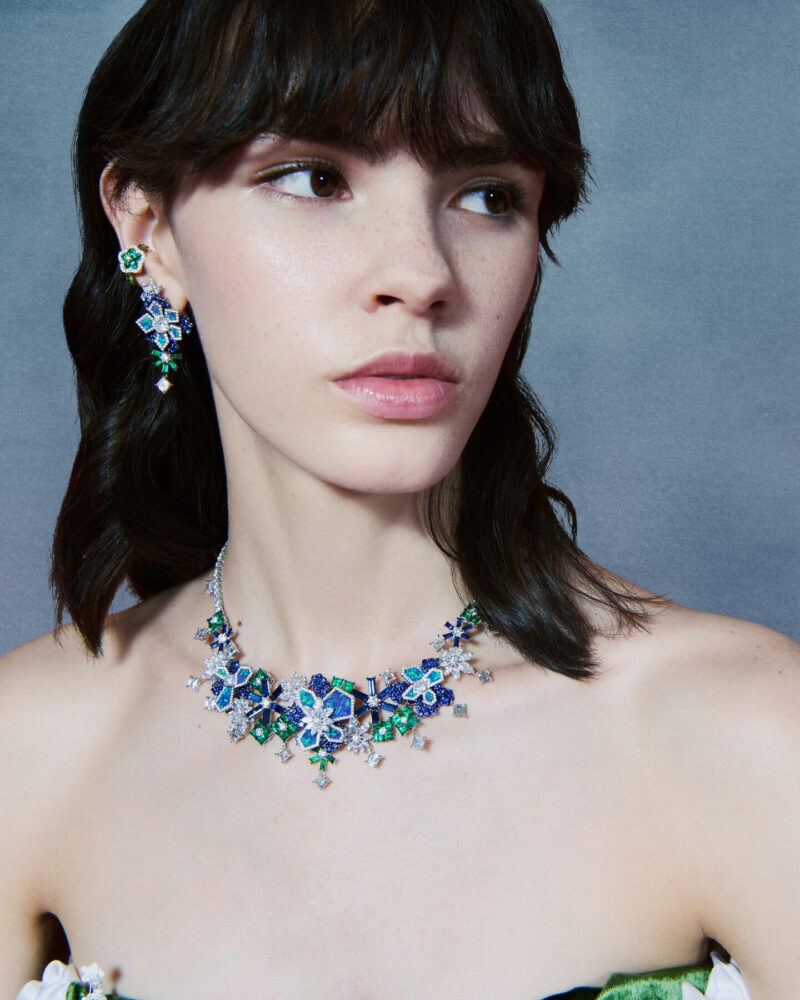
Diorissima: A Garden Composed in Gemstones
A green flower beside blue, a jewel above an open back, a brush at
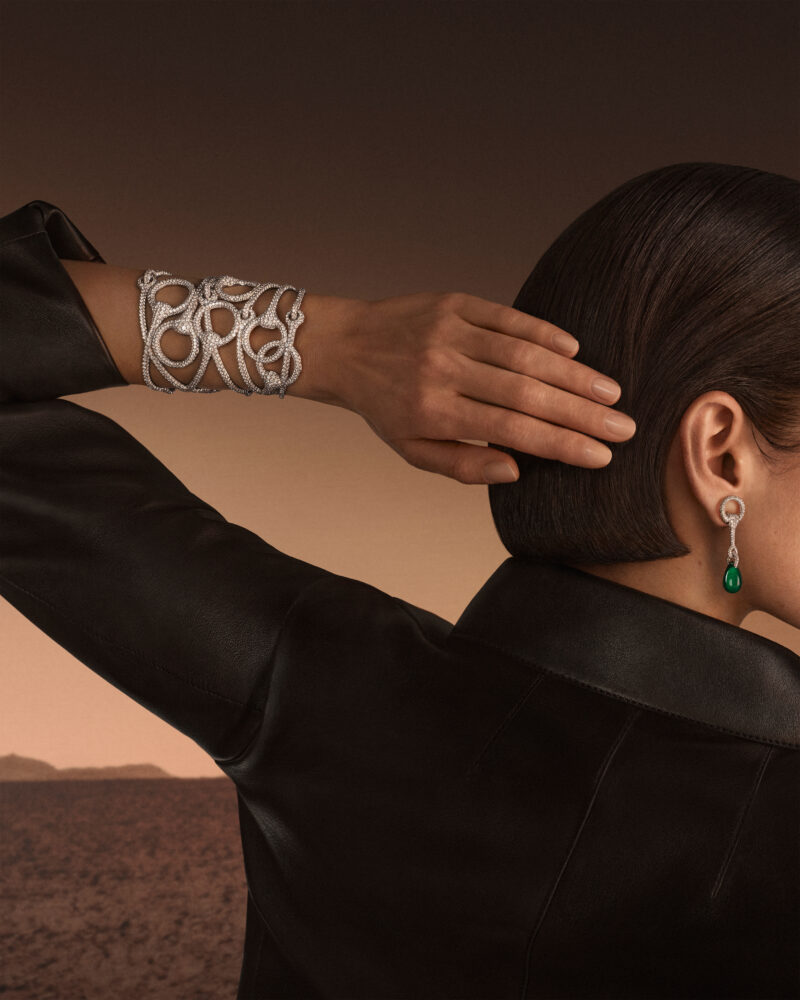
Hermès Horsescape: The Horse in the Line
A saddle at the wrist, a stirrup held against the sky, bright lines beside
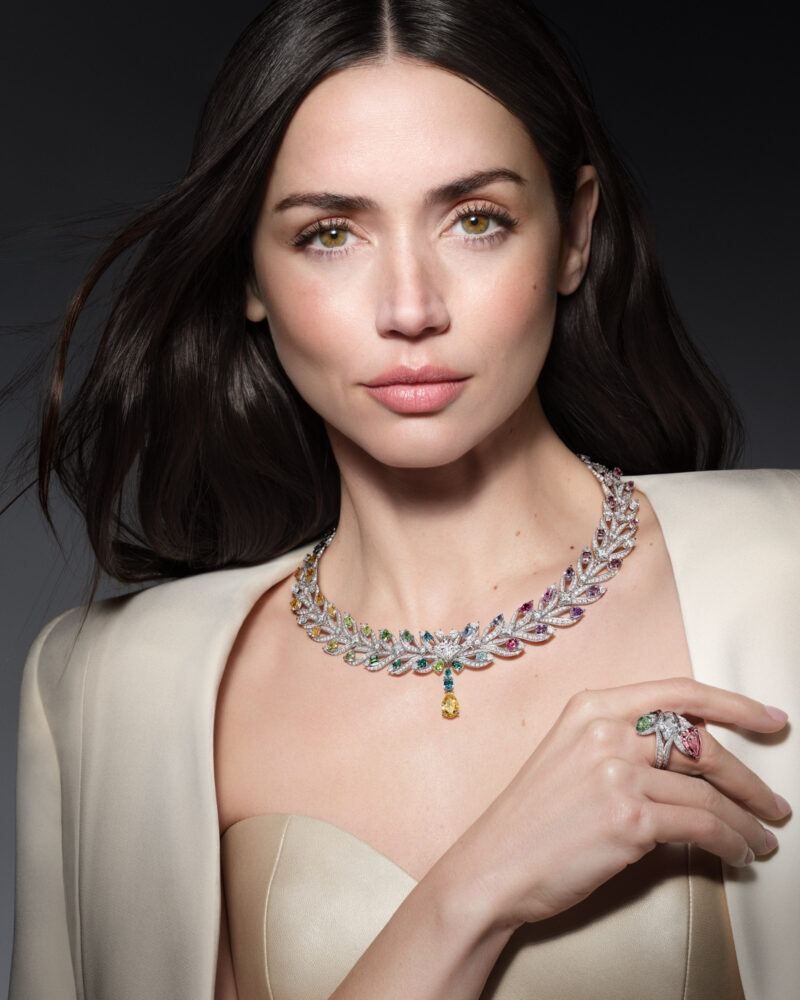
Louis Vuitton Mythica: Colour in Command
Victory’s changing colours, Conquest’s red pulse and Fortitude’s blue centre: three ways Mythica gives

CHANEL COCO CRUSH: Choosing the Mix
CHANEL’s Style Guide shows how COCO CRUSH changes when rings, bracelets, earrings and a
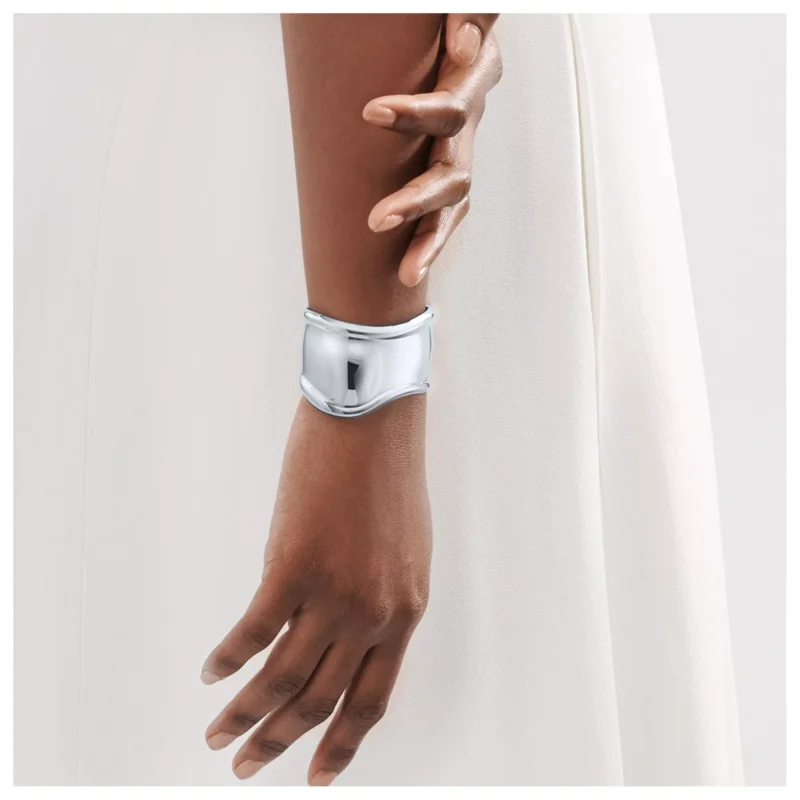
Elsa Peretti’s Bone Cuff: When Jewellery Follows the Body
Elsa Peretti’s Bone cuff begins with anatomy: a side-specific, asymmetric silver form whose surface
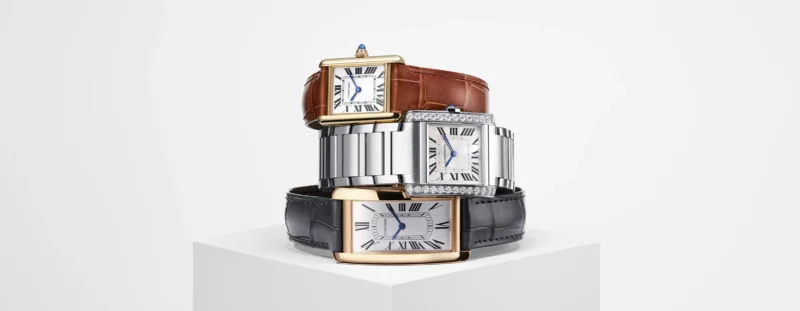
The Cartier Tank: A Rectangle in Conversation with Dress
A close reading of the Cartier Tank through proportion, brancards, strap, bracelet and the