
TheTimeo / Luxury Living
BONE CUFF:
the body becomes the brief
Elsa Peretti’s Bone cuff begins with anatomy: a side-specific, asymmetric silver form whose surface changes with the wrist, light and movement.
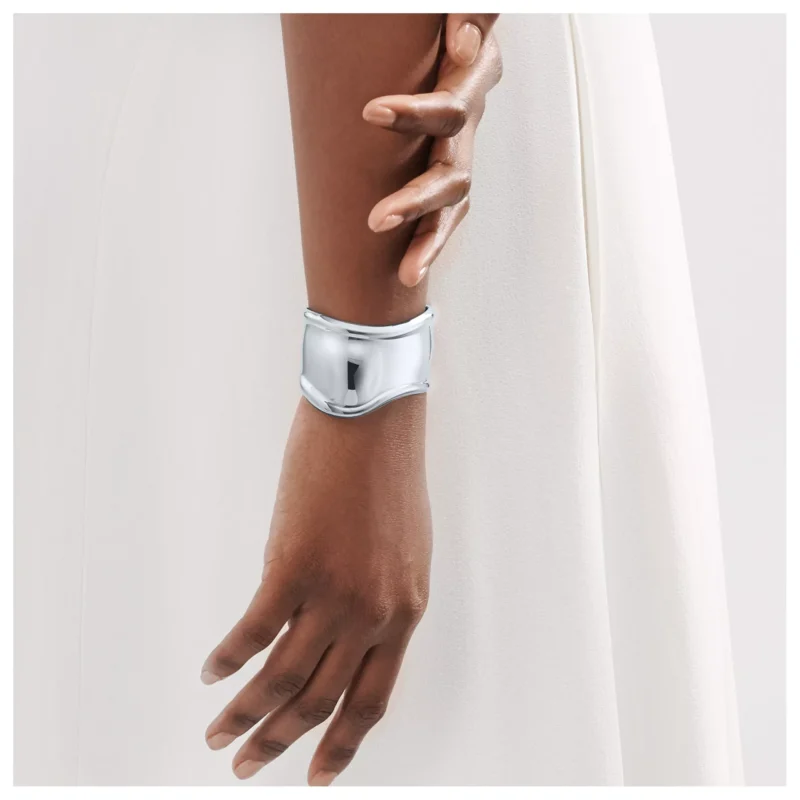
The cuff becomes legible when its asymmetric volume meets the wrist. Courtesy of Tiffany & Co..
Explore the story
The Bone cuff does not sit neutrally around the arm. One edge rises over the wrist bone; the surface swells, narrows and opens according to anatomy. Turn the hand and the object seems to change shape because its polished plane redraws the light. Elsa Peretti’s design is a lesson in jewellery that begins with the body rather than treating the body as a stand.
The object, in five lines
- Tiffany records Peretti’s arrival at the house in 1974 and her use of organic forms.
- Museum records identify Bone cuffs shaped specifically for the left or right wrist.
- Asymmetry lets the cuff follow anatomy and gives it a clear direction.
- Silver makes changing light part of the worn design.
- The cuff offers a way to think about bodily fit without turning fit into a style rule.
Start at the wrist bone
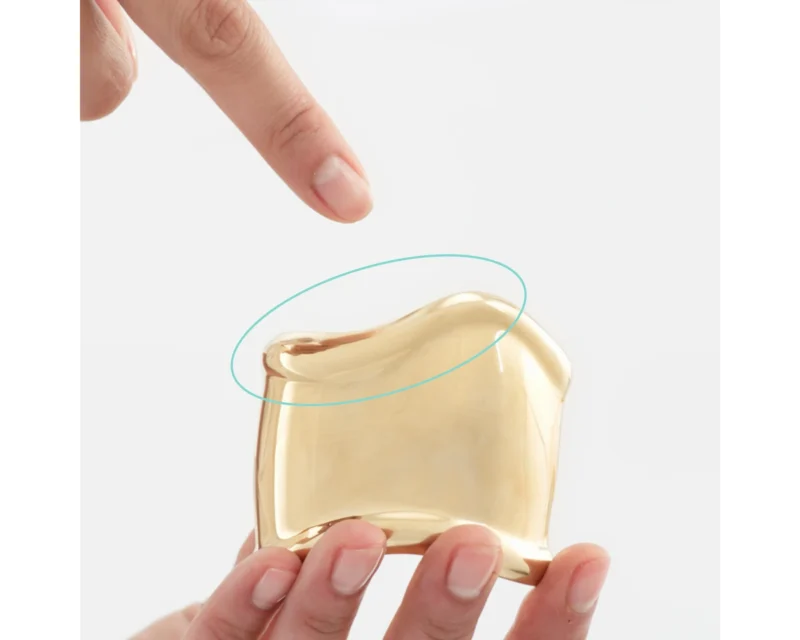
Side-specific construction gives the cuff an exact orientation on the wrist. Courtesy of Tiffany & Co..
Ordinary gesture changes the highlights and apparent volume of the polished cuff. Courtesy of Tiffany & Co..
The first useful fact about the Bone cuff is practical: versions are made for a particular side. The Museum of Fine Arts, Boston describes its large sterling-silver example, dated about 1978, as fitted over the prominent bone of the left wrist and extended up the arm. The split in the upper section echoes the gap between the forearm bones. The museum gives its dimensions as 11.4 by 9.5 centimetres, large enough for the relationship to anatomy to be visible from across a room.
That side-specific construction prevents the cuff from becoming a generic oval. Its raised area has somewhere to go; its opening has an orientation; its outline answers a body that is itself unequal from side to side. The design does not hide asymmetry. It uses it.
Tiffany & Co.’s archive describes the Bone cuff as formed in the shape of a wrist bone and places it within Peretti’s vocabulary of organic, tactile forms. The archive is a maison source and its praise should not be mistaken for independent criticism. Still, its chronology is clear: Peretti joined Tiffany in 1974 after beginning to design jewellery alongside her work in fashion, and the cuff became one of the forms associated with that collaboration.
A surface that moves without hinges
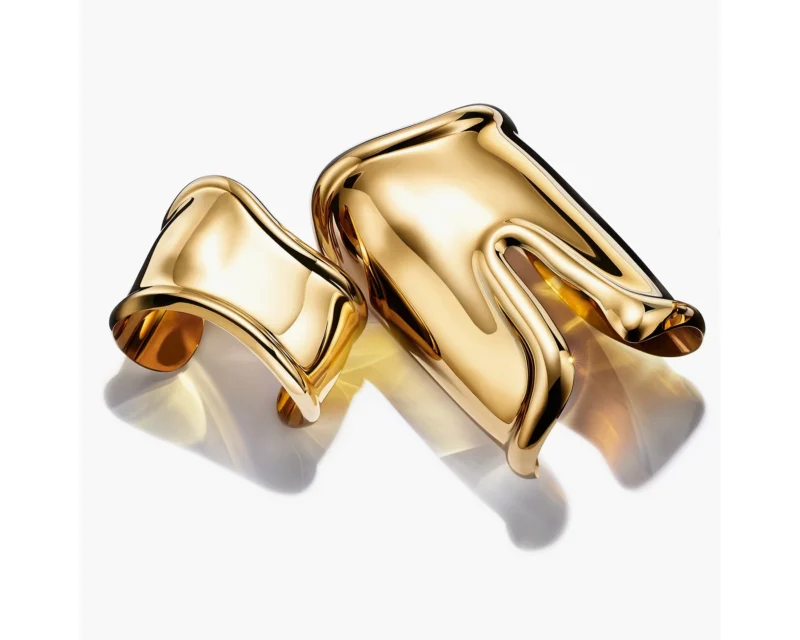
A group of Bone cuffs makes the design’s changing scale and uninterrupted surfaces visible. Courtesy of Tiffany & Co..
The cuff is a rigid object, but its appearance is mobile. Polished silver carries a distorted image of the room, the garment and the wearer’s skin. A broad highlight can make the centre appear fuller; a dark reflection can cut through the same volume. Photography from a single angle therefore records only one version of the piece.
This is not movement in the mechanical sense. It is movement produced by the body and the environment. The wrist rotates, the elbow bends and the hand changes the cuff’s relationship to light. The Bone cuff makes those ordinary gestures unusually legible because its surface is broad and uninterrupted.
The Met’s Jewelry: The Body Transformed defined jewellery through connection and interaction with the body: extending, accentuating, concealing or transforming it. The cuff fits that frame without needing to become theatrical. It amplifies a small anatomical landmark and turns it into the starting point of a sculptural form.
Organic does not mean formless
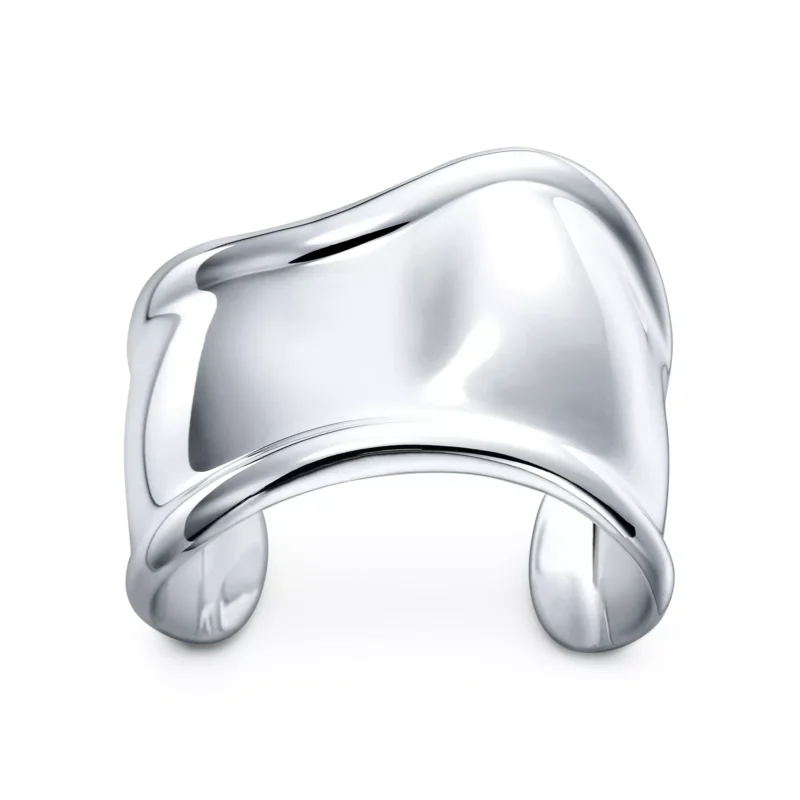
The uninterrupted silver surface turns reflected light into part of the form. Courtesy of Tiffany & Co..
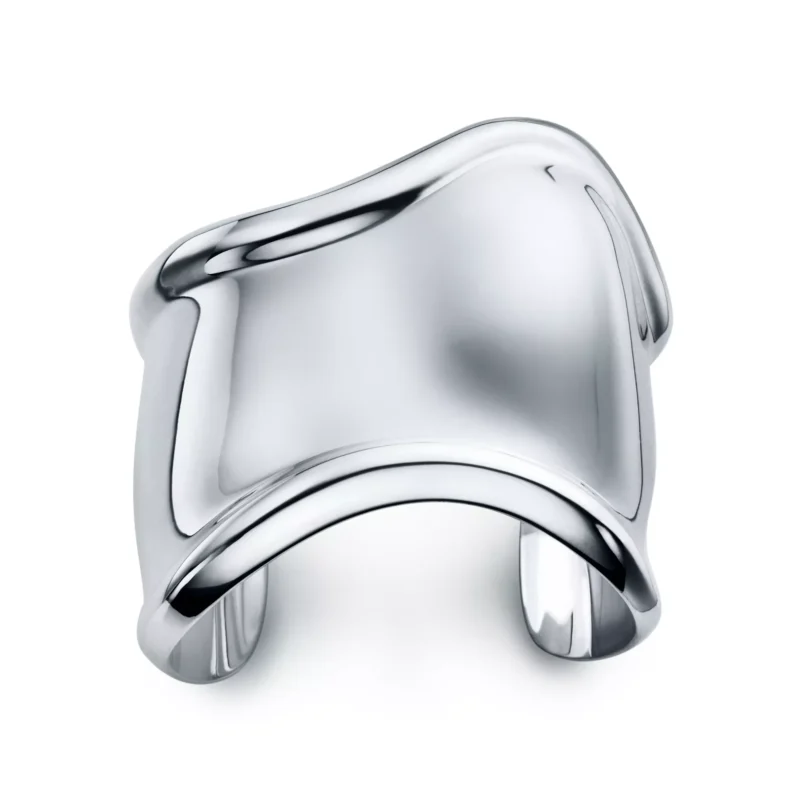
At medium scale, asymmetry remains structural rather than decorative. Courtesy of Tiffany & Co..
Descriptions of Peretti frequently use the word organic, but the cuff is tightly resolved. Its curves are not random. The opening permits the object to pass onto the wrist; the asymmetric rise establishes top and side; the polished skin maintains visual continuity. Even the split on the larger MFA example has structural clarity.
The British Museum’s biographical and collection record broadens the picture. It holds dozens of objects connected to Peretti, including jewellery, tableware and accessories made in silver, glass, lacquer, wood and other materials. This range suggests that her interest in touch and useful form was not limited to adornment. It moved between the wrist, hand and table.
That context matters because the Bone cuff is sometimes discussed only as an image. Its strength lies equally in how a three-dimensional form meets a particular body. A silhouette may be widely recognised while the actual experience remains local: one wrist, one side, one point of contact.
Scale changes the conversation
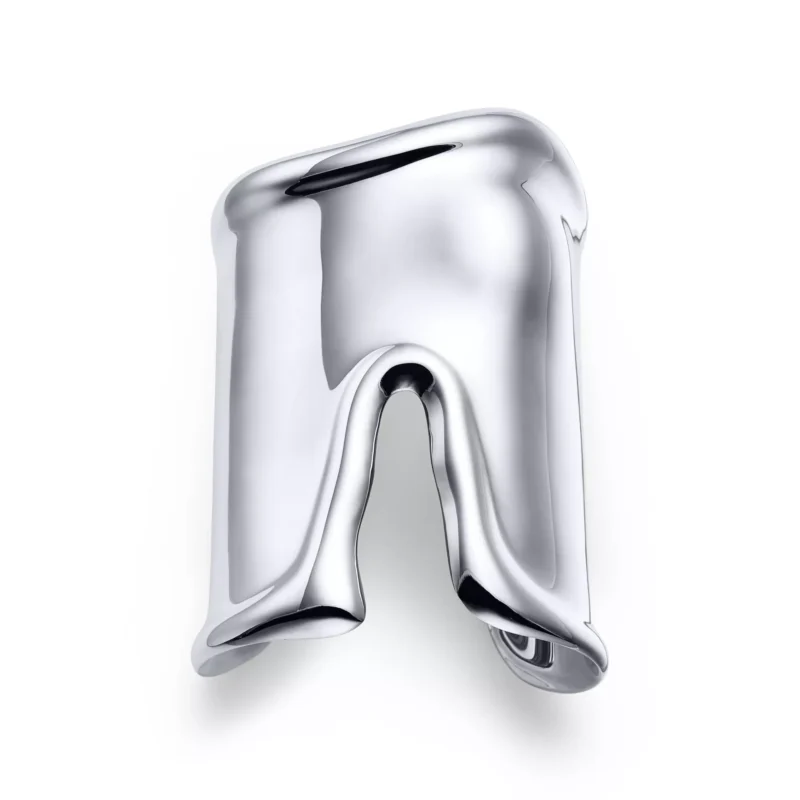
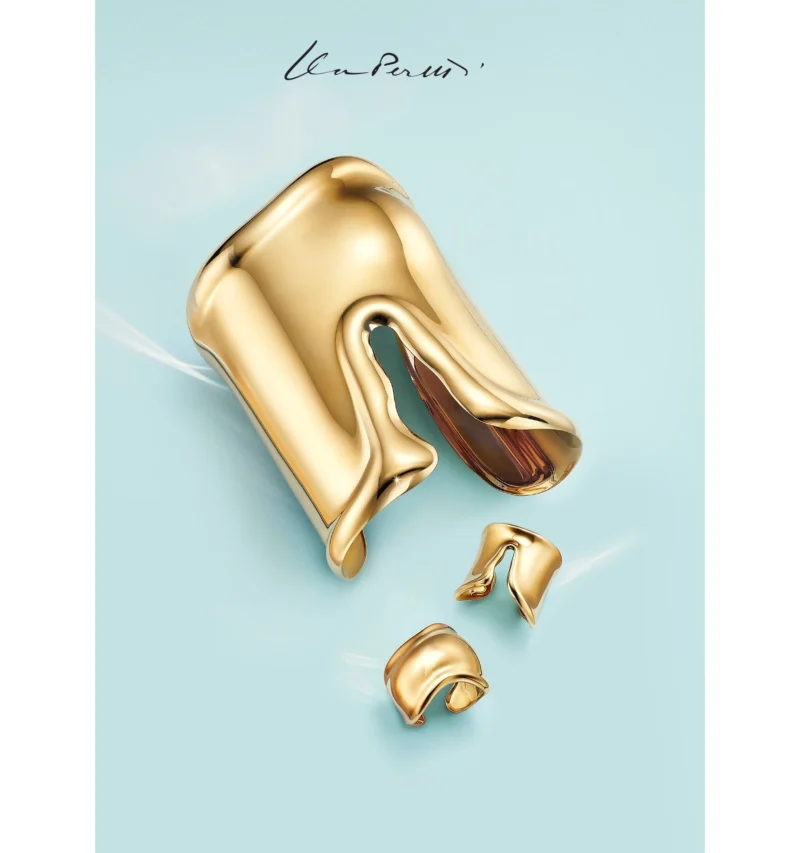
The larger cuff occupies the transition between hand, wrist and sleeve. Courtesy of Tiffany & Co..
A large cuff creates a different relationship with clothes from a narrow bracelet. It occupies the zone where sleeve and hand meet, so there may be little room for both the object and a close cuff. One response is to expose it fully with a shorter or pushed-back sleeve. Another is to let fabric overlap the lower edge so that the silver appears and disappears. Neither approach is inherently more faithful to the design.
Scale can be balanced elsewhere without literal repetition. A broad trouser line, a strong shoulder or a substantial shoe may distribute visual weight through the whole figure. Equally, a pared-back garment can allow the cuff to be the only concentrated form. The choice depends on whether the wearer wants continuity or interruption.
Adding a watch beside it requires attention to contact. Two broad hard objects may compete visually and strike physically. Moving one to the other wrist is an obvious option, but not the only one. A narrow watch, a leather strap or more space between objects can change the rhythm. Try the arrangement through actual gestures before deciding.
Left, right and personal habit
Side-specific jewellery raises an intimate question: which hand leads a person’s day? A watch is often placed on the non-dominant wrist for convenience, but habit varies. A cuff may feel more visible on the hand used to gesture or more protected on the other side. Clothing details may also be asymmetric: a pocket, fastening or draped panel can pull the composition in one direction.
There is no need to force balance by mirroring the cuff with another large object. Asymmetry can feel complete when the rest of the look gives it space. The empty wrist becomes part of the decision.
Fit remains distinct from appearance. The MFA record explains the intended anatomical position, but only trying an appropriately sized example can establish comfort for an individual. Pressure, range of motion and security are not reliably judged from photographs. A beautiful line that prevents ordinary movement has failed the wearer, whatever its pedigree.
Patina and care
Silver changes with exposure and wear. That developing surface may be welcomed as part of use or periodically polished, but cleaning choices should follow the maker’s instructions and the condition of the specific object. The design’s broad reflective plane makes small changes visible; aggressive treatment can also alter finish over time.
The more interesting point is that perfection is not the only way to read a tactile object. Fine marks may record use rather than neglect. Museums preserve and interpret objects under professional conditions; a worn cuff participates in daily life. Those are different responsibilities.
The Bone cuff remains compelling because it turns a familiar part of the body into a design brief. Its asymmetry is not an eccentric decoration applied at the end. It is the structure. The wrist does not merely carry the piece: it explains it.
Sources & further reading
This study uses Tiffany & Co.’s Elsa Peretti archive, the Museum of Fine Arts, Boston Large Bone Cuff object record, the British Museum’s Elsa Peretti collection record and the Metropolitan Museum of Art’s Jewelry: The Body Transformed. Sources were checked on 3 September 2026. Dates, materials and collection facts follow the cited records; comments on styling and movement are visual analysis.
The Edit
Luxury Living stories
Selected stories from the same editorial universe.
The Brooch in Motion: Placement, Gesture and Dress
A brooch changes the line of a garment through placement, scale and movement. This

Before the Wrist: When Timekeeping Was Worn as Jewellery
From an enamelled chatelaine to Santos, Tank, Tutti Frutti and Crash: Cartier shows how
The Cartier Tank: A Rectangle in Conversation with Dress
A close reading of the Cartier Tank through proportion, brancards, strap, bracelet and the
Watches in High Fashion: Blurring the Line Between Horology and Couture
Luxury watches have evolved from simple timekeeping devices into status symbols and integral fashion
Celebrity Endorsements: How A-List Icons Are Influencing Watch Trends in 2024
Luxury watches and celebrity culture have long been intertwined, with A-list icons driving major
The Watch as a Fashion Icon: How to Make Your Timepiece the Focal Point of Any Outfit
Luxury watches have transformed from simple timekeeping devices into powerful fashion statements. Whether attending