
TheTimeo / Luxury Living
THE BROOCH:
placement creates the gesture
A brooch changes the line of a garment through placement, scale and movement. This object-led study reads the jewel where cloth and gesture meet.
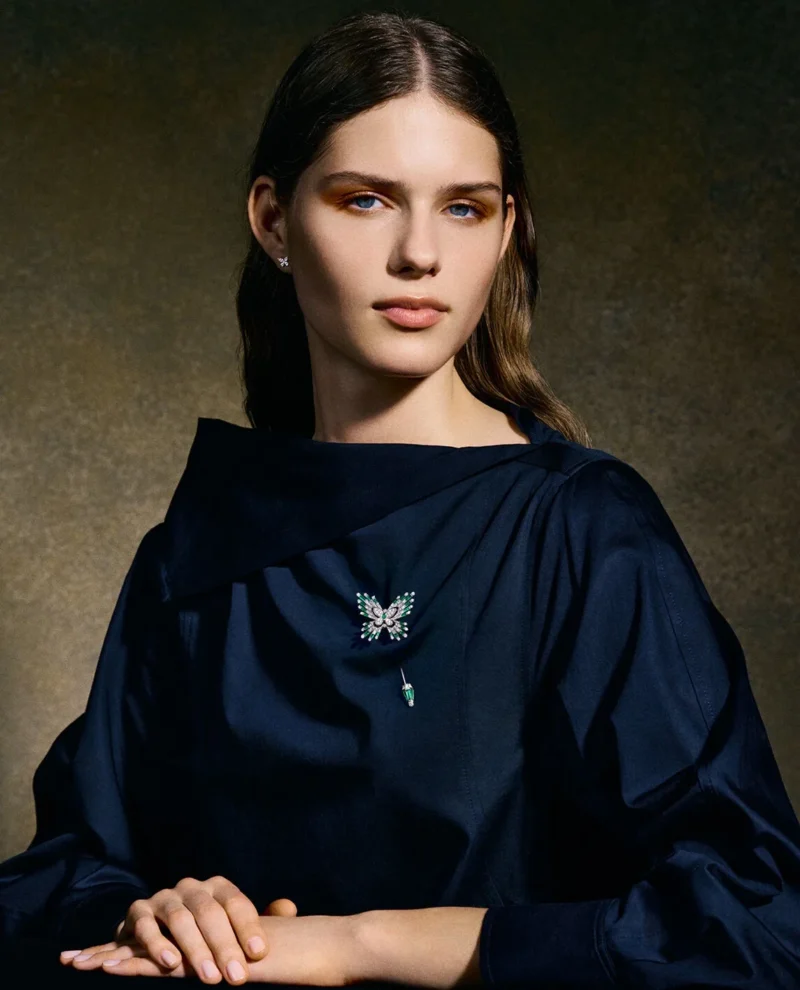
Tamara worn: the jabot-pin line establishes scale and movement on the body. Courtesy of Graff.
Explore the story
Move a brooch ten centimetres and the garment changes. High on a shoulder it can pull the eye upward; at the centre of a collar it becomes a fastening; on a scarf it gathers soft material into a new line. Unlike jewellery assigned to a finger, ear or wrist, the brooch offers a movable point of emphasis. Its meaning and visual force depend on where the wearer puts it.
The object, in five lines
- Brooches have served as fasteners, ornaments, symbols and messages across long periods.
- Placement changes both the silhouette and the way an object moves.
- Historical objects include detachable, convertible and spring-mounted elements.
- Cloth weight, pin construction and object weight set practical limits.
- Contemporary placement works best as a choice about line, not a claim of novelty.
A jewel with an address
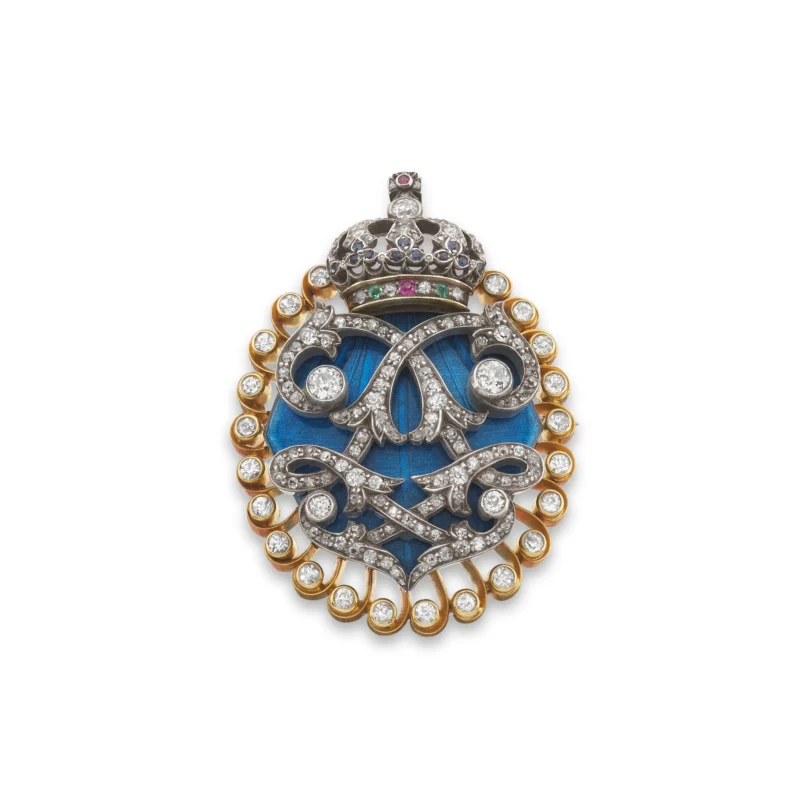
A late nineteenth-century brooch whose materials, condition and provenance must be read together. Courtesy of Phillips.
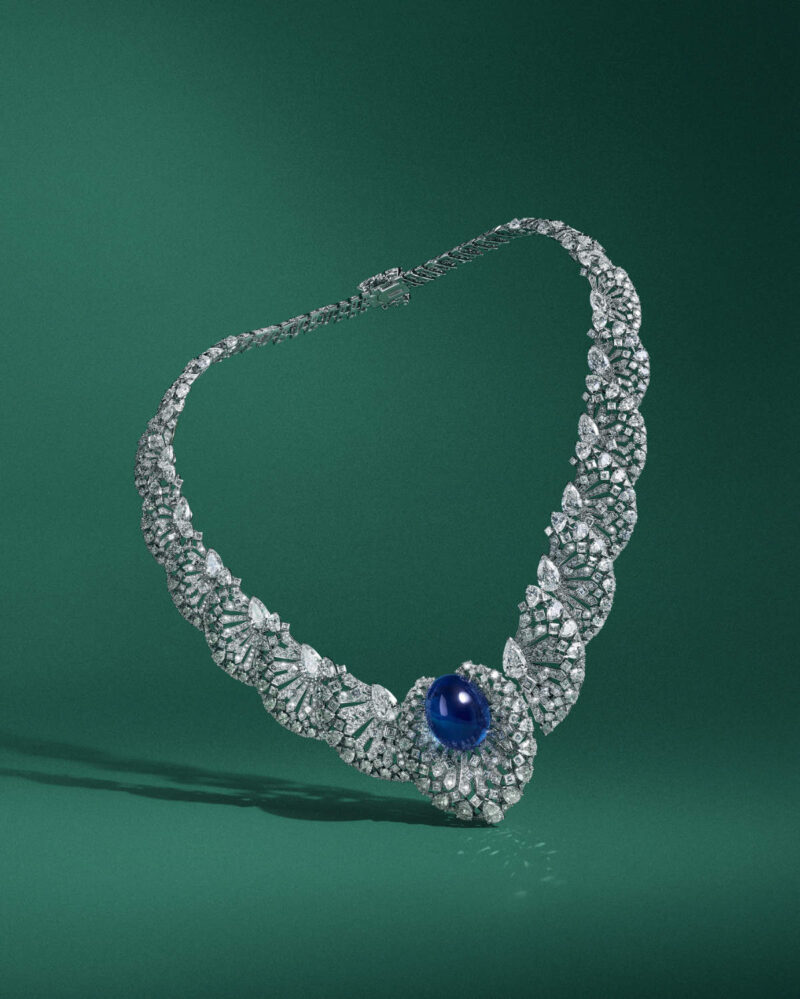
Cartier En Équilibre Pavocelle necklace and brooch with sapphire cabochon. Image courtesy of Cartier.
Every brooch needs an address on the body, but few have only one. A lapel is familiar because it provides a reinforced edge and a ready diagonal. The convention is useful, not compulsory. A brooch may also sit at a neckline, shoulder, waist, pocket, scarf or hat, provided the material and fastening can support it safely.
The Victoria and Albert Museum’s jewellery history shows how closely these objects have followed dress. In the seventeenth century, large bodice ornaments were pinned or stitched to stiff fabrics. A nineteenth-century floral spray in the collection has flowers mounted on springs so that they sparkle as the wearer moves, while individual sprays can be removed and worn in the hair. Such construction makes mobility more than a styling idea: it is built into the object.
Older brooches could also perform the literal work of holding cloth. British Museum material on Anglo-Saxon dress notes that brooches were both decorative and used to fasten clothing. That dual role survives whenever a modern wearer uses a pin to gather a scarf or control a drape, though delicate historic jewels should never be asked to bear loads they were not designed to take.
Placement redraws the garment
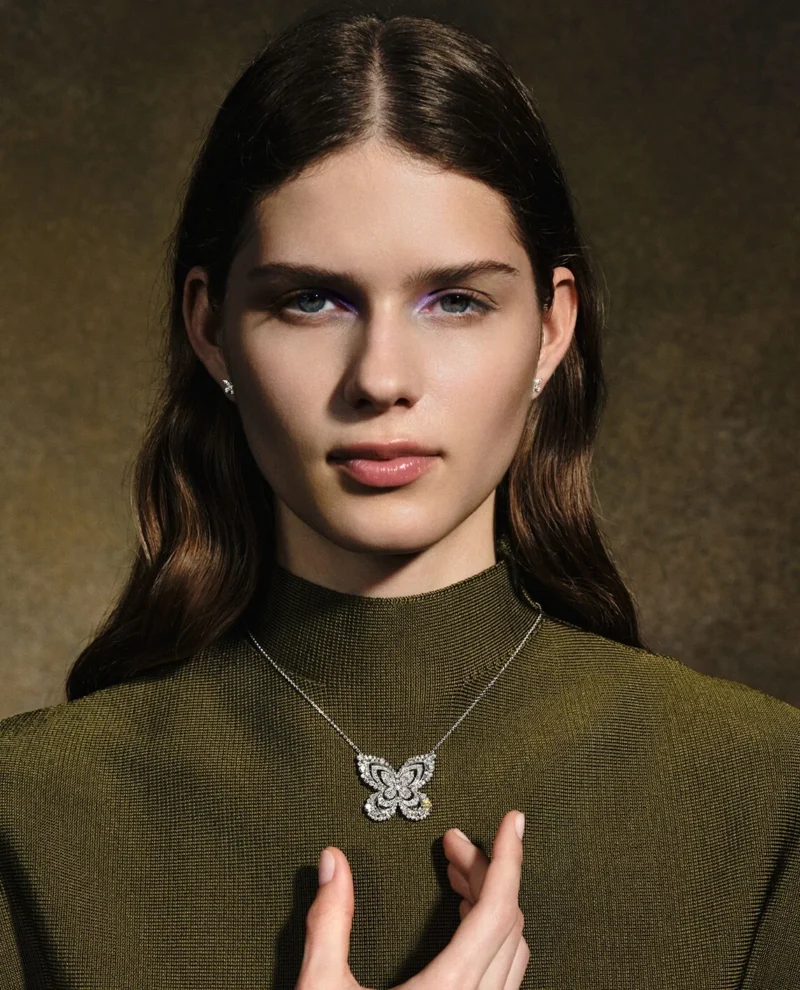
Marina in its pendant configuration, showing how transformability changes the jewel’s relationship to the body. Courtesy of Graff.
A brooch is a visual anchor. Put it close to the face and it brings colour and reflected light upward. Place it on the outer point of a shoulder and it can extend the shoulder line. Set it near a pocket and the eye drops; use two points and the space between them becomes active.
These effects depend on the garment. A small pin can disappear in a large pattern but become decisive on plain cloth. A pale jewel may merge into a light textile while its silhouette remains visible on black. A long vertical brooch can reinforce a jacket opening; a round form can interrupt the same line.
The object does not need to be centred. In fact, an off-centre placement often gives the body more room to move without turning the brooch into a badge. The exact position can follow the garment’s construction: a seam, fold, collar point or closure already supplies a line to answer.
Movement belongs in the decision
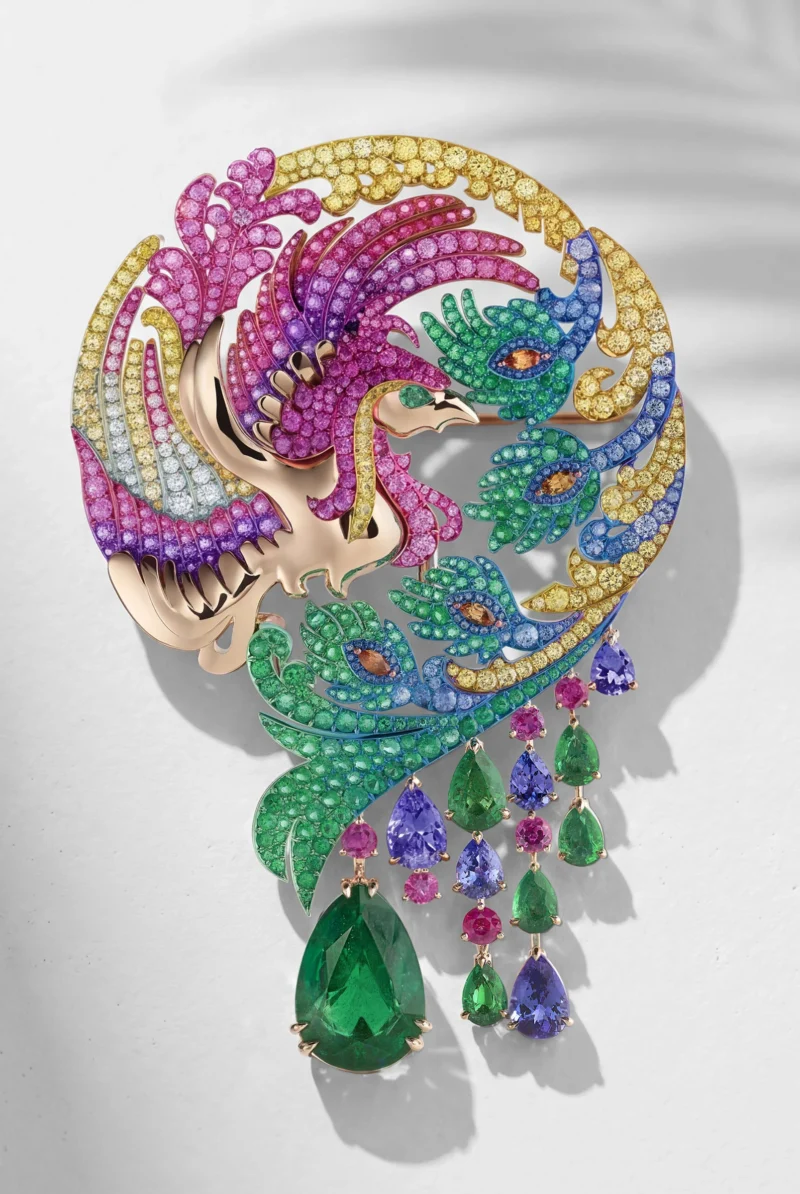
The phoenix builds motion through sweeping colour fields, titanium-supported breadth and suspended drops. Courtesy of Chopard.
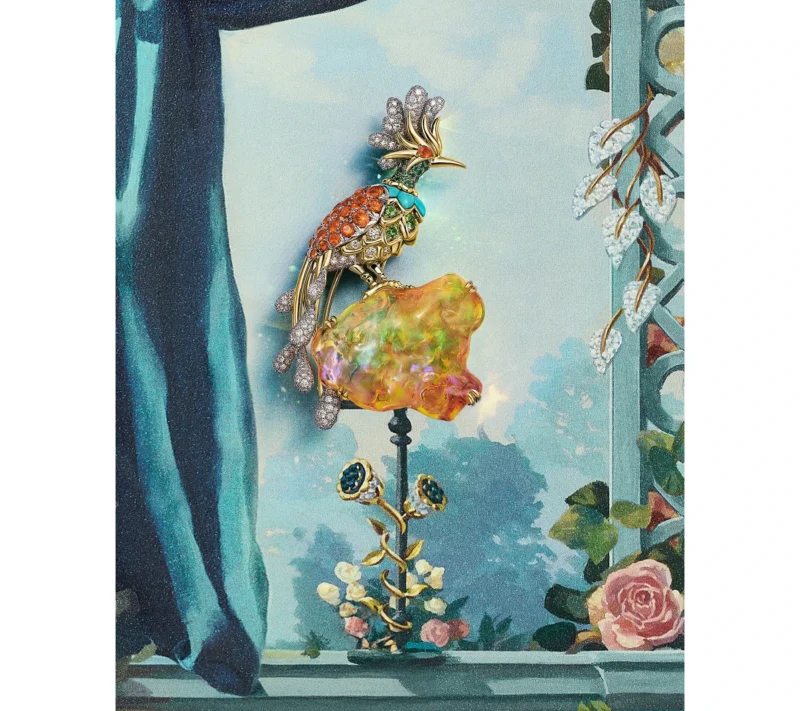
Paradise Bird places the familiar avian language on an unexpected opal ground. Courtesy of Tiffany & Co..
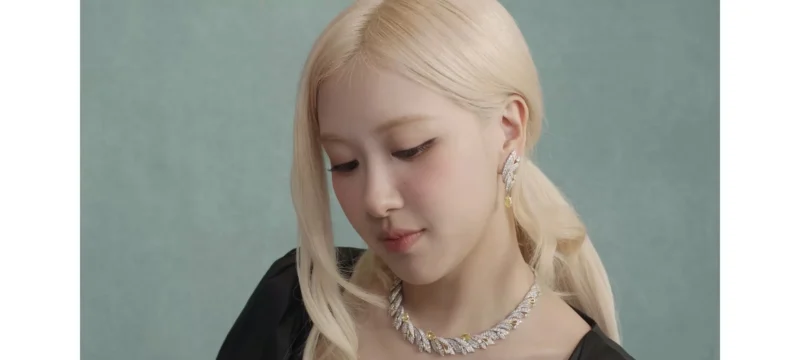
Butterfly keeps the motif recognisable while changing its scale, colour and rhythm. Courtesy of Tiffany & Co..
The Met’s Jewelry: The Body Transformed asks how jewellery activates the body. A brooch activates the clothed body as well. It rises with a shoulder, tilts when a lapel opens and changes plane as the torso turns. A pendant swings from a fixed suspension point; a brooch lets the wearer choose that point.
This makes a mirror test incomplete. Walk, sit, put on a coat and carry the bag intended for the day. A shoulder strap may strike the pin. A seat belt may cross it. A soft collar may collapse under its weight. An object that appears secure while standing can rotate when the cloth moves.
The V&A’s account of a Cartier diamond and platinum brooch from 1910 offers a useful object study. More than one hundred diamonds are arranged around a cushion-cut centre stone in a design the museum connects to Islamic art and architecture. Whatever its material value, the brooch is also a concentrated geometry. Its effect on dress would depend on whether that geometry repeats a textile pattern or creates a single hard focus against plain fabric.
One brooch, four approaches
On a lapel, begin with the existing diagonal. Aligning a long brooch with the edge makes the line calmer; crossing it creates tension. Test the jacket both open and closed, because the lapel angle changes.
At a collar or neckline, the brooch becomes close to a clasp. Centring it can create formality, while shifting it to one side makes the closure less symmetrical. Check that the pin back cannot touch the neck and that the weight does not drag the collar down.
On a scarf, think about fabric rather than spectacle. A pin can gather volume, but silk and other fine textiles may mark. Use only a fastening suitable for the material, avoid forcing a thick bundle through a short pin, and consult a textile specialist for fragile or valuable pieces.
On an unexpected area such as a pocket, waist tab or hat, let construction provide support. The placement should not interfere with bending or with a hand entering the pocket. Novelty is not a sufficient reason to risk either object or garment.
Multiples and conversion
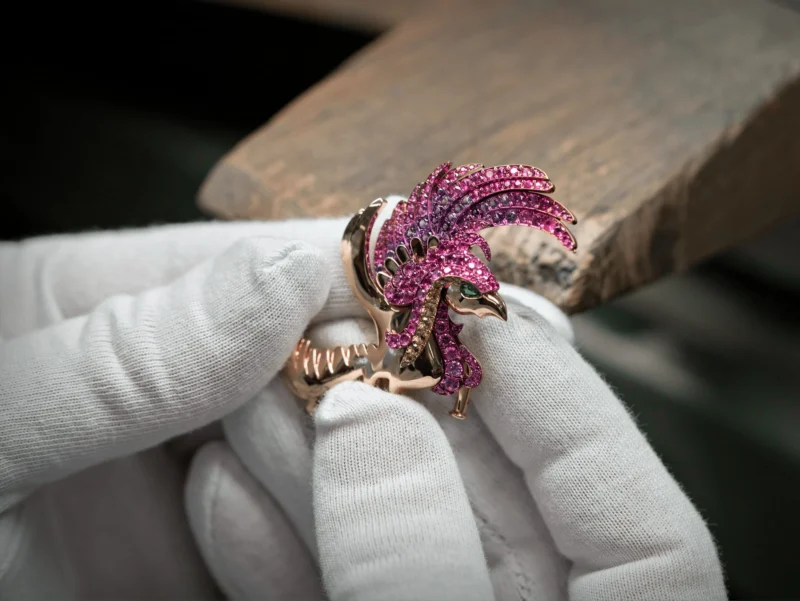
In the workshop, the structure beneath the phoenix becomes visible before the final colour field takes over. Courtesy of Chopard.
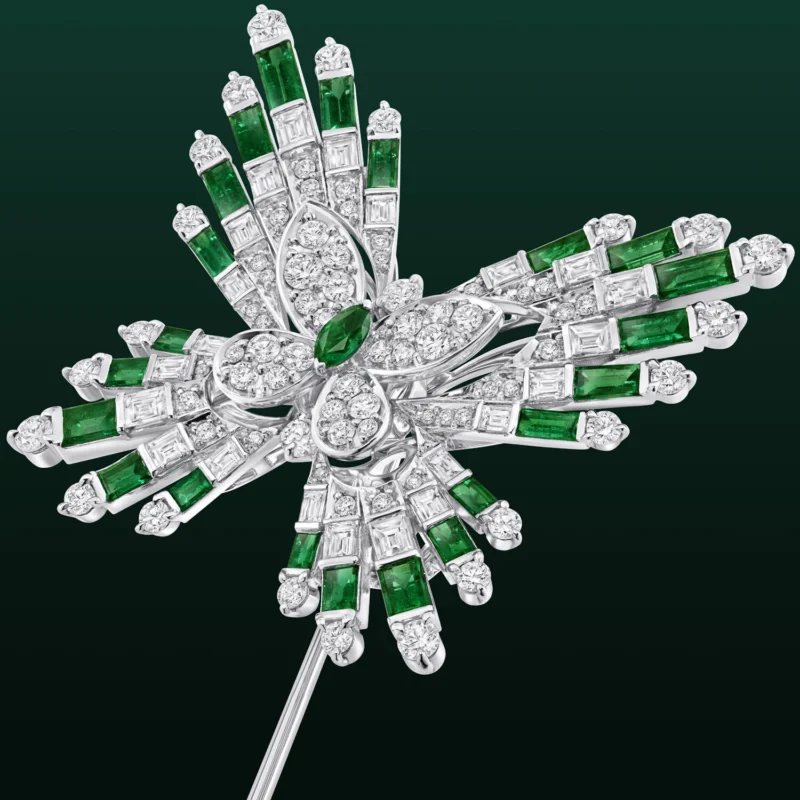
Tamara, reference GP110866: emerald geometry radiates from the butterfly at the centre. Courtesy of Graff.
Two or more brooches introduce rhythm. Similar forms at different scales can look like a sequence; unrelated objects can be connected by colour, material or spacing. Clustering concentrates weight, while distributing pieces creates a path across the garment.
History offers examples of jewellery designed to convert. The V&A’s floral spray with removable elements is one; Cartier’s exhibition research also records pieces moving between decorative traditions and uses. Conversion challenges the idea that a jewel has one permanently correct orientation.
Still, not every brooch should be dismantled, modified or improvised into another role. Original fittings, age and condition matter. A qualified jeweller should inspect uncertain hinges, catches and pins. The wearer can be inventive about placement without being careless about the object.
Meaning moves too
Brooches are unusually suited to explicit messages. The V&A’s design collection includes Keith Lewis’s 1993 brooch Peeling off the Bitter Rind, created in response to the AIDS crisis. Its image and bodily placement carry social and emotional force far beyond decoration. Other brooches commemorate people, events, affiliations or private relationships.
Placement can amplify that meaning. Near the heart is an obvious symbolic choice, but symbolism may be public, private or absent. A brooch inherited from someone need not announce its story to remain significant. Moving it to a daily coat rather than reserving it for formal dress can change the role it plays in a life.
The brooch has not returned from disappearance so much as remained available, waiting for an address. Its freedom is practical and expressive: the wearer chooses the point where object, cloth and gesture meet. The best placement is the one that makes that relationship clear and keeps both jewel and garment secure.
Sources & further reading
This article draws on the Victoria and Albert Museum’s history of jewellery, its study of jewellery designs and its close look at a Cartier brooch, the Metropolitan Museum of Art’s Jewelry: The Body Transformed, and the British Museum’s Anglo-Saxon learning resource. Sources were checked on 3 September 2026. Placement suggestions are practical analysis, not conservation advice for fragile objects or textiles.
The Edit
Luxury Living stories
Selected stories from the same editorial universe.
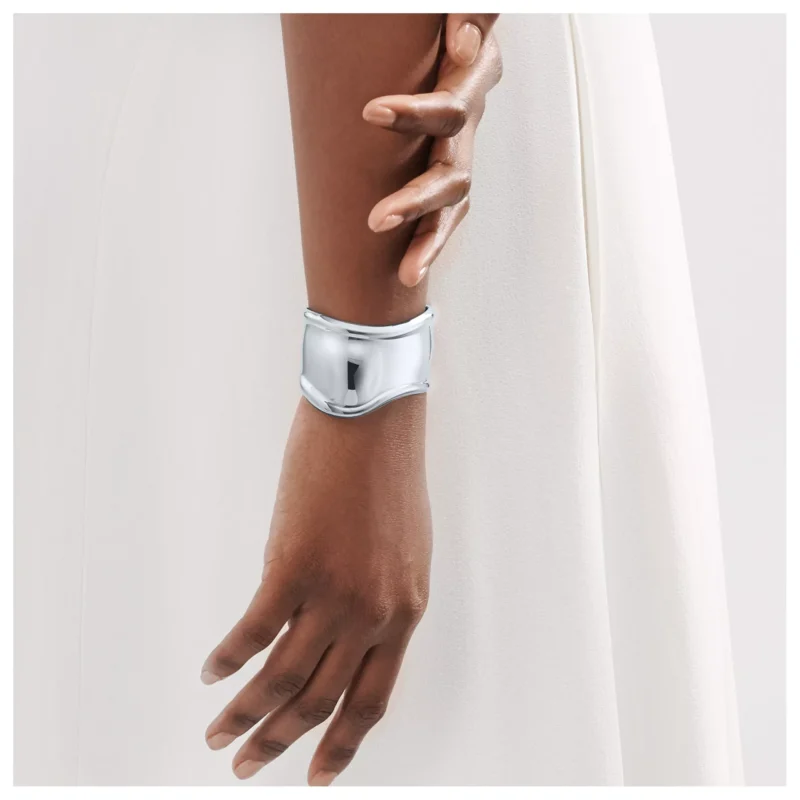
Elsa Peretti’s Bone Cuff: When Jewellery Follows the Body
Elsa Peretti’s Bone cuff begins with anatomy: a side-specific, asymmetric silver form whose surface
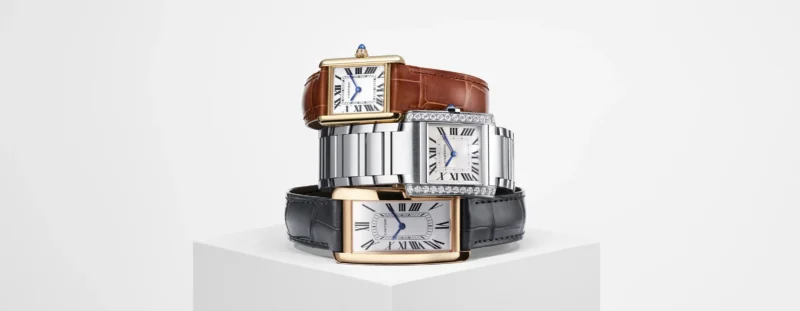
The Cartier Tank: A Rectangle in Conversation with Dress
A close reading of the Cartier Tank through proportion, brancards, strap, bracelet and the
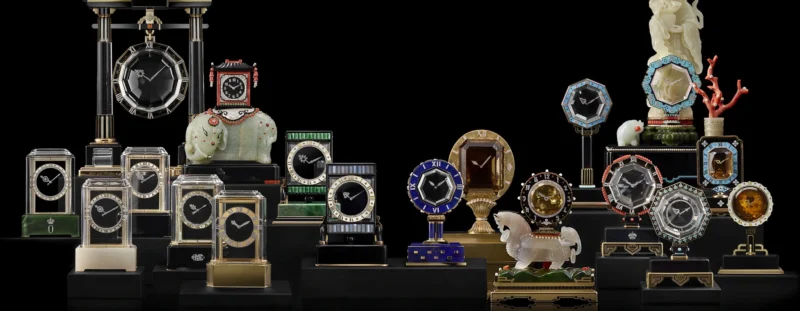
Before the Wrist: When Timekeeping Was Worn as Jewellery
From an enamelled chatelaine to Santos, Tank, Tutti Frutti and Crash: Cartier shows how
Watches in High Fashion: Blurring the Line Between Horology and Couture
Luxury watches have evolved from simple timekeeping devices into status symbols and integral fashion

Celebrity Endorsements: How A-List Icons Are Influencing Watch Trends in 2024
Luxury watches and celebrity culture have long been intertwined, with A-list icons driving major
The Watch as a Fashion Icon: How to Make Your Timepiece the Focal Point of Any Outfit
Luxury watches have transformed from simple timekeeping devices into powerful fashion statements. Whether attending