
TheTimeo / Jewelry
Bulgari SerpentiThe art of transformation
From supple Tubogas coils to enamelled secret watches, how Bulgari keeps reinventing the serpent through construction, colour and movement.
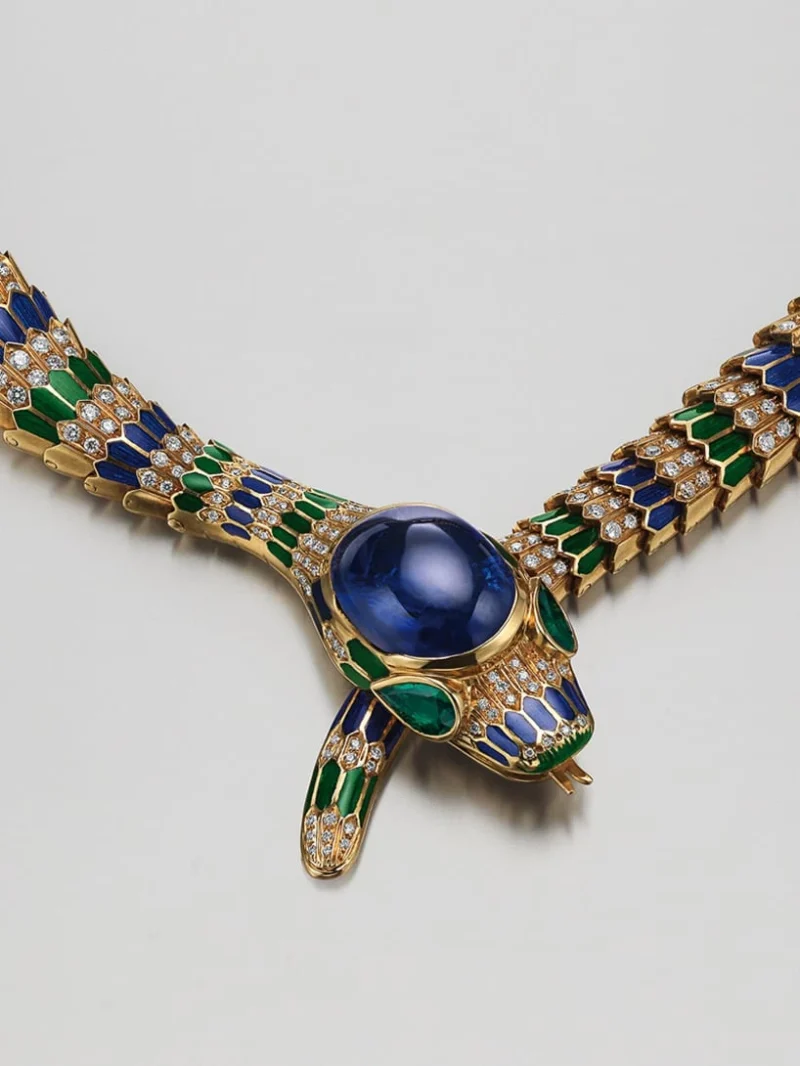
Bulgari Serpenti necklace with a blue cabochon and coloured details defining the head and body. Courtesy of Bulgari.
Explore the story
A Bulgari Serpenti can wind around the wrist in a smooth coil of gold, build its body from enamelled scales or conceal a watch beneath a jewelled head. The fascination lies in how differently each version turns the same animal into jewellery.
Serpenti has endured because Bulgari has allowed it to change. Some pieces resemble snakes closely; others suggest one through a curve or a repeating pattern. Looking at their construction, rather than simply recognising the motif, reveals the ingenuity behind the family.
A coil before the scales
Bulgari dates its first Serpenti to 1948. The early jewellery-watches used Tubogas bracelets and geometric watch faces. Their identity came largely from the way the metal wound around the wrist. The bracelet could suggest a serpent without a naturalistic head, gemstone eyes or individually modelled scales.
That beginning helps explain the variety that followed. Serpenti was never tied to one exact silhouette. Its earliest designs already relied on an action — wrapping around the wearer — as much as on an image.
The surviving pieces in Bulgari’s heritage collection make the point particularly well. Follow the ridges around an early Tubogas bracelet and the eye travels continuously along the coil. The watch face appears as one part of a larger jewel, rather than a conventional watch attached to a decorative strap.
Why Tubogas looks and moves differently
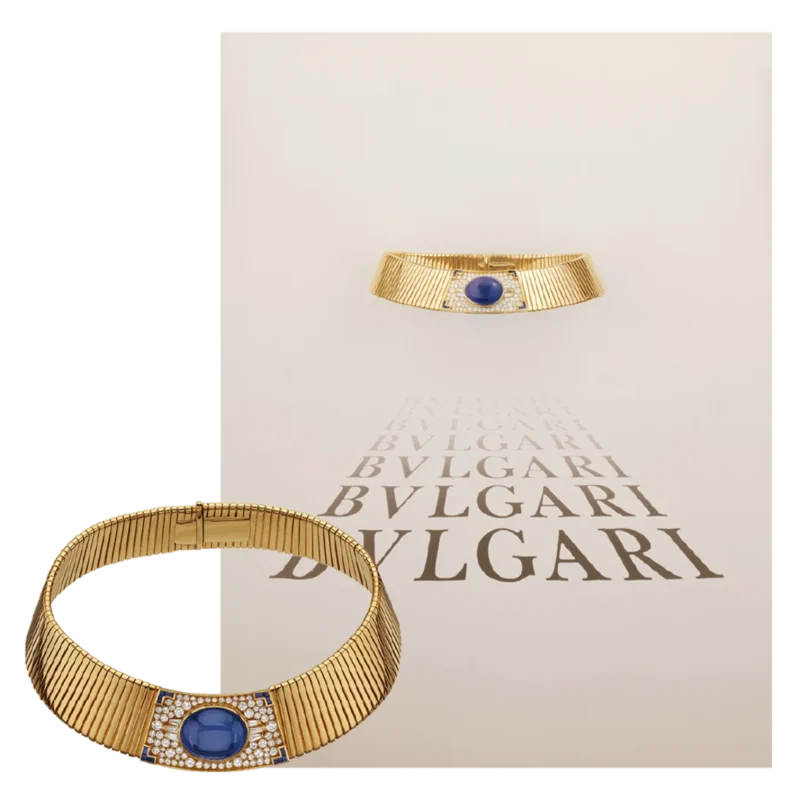
Bulgari Tubogas jewellery alongside an archival advertisement: the technique also has a life beyond Serpenti. Courtesy of Bulgari.
Tubogas takes its name from corrugated industrial tubing. In jewellery, interlocking metal bands produce a rounded, flexible structure without soldering the individual turns together. The closely repeated ridges create the appearance of a continuous tube.
For Serpenti, that construction is especially expressive. A conventional linked bracelet makes its joints visible; Tubogas carries the eye around a single curving form. Its rhythm can suggest the body of a snake even when no scales are depicted.
It is worth keeping the two names separate. Tubogas is a technique that Bulgari has used for other jewels, while Serpenti is the wider family of serpent-inspired designs. Some Serpenti pieces use Tubogas; others achieve their shape through articulated scales, modular links or more rigid jewellery structures.
When the watch disappears inside the jewel
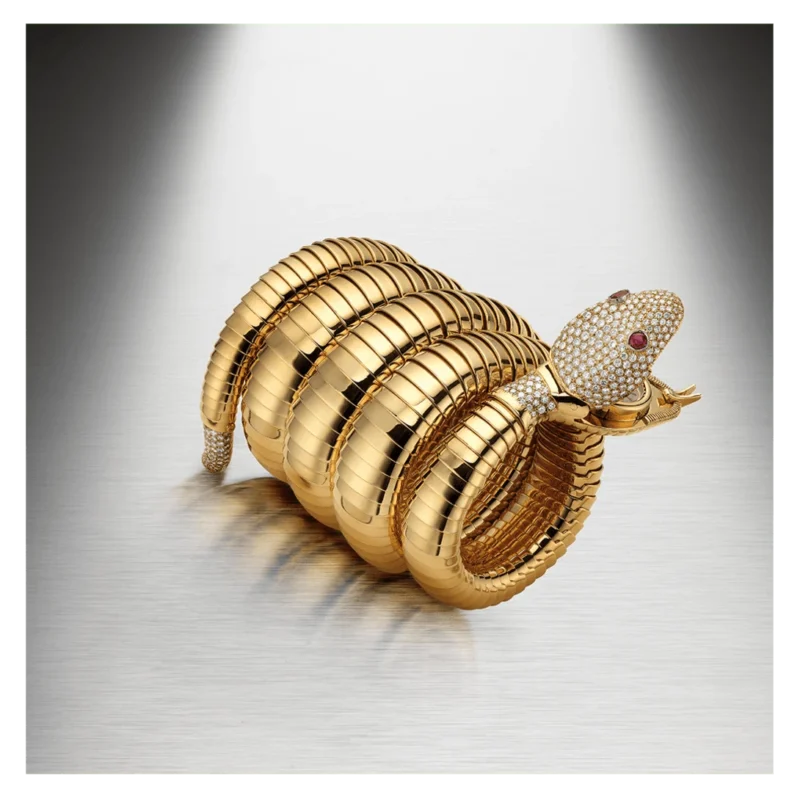
A coiled gold Serpenti watch, its jewelled head opened to reveal the dial. Courtesy of Bulgari.
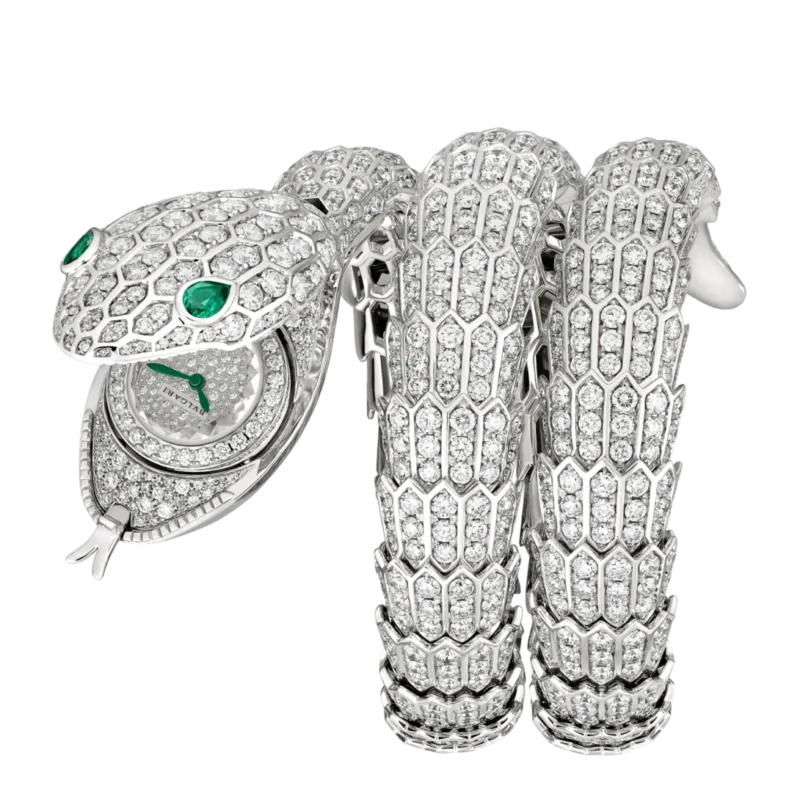
Serpenti Misteriosi: the raised head reveals a watch dial within the diamond-set body. Courtesy of Bulgari.
During the 1960s, Serpenti became more figurative. Articulated scales, enamel and gemstone eyes gave the bracelets a recognisable anatomy. In secret watches, the serpent’s head opened to reveal the dial.
Around 1960, a black-enamel example catalogued by Christie’s combined pear-shaped diamond eyes with a concealed dial signed Le Coultre. Another, dated around 1965, used multicoloured enamel scales and an Omega-signed dial. Such details are part of the history of those particular pieces: the jewellery design and the timekeeping mechanism could come from different specialist traditions.
The arrangement changes how a watch is experienced. The dial no longer occupies the centre of attention. A hinge, a small cavity and the mechanism inside must all serve the shape of the head. From the outside, the bracelet remains a jewel; telling the time becomes a private gesture.
The colour of Bulgari’s Rome
Calling Serpenti Roman is less about tracing it to one ancient object than about recognising the house that shaped it. Bulgari’s own history describes the emergence of a style built around generous volumes and strong colour combinations in the 1950s, alongside its growing use of rounded cabochon stones.
Serpenti offered a surface on which that approach could flourish. Enamel could carry colour along the body, while gemstone eyes concentrated it at the head. As the articulated bracelet curved, the coloured elements appeared in changing relationships to one another.
A black-enamel serpent reads as a bold outline. A multicoloured example draws attention to the individual scales. A polished gold coil gives more emphasis to light moving across the ridges. These are different visual experiences, even before differences in stones or mechanism enter the conversation.
This is our reading of Serpenti’s Roman character: confidence with colour, scale and precious materials, combined with an ease in turning an old symbol into a contemporary jewel. It is an interpretation of the designs, not a claim that every Serpenti copies an ancient Roman model.
One family, several ways to wear it
Modern Serpenti designs retain different parts of this inheritance. Tubogas keeps the continuous coil. Seduttori makes the scale into a repeating bracelet link beneath a recognisable head-shaped case. Viper simplifies the animal into stylised jewellery forms. Misteriosi returns to the secret watch, placing the dial inside a more figurative head.
Explore the comparison
| Design | What to notice |
|---|---|
| Tubogas | The continuous ridged coil and how many times it wraps. |
| Seduttori | The bracelet’s repeated scale-like links and their relationship to the case. |
| Viper | The taper and repetition of stylised scales, without a time display. |
| Misteriosi | The sculpted head and the mechanism that reveals the hidden dial. |
These variations are more than different decorations. They change the proportion of metal to open space, the way the piece sits on the body and the degree to which it resembles an animal. The necklace pictured at the opening shows another possibility: the serpent follows the neckline, with a blue cabochon drawing attention to its head. The familiar motif can organise a whole jewel rather than remain a detail on a bracelet.
Looking closely at an individual Serpenti
Begin with the bracelet. Is it a continuous Tubogas coil, a series of articulated scales or a linked construction? Look at how it meets the head and how the form narrows towards its end. A photograph from the side can explain this more clearly than a frontal view alone.
Next, consider what the surface is doing. On an enamelled example, the pattern and condition of the enamel deserve attention. On a gem-set piece, notice how the stones follow the curves and where metal remains visible. On polished gold, the outline and the repeating forms carry more of the design.
If the piece includes a watch, establish whether the dial is exposed or concealed and ask about the movement and service history. For a historical example, maker’s signatures, numbers and accompanying documents help place it in context. An unusual dial signature should prompt research into that specific object, not an assumption based on today’s collection.
Finally, consider scale and fit. A multiple-wrap coil and a single linked bracelet can look related in a catalogue while occupying the wrist very differently. Measurements and, where possible, a fitting are more useful than trying to infer that experience from one image.
A design that can afford to change
The most telling comparison is between an early Tubogas watch and an elaborate enamel serpent. One suggests the animal through a continuous curve; the other builds its anatomy in detail. Both belong naturally to Bulgari.
That freedom remains Serpenti’s strength. The house can move towards abstraction, return to a secret watch or let colour dominate without losing the family resemblance. Once you see how the bracelet, head and surface work together, the familiar snake becomes a much more interesting object.
Sources & further reading
Bulgari’s Serpenti heritage collection, Tubogas history and 1950s house history provide the historical and construction context.
Individual secret-watch examples: Christie’s black-enamel bracelet-watch, circa 1960 and multicoloured enamel bracelet-watch, circa 1965.
The Edit
Jewelry stories
Selected stories from the same editorial universe.
Why Wedding Bands Do Not Always Sit Flush—and Why That Can Be Better
A visible gap is not automatically a design failure. Profile, basket, shoulders and movement
Chopard Miracles 2026: How 79 High Jewellery Pieces Avoid Becoming One Idea
Chopard’s Red Carpet Collection becomes most compelling when the festival theme recedes and each
One Butterfly, Twelve Constructions: How Graff Turns a Motif into High Jewellery
Graff holds one butterfly silhouette still, then changes colour, volume, surface and movement across
Chaumet Envol: A Tiara in Motion
Blue wings move from hair to face and cloth. Chaumet’s Envol invites a bridal

Messika My Twin: Two Cuts, One Bridal Look
An emerald cut, a pear and an unequal pair: the small asymmetry of Messika
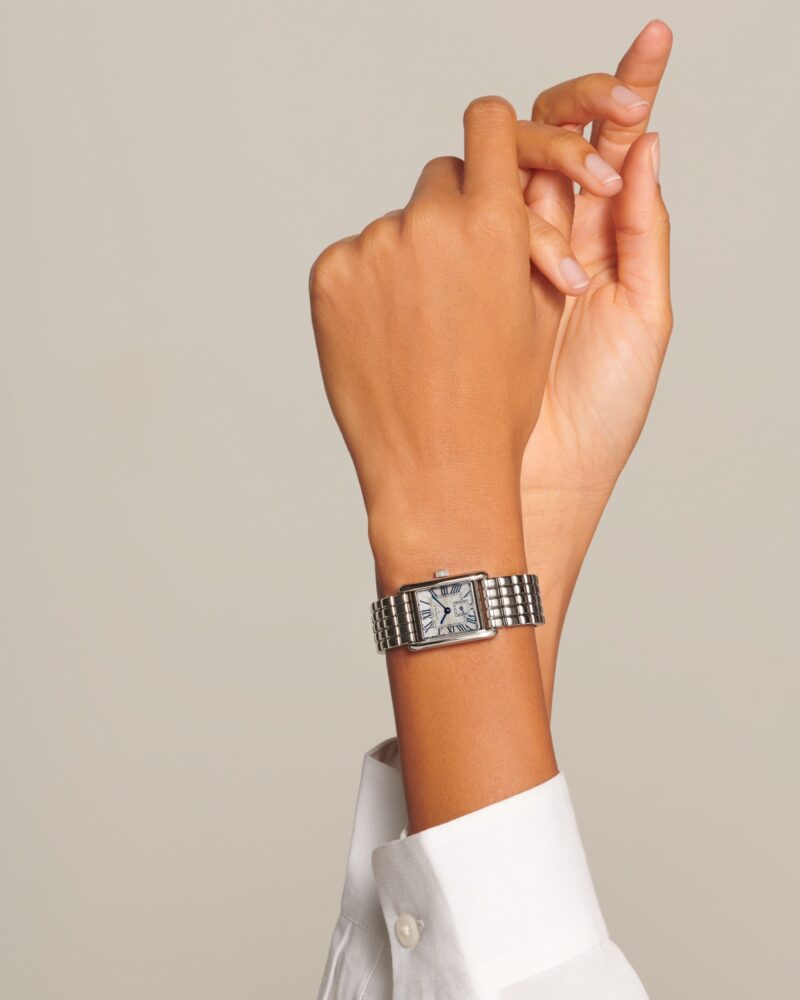
Longines Mini DolceVita: A Small Watch for the Life Ahead
A silver flinqué dial, blue hands and a closely linked steel bracelet: Longines Mini