
TheTimeo / TheTimeo Encyclopedia
TIFFANY & CO.:
New York clarity, drawn in metal and stone
An evergreen guide to Tiffany & Co.: its New York foundation, Blue Book, Tiffany Setting, key designers, collection language and collector checks.
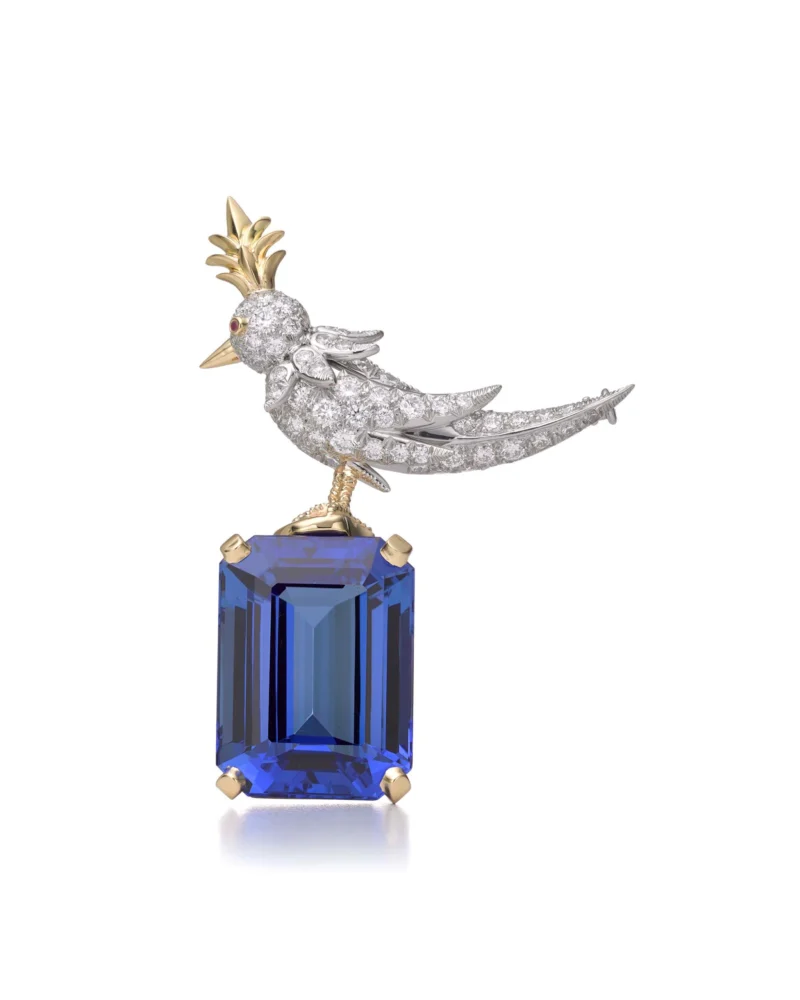
Jean Schlumberger’s Bird on a Rock places a diamond-set bird above an emerald-cut tanzanite. The motif changes with the scale, colour and cut of its gemstone. Courtesy of Tiffany & Co.
Explore the story
Tiffany & Co. is a New York jewellery house founded in 1837. Its identity connects diamonds and coloured gemstones with an unusually clear graphic system: the Blue Book, the blue box, a six-prong engagement-ring setting and distinct bodies of work by designers including Jean Schlumberger and Elsa Peretti.
This guide separates those enduring codes from the details of an individual jewel. A name such as Tiffany Setting, Bean or Bird on a Rock describes a design family; date, dimensions, materials, marks and construction establish the object in front of you.
Definition and scope
The house operates across jewellery, high jewellery, watches, objects and gifts. Charles Lewis Tiffany established an American point of view through retail, cataloguing and gemstone presentation. Later designers did not produce one uniform style: Schlumberger’s coloured, animated forms and Peretti’s reduced, bodily curves belong to the same house precisely because each retained a strong authorial language.
For reference purposes, Tiffany is best read through systems. Settings control how a stone meets light. Lines and surfaces control how metal meets the body. Catalogues, signatures and object records control how a design is named and placed in time.
Foundation and historical development
- 1837: Charles Lewis Tiffany opened the first store in New York City.
- 1845: the first Tiffany catalogue appeared; the house dates use of its characteristic blue on the catalogue cover to this year.
- 1886: the six-prong Tiffany Setting was introduced, raising the diamond above the band.
- 1956: Jean Schlumberger joined Tiffany & Co.
- 1974: Elsa Peretti joined the house and developed a vocabulary of organic, tactile forms.
- 2014: Tiffany T debuted as a graphic collection built around the letter and right-angled geometry.
The timeline identifies house milestones. It does not date a jewel automatically: signatures, construction, material marks and documentary evidence remain reference-specific.
Aesthetic and design identity
Clarity around the stone
The Tiffany Setting makes space beneath and around a diamond, using six prongs to lift it above the band. The idea is architectural: the mount should support the stone while reducing visual interruption. Prong condition and symmetry are therefore functional as well as aesthetic.
Graphic New York line
Atlas numerals, T-shaped links, HardWear chains and clean bands turn familiar signs into structure. Scale matters. A slender T wire, a substantial gauge link and a watch bracelet may share geometric discipline but behave very differently on the body.
Designer voices
Schlumberger used colour, crossing lines and lively natural subjects; Bird on a Rock is the best-known shorthand, but not the full vocabulary. Peretti reduced beans, bones, tears and open forms to smooth, tactile silhouettes. Attribution should follow documented design and period evidence, not resemblance alone.
Technical and manufacturing ideas
- Setting as light control
Prongs, bezels and pavé do different work. The six-prong Tiffany Setting opens the side profile of a diamond; a bezel draws a continuous metal boundary; pavé creates a field of small stones. Each must be described by what is visible and documented on the specific jewel.
- Surface and hollow volume
Peretti’s sculptural forms depend on uninterrupted surfaces and carefully judged thickness. Some apparently solid volumes may be engineered for wearability. Dents, over-polishing and distorted openings can change the intended line, so weight and wall construction should never be assumed from photographs.
- Links, clasps and movement
HardWear and other chain-based designs make articulation part of the image. Inspect link joins, alignment, clasp security and movement under light handling. On a bracelet or necklace, the reverse and connecting hardware are as informative as the presentation face.
Fundamental collections and objects
Tiffany Setting
The 1886 six-prong engagement-ring design raises the diamond above a plain band. Stone shape, carat weight, metal, proportions and later variations must be recorded individually.
Blue Book and high jewellery
Blue Book began as a house catalogue and now also names high-jewellery presentations. A Blue Book association should be tied to an official record, publication or provenance document rather than inferred from complexity.
Schlumberger
Bird on a Rock, enamel bracelets and nature-derived jewels combine colour with precise mechanisms and settings. Identify the exact motif, stones, enamel condition and signature configuration.
Elsa Peretti
Bean, Bone cuff, Open Heart and Diamonds by the Yard explore contour, negative space and direct contact with the body. Size and proportion are essential identifiers because a familiar outline exists in many scales and materials.
Contemporary graphic families
Tiffany T, HardWear, Lock and Knot develop letters, hardware and closure ideas. Their mechanisms and dimensions differ within each collection; names should not replace reference-level description.
What matters to a collector
- Read marks in context
Record the Tiffany & Co. signature, material marks, designer signature where present, numbers and country or assay marks. Their form and placement should be consistent with the object and period. A signature alone does not establish authenticity.
- Separate stone documents from jewel identity
A gemstone report describes the submitted stone within its stated scope; it does not by itself establish the history of the mount. Match inscriptions, measurements and documents carefully, and distinguish laboratory findings from seller descriptions.
- Protect the designed line
Polishing, resizing, prong work and link repair can alter proportion or erase evidence. Ask a qualified specialist to document condition and proposed intervention, especially for enamel, signed designer pieces and mechanically complex jewels.
Terminology and related references
- Tiffany Setting: the house’s six-prong raised diamond setting introduced in 1886.
- Blue Book: the historic Tiffany catalogue name, now also associated with high-jewellery presentations.
- Prong: a metal element that secures a gemstone at its edge.
- Pavé: a surface set closely with small stones.
- Negative space: an intentional opening that forms part of a design.
- Related reading: diamond reports, hallmarks, enamel, stone setting, designer jewellery and conservation.
Sources & further reading
This evergreen guide was rechecked on 11 September 2026 against Tiffany & Co.’s official heritage and timeline pages, Blue Box history, setting guide and its accounts of Jean Schlumberger and Elsa Peretti. The text uses dated records and construction details, and does not authenticate or grade an individual object.
- Tiffany & Co. — Heritage
- Tiffany & Co. — Timeline
- Tiffany & Co. — The Tiffany Blue Box
- Tiffany & Co. — Engagement ring settings
- Tiffany & Co. — Jean Schlumberger
- Tiffany & Co. — Elsa Peretti
Media: official Tiffany & Co. photography retained as WordPress media 6635 and reverified against its governed source article and file record.
The Edit
TheTimeo Encyclopedia stories
Selected stories from the same editorial universe.
Tudor: tool-watch clarity and modern manufacture
An evergreen guide to Tudor: its 1926 origins, Oyster Prince and diving-watch history, Black

TAG Heuer: chronographs, instruments and design systems
An evergreen guide to TAG Heuer: its 1860 origins, timing instruments, Carrera and Monaco

Girard-Perregaux: architecture, Three Bridges and the Laureato
An evergreen guide to Girard-Perregaux: the Bautte and Girard-Perregaux lineages, Three Bridges, movement manufacture,

Hublot: material fusion, Big Bang and Unico
An evergreen guide to Hublot: the 1980 gold-and-rubber premise, Big Bang architecture, Unico chronographs,