
TheTimeo / TheTimeo Encyclopedia
Spinel,
in its own
colours.
Blue and red can meet in the same ring without either stone being sapphire or ruby. A photographic reference to spinel, its colours, its identity and the questions worth asking.
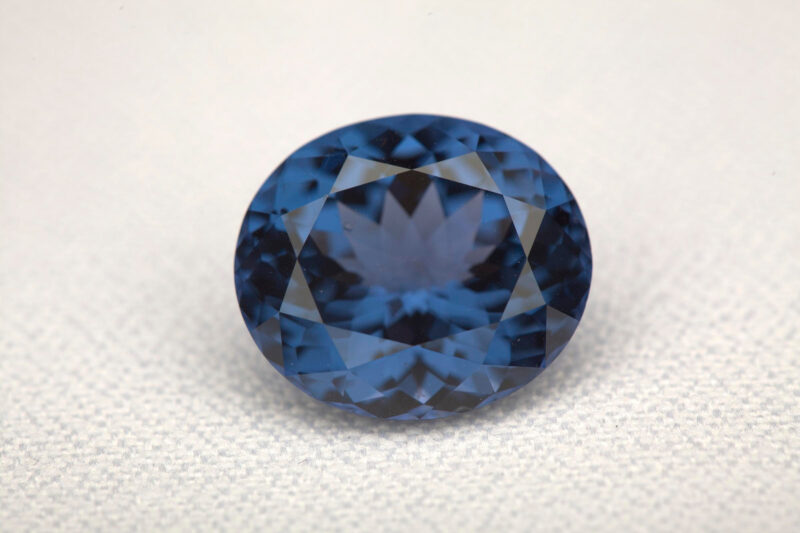
Blue spinel, 14.02 ct, recorded from Sri Lanka; NMNH G10629. Smithsonian Institution. CC0.
Explore the story
Two cushions meet on a crossover ring: one blue, one red. Both are spinels. That small fact opens a more interesting conversation than deciding which other gem either resembles. Spinel has a mineral identity of its own and a broad range of colours. Looking at real stones, a museum colour suite and two documented rings makes those possibilities tangible, from a loose blue oval to a vivid pair on the hand.
Red and blue, in one ring
01 / 02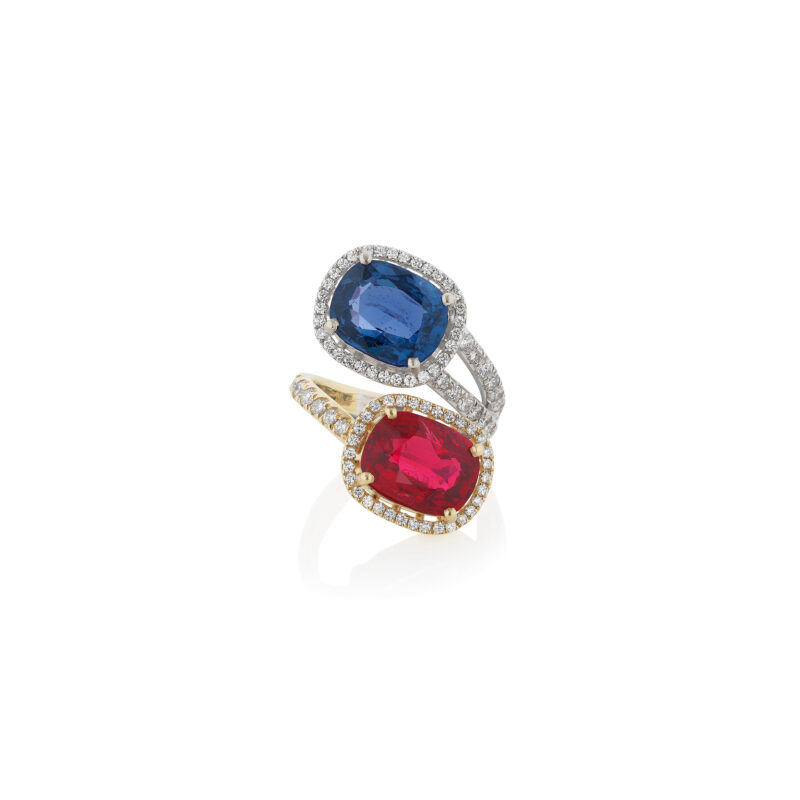
Two spinels in one crossover ring: 4.91 ct blue and 4.30 ct red in Phillips’ lot 394. Photograph courtesy of Phillips.
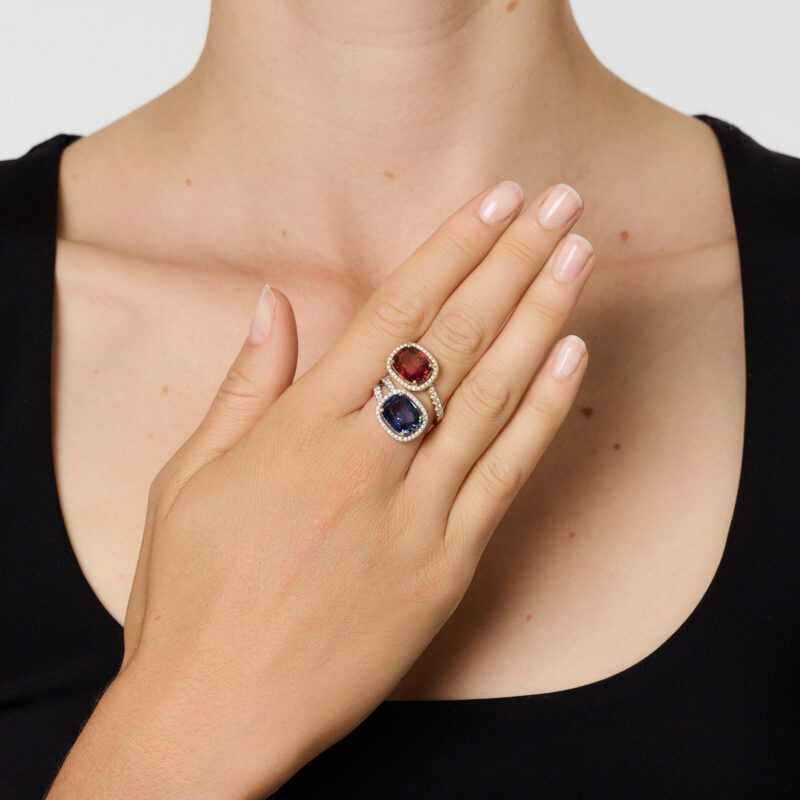
The crossover ring on the hand, in official catalogue photography. Courtesy of Phillips.
The crossover ring makes the contrast immediate. One cushion sits above the other, each held within a diamond border. Their colours share a composition while remaining individually clear. Phillips’ catalogue lists a 4.91-carat blue spinel and a 4.30-carat red spinel for this jewel, lot 394 in Geneva Jewels VII. In the worn photograph, the two stones form a long gesture along the finger.
The word spinel is doing useful work here. Ruby and sapphire are varieties of corundum. Spinel is a different mineral, magnesium aluminium oxide, written chemically as MgAl2O4. Its name identifies the material rather than a colour. A red spinel can therefore be admired as a red spinel, and a blue one as a blue spinel, without either needing another gemstone’s name to explain its appeal.
The loose blue oval in the opening photograph belongs to the Smithsonian collection. The museum records it as a 14.02-carat spinel from Sri Lanka, catalogued as NMNH G10629. Its broad central surface and the smaller facets around it create a different visual rhythm from the paired cushions. Together, the two examples show how mineral identity, colour and jewellery design can remain distinct parts of the same reading.
One mineral, many colours
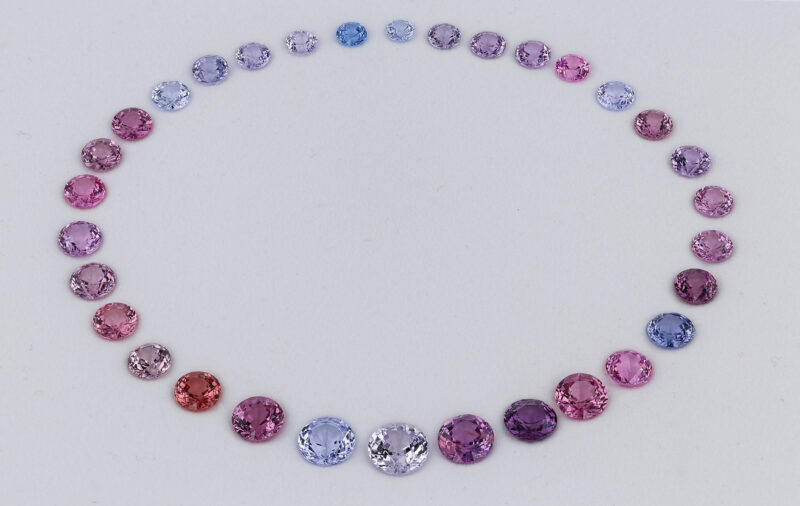
Thirty-two round-cut spinels from Vietnam, NMNH G11463. Photograph: Greg Polley / Smithsonian Institution. CC0.
The Smithsonian’s suite of thirty-two round-cut spinels from Vietnam widens the view. Arranged in a circle, the gems move through pale and stronger colours, including pink, lilac, purple and blue. It is a collection of actual specimens, photographed together, rather than a set of invented digital swatches. The museum records the suite as NMNH G11463; the photograph is by Greg Polley.
Give the sequence a little time. Notice which colours draw your eye back, and how differently a pale stone reads beside a more saturated neighbour. The image is a useful introduction to variety, rather than a colour-grading chart. It does not tell you that every spinel from one locality looks alike, or that a photograph can establish where another stone was found.
That distinction leaves room for a more personal starting point. You might be drawn to a quieter lilac, a deep blue or a strong red. Begin with the colour that interests you, then examine the individual stone: its distribution of light, visible features, outline and the setting around it. The family offers possibilities; the particular gem is what you will actually see and wear.
A different kind of presence
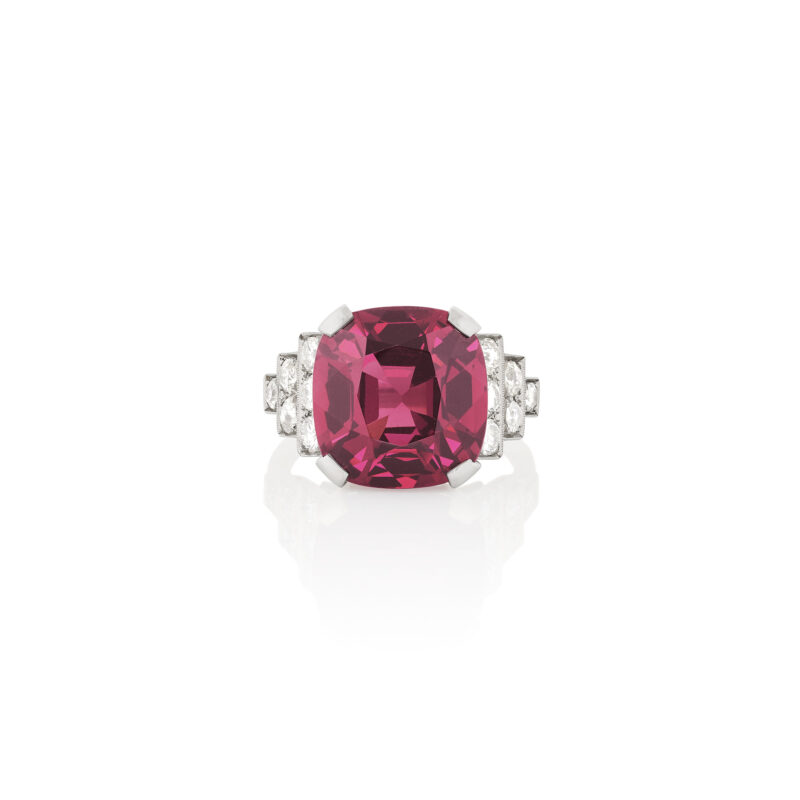
A different ring: Phillips lot 405, centred on an 11.71 ct spinel. Photograph courtesy of Phillips.
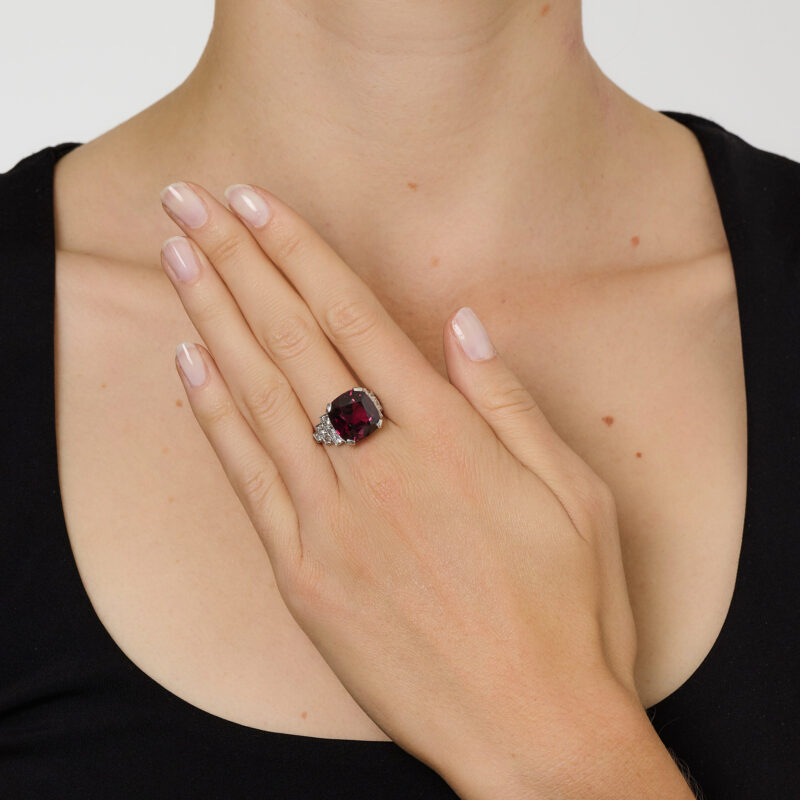
Lot 405 on the hand. The setting and body give the stone another context. Photograph courtesy of Phillips.
The second ring changes the composition. A single cushion-shaped spinel occupies the centre, with diamonds at the shoulders. Phillips lists its weight as 11.71 carats in lot 405. In the whole-object photograph, the central shape dominates; on the hand, the stone takes its place among the lines of the fingers and the surrounding clothing.
Compare that arrangement with the crossover ring. Two smaller centres create a conversation between colours and positions. One larger centre gives the eye a more direct destination. Neither photograph determines which you should prefer. They make it easier to see how a choice concerns the whole jewel as well as the gem: silhouette, setting and the area of colour you would like to carry.
Look at the outline first, then follow the light within it. A cushion and an oval guide the eye differently, even before colour enters the comparison. When you see a stone in person, turn it gently and observe the whole face rather than judging it from one bright reflection. Let the changing view contribute to your impression of the cut and to the questions you ask about it.
A small reference for looking closer
- Identity and description
GIA lists spinel at 8 on the Mohs hardness scale. Hardness concerns resistance to scratching; it does not describe the security of a particular setting. Keep a clear description of the stone and jewel with your purchase documents. If natural origin matters to the decision, an appropriate laboratory report can address that question. Synthetic spinel also exists, so appearance alone should not be asked to settle identity.
- Treatment and the exact stone
Read treatment information for the stone in front of you. GIA describes possible heating and fracture filling in spinel. The crossover ring offers a concrete reminder to read complete comments: Phillips’ disclosure for its red stone includes a minor amount of oil in fissures, alongside a finding of no indications of heating. Those statements concern different matters. They should remain together when you understand and care for that particular gem.
- Quality words and laboratory reports
A grading phrase used by a seller belongs to that seller’s description unless its meaning is clearly explained. GIA notes that there is no standard spinel quality scale and distinguishes identification from grading. Ask what a term describes: colour, clarity, cut or something else. Clear answers are more useful than an impressive sequence of letters, particularly when you are comparing two very different stones.
- Care in everyday life
GIA recommends warm soapy water as a simple cleaning approach for spinel and gives particular cautions for fracture-filled material. The complete jewel deserves attention too: other gemstones, the metal and the construction can change the appropriate care. Ask the jeweller for guidance for the actual piece, especially before using ultrasonic or steam equipment. Keep that advice with its other documents so that the details remain easy to find.
Choose the colour you return to
The most useful first impression may be a colour you keep noticing. Give it a name, learn which material carries it, then see how the gem belongs in its setting. Spinel rewards that sequence: a mineral with its own identity, expressed through individual stones and very different ways of wearing them.
Sources & further reading
- GIA — spinel identity and properties
- GIA — spinel buyer’s guide and laboratory reporting
- GIA — spinel care and cleaning
- Phillips — lot 394, exact red/blue crossover ring and disclosures
- Phillips — lot 405, 11.71 ct spinel ring
- Smithsonian —32 spinels from Vietnam, NMNH G11463, CC0
- Smithsonian — blue spinel, NMNH G10629, 14.02 ct, CC0
- Blue spinel, NMNH G10629 — Smithsonian Institution, CC0 1.0. Display copy resized and converted to sRGB; original composition retained.
- Spinel suite, NMNH G11463 — Greg Polley, CC0 1.0. Display copy resized and converted to sRGB; original composition retained.
The Edit
TheTimeo Encyclopedia stories
Selected stories from the same editorial universe.
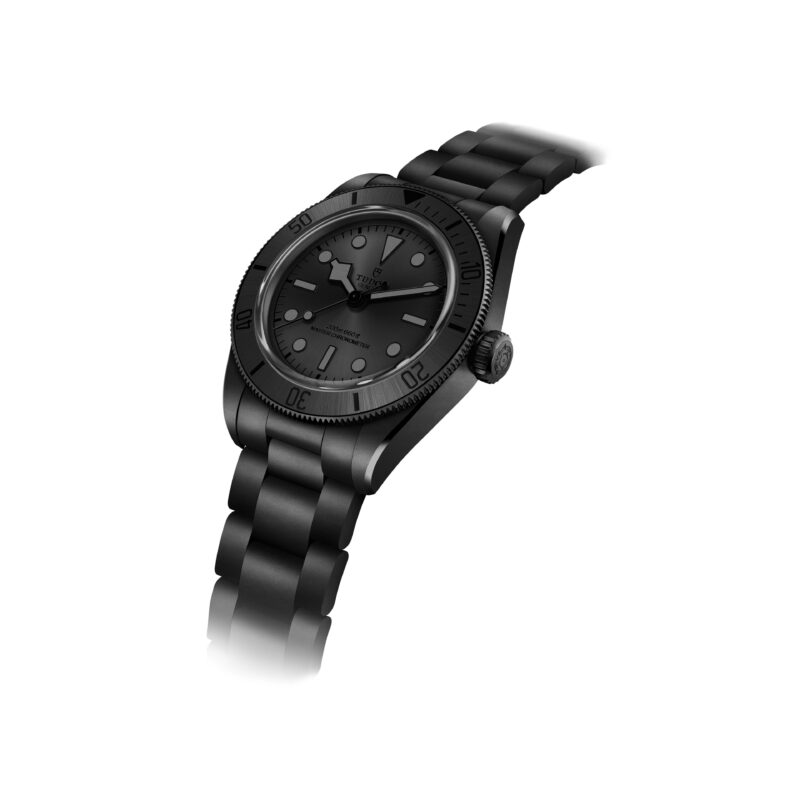
Tudor: tool-watch clarity and modern manufacture
An evergreen guide to Tudor: its 1926 origins, Oyster Prince and diving-watch history, Black

TAG Heuer: chronographs, instruments and design systems
An evergreen guide to TAG Heuer: its 1860 origins, timing instruments, Carrera and Monaco
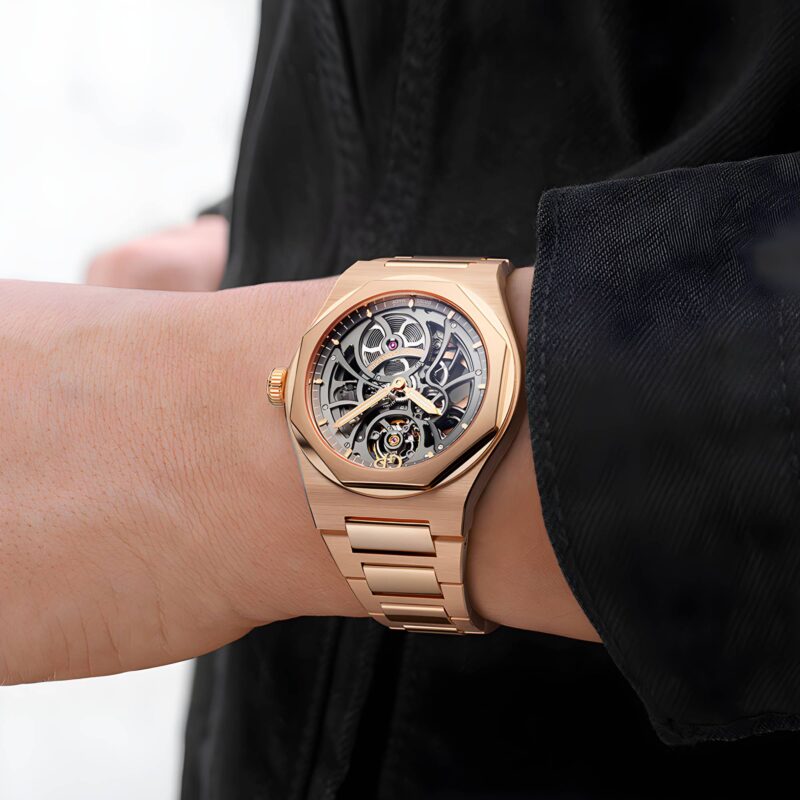
Girard-Perregaux: architecture, Three Bridges and the Laureato
An evergreen guide to Girard-Perregaux: the Bautte and Girard-Perregaux lineages, Three Bridges, movement manufacture,

Hublot: material fusion, Big Bang and Unico
An evergreen guide to Hublot: the 1980 gold-and-rubber premise, Big Bang architecture, Unico chronographs,