
TheTimeo / TheTimeo Encyclopedia
POMELLATO:
Milanese colour, shaped for the body
An evergreen guide to Pomellato: its 1967 Milan foundation, prêt-à-porter idea, colour, Nudo, Iconica, gold construction and collector checks.
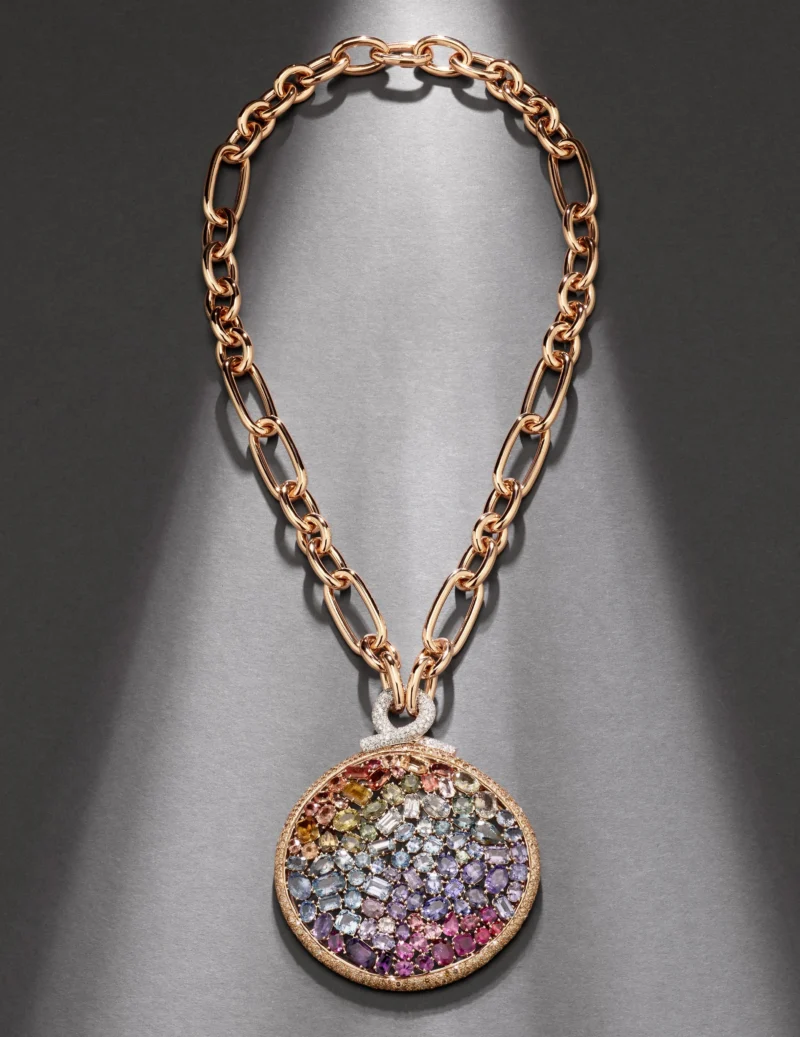
Mandala Chromia: a multicoloured sapphire medallion suspended from a rose-gold chain. Source: Pomellato.
Explore the story
Pomellato is a Milan jewellery house founded in 1967 by Pino Rabolini. It proposed jewellery with the immediacy of ready-to-wear: recognisable design, substantial gold and colour intended for regular use. Nudo, Iconica, Catene and Sabbia show how that premise can move from a single exposed stone to links, bands and irregular fields of light.
This guide treats the collection name as an entry point. Accurate description still depends on dimensions, gold colour, stone identity, setting, marks and construction.
Definition and scope
Pomellato works primarily in jewellery and high jewellery. Its official account ties the house to Milan, rose gold, coloured stones and a workshop culture in which casting, setting, polishing and assembly support rounded, tactile form. The result is often informal in use but technically exact in execution.
Colour is not an afterthought. Stones can be selected for unexpected hue and arranged to work with warm gold. Volume is equally important: a ring, link or bezel is designed as a three-dimensional object that meets the hand, not only as a frontal image.
Foundation and historical development
- 1967: Pino Rabolini founded Pomellato in Milan.
- Late twentieth century: the house developed its ready-to-wear jewellery proposition through bold gold forms, chains and coloured stones.
- 2001: Nudo was introduced, exposing a specially cut stone above a restrained setting.
- Anniversary period: Iconica was created as a gold-centred statement of the house’s Milanese craft vocabulary.
- Contemporary practice: Nudo, Iconica, Catene and Sabbia continue across multiple sizes, stones and constructions.
The sequence explains design development but does not date a jewel. Signatures, marks, dimensions and documented collection records must be assessed together.
Aesthetic and design identity
Colour without a heavy frame
Nudo makes the stone appear visually open by reducing the visible setting. Its irregular 57-facet cut is a documented collection code. Colour may derive from a natural gem, a doublet or another specified construction; the exact product record must decide the description.
Sculpted gold
Rounded bands, generous bezels and softly inflated links give Pomellato jewellery a tactile quality. Rose gold is recurrent, but metal and finish must be recorded for the particular object rather than inferred from house style.
Milanese ease
The ready-to-wear premise encourages stacking, mixing and daily use. That flexibility is visual and practical: proportions, internal curves and link movement determine comfort just as much as colour determines recognition.
Technical and manufacturing ideas
- Lost-wax casting and finishing
Pomellato’s official craftsmanship account describes microfusion, or lost-wax casting, as part of the route to rounded gold volumes. Casting is followed by assembly, setting and surface finishing; seams, junctions and interior surfaces deserve the same attention as the polished exterior.
- The Nudo cut and setting
Nudo’s stone is cut with 57 irregular facets and mounted so that it appears to float. Inspect the stone edges, seating and junction with the ring without assuming that every colour uses the same gem construction.
- Links and pavé fields
Catene turns enlarged links into the design, while Sabbia uses irregular arrangements of stones to form granular light. Articulation, clasp security, stone setting and mixed surface finishes are reference-level facts.
Fundamental collections and models
Nudo
Introduced in 2001, Nudo centres an exposed coloured stone above a restrained shank. Size, cut, material construction, gold colour and ring dimensions vary.
Iconica
A family of smooth, substantial gold bands and links associated with the house’s anniversary and Milanese goldsmithing. Versions range from plain gold to diamond-set compositions.
Catene
Chain links are enlarged and polished into the principal motif. Link gauge, articulation, closures and stone-set sections should be recorded individually.
Sabbia
Irregular pavé arrangements evoke grains of sand rather than a rigid grid. Note stone type, setting pattern, metal and whether the element is fixed or articulated.
What matters to a collector
- Identify the stone construction
Do not translate colour into gem identity. Match the jewel to an official reference or reliable documentation and record whether the stone is natural, assembled or treated when that information is supplied.
- Check volume, fit and movement
Photograph the profile and interior as well as the face. On rings, confirm size and evidence of alteration. On chains, inspect link alignment, solder areas and clasps under gentle handling.
- Conserve the surface
Repeated polishing can change a rounded contour, thin edges and blur marks. Pavé and exposed stone edges require specialist inspection before cleaning or repair. Keep the written scope and service record.
Terminology and related references
- Prêt-à-porter jewellery: Pomellato’s ready-to-wear proposition for recognisable jewellery intended for regular use.
- Microfusion: lost-wax casting used to form a metal object from a model.
- Doublet: an assembled stone made from joined layers; use only when documented for the reference.
- Pavé: closely set small stones creating a continuous field.
- Related reading: coloured gemstones, rose gold, casting, stone setting, hallmarks and jewellery care.
Sources & further reading
This evergreen guide was rechecked on 11 September 2026 against Pomellato’s official craftsmanship, Nudo and Iconica pages and Kering’s institutional account. A former legal-page citation was removed because it did not support the editorial claims. The text does not authenticate or grade an individual object.
- Pomellato — Craftsmanship
- Pomellato — Nudo since 2001
- Pomellato — Iconica
- Kering — The making of a revolutionary jeweller
Media: official Pomellato photography retained as WordPress media 6755 and reverified against its governed source article and file record.
The Edit
TheTimeo Encyclopedia stories
Selected stories from the same editorial universe.
Tudor: tool-watch clarity and modern manufacture
An evergreen guide to Tudor: its 1926 origins, Oyster Prince and diving-watch history, Black

TAG Heuer: chronographs, instruments and design systems
An evergreen guide to TAG Heuer: its 1860 origins, timing instruments, Carrera and Monaco
Girard-Perregaux: architecture, Three Bridges and the Laureato
An evergreen guide to Girard-Perregaux: the Bautte and Girard-Perregaux lineages, Three Bridges, movement manufacture,

Hublot: material fusion, Big Bang and Unico
An evergreen guide to Hublot: the 1980 gold-and-rubber premise, Big Bang architecture, Unico chronographs,