
TheTimeo / TheTimeo Encyclopedia
PIAGET:
thinness as creative space
An evergreen guide to Piaget: its 1874 foundation, 9P and 12P calibres, Altiplano, hard-stone dials, goldwork, Piaget Polo and collector checks.
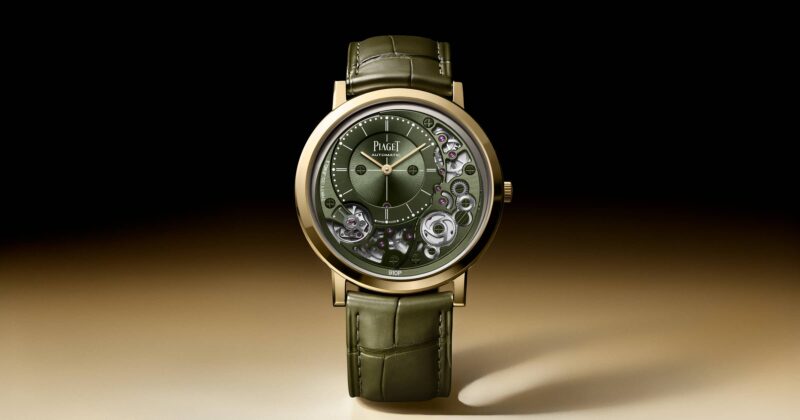
Piaget Altiplano. Courtesy of Piaget.
Explore the story
Piaget is a Swiss watch and jewellery house founded by Georges-Édouard Piaget at La Côte-aux-Fées in 1874. Its identity connects ultra-thin movements with an unusually expressive use of gold, ornamental-stone dials and jewellery construction. The 9P and 12P calibres created room for that visual freedom; Altiplano, Piaget Polo and Possession developed it in different directions.
This guide distinguishes the house codes from the facts of an individual object. A thin profile, stone dial or integrated gold bracelet may suggest a Piaget vocabulary, but reference, calibre, dimensions, marks and documented materials establish the watch or jewel.
Definition and scope
Piaget works across watchmaking, jewellery and high jewellery. Its two historic centres help explain the catalogue: La Côte-aux-Fées is associated with movement manufacture, while Geneva developed goldsmithing and gem-setting. Technique and appearance are therefore closely connected.
Thinness is not simply a measurement. Reducing movement height can change the case, dial, hands and the way a watch sits on the wrist. Gold is likewise treated structurally, through bracelets, textured surfaces and moving jewellery elements rather than as a neutral shell.
Foundation and historical development
- 1874: Georges-Édouard Piaget established a workshop on the family farm at La Côte-aux-Fées, producing movements and components.
- 1943: Piaget became a registered trademark; a larger manufacture followed at La Côte-aux-Fées in 1945.
- 1957: the hand-wound calibre 9P was presented at 2 mm thick.
- 1959: the first Salon Piaget opened in Geneva, bringing jewellery and watches into one presentation.
- 1960: calibre 12P used a micro-rotor to create a notably thin automatic movement.
- 1961 onward: Decor Palace gave gold a hand-worked, irregularly striated surface.
- 1963: the house records the introduction of watches with ornamental-stone dials.
- 1979: Piaget Polo joined case and bracelet in a continuous gold design.
Altiplano later became the principal collection name for the ultra-thin lineage. These dates organise the official history; they do not date an object without supporting reference evidence.
Aesthetic and design identity
Thinness and proportion
An ultra-thin watch succeeds through the relationship between movement, case, bezel, dial and hands. A low numerical thickness does not describe the entire wearing experience: diameter, lug geometry, crystal and case-back construction all matter.
Gold as architecture
Piaget bracelets can make watch and jewel visually continuous. Polished links, woven structures and textured surfaces articulate light across the wrist. The Geneva foundry and specialist ateliers form part of the house’s official account, but each object still requires its own material marks and construction description.
Colour and stone dials
Lapis lazuli, malachite and other ornamental materials brought intense, naturally variable colour to thin watch cases. Veining and colour variation are intrinsic to many stones. Identification should follow documentation and qualified examination, not colour alone.
Technical and manufacturing ideas
- Calibres 9P and 12P
The 9P is a hand-wound movement documented at 2 mm thick. The automatic 12P uses a micro-rotor set within the movement plane rather than a full rotor above it. Calibre number, dimensions and later derivatives must be checked at reference level.
- Integrated architecture
Altiplano Ultimate Concept merges the case and movement architecture; the named model is documented at 2 mm overall. This solution cannot be generalised to every Altiplano. Service procedures and component tolerances are specific to the reference.
- Decor Palace and articulated gold
Developed in 1961, Decor Palace is engraved by hand to create rhythmic, irregular striations. Repeated polishing can reduce its depth. On bracelets and moving jewels, inspect articulation, closures and the transition between decorated and polished surfaces.
Fundamental collections and models
Altiplano
The principal ultra-thin family, spanning restrained two-hand watches, complications, skeletonised constructions and integrated ultra-thin architectures. Record the exact calibre, case dimensions and display.
Piaget Polo
Introduced in 1979 as a continuous gold case-and-bracelet design. Later Polo references use different cases, bracelets, materials and movements; the name alone does not imply the original construction.
Jewellery watches and stone dials
Gold bracelets, concealed dials and ornamental stones blur the line between watch and jewel. Note how the watch head is integrated, how the bracelet moves and whether a stone dial shows cracks or previous replacement.
Possession and Piaget Rose
Possession uses rotation as a jewellery gesture; Piaget Rose develops a layered floral motif. Size, mechanism, stones, metal and marks distinguish their many versions.
What matters to a collector
- Match calibre to case
Record case reference, movement calibre and serial information where accessible through appropriate service. Ultra-thin components are sensitive; opening and intervention belong with a qualified specialist.
- Examine ornamental materials carefully
Stone dials can be thin and brittle. Look for fractures, lifting, replacement evidence and damage around dial feet or apertures without applying pressure. Ask whether material identity is documented.
- Preserve designed surfaces
Refinishing can soften a thin case, alter bracelet geometry and erase Decor Palace texture or marks. Obtain a written conservation scope and retain photographs, replaced components where available and service records.
Terminology and related references
- Ultra-thin: a relative watchmaking description that must be tied to a documented movement or complete-watch measurement.
- Micro-rotor: a compact automatic-winding rotor integrated into the movement plane.
- Decor Palace: Piaget’s hand-worked striated gold decoration introduced in 1961.
- Ornamental-stone dial: a dial made from decorative mineral material, often naturally variable and fragile.
- Related reading: calibre architecture, stone dials, integrated bracelets, gold marks and conservation.
Sources & further reading
This evergreen guide was rechecked on 11 September 2026 against Piaget’s official history, Altiplano, House of Gold and Altiplano Ultimate Concept records. Measurements and mechanisms are attributed only to their named calibres or models. The text does not authenticate or grade an individual object.
- Piaget — History
- Piaget — Altiplano collection
- Piaget — House of Gold
- Piaget — Altiplano Ultimate Concept
Media: official Piaget Altiplano photography retained as WordPress media 6596 and reverified against the governed manufacturer source and file hash.
The Edit
TheTimeo Encyclopedia stories
Selected stories from the same editorial universe.
Tudor: tool-watch clarity and modern manufacture
An evergreen guide to Tudor: its 1926 origins, Oyster Prince and diving-watch history, Black
TAG Heuer: chronographs, instruments and design systems
An evergreen guide to TAG Heuer: its 1860 origins, timing instruments, Carrera and Monaco
Girard-Perregaux: architecture, Three Bridges and the Laureato
An evergreen guide to Girard-Perregaux: the Bautte and Girard-Perregaux lineages, Three Bridges, movement manufacture,
Hublot: material fusion, Big Bang and Unico
An evergreen guide to Hublot: the 1980 gold-and-rubber premise, Big Bang architecture, Unico chronographs,