
TheTimeo / TheTimeo Encyclopedia
A colour
to live
with.
A blue-green centre moves from a ring to a pendant. Two documented jewels open a closer reading of Paraíba tourmaline, its name, its origins and its place in a personal collection.
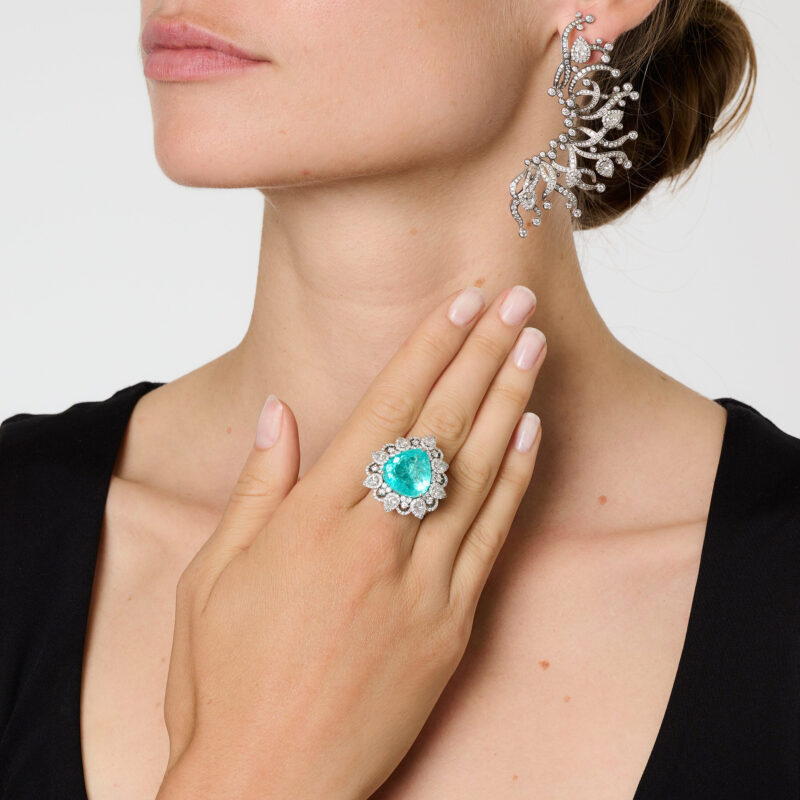
The ring and diamond earrings from Phillips’ lot 370, shown separately on the body. Official catalogue photograph; courtesy of Phillips.
Explore the story
The blue-green centre catches the eye before the diamonds around it. On the hand, it belongs to a ring; in another arrangement, the same colour sits at the neckline inside a much larger radiating composition. Phillips’ photographs of this convertible jewel offer an inviting way into Paraíba tourmaline. Begin with the pleasure of its colour, then look at the name, the place and the details that let you understand an individual stone.
One centre, two arrangements
01 / 02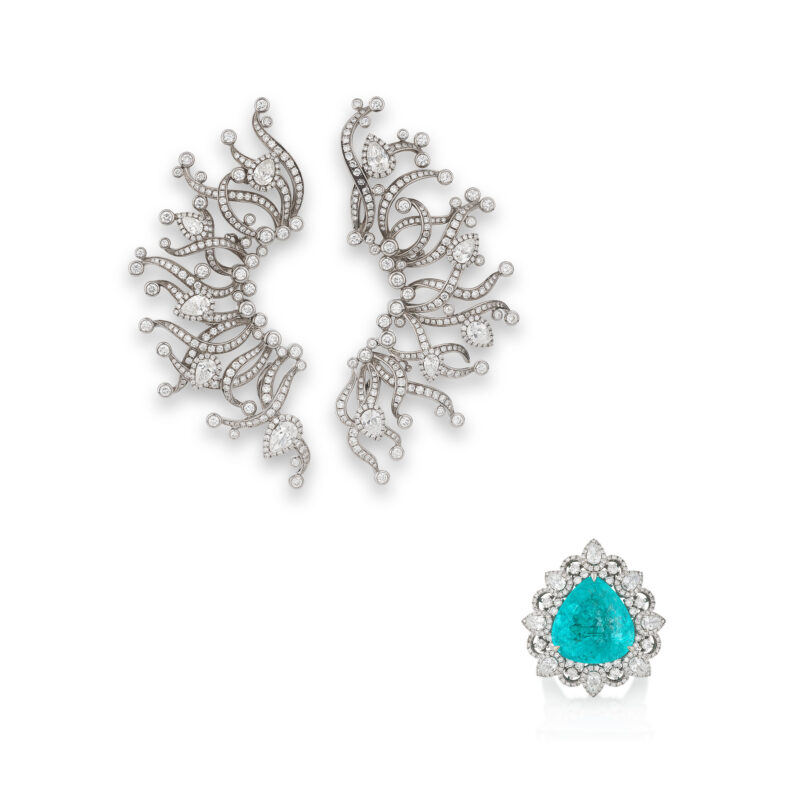
Lot 370: a 13.99 ct tourmaline ring with diamond earrings. The earrings contain diamonds; the blue-green centre belongs to the ring. Photograph courtesy of Phillips.
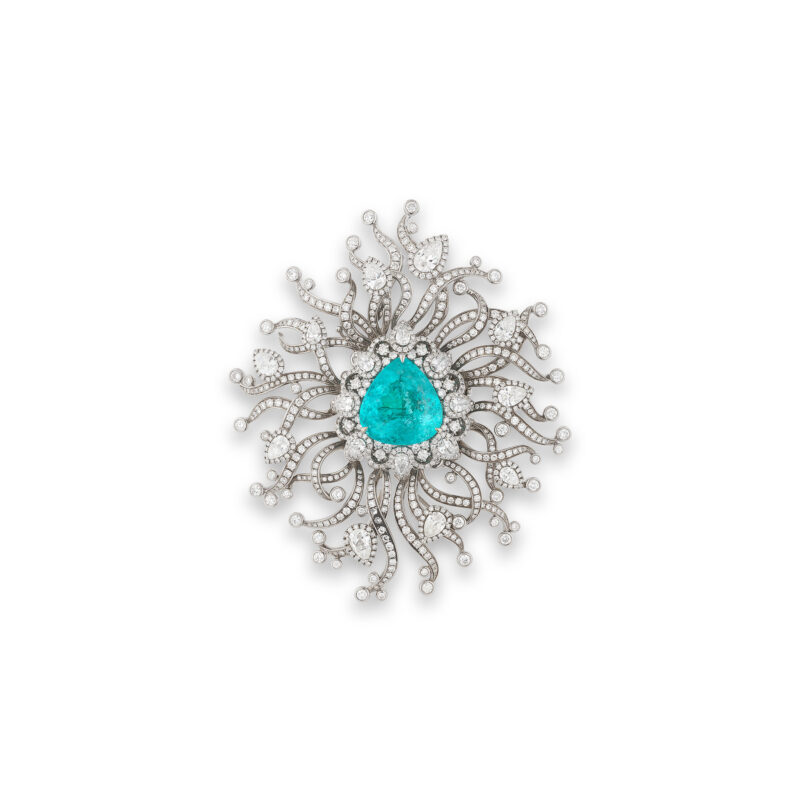
The pendant arrangement illustrated for the same lot. The catalogue records a detachable shank and components that may be worn together. Courtesy of Phillips.
The first photograph shows the pieces separately: a pear-shaped tourmaline ring below two long diamond earrings. The second brings them into a pendant arrangement. Small diamond branches extend around the blue-green centre, changing a concentrated point of colour into the focus of a broad, openwork jewel. You can follow the design from its middle outwards, or begin at the perimeter and let the diamonds lead you back to the stone.
Phillips catalogues this group as lot 370 in Geneva Jewels VII. The central tourmaline weighs 13.99 carats. The description records a detachable ring shank and earrings that may be worn together with it as a pendant. The earrings are diamond-set: the tourmaline remains the single coloured centre in the illustrated assembly. That distinction makes the transformation particularly clear. More surrounding design appears, while the colour keeps its role.
There are two different pleasures here. A ring makes the colour part of the hand’s movements, visible beside a cuff or resting against a dark sleeve. The assembled pendant creates a larger silhouette against the body. Looking at both arrangements is a useful reminder that choosing a coloured stone also means choosing how its colour will occupy your day. The setting determines where you encounter it and what surrounds it.
The colour finds a different place
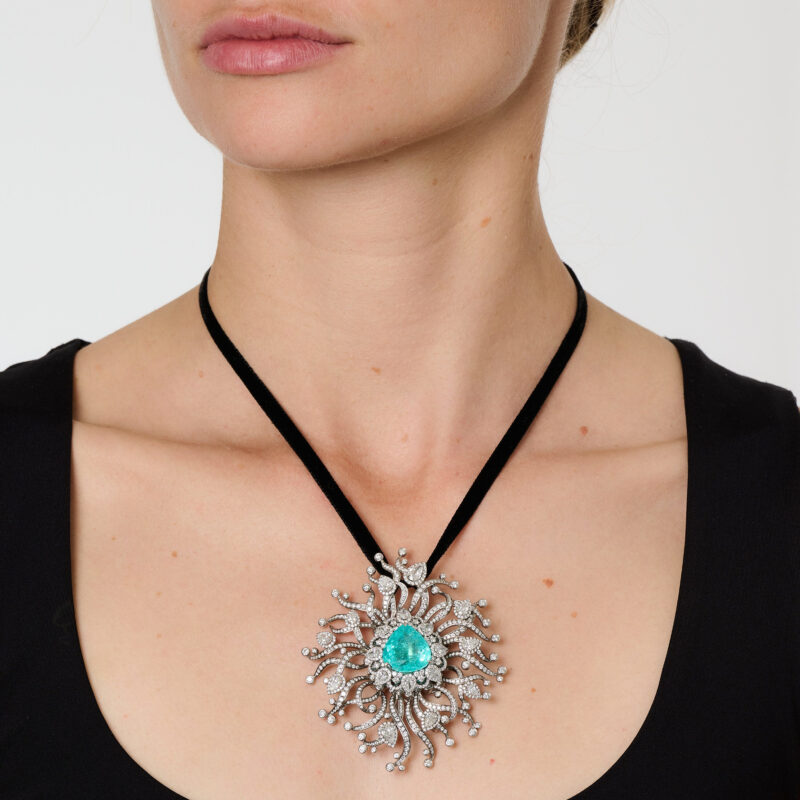
The catalogue’s worn view of the combined pendant arrangement. Courtesy of Phillips.
In the worn pendant photograph, a black ribbon draws a simple line around the neck. Below it, the diamond branches spread across bare skin. The blue-green centre is still easy to find, although the jewel now covers a much wider area. Dark fabric, skin and white diamonds give it three different neighbours in one composition.
This is where a photograph of a complete jewel earns its place beside the isolated product view. The size of the pendant becomes understandable without imagining it against an empty background. The arrangement also suggests questions to bring to a viewing: where does the jewel sit, how does it move, and does its outline belong with the neckline you have in mind? The answers come from the actual piece and your own clothes.
You might prefer the concentration of the ring, or the more expansive pendant. A convertible jewel leaves room for that preference to change. Its appeal can lie in recognising the same centre in a different setting, rather than building an entirely new look around another stone. The colour becomes a familiar element, carried into a new proportion.
A name, and a place
Paraíba describes a particular family
The name began with a Brazilian locality. SSEF describes qualifying blue-to-green tourmalines whose colour is mainly associated with copper and manganese; material from Nigeria and Mozambique is also known by the Paraíba trade name. A vivid blue-green appearance is the visual invitation, while identification belongs to gemmological examination. In SSEF’s reporting, colour is expressed with descriptive terms rather than an electric or neon grade. Those evocative words can describe an impression without becoming a laboratory classification.
Geographic origin is a separate statement
Keep the place beside the name. Phillips attributes Mozambican origin to the accompanying SSEF reports for both jewels illustrated here. The catalogue also records indications of heating and a minor amount of filler in fissures for each stone. Read those comments together when considering the particular piece. They make the description more complete and help the jeweller give appropriate care advice. A Paraíba name on its own leaves these individual details to be explored.
Another outline for the same family
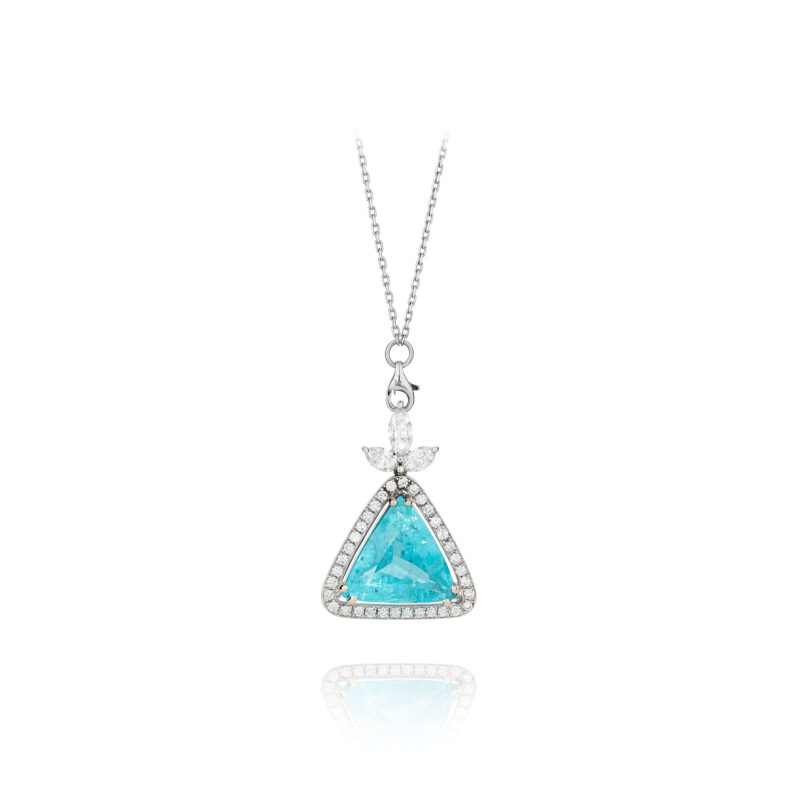
A different jewel: lot 396, with a 13.35 ct triangular tourmaline. Photograph courtesy of Phillips.
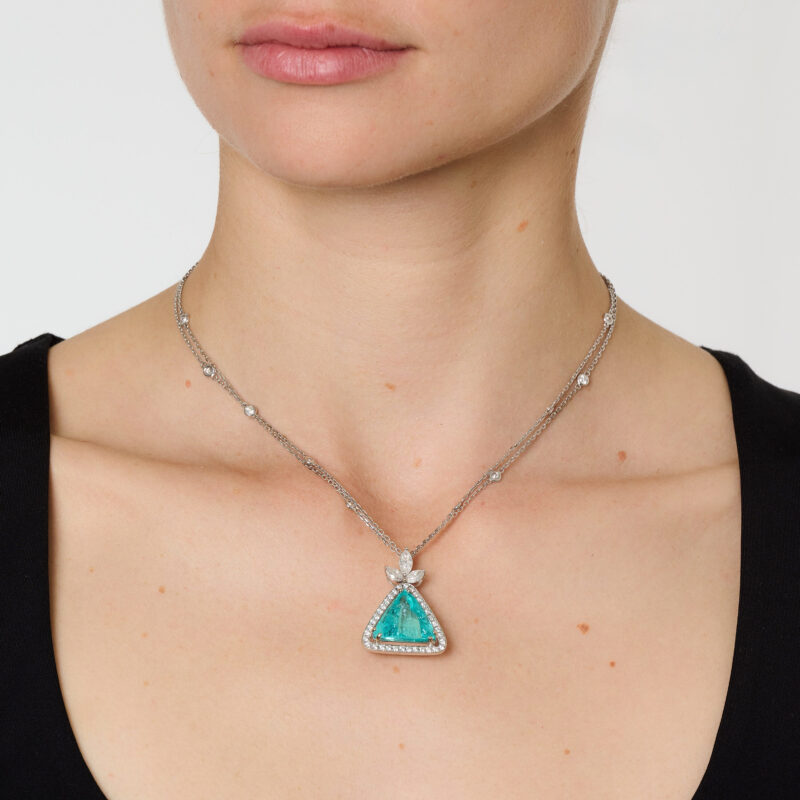
Lot 396 on the body, with its double chain and triangular centre. Official catalogue photograph; courtesy of Phillips.
The second jewel changes the geometry. A triangular tourmaline sits inside a close diamond frame, with marquise-shaped diamonds above it. Two fine chains carry the pendant, with small diamond accents along their length. Phillips lists the stone at 13.35 carats in lot 396, a separate jewel from the convertible ring and earrings.
The triangle gives the colour three clear directions. The diamond frame follows its perimeter closely, so the whole pendant reads as a compact shape at the base of the neck. Compare it with the radiating pendant arrangement: one lets the surrounding branches spread, while the other keeps the composition close to the stone. The difference is in design as much as in outline.
Use the worn photographs to judge which relationship interests you. A long open neckline gives a pendant a different setting from a high collar; a fine chain creates a different line from a ribbon. Let the jewel’s position, the clothes and the area of colour work together. Looking this way makes the choice personal before it becomes a list of specifications.
Care is part of living with that choice. GIA recommends warm, soapy water for tourmaline and advises against ultrasonic and steam cleaners. Ask the jeweller how that guidance applies to the complete piece, including its treatment history, other stones and construction. A specific care routine is easier to keep when it travels with the jewel’s documents, rather than being remembered as a general rule for all coloured gems.
The paperwork for these two stones is identified in the catalogue as SSEF reports 155710 and 155578. Keep the correct report with the correct jewel and request the complete current documents when viewing an offered piece. The photographs here offer two ways of wearing a colour; the individual descriptions let you follow each object precisely.
Keep the colour close
The most lasting attraction may be the way a particular blue-green looks beside your skin, a black ribbon or the sleeve you wear most often. Give that response some time. See the whole jewel, follow its changes of scale and learn the individual stone’s description.
Paraíba becomes more interesting when the name opens a conversation rather than ending it. Colour draws you in; the design decides where it will live.
Sources & further reading
The Edit
TheTimeo Encyclopedia stories
Selected stories from the same editorial universe.
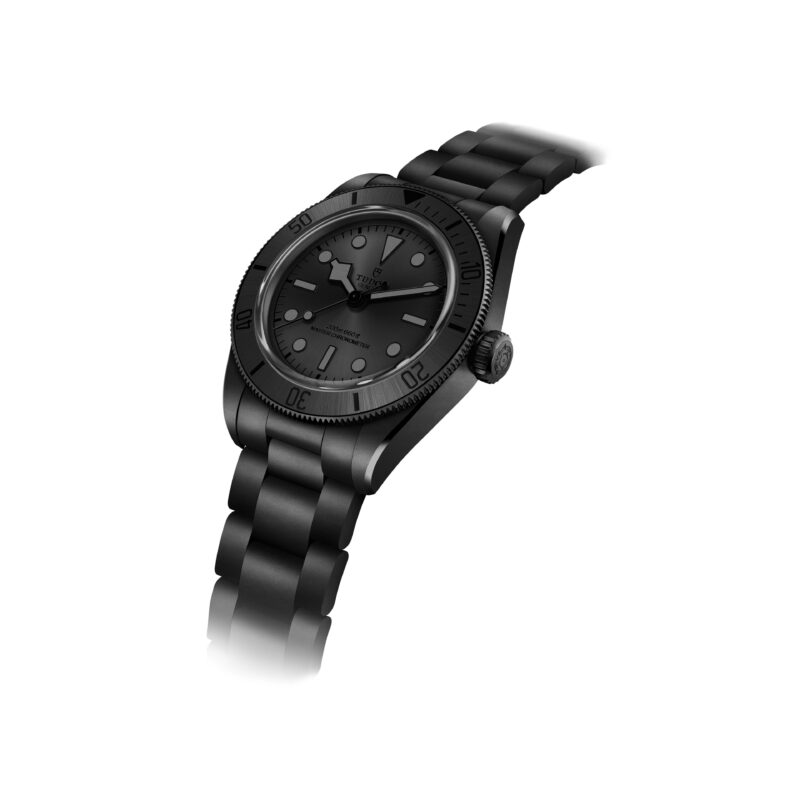
Tudor: tool-watch clarity and modern manufacture
An evergreen guide to Tudor: its 1926 origins, Oyster Prince and diving-watch history, Black
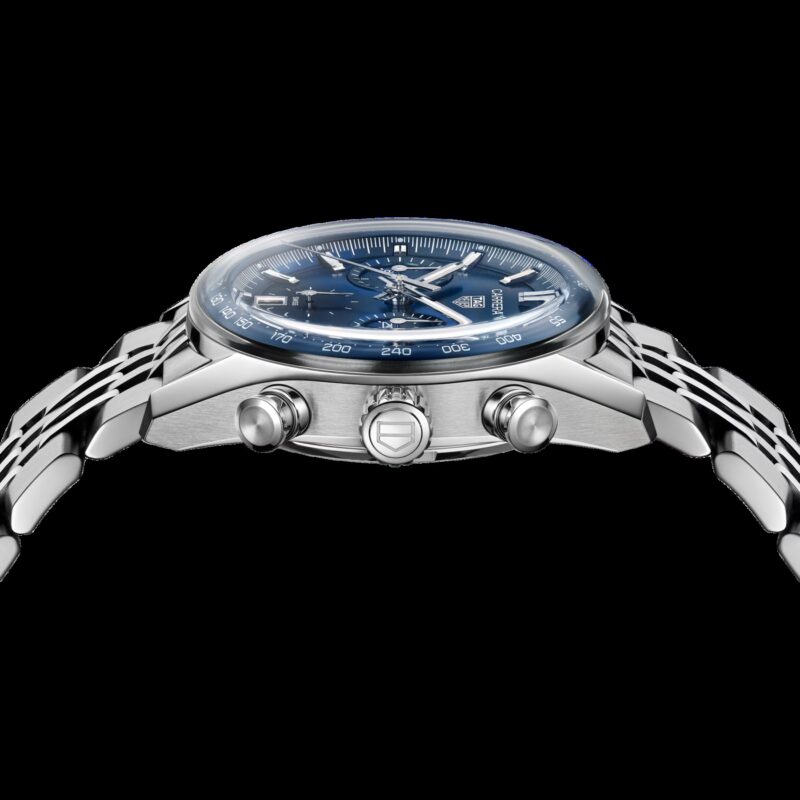
TAG Heuer: chronographs, instruments and design systems
An evergreen guide to TAG Heuer: its 1860 origins, timing instruments, Carrera and Monaco
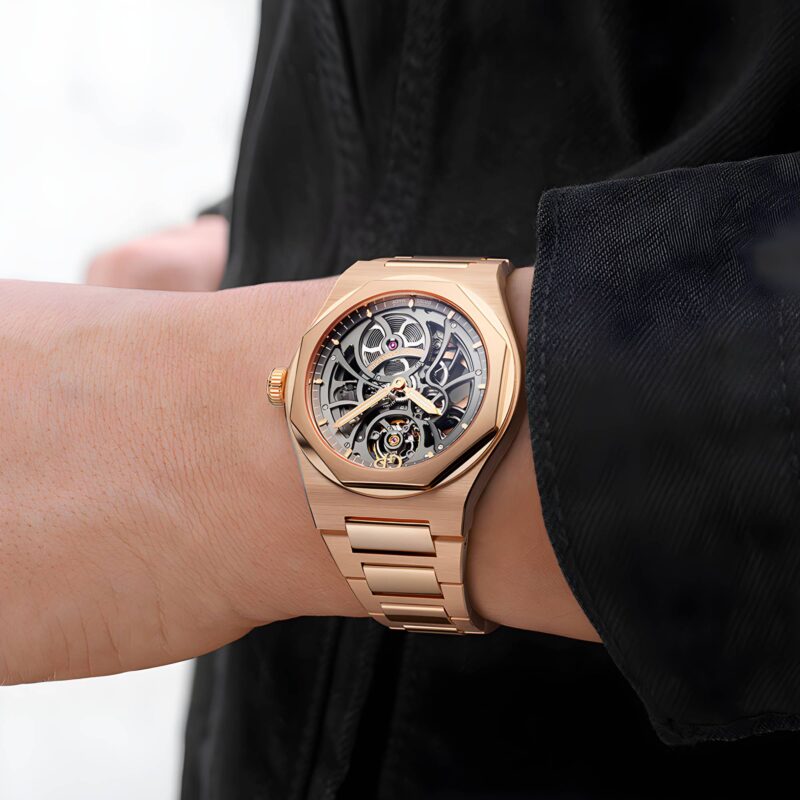
Girard-Perregaux: architecture, Three Bridges and the Laureato
An evergreen guide to Girard-Perregaux: the Bautte and Girard-Perregaux lineages, Three Bridges, movement manufacture,

Hublot: material fusion, Big Bang and Unico
An evergreen guide to Hublot: the 1980 gold-and-rubber premise, Big Bang architecture, Unico chronographs,