
TheTimeo / TheTimeo Encyclopedia
LAURENT FERRIER:
classical proportion, considered mechanics
An evergreen guide to Laurent Ferrier: the 2010 debut, balanced case design, natural escapement, micro-rotor calibres and key Classic, Square and Sport families.
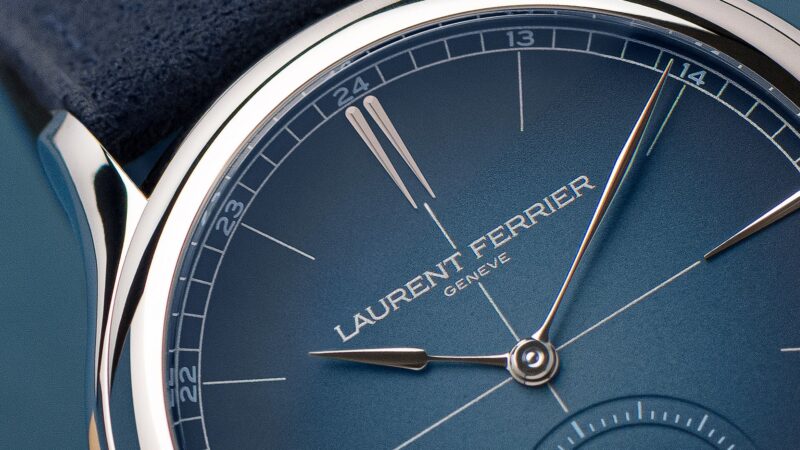
Classic Origin Blue. Courtesy of Laurent Ferrier.
Explore the story
Laurent Ferrier is an independent Geneva watchmaker founded around the work of Laurent Ferrier and François Servanin, with its first watch presented in 2010. The house is defined by a deliberate separation between calm exterior design and technically distinctive movements: rounded cases, sparse dials and fine hands on the front; tourbillons, micro-rotors, natural escapements and extensive hand finishing on the back.
This guide treats Laurent Ferrier as a continuing design and movement system, not as a single “Galet” silhouette. It explains the codes that recur across Classic, Square, École and Sport watches, and the checks required before applying a family-level description to an individual reference.
Definition and scope
The Maison’s centre of gravity is classical Genevan watchmaking interpreted through modern engineering. “Classical” here does not mean a replica of an antique watch. It describes proportion, legibility and finish: convex cases without aggressive facets, balanced dial furniture, small seconds where appropriate and movements that reveal their complexity gradually.
Its catalogue spans hand-wound time-only watches, micro-rotor automatics, tourbillons, annual calendars, travel-time pieces and integrated-bracelet sports watches. The common thread is not one complication. It is the attempt to remove visual noise while preserving demanding construction and finishing.
Foundation and development
- Before the Maison: Laurent Ferrier trained at the École d’Horlogerie de Genève, graduating in 1968, and later spent 37 years at a major Geneva manufacture in technical, prototype and exterior-design roles.
- 1979: Ferrier, Servanin and François Trisconi finished third overall at the 24 Hours of Le Mans. The racing connection later informed the Sport Auto narrative but does not define the whole company.
- 2009–2010: Ferrier began the independent project in his early sixties. The first creation, the Classic Tourbillon Double Hairspring, won the men’s watch prize at the 2010 Grand Prix d’Horlogerie de Genève.
- 2012: the automatic FBN229.1 calibre brought together a micro-rotor and a natural escapement, establishing the second major movement branch.
- Later development: Square cases, the École Annual Calendar, Grand Sport, Sport Auto, Traveller and Classic Moon widened the catalogue without abandoning the original proportion-led approach.
The founding story is important because it explains the mature design language at launch. It should not be used as shorthand for the condition, rarity or authorship of every later watch.
Aesthetic and design identity
The original round case was nicknamed “Galet”, French for pebble, because its polished curves avoid a hard transition between bezel, middle and back. Current naming more often uses “Classic”, but the underlying idea survives. A ball-shaped crown refers to nineteenth-century pocket watches and provides a tactile counterpoint to the smooth case.
On the dial, drop-shaped indices and slender Assegai-shaped hands are the clearest identifiers. Small seconds is usually integrated without disturbing the main axis. Sector tracks, applied markers, enamel, stone and restrained colour gradients change the mood while leaving the proportions legible. The Square family translates the same restraint into a soft-cornered case rather than treating it as a separate design language.
The Sport and Grand Sport watches use broader cases and integrated bracelets, yet the dial remains ordered and the movement finishing visible. For a collector, that continuity is more useful than calling the sports pieces a break with tradition.
Technical contributions and manufacture
- Tourbillon with double hairspring
The debut calibre uses two hairsprings mounted in opposition within a tourbillon. The arrangement is intended to improve centring and compensate for forces affecting the regulating organ. The tourbillon remains on the movement side, consistent with the house’s preference for a quiet dial rather than a front-facing mechanical display.
- Micro-rotor and natural escapement
The FBN229.1 automatic calibre uses a small off-centre winding mass so the bridges and escapement remain visible. Its natural escapement has two escape wheels and gives direct impulses to the balance in both directions. Laurent Ferrier describes the modern construction as a way to reduce inertia and energy loss; it demands careful adjustment and should not be confused with a conventional Swiss lever simply because both regulate a mechanical watch.
- Movement finishing
The workshop distinguishes machining from the manual work that follows: anglage, black polishing, satin finishes, circular graining, sandblasting and Geneva stripes. These are observable techniques, not a generic promise of quality. Interior angles, the continuity of bevels, screw heads and the treatment of steel parts are therefore useful examination points, always compared with the correct calibre generation.
Collections and fundamental models
The catalogue is best read through case families and movement branches together.
Classic Tourbillon
The founding form and technical statement: a rounded Classic case, restrained dial and the hand-wound double-hairspring tourbillon visible from the back.
Classic and Square Micro-Rotor
The automatic branch built around a micro-rotor and natural escapement. Classic is round; Square uses softened geometry, but both preserve the same approach to dial balance and movement display.
Classic Origin
A hand-wound, time-only expression introduced as a comparatively direct route into the design language. The LF116.01 calibre omits the micro-rotor and natural escapement, an important distinction when comparing it with a Classic Micro-Rotor.
École, Traveller and Moon
These families extend the vocabulary to annual-calendar, travel-time and astronomical displays. Names, indications and calibres should be recorded precisely because similar cases can contain different mechanisms.
Grand Sport and Sport Auto
Integrated-bracelet watches that connect the founders’ motor-racing history to a more robust case architecture. They retain manufacture calibres and detailed finishing rather than functioning as design-only derivatives.
What matters to a collector
- Separate case family from calibre family
A Classic case can house Origin, Micro-Rotor, Tourbillon, Moon or Traveller mechanisms. Write down the full reference and calibre before comparing specifications. “Classic” alone does not establish winding system, escapement or complication.
- Read the dial furniture closely
Check the shape, length and alignment of hands; the profile of drop indices; printing; subdial depth; and the relationship between minute track and case. These restrained designs leave little room for poor replacement parts or careless refinishing to hide.
- Use the movement as evidence, not decoration
Confirm calibre engraving and architecture, then assess finishing under neutral magnification. A micro-rotor does not automatically mean the natural-escapement generation, and a highly finished bridge cannot establish service condition. Ask for service documents and timing observations tied to the watch.
- Evaluate the case and crown in profile
The characteristic curves depend on edge integrity. Excessive polishing can flatten transitions and alter the relationship between bezel, middle and back. The ball crown, lugs and bracelet links should operate cleanly; comfort remains a wrist-specific judgement.
Terminology and related references
- Galet: the pebble-like case idea associated with early pieces; current product names generally use Classic.
- Assegai hands: the Maison’s long, spear-like hour and minute hands.
- Natural escapement: a two-wheel, double-direct-impulse escapement used in the micro-rotor movement branch.
- Micro-rotor: a compact winding mass integrated into the movement plane rather than covering it with a full-diameter rotor.
- Double hairspring: two opposed springs used in the tourbillon regulating system.
- Related reading: tourbillon, escapement, micro-rotor, anglage, black polish, annual calendar and travel time.
Sources & further reading
This evergreen guide was rechecked on 9 September 2026 against Laurent Ferrier’s official history, natural-escapement explanation, Classic Origin documentation and workshop finishing account. The sources establish the company’s chronology, terminology and stated constructions; they do not authenticate or grade an individual watch.
- Laurent Ferrier — Our Story
- Laurent Ferrier — An in-depth look at the natural escapement
- Laurent Ferrier — Classic Origin Blue
- Laurent Ferrier — The Art of Finishing
Media: Classic Origin Blue official Maison photography, retained as WordPress media 6612 and reverified against its governed source record.
The Edit
TheTimeo Encyclopedia stories
Selected stories from the same editorial universe.
Tudor: tool-watch clarity and modern manufacture
An evergreen guide to Tudor: its 1926 origins, Oyster Prince and diving-watch history, Black
TAG Heuer: chronographs, instruments and design systems
An evergreen guide to TAG Heuer: its 1860 origins, timing instruments, Carrera and Monaco
Girard-Perregaux: architecture, Three Bridges and the Laureato
An evergreen guide to Girard-Perregaux: the Bautte and Girard-Perregaux lineages, Three Bridges, movement manufacture,
Hublot: material fusion, Big Bang and Unico
An evergreen guide to Hublot: the 1980 gold-and-rubber premise, Big Bang architecture, Unico chronographs,