
TheTimeo / TheTimeo Encyclopedia
DIGITAL GEMSTONE MAPPING:
a measured model, not the stone itself
A technical reference to digital gemstone mapping: geometry, inclusion plots, cutting plans, laboratory records, identity links, provenance limits and collector checks.
Explore the story
Digital gemstone mapping is the structured recording of a gem’s observable geometry and internal features. Depending on the purpose, the record may combine photographs, measurements, inclusion plots, three-dimensional scans and links to a laboratory report. It can support cutting decisions, comparison and traceability, but its evidential value depends on how the data were captured and how the record is tied back to the physical stone.
The phrase covers several workflows that should not be collapsed into one claim. Planning software may model rough material and propose polished outcomes. A laboratory plot records identifying characteristics seen during examination. Report Check retrieves archived report information. Inscription matching compares a girdle inscription with a stored record. Each answers a different question.
Definition and scope
A family of records
Mapping can mean a clarity plot, a three-dimensional scan, a cutting model or a linked set of report assets. The record must name which one.
Not a digital twin by default
Completeness, resolution and version history must be demonstrated rather than inferred from a polished rendering.
From rough geometry to a cutting plan
Capture and modelling
A scan of rough diamond can give software a geometric model of the outer surface. Internal imaging and expert observation can add inclusions and other features. Planning software then tests possible positions, shapes and proportions for polished stones within that model. The output is a set of options constrained by the measured rough, mapped inclusions and the planner’s priorities.
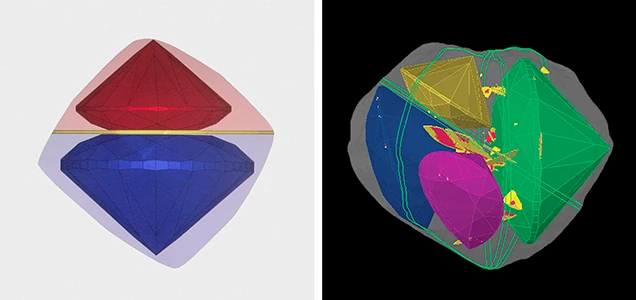
GIA’s published Figure 9 shows why the map is not a generic digital twin: differently shaped rough produces different feasible plans. The illustration is retained here at its native maximum width. It documents a research example, not the interface or predictive accuracy of every commercial system.
What a map may contain
Layers and identifiers
- External geometry: dimensions, facets or an unpolished surface model.
- Internal features: plotted inclusions, fractures, growth structures or other observed characteristics.
- Planning layers: candidate outlines and orientations for one or more polished stones.
- Reference identifiers: a laboratory report number, image set, inscription or controlled record identifier.
- Provenance events: dated observations or transformations, if the system records who created them and under which procedure.
Resolution, calibration, lighting, operator judgement and software assumptions all matter. A clean rendering does not reveal by itself which instrument was used, whether every feature was detectable or whether the model has been altered since capture.
Mapping, grading and identification
Different questions, different evidence
A map can help relocate inclusions and compare characteristic patterns, yet a grading report represents a laboratory examination under a defined service. Colour, clarity, treatment status and species identification are not safely inferred from a planning image alone. A report number retrieved online confirms what is stored under that number; it does not, without a reliable physical link, prove that the stone in hand is the examined stone.
Laser inscriptions provide one possible link. GIA’s Match iD workflow analyses the physical characteristics and number of an inscription against its secure database for eligible loose diamonds. Its own eligibility limits matter. The result relates an inscription image to a corresponding report; it is not a substitute for examining damage, treatments or changes made after grading.
Origin and chain of custody
Continuity must be recorded
Geographic origin requires a stronger chain than an after-the-fact scan. In GIA’s documented Diamond Origin programme, rough material is submitted before polishing, its characteristics are recorded, and the polished result is later scientifically matched with that earlier record. That sequence illustrates the evidential principle: origin rests on controlled observations and continuity, not on the existence of a digital file alone.
For coloured stones, origin opinions also draw on gemmological properties and reference data specific to material and locality. “Mapped” should therefore never be treated as a synonym for “origin verified”. The record should state exactly which institution made which determination.
How to assess a digital record
A six-step check
- Define the question. Is the file for cutting, identification, grading, origin or custody?
- Identify the issuer. Record the laboratory, manufacturer or platform and the applicable service.
- Check the capture. Look for date, instrument, resolution, calibration and operator or automated-process information.
- Verify the physical link. Compare report number, dimensions, inscription and observable characteristics; escalate discrepancies to a qualified laboratory.
- Preserve versions. A pre-cut map and a polished-stone report describe different states. Do not overwrite the transformation history.
- Read limitations. Predictions, inaccessible inclusions and eligibility rules should remain attached to the record.
Terminology and related references
Terms that should not be conflated
- Inclusion plot: a diagram recording the position and type of internal or surface-reaching features observed in examination.
- Planning model: a digital representation used to test cutting outcomes.
- Report Check: retrieval of report data held by an issuing laboratory.
- Inscription matching: comparison of a physical inscription image with a stored reference.
- Chain of custody: documented continuity of possession or control between recorded events.
- Related reading: diamond grading report, gemmological laboratory, provenance, laser inscription and digital product passport.
Sources & further reading
This reference was rechecked on 12 September 2026 against GIA research, service documentation and origin-report material. The sources distinguish planning, report retrieval, inscription matching and origin work. No claim is made that a digital image or database entry independently authenticates, grades or establishes the origin of a physical stone.
The Edit
TheTimeo Encyclopedia stories
Selected stories from the same editorial universe.

Tudor: tool-watch clarity and modern manufacture
An evergreen guide to Tudor: its 1926 origins, Oyster Prince and diving-watch history, Black

TAG Heuer: chronographs, instruments and design systems
An evergreen guide to TAG Heuer: its 1860 origins, timing instruments, Carrera and Monaco
Girard-Perregaux: architecture, Three Bridges and the Laureato
An evergreen guide to Girard-Perregaux: the Bautte and Girard-Perregaux lineages, Three Bridges, movement manufacture,

Hublot: material fusion, Big Bang and Unico
An evergreen guide to Hublot: the 1980 gold-and-rubber premise, Big Bang architecture, Unico chronographs,