
TheTimeo / TheTimeo Encyclopedia
DE BETHUNE:
a modern language for mechanical watchmaking
An evergreen guide to De Bethune: its 2002 foundation, celestial design language, balance research, blued titanium and the DB25 and DB28 families.
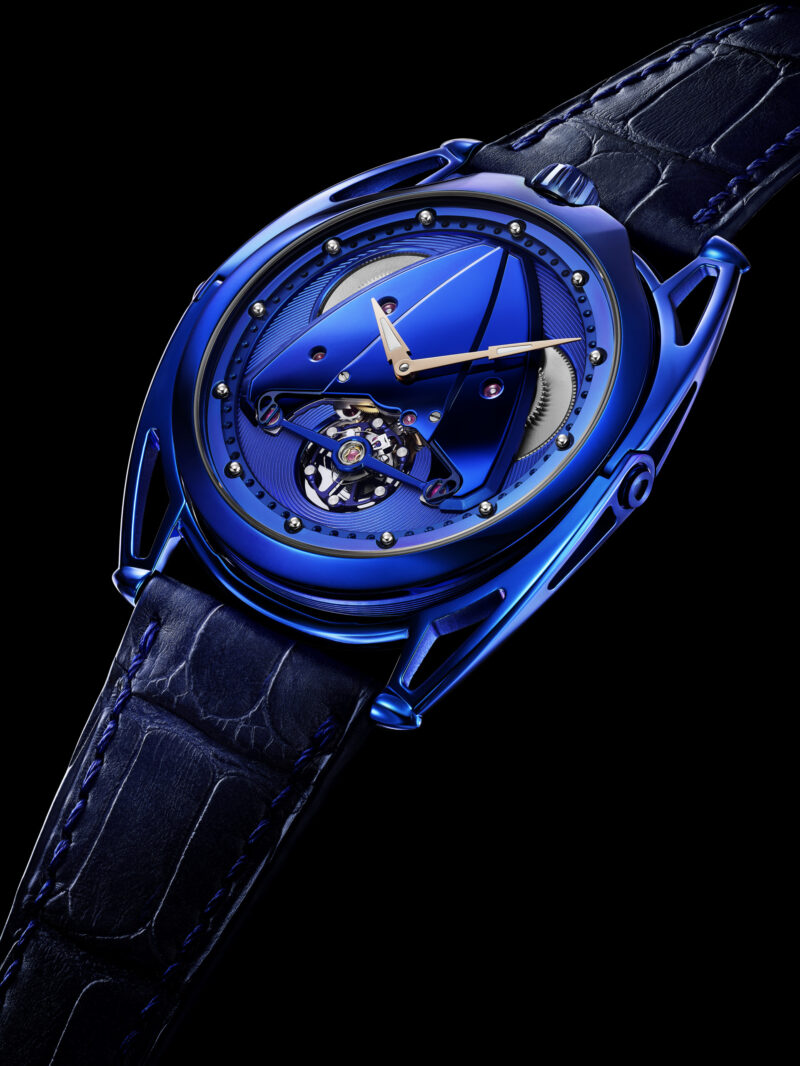
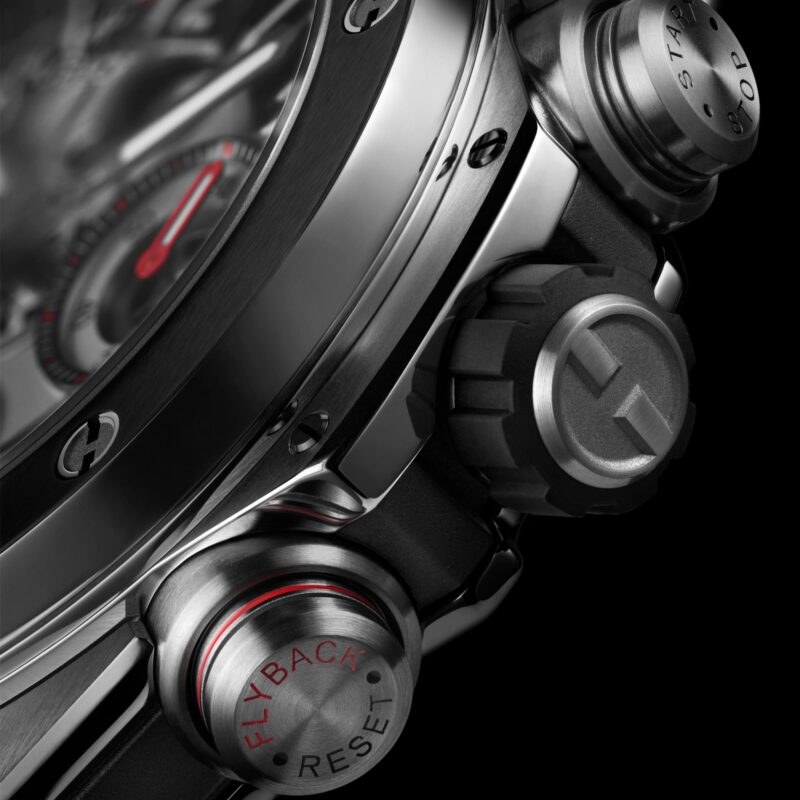
DB28XP Kind of Blue. Courtesy of De Bethune.
Explore the story
De Bethune is an independent Swiss watch manufacture founded in 2002 by Denis Flageollet and David Zanetta. Its identity joins classical watchmaking architecture to an unusually contemporary vocabulary: mirror-polished titanium, heat-developed blue surfaces, delta-shaped bridges, mobile lugs and astronomical displays. The result is not one signature model but a recognisable system of forms, materials and movement solutions.
This House Guide separates those recurring codes from the specifications of any one reference. It is a map of the Maison’s history, design and technical work, intended to help a collector identify what belongs to De Bethune and what must still be checked on the individual watch.
Definition and scope
De Bethune operates from L’Auberson in the Swiss Jura and presents research and development as a central part of its manufacture. In practical terms, the name covers several related but distinct strands: traditional round dress watches in the DB25 family; the more architectural DB28; shaped cases such as the Dream Watch line; and complications that range from spherical moon phases to chronographs and tourbillons.
The useful definition is therefore broader than “the blue-watch brand”. Blue titanium is important, but it sits beside a sustained investigation of regulating organs, shock protection, escapements, energy management and display construction. Likewise, the celestial imagery is not purely decorative: the spherical moon and star fields repeatedly connect the dial side to the Maison’s mechanical programme.
Foundation and development
- 2002: Flageollet and Zanetta establish De Bethune in L’Auberson and form an internal research and development department.
- 2004: the official chronology records the titanium-and-platinum balance, a flat terminal-curve hairspring, the spherical moon-phase display and early use of thermally blued titanium.
- 2005–2006: the triple pare-chute shock system and mobile-lug architecture become part of the technical and ergonomic vocabulary; early DB15, DB17, DBS and DB21 pieces establish several enduring design cues.
- 2010: the DB28 consolidates the open, symmetrical movement architecture and floating lugs into the form most closely associated with the house.
- 2014 onward: the Maxichrono’s absolute-clutch chronograph and continuing balance-wheel revisions show that the early inventions were a platform for further work, not a closed launch narrative.
Dates above describe introductions documented by the Maison. They should not be used to date an individual example without a reference number, case number and supporting records.
Aesthetic and design identity
The most legible De Bethune code is contrast. Polished surfaces sit beside micro-texture; familiar round cases frame bridges that resemble instruments or spacecraft; traditional flame-blued hands share the dial with three-dimensional moons and fields of tiny gold stars. The house’s “delta” bridge provides a strong axis, while Côtes De Bethune radiate from the centre rather than following conventional parallel stripes.
Thermal oxidation gives titanium its blue colour without a surface coating. Colour can vary with the temperature reached and the preparation of the metal, so the finish should be read as a material process rather than a generic blue treatment. Starry dials may combine polished or blued titanium with gold pins, leaf or applied elements. On the DB28, articulated “floating” lugs change how a relatively large case settles on different wrists; their condition and free movement matter as much as diameter on paper.
The DB25 offers the quieter counterpoint: round cases, more conventional dial layouts and a dress-watch silhouette, often carrying the same regulating and astronomical research underneath. The shaped Dream Watch pieces push in the opposite direction and are useful evidence that De Bethune’s vocabulary is not tied to one case outline.
Technical contributions and manufacture
- Regulation and shock protection
De Bethune’s balance research seeks high inertia with low overall mass by combining a titanium structure with dense peripheral weights. The precise construction changed over time, so “De Bethune balance” is not one immutable part. The triple pare-chute supports the regulating organ through a central shock absorber and two additional spring-supported points at the ends of a bridge. Its purpose is stability under impact; its presence does not eliminate the need for service history or timing checks.
- Escapement and energy
The Maison has used silicon escape wheels and revised tooth geometry to reduce inertia and friction in its lever escapements. Self-regulating twin barrels appear across important calibres to manage torque and power delivery. These features must be verified calibre by calibre: the family name alone is not proof that every invention is present.
- Astronomical and chronograph work
The three-dimensional moon phase, first documented by the company in 2004, became one of its clearest displays. De Bethune states an indicated deviation of one day in 122 years for the mechanism used in pieces such as the DB15 and DB25L. The DB21 and later Maxichrono pursued a different problem: arranging chronograph indications centrally and, later, controlling the mechanism through the patented absolute clutch.
Collections and fundamental models
Collection names are the first orientation point, not a substitute for the reference.
DB25
The classical branch: round cases, conventional lugs and comparatively restrained dials. It includes time-only watches and substantial complications, including perpetual calendars and astronomical displays.
DB28
The architectural branch and the most direct expression of floating lugs, exposed delta bridges, polished titanium and visible regulating organs. DB28, DB28XP and DB28xs labels indicate materially different proportions and executions.
DB Kind of Two
A reversible construction that places two display identities on one watch. It is especially useful for understanding the house’s dialogue between classical and contemporary faces.
Dream Watch and historical pieces
Dream Watch designs explore sculptural cases, while early DB15, DB17, DBS and DB21 references document how the technical vocabulary developed before the DB28 became the best-known form.
What matters to a collector
- Identify the exact generation
Record the complete reference, case material, dial execution, calibre and approximate production period. Similar names can conceal different case sizes, balance constructions, lugs and displays. Compare the watch with the correct official technical sheet rather than a later model carrying the same family name.
- Inspect surfaces before judging originality
Mirror-polished titanium reveals handling marks and refinishing differently from brushed steel. Thermally blued parts should be assessed for uniformity, damage and replacement in context; colour alone cannot authenticate them. Star fields and hand-finished components deserve high-resolution inspection, but photography is not a substitute for physical examination.
- Ask for service and operating evidence
Confirm the behaviour of mobile lugs, crown, quick-setting systems and complications. On moon phases, calendars and chronographs, test the sequence according to the correct manual. Timing, amplitude and power-reserve observations should be taken by a qualified watchmaker, with the result tied to the actual calibre and service date.
Terminology and related references
- Blued titanium: titanium coloured through controlled thermal oxidation, not simply blue paint or plating.
- Floating lugs: articulated supports designed to follow the wrist; a defining DB28 ergonomic element.
- Triple pare-chute: the Maison’s three-point shock-protection architecture for the regulating organ.
- Côtes De Bethune: a radiating movement decoration organised from the centre.
- Spherical moon phase: a three-dimensional display using a two-colour sphere rather than a flat disc.
- Related reading: balance wheel, hairspring, silicon escapement, perpetual calendar, chronograph and thermal oxidation.
Sources & further reading
This evergreen guide was rechecked on 9 September 2026 against De Bethune’s official history, heritage selection and chronometry material. The sources establish the Maison’s own chronology, terminology and stated technical principles; they do not authenticate an individual watch or replace its records, manual and physical examination.
- De Bethune — Our Vision and official timeline
- De Bethune — selection of emblematic pieces
- De Bethune — Chronometry in the 21st Century
- De Bethune — chronometry technical paper
Media: DB28XP Kind of Blue official Maison photography, retained as WordPress media 6609 and reverified against its governed source record.
The Edit
TheTimeo Encyclopedia stories
Selected stories from the same editorial universe.
Tudor: tool-watch clarity and modern manufacture
An evergreen guide to Tudor: its 1926 origins, Oyster Prince and diving-watch history, Black
TAG Heuer: chronographs, instruments and design systems
An evergreen guide to TAG Heuer: its 1860 origins, timing instruments, Carrera and Monaco
Girard-Perregaux: architecture, Three Bridges and the Laureato
An evergreen guide to Girard-Perregaux: the Bautte and Girard-Perregaux lineages, Three Bridges, movement manufacture,
Hublot: material fusion, Big Bang and Unico
An evergreen guide to Hublot: the 1980 gold-and-rubber premise, Big Bang architecture, Unico chronographs,