
TheTimeo / TheTimeo Encyclopedia
BULGARI:
Rome drawn in colour and volume
An evergreen guide to Bulgari: Roman design, coloured gemstones, Serpenti, Tubogas, Octo and the checks that distinguish a family from a reference.
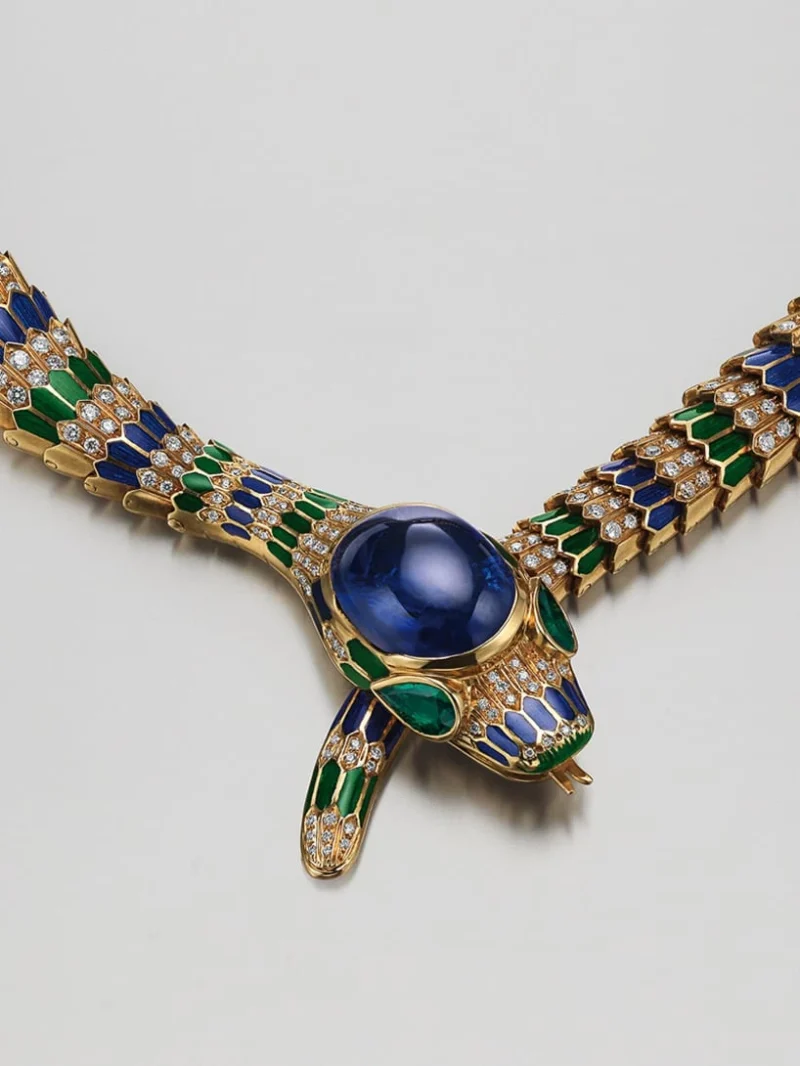
Bulgari Serpenti necklace with a blue cabochon and coloured details defining the head and body. Courtesy of Bulgari.
Explore the story
Bulgari is a Roman jewellery and watch house founded in 1884 by the Greek silversmith Sotirio Bulgari. Its most legible design language joins architectural volume, emphatic colour and forms that wrap, coil or repeat around the body. Serpenti and Tubogas show that language in motion; Bvlgari Bvlgari and Octo translate it into watch cases and dials.
This guide treats those names as starting points. It separates a house code from the material, construction and reference details needed to describe an individual object accurately.
Definition and scope
Bulgari works across jewellery, high jewellery, watches and objects. Rome is more than a location in its official history: classical geometry, domes, coins and strong contrasts recur in the designs. Greek origins and Italian production also explain why the house can combine Mediterranean colour with disciplined, often symmetrical structures.
Three ideas organise the catalogue. Colour is used in deliberate combinations rather than as a secondary accent. Gold is treated as volume, from rounded links to polished architectural planes. Transformation appears physically in flexible bands, articulated animals and watches whose cases become part of a bracelet.
Foundation and historical development
- 1884: Sotirio Bulgari opened his first Rome boutique on Via Sistina, bringing his training as a Greek silversmith to the city.
- 1940s: yellow gold and softer, more sinuous forms became increasingly important in the house vocabulary.
- 1948: the first Serpenti bracelet-watches combined a coiled Tubogas band with a geometric watch dial.
- Later twentieth century: Serpenti developed through stylised and figurative heads, scales, enamels and gemstone treatments.
- Contemporary watchmaking: Octo and Octo Finissimo use an eight-sided architectural case as a platform for thin mechanical construction.
These dates identify documented developments, not a shortcut for dating an object. Marks, reference numbers, materials and period construction must be read together.
Aesthetic and design identity
Roman geometry
Circles, octagons, stepped profiles and coin-like frames give many Bulgari objects a monumental quality at small scale. The repeated BVLGARI signature around a bezel is one example; the faceted Octo case is another. Proportion and finishing determine whether the geometry reads as crisp or soft.
Colour as structure
Coloured gemstones are often combined for contrast in hue, opacity and cut. Cabochons can create rounded volume while faceted stones add light and edge. A description should record each documented material instead of treating a colourful composition as proof of stone identity or origin.
The body as part of the design
Tubogas coils, Serpenti bracelets and rounded gold links are understood fully only when worn. Flexibility, balance and the transition between rigid and moving parts are functional design questions, not merely visual effects.
Technical and manufacturing ideas
- Tubogas construction
Tubogas takes its name from flexible industrial tubing. Metal strips are wrapped tightly around a core to create a rounded, flexible band without soldering the successive wraps. Even tension is essential. On an older piece, kinks, stretched sections and repairs deserve examination from every angle.
- Serpenti articulation
Serpenti is a design territory rather than one construction. Some examples use Tubogas coils; others use articulated scales or more rigid jewellery structures. Heads may be geometric, naturalistic or concealed around a watch dial. The exact mechanism, number of coils and opening method should be documented.
- Thin watchmaking in Octo
Octo Finissimo connects a broad, faceted case with very thin movements and components. Reference 102713 is a useful documented example: a 40 mm titanium case, 5.15 mm overall thickness and the automatic calibre BVL 138 with a micro-rotor. Those figures belong to that reference and must not be applied to the whole family.
Fundamental collections and models
Serpenti
A jewellery-and-watch family built around the serpent. Identify whether the object is figurative or abstract, how it coils, the head and tail treatment, the dial position and the construction beneath any scales or stones.
Tubogas
Both a technique and a recognisable visual language. It appears in bracelets, necklaces and watches, sometimes in single coils and sometimes in multiple rows. Width, metal combination and flexibility materially change the object.
Bvlgari Bvlgari
A watch family that makes the double signature part of the bezel architecture. Case diameter, lug shape, dial, movement and bracelet or strap vary; the inscription alone does not identify a reference.
Octo and Octo Finissimo
Octagonal case geometry links Roman architectural cues with contemporary mechanical watchmaking. Finissimo denotes a thin proposition within the larger Octo universe, not one fixed calibre or dimension.
Jewellery signatures
Monete, Divas’ Dream, B.zero1 and other families explore coins, fan forms and spiralled architecture. Their shared house language should not obscure collection-specific materials, dimensions and mechanisms.
What matters to a collector
- Identify construction before condition
Establish whether a bracelet uses Tubogas, articulated links or a rigid structure before judging wear. Check symmetry, tension, closures and the transition into a watch or decorative head. A surface photograph cannot show the complete mechanism.
- Record the reference-level facts
For watches, note reference, case material, dimensions, calibre, dial and bracelet or strap. For jewellery, record measurements, weight where documented, stones, hallmarks and moving elements. Collection names cover many materially different objects.
- Preserve volume and movement
Polishing can soften edges, inscriptions and scale definition. Repairs to coils or articulated structures require relevant specialist experience. Ask for the proposed work in writing and retain photographs, replaced components where possible and service documentation.
Terminology and related references
- Tubogas: a flexible band made by tightly wrapping metal strips around a core without soldering successive wraps.
- Cabochon: a polished, unfaceted stone form that emphasises colour and volume.
- Articulation: linked construction that permits controlled movement.
- Micro-rotor: a compact automatic-winding rotor integrated into the movement plane.
- Reference: the maker’s identifier for a particular configuration.
- Related reading: coloured gemstones, bracelet construction, shaped watches, thin movements, hallmarks and conservation.
Sources & further reading
This evergreen guide was rechecked on 11 September 2026 against Bulgari’s official 1884 and 1940s histories, Serpenti and Tubogas studies, and the product record for Octo Finissimo reference 102713. House language has been reduced to dated facts, described mechanisms and observable design codes. The text does not authenticate or grade an individual object.
- Bulgari — 1884: The dawn of Bvlgari
- Bulgari — 1940s: Birth of an icon
- Bulgari — Serpenti heritage
- Bulgari — The Tubogas icon
- Bulgari — Octo Finissimo Automatic 102713
Media: official Bulgari photography retained as WordPress media 6671 and reverified against its governed source article and file record.
The Edit
TheTimeo Encyclopedia stories
Selected stories from the same editorial universe.
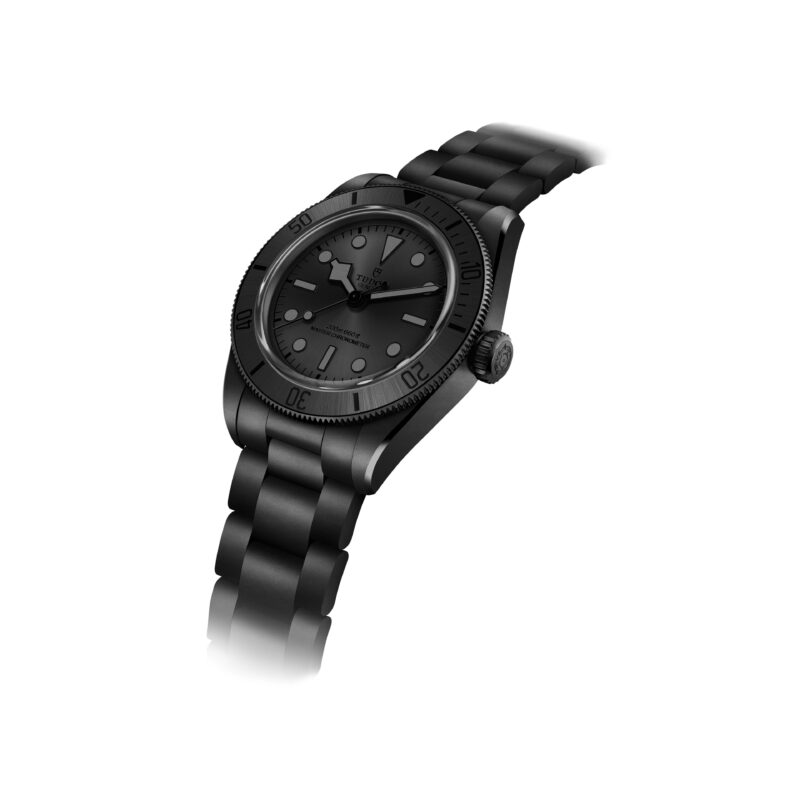
Tudor: tool-watch clarity and modern manufacture
An evergreen guide to Tudor: its 1926 origins, Oyster Prince and diving-watch history, Black

TAG Heuer: chronographs, instruments and design systems
An evergreen guide to TAG Heuer: its 1860 origins, timing instruments, Carrera and Monaco
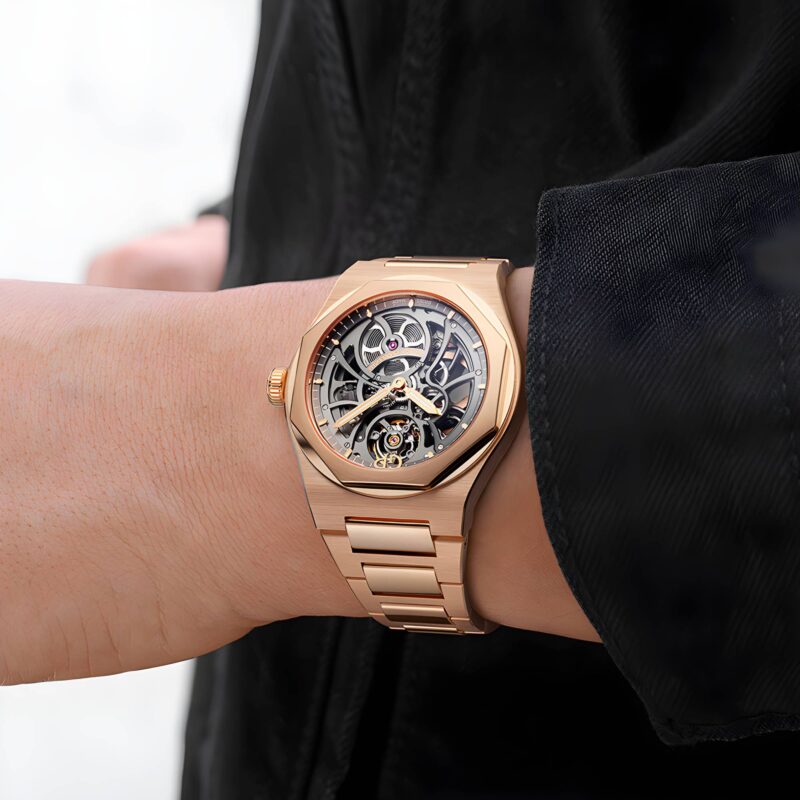
Girard-Perregaux: architecture, Three Bridges and the Laureato
An evergreen guide to Girard-Perregaux: the Bautte and Girard-Perregaux lineages, Three Bridges, movement manufacture,
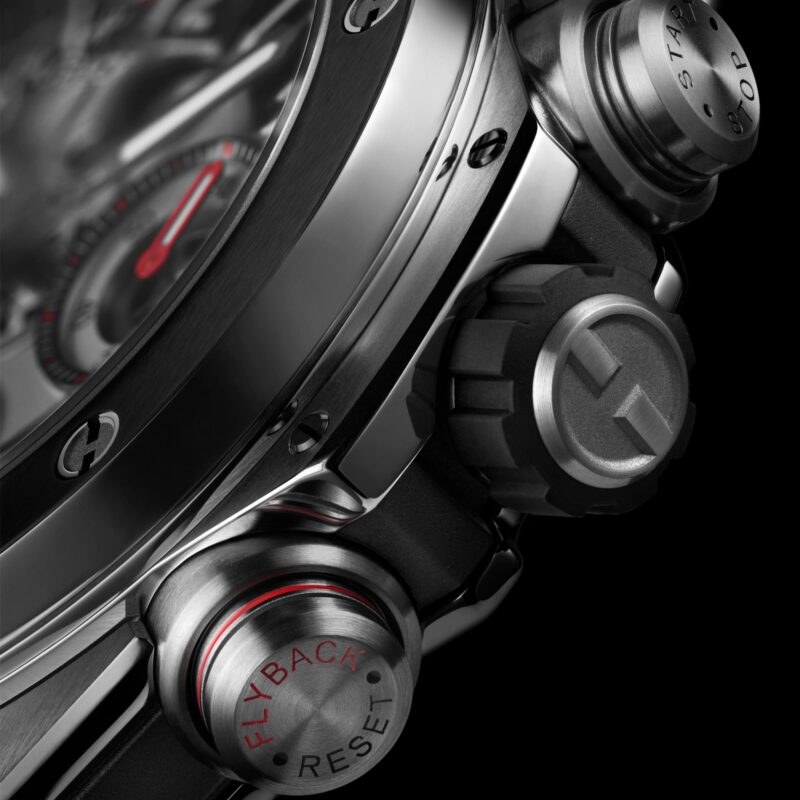
Hublot: material fusion, Big Bang and Unico
An evergreen guide to Hublot: the 1980 gold-and-rubber premise, Big Bang architecture, Unico chronographs,