High Jewellery Atelier
JewelryCartier Le Chœur des Pierres: Kentia, Haryma and Tesselia
Cartier Le Chœur des Pierres gives gemstones the lead through Kentia, Haryma and Tesselia: a panther sapphire necklace, a tiger topaz composition and a ruby ring of concentrated force.

In brief
Why this creation matters
Cartier Le Chœur des Pierres asks what a stone wants to become. Kentia, Haryma and Tesselia show sapphire, topaz and ruby directing animal codes, line and construction rather than sitting quietly inside a design.
Le Chœur des Pierres matters because the stones do not sit quietly: they lead, and Cartier proves that listening can still produce unmistakable maison architecture.
TheTimeo editorial desk
Object first
A closer reading of the creation

Editorial dossier
When stones lead the drawing
Le Chœur des Pierres is strongest when the jewel seems to take instruction from the gem itself. Listening to a stone means accepting its volume, colour temperature, optical behaviour and weight as constraints that define the jewel. Kentia, Haryma and Tesselia prove that discipline at three different scales.
Atelier reading
Kentia and the blue centre
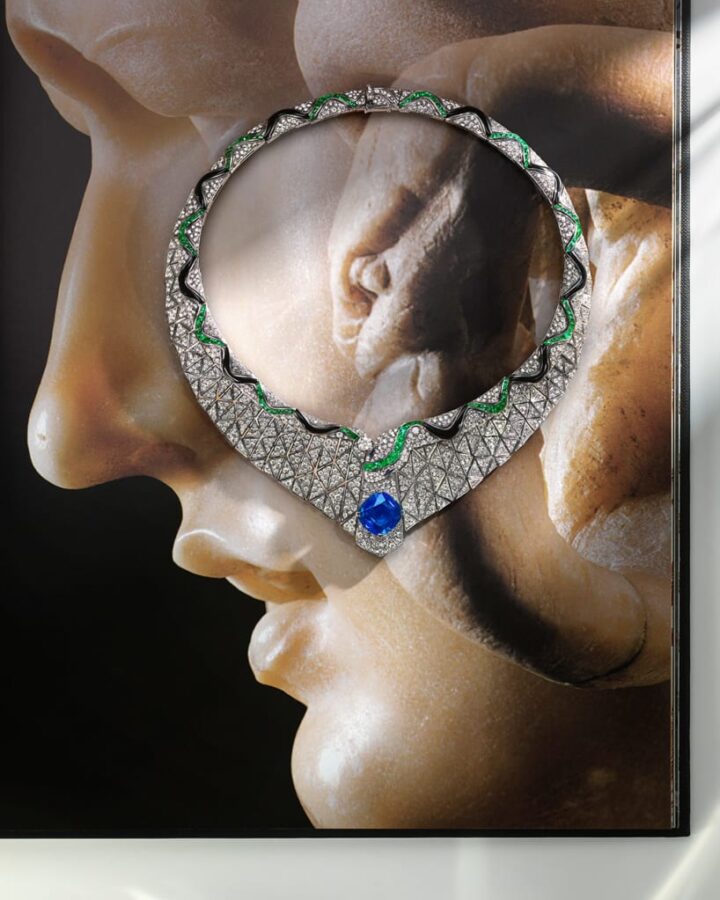
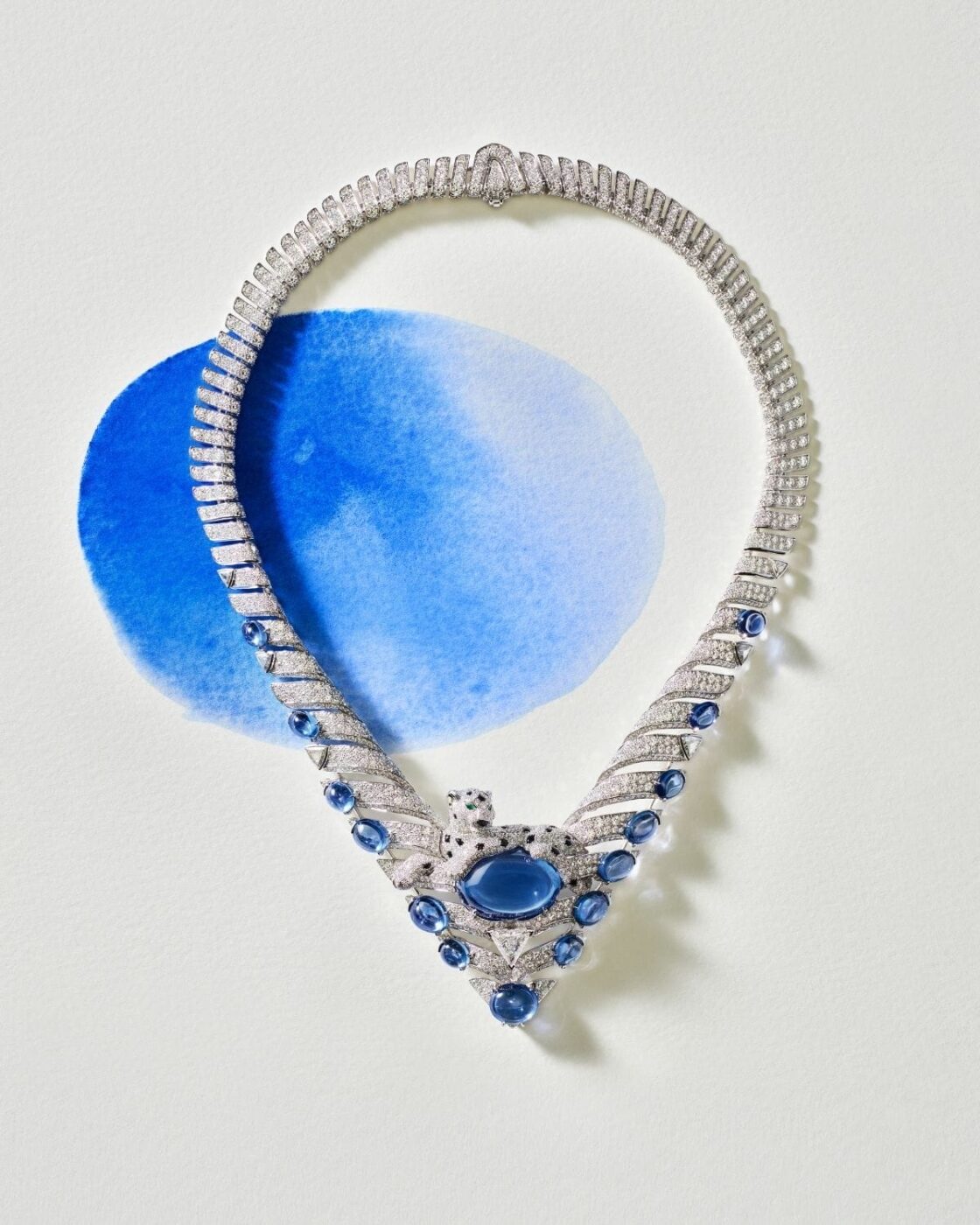
The Kentia necklace begins with a cabochon-cut Ceylon sapphire of 50.13 carats whose softness sets the tone for everything around it. Cartier places the panther as companion and counterweight: the feline guards and frames, but the sapphire remains the gravitational centre.
Atelier reading
Haryma and animal tension
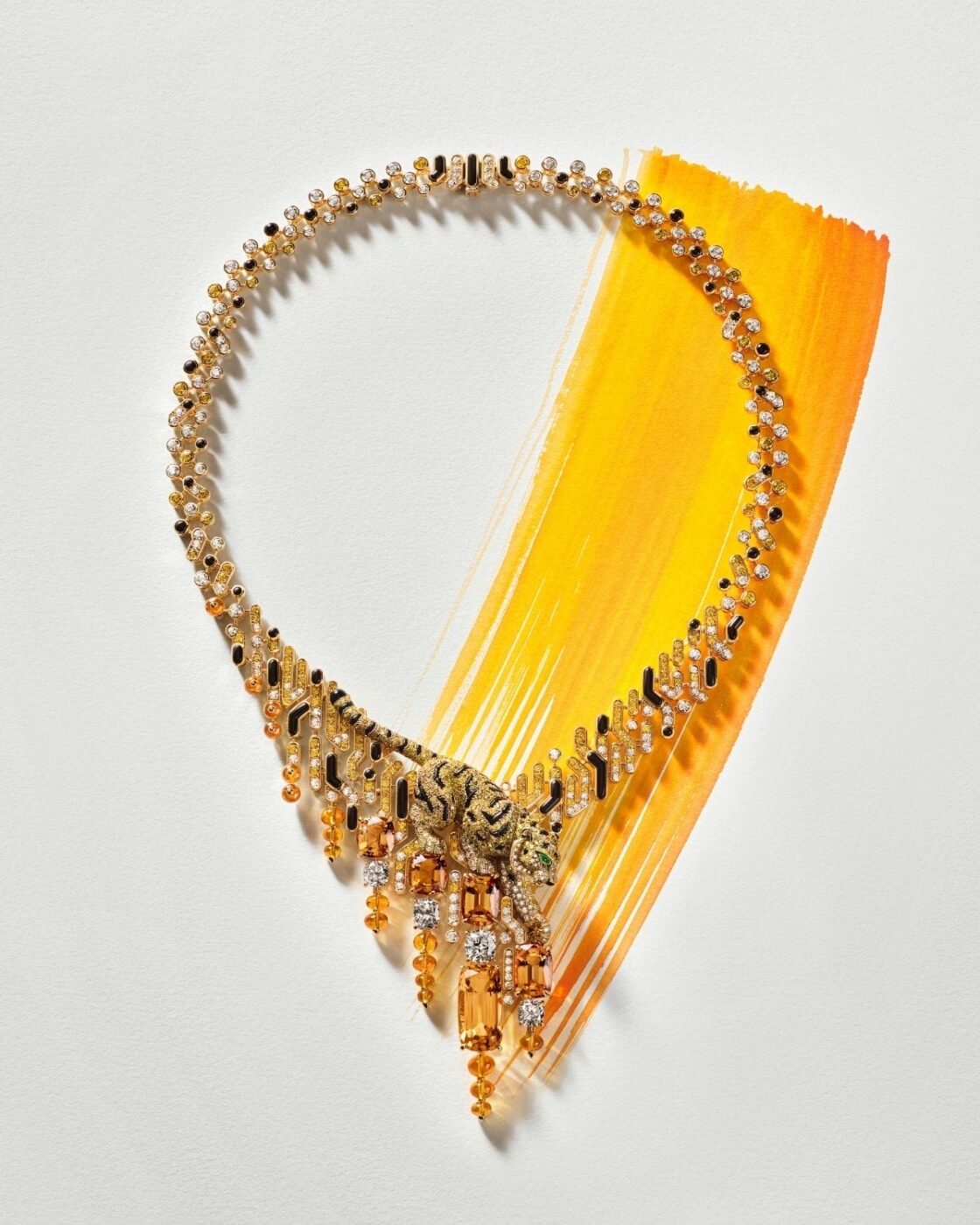
Haryma does not illustrate a tiger. It engineers one. Five imperial topazes totalling 28.04 carats establish the warm field; garnets, white, yellow and orange diamonds sharpen the palette; individually cut onyx turns pattern into calibrated skin.
Atelier reading
Tesselia and ruby force
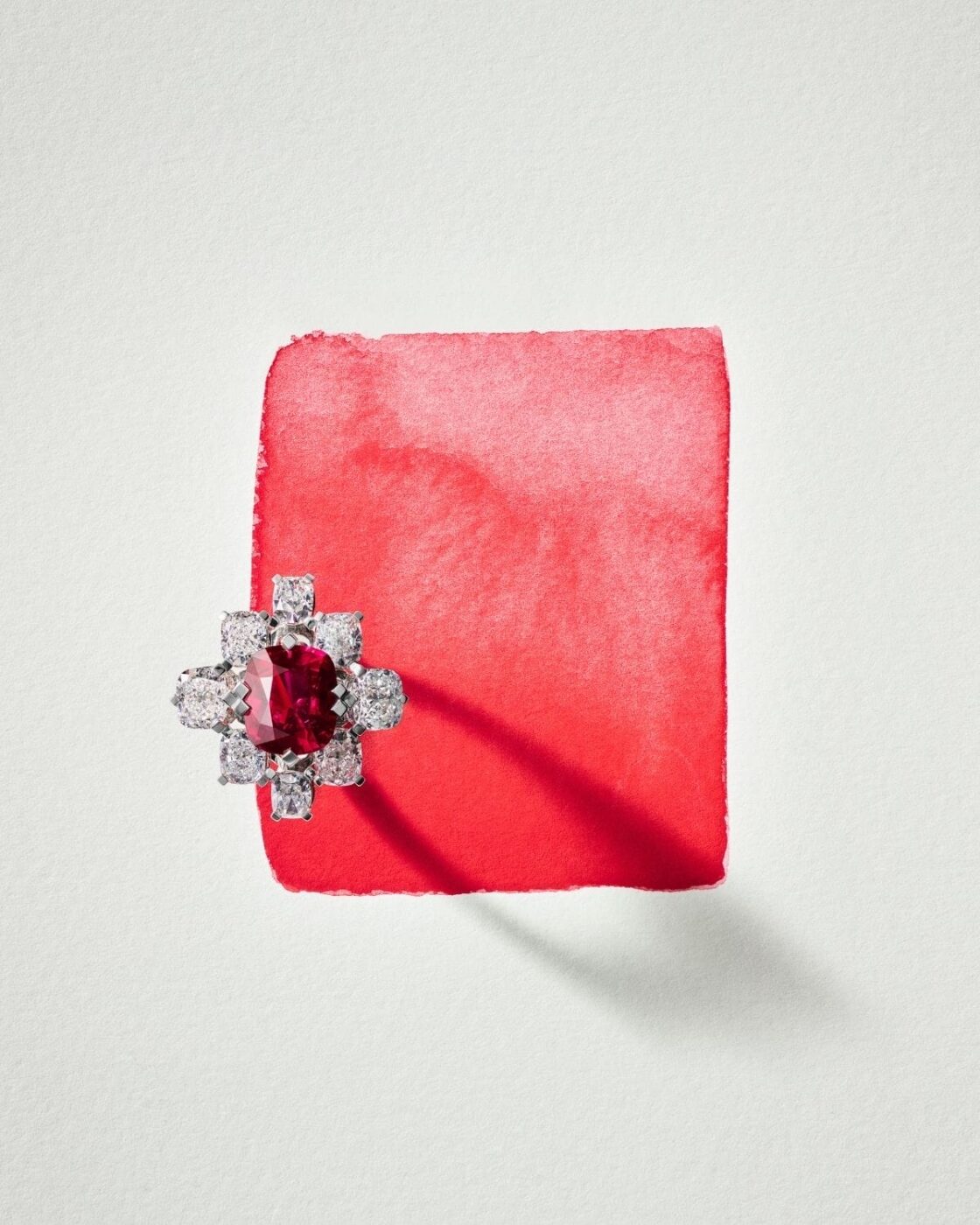
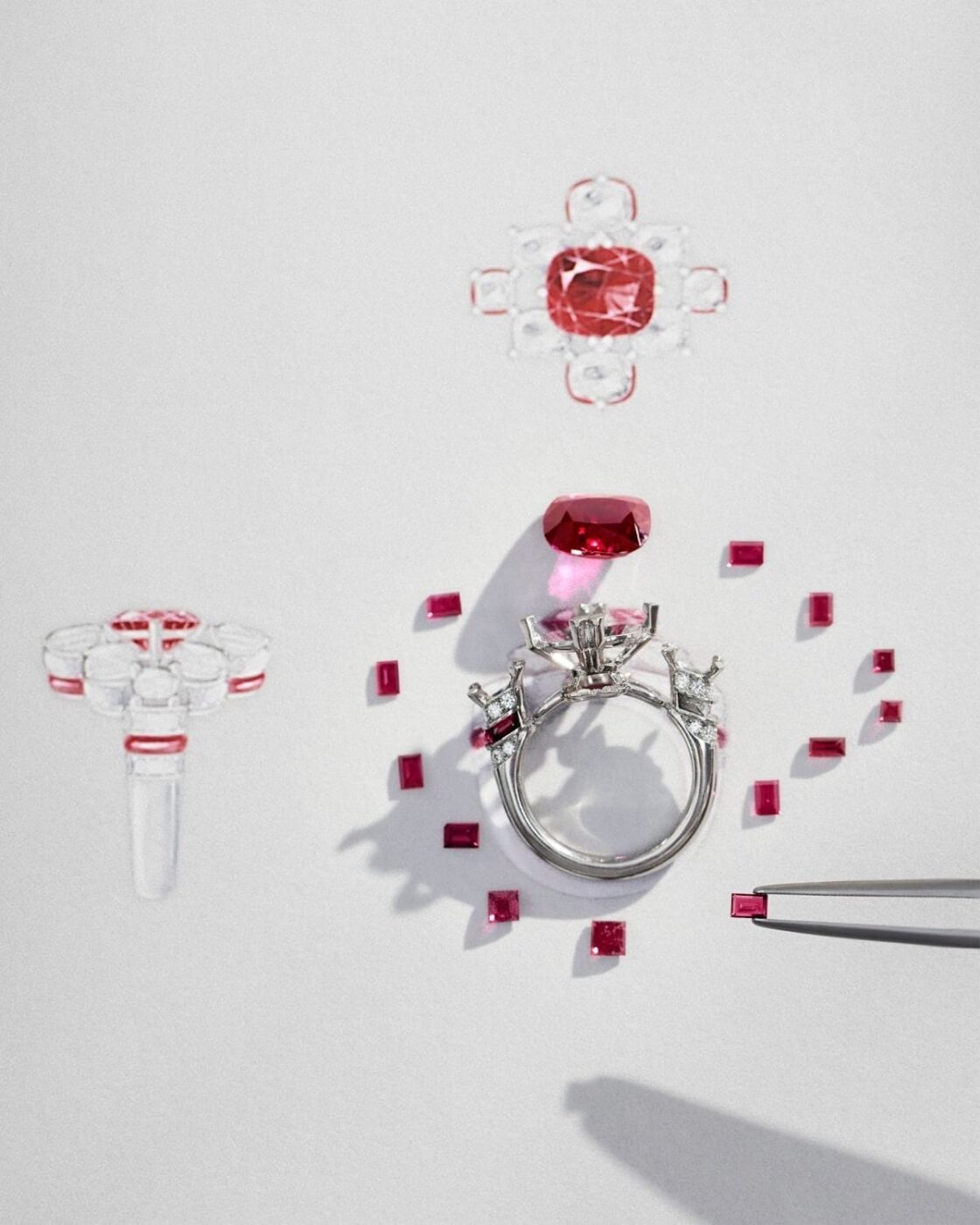
Tesselia proves that a ring does not need scale to hold authority. The 5.24-carat Mozambique ruby gives the piece its colour command, while cushion-cut diamonds, custom-cut ruby accents and openwork make the centre stone feel honoured rather than merely displayed.
Visual dossier
The image sequence behind the story

Le Chœur des Pierres opens with a question that Cartier does not state but makes visible through every piece: what does a stone want to become? The collection’s thesis, that gemstones lead the design and not the other way around, sounds like a creative premise. It is actually a technical discipline.
Listening to a stone means accepting its volume, colour temperature, optical behaviour and weight as constraints that define the jewel. Kentia, Haryma and Tesselia show three different results of that discipline: one built around the gravity of a blue cabochon sapphire, one around animal tension and imperial topaz, and one around a ruby whose colour becomes the architecture of the ring. None of them sounds like the others.
A collection led by stones
Cartier has long been at its strongest when colour is treated as structure. Tutti Frutti, Art Deco geometry, peacock-blue and green combinations, panther codes and calibrated stone cutting all belong to the same discipline: precious stones are never merely decoration. They are rhythm, contrast, attitude and identity.
Le Chœur des Pierres pushes that logic into a contemporary register. The first chapter is reported as more than 125 unique pieces requiring more than 85,000 hours of atelier work. Scale matters here, but it is not the real point. The more interesting question is how Cartier prevents abundance from becoming noise. The answer is restraint: each important stone is allowed to define the tempo of the jewel around it.
Kentia, Haryma and Tesselia show three versions of that intelligence. Kentia is architectural and feline; Haryma is held in the second before movement; Tesselia is compact, floral and intensely chromatic. Together they explain why this collection feels less like a display of gemstones and more like a conversation between stones, bodies and Cartier codes.
Kentia: the panther and the blue centre
Panthere Kentia begins with one of Cartier’s most enduring presences: the panther. Yet the animal is not treated as a logo placed on top of a necklace. It becomes part of the architecture, positioned around a cabochon-cut Ceylon sapphire of 50.13 carats. The stone gives the jewel its centre of gravity; the panther gives it temperature, watchfulness and tension.
The importance of Kentia is the balance between curve and line. Cabochons bring softness, volume and light that seems to rise from inside the stone. Cartier counters that softness with a necklace built in measured, geometric waves. The effect is not nostalgic animalier. It is a controlled collision between the rounded authority of the sapphire, the sculptural presence of the panther and the discipline of the necklace’s repeated forms.
Emerald eyes and custom-cut onyx markings keep the feline language precise. These are small details, but they matter because they avoid illustration. The panther is readable at once, yet the jewel does not surrender to literalism. Kentia remains a high jewellery necklace first: stone, structure, volume and body all working in one system.
Haryma: the tiger before movement
Haryma shifts the energy from blue composure to gold tension. The necklace is built around a tiger, poised as if movement has been delayed by one second. That pause is where the piece becomes Cartier. The animal is present, but the drama sits in the relationship between stillness and force.
The material language is warmer and more dangerous than Kentia. Five imperial topazes totalling 28.04 carats sit with garnets and white, yellow and orange diamonds in yellow gold. The palette is not simply golden; it is striped, charged and animal. Onyx is used to recreate the tiger’s coat pattern, but again Cartier avoids a flat translation. The stones are part of a sculptural skin.
Haryma also shows why high jewellery engineering is never separate from sensuality. A necklace like this has to carry an animal, exceptional stones and a complex composition while still sitting close to the neck. The technical achievement is not only that the tiger is convincing. It is that the entire jewel behaves as a second skin rather than an object placed on the body.
Tesselia: the ruby as a centre of force
Tesselia brings the collection down to the scale of the hand, where every decision becomes immediate. At the centre is a 5.24-carat ruby from Mozambique, notable not only for size but for colour: a red with a pink-inflected intensity, avoiding the orange or violet modifiers that can disturb the purity of a ruby’s presence.
The ring unfolds around that stone like a corolla. Eight cushion-cut diamonds establish the outer rhythm, while openwork and custom-cut ruby accents extend the language of the centre stone. This is a Cartier move: the principal gem is not isolated as a trophy. It sends a visual command through the whole object.
The savoir-faire is especially demanding because a ruby of this scale cannot simply be inserted into a pre-existing design. The architecture must protect the volume, respect the colour and keep the ring alive from multiple angles. Tesselia is therefore not a small chapter inside the collection. It is a concentrated statement about how Cartier turns gemstone selection into design consequence.
Why these three pieces matter together
Kentia, Haryma and Tesselia form a useful trilogy because each one gives a different answer to the same high jewellery problem: how does a maison let a stone speak without losing authorship?
Kentia answers through authority. The sapphire commands the necklace, but Cartier’s panther and geometry transform that command into a full composition. Haryma answers through character. The topazes, diamonds, garnets and onyx do not just make the tiger beautiful; they make it psychologically legible. Tesselia answers through concentration. One ruby becomes the source from which the entire ring opens.
The collection’s deepest Cartier quality is therefore not excess. It is orchestration. The stones are singular, but they are never alone. They are placed into systems of movement, line, animal presence, colour theory and bodily intelligence.
Collector relevance
For collectors, Le Chœur des Pierres sits in a valuable category: it is recognisably Cartier, but it is not dependent on one familiar motif. Kentia carries the panther, but the sapphire is equally important. Haryma uses animal codes, but the technical work around topaz, onyx and gold is the real achievement. Tesselia is a ruby ring, but its significance lies in how the stone restructures the whole jewel.
That distinction matters because high jewellery must survive beyond first impact. A piece can be spectacular for one image and forgettable in memory. These creations are stronger because they have a second reading. After the colour, there is construction. After the animal, there is engineering. After the central stone, there is a full Cartier grammar.
Key references inside Le Chœur des Pierres
| Creation | Core stone language | Design reading | TheTimeo view |
|---|---|---|---|
| Panthere Kentia | 50.13-carat cabochon-cut Ceylon sapphire | Panther, geometry, cabochon volume and botanical rhythm | The blue stone becomes the gravitational centre of a feline architecture. |
| Haryma | Five imperial topazes totalling 28.04 carats, with garnets, diamonds and onyx | Tiger tension, yellow gold warmth and second-skin construction | The animal is not illustrated; it is engineered into the necklace’s movement. |
| Tesselia | 5.24-carat Mozambique ruby | Corolla structure, cushion-cut diamonds and custom-cut ruby accents | The ring proves that a centre stone can dictate the whole architecture. |
TheTimeo view
Le Chœur des Pierres succeeds because it gives precious stones a voice without turning Cartier into a passive frame. The maison listens to the gems, but it still composes. Kentia, Haryma and Tesselia show the same discipline at three scales: necklace as panther architecture, necklace as animal tension, ring as chromatic force.
For a reader, the appeal is immediate: colour, animals, volume, movement. For a collector, the importance is more serious. These jewels do not only display rarity; they translate rarity into design language. That is where Cartier remains difficult to imitate.