High Jewellery Atelier
JewelryCartier En Équilibre: The High Jewellery Art of Balance
Cartier En Équilibre turns balance into high jewellery language through Vetrata, Byzas, Haliade, Shito, Hyala, Panthère Dentelée, Tsagaan, Traforato and Pavocelle.
In brief
Why this creation matters
Cartier En Équilibre makes balance active: emerald drops, animal presence, openwork and transformation are held in controlled opposition until discipline becomes spectacle.
En Équilibre is an argument: that discipline is the highest form of spectacle.
TheTimeo editorial desk
Object first
A closer reading of the creation
Editorial dossier
Precision, nothing in excess
En Équilibre is Cartier working through controlled opposition: symmetry and asymmetry, full and empty, gemstone volume and clean line, animal presence and architectural restraint. The collection is strongest when the object seems calm, but the design intelligence underneath is clearly under pressure.
Atelier reading
Emerald line, resolved asymmetry
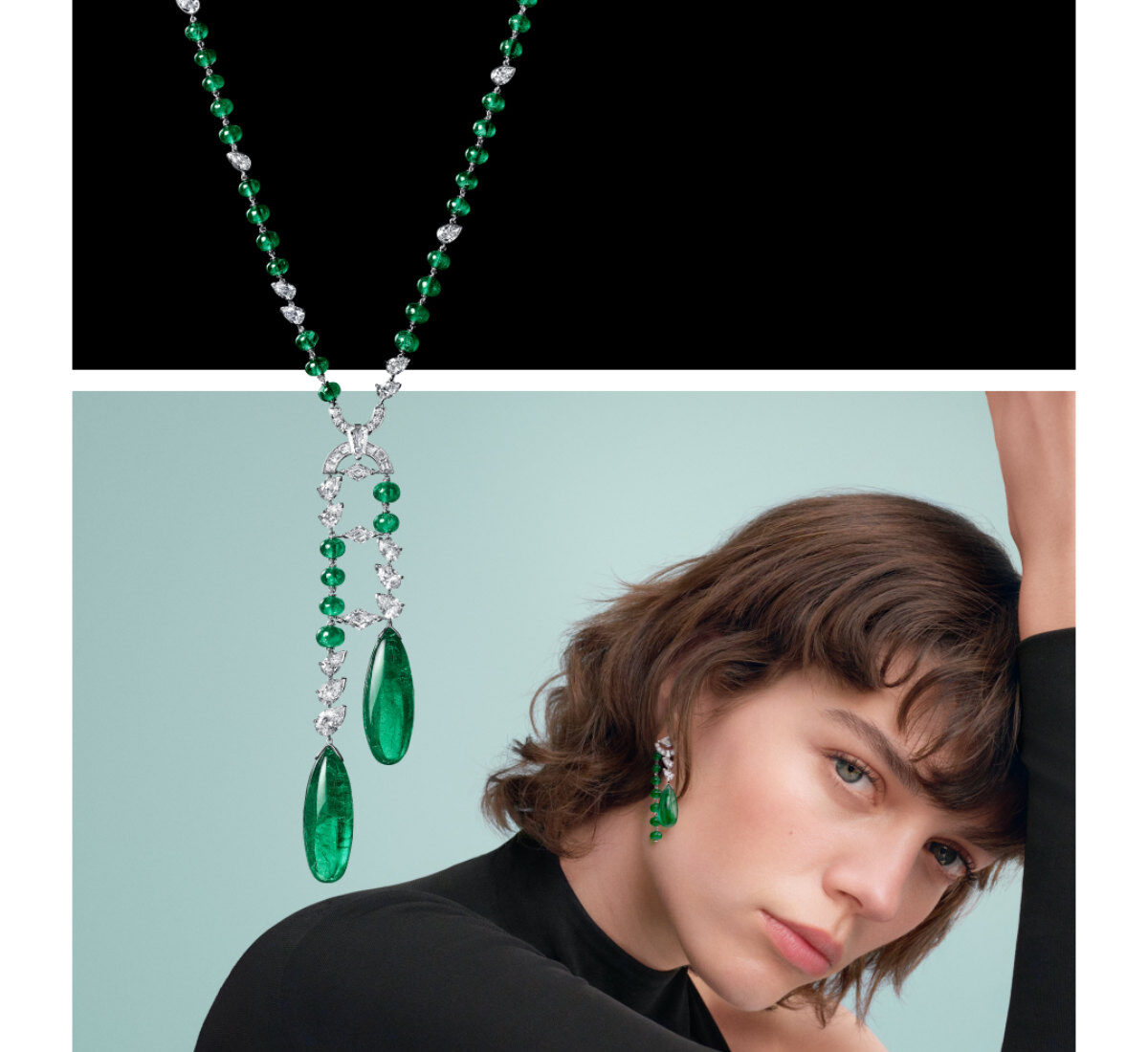
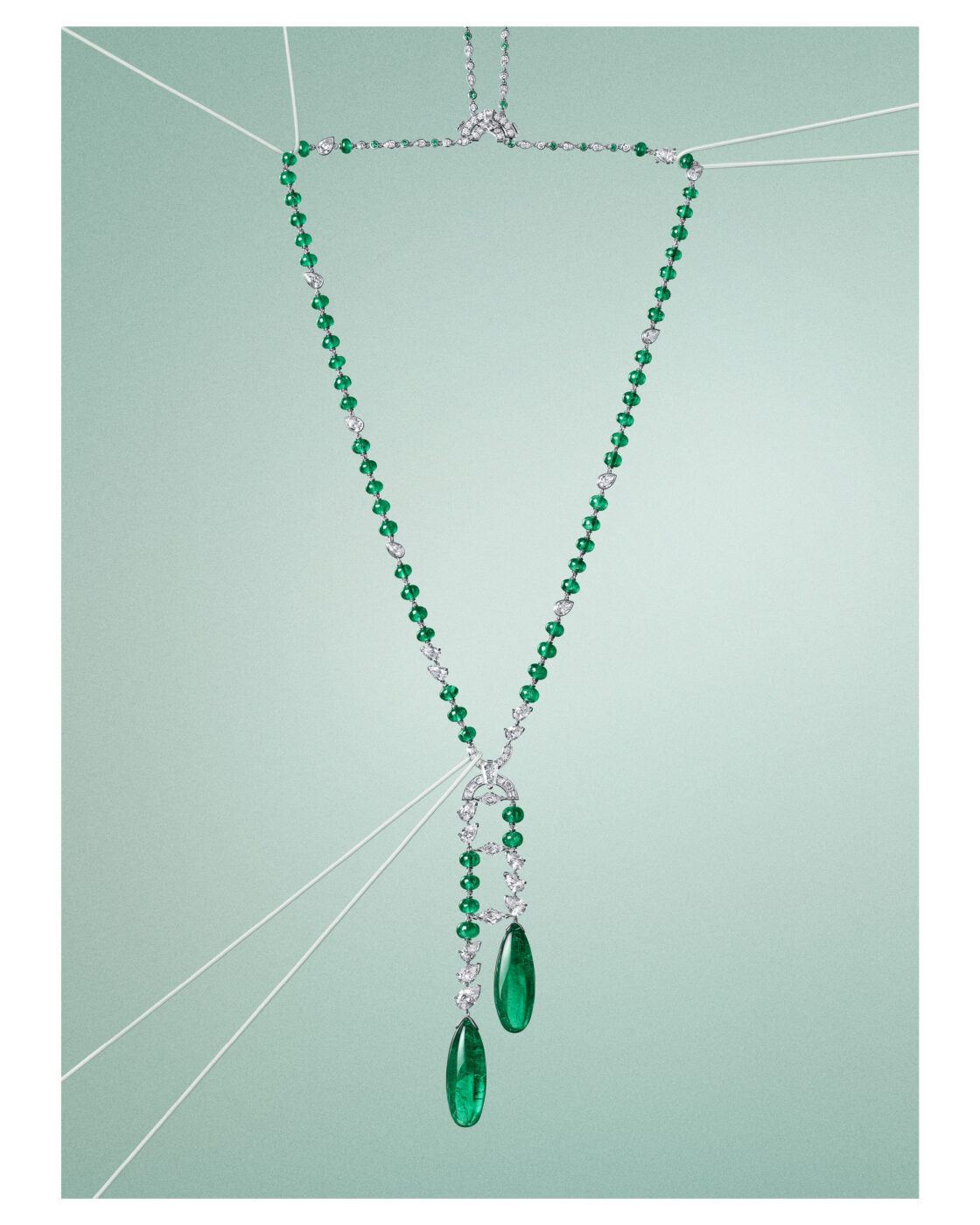
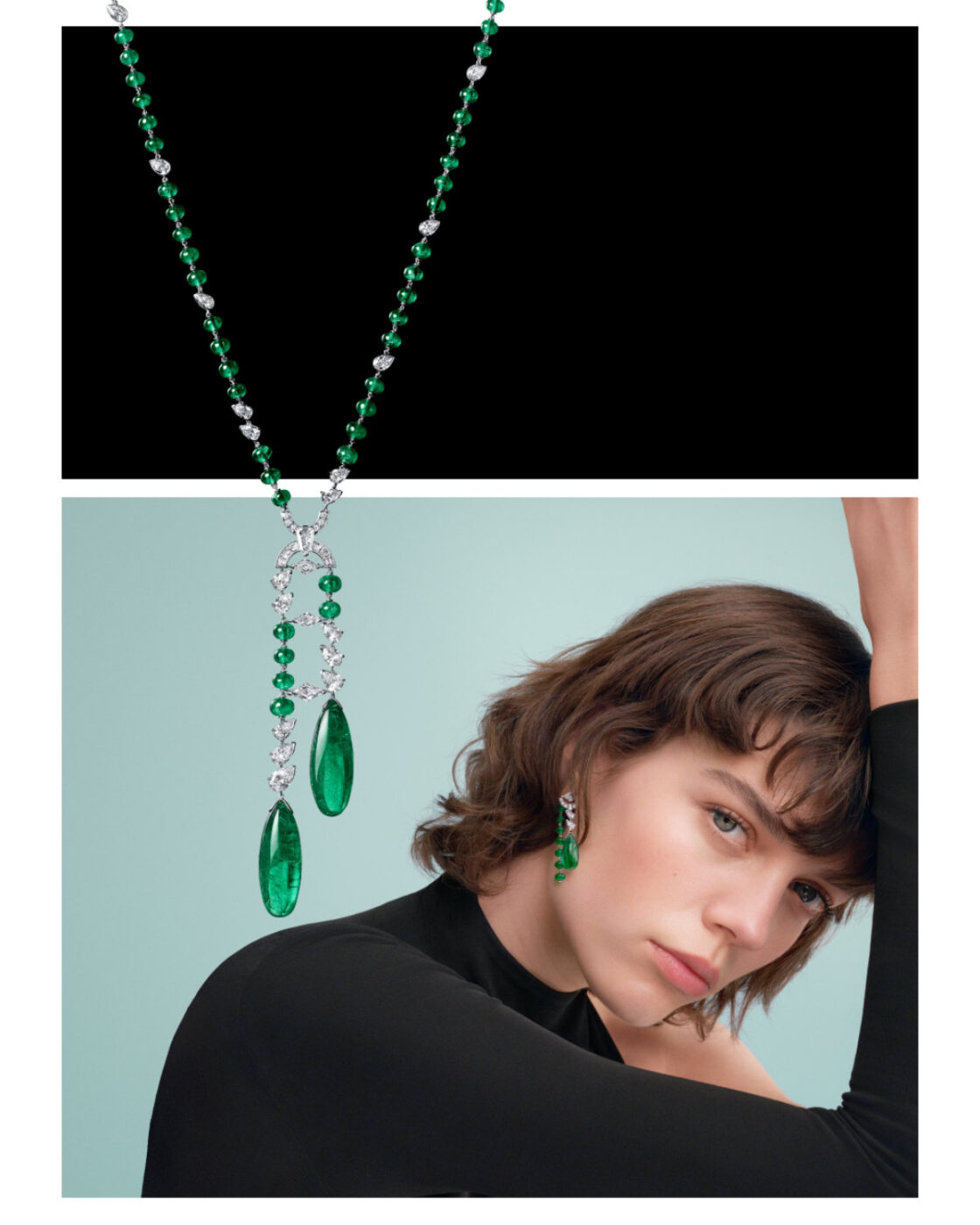
Shito begins with two Zambian emerald drops of 49.37 carats each, suspended in a resolved asymmetry that required more design intelligence than symmetry would have. The drops begin and end the line; the diamonds give it direction; the negative space between them is not absence but structure.
Atelier reading
Animal presence made light
Panthère Dentelée translates the panther into lace: onyx spots, openwork body and diamond field make the animal unmistakable and weightless. Tsagaan takes the argument further, making the snow leopard appear through trompe-l’œil, geometric diamond cuts and onyx.
Atelier reading
Transformation as balance
Pavocelle is spectacular because it remains disciplined. A 58.08-carat sapphire cabochon becomes the centre of a peacock whose openwork tail can detach and become a brooch, changing function without changing logic.
Visual dossier
The image sequence behind the story
Balance in Cartier’s hands is never passive. En Équilibre is not a collection about harmony as comfort; it is a collection about harmony as the result of controlled opposition held at maximum tension. Cartier has always been at its most interesting when something is about to break, and does not. The panther that stays still. The emerald drops that hang asymmetrically but do not tip. The peacock necklace that becomes a brooch without losing its reason for existing.
En Équilibre is an argument: that discipline is the highest form of spectacle. Line, volume, colour, animal presence and negative space are made to oppose one another without breaking the harmony of the jewel. Cartier does not simply decorate precious stones. It gives them a frame of order: black and white against green, geometry against animal movement, cabochon volume against clean line, supple drape against architectural control.
The art of balance
The official language of En Équilibre is harmony through the art of balance. In practice, that means the collection is less about one single motif than a set of controlled oppositions. The most Cartier moments arrive when the jewel seems almost simple at first, then reveals the difficulty behind that simplicity: asymmetrical emerald drops, a barely visible necklace over the skin, a panther made of lace-like openwork, or a peacock necklace that can transform into a brooch.
This is not minimalism. It is discipline. Cartier uses extravagance, but it edits it. It uses strong gemstones, but avoids letting carat weight become the only story. The collection is strongest when the eye can move between clarity and complexity without losing the object.
Vetrata, Byzas and Haliade: balance begins with architecture
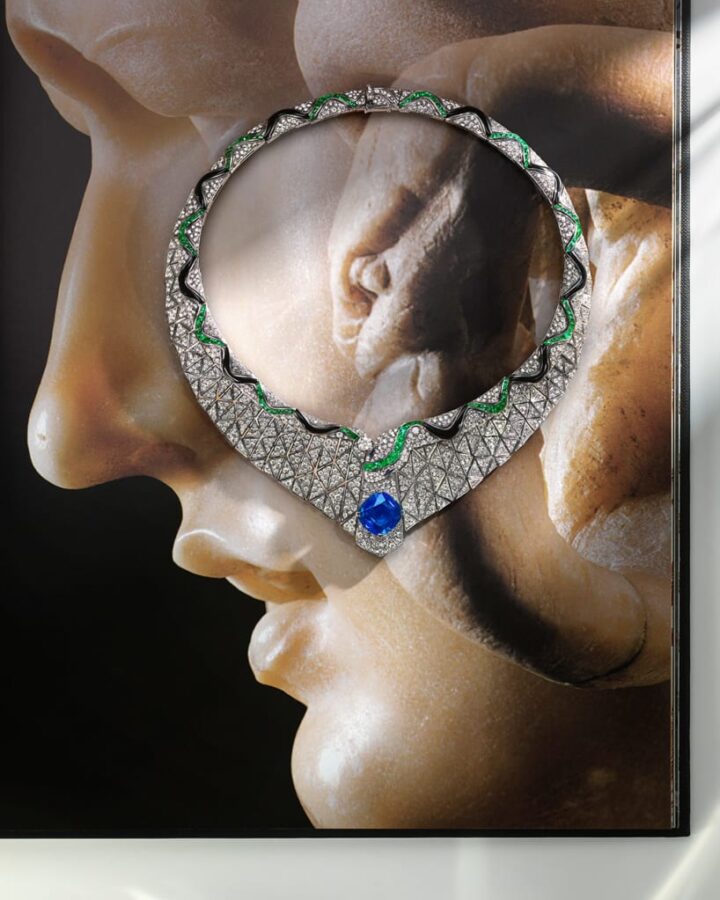
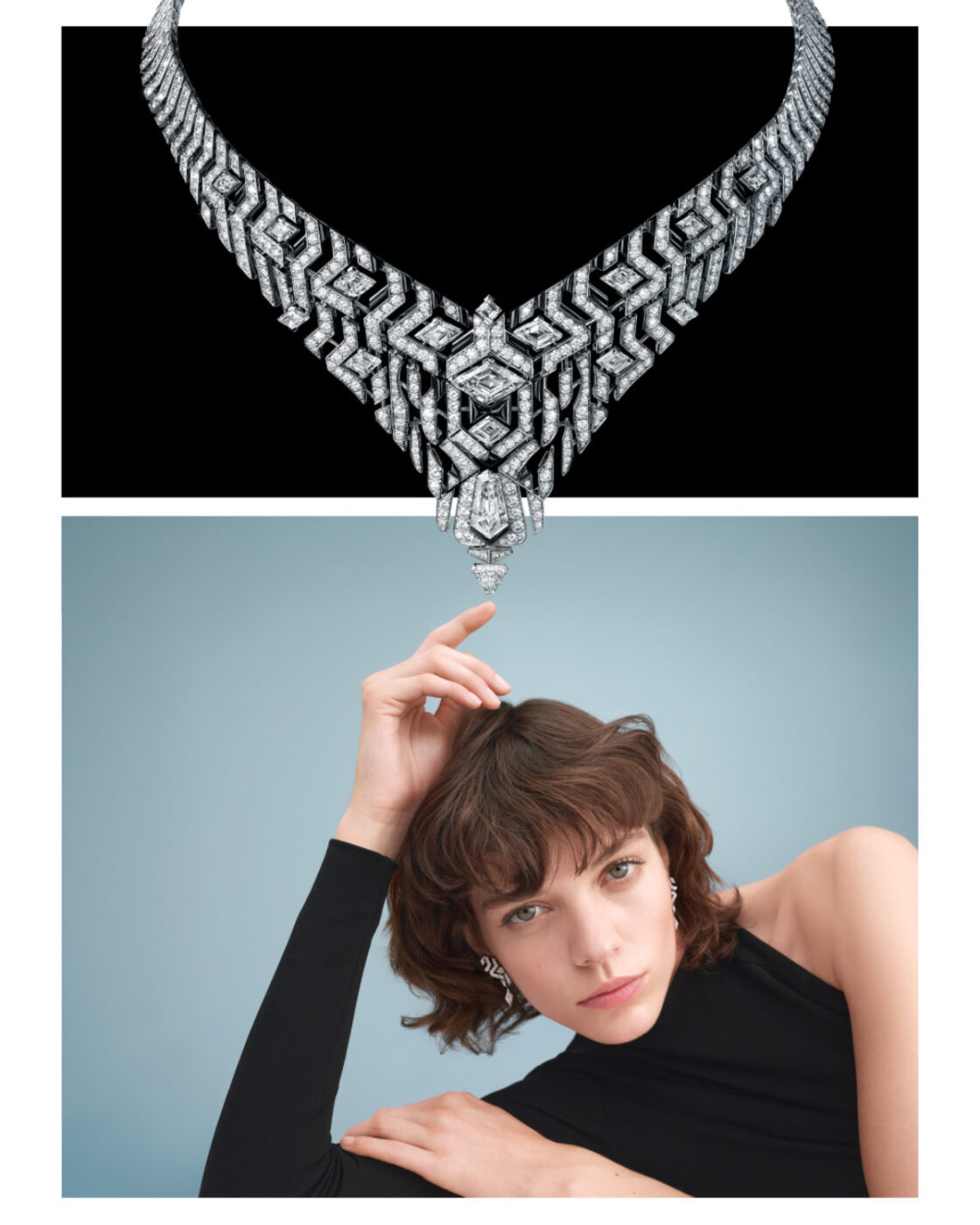
Vetrata gives the collection its most rigorous Art Deco reading. A rectangular-cut diamond of 8.15 carats sits at the centre, surrounded by twenty diamonds of a similar shape. Onyx separates the symmetrical elements and gives the whole piece a graphic charge. The result is not nostalgia for Art Deco, but a contemporary exercise in proportion: every line has to look inevitable.
Byzas brings colour into that discipline. An 11.70-carat pear-shaped Ceylon sapphire meets eight Zambian emeralds totaling 8.94 carats. Blue and green are one of Cartier’s great chromatic territories, but here the interest is the way geometry controls the accord. The cushion shape of the emeralds is amplified by repeated motifs, so the colour becomes architectural rather than merely ornamental.
Haliade moves toward volume. A 41.85-carat Madagascar sapphire anchors a necklace of supple waves, diamonds and calibrated sapphires. The technical challenge is clear: the wave must feel soft, but the composition cannot collapse into fluidity. It needs depth, rhythm and a centre of gravity.
Colour as equilibrium
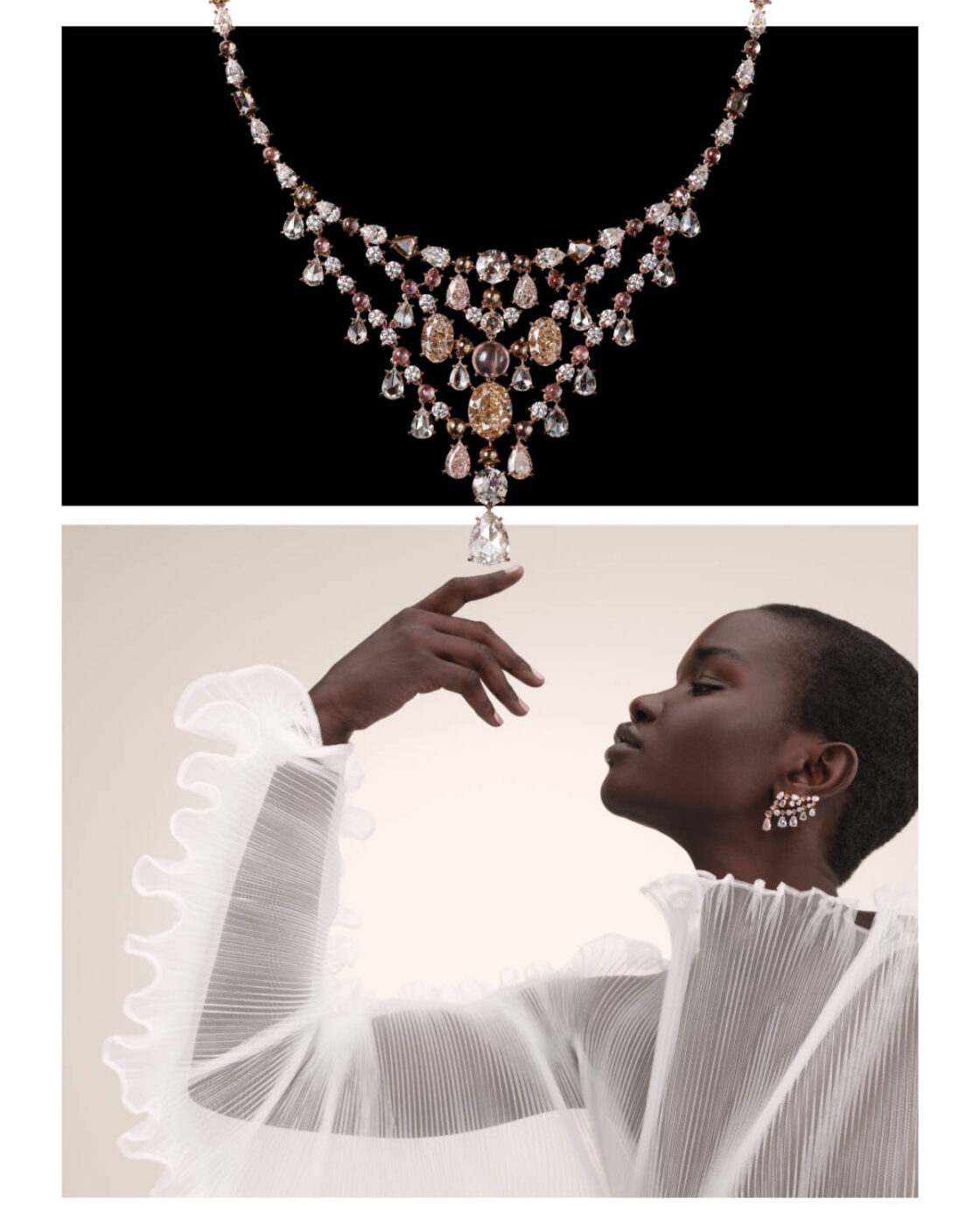
Several creations show that En Équilibre treats colour as a balancing force. Cafayate uses opals, yellow and rose gold mesh, coloured sapphires and warm reflections to create a wave of light. Tutti Ta Prohm revisits the Tutti Frutti language through imposing emeralds and carved rubies, transforming botanical abundance into a controlled Cartier composition.
Shito is more restrained but no less powerful. Two Zambian emerald drops of 49.37 carats each are suspended in asymmetrical pendants, joined by a line of emeralds and diamonds. The beauty of the piece lies in its refusal to over-explain itself. The drops begin and end the line; the rest is precision.
Traforato returns to the maison’s black, white and green vocabulary. Three octagonal Colombian emeralds form the central axis of a geometric openwork mesh, with emerald and onyx accents adding relief. It is one of the collection’s clearest demonstrations of balance through space: the empty areas are not absence, but structure.
Animals, reduced to essentials
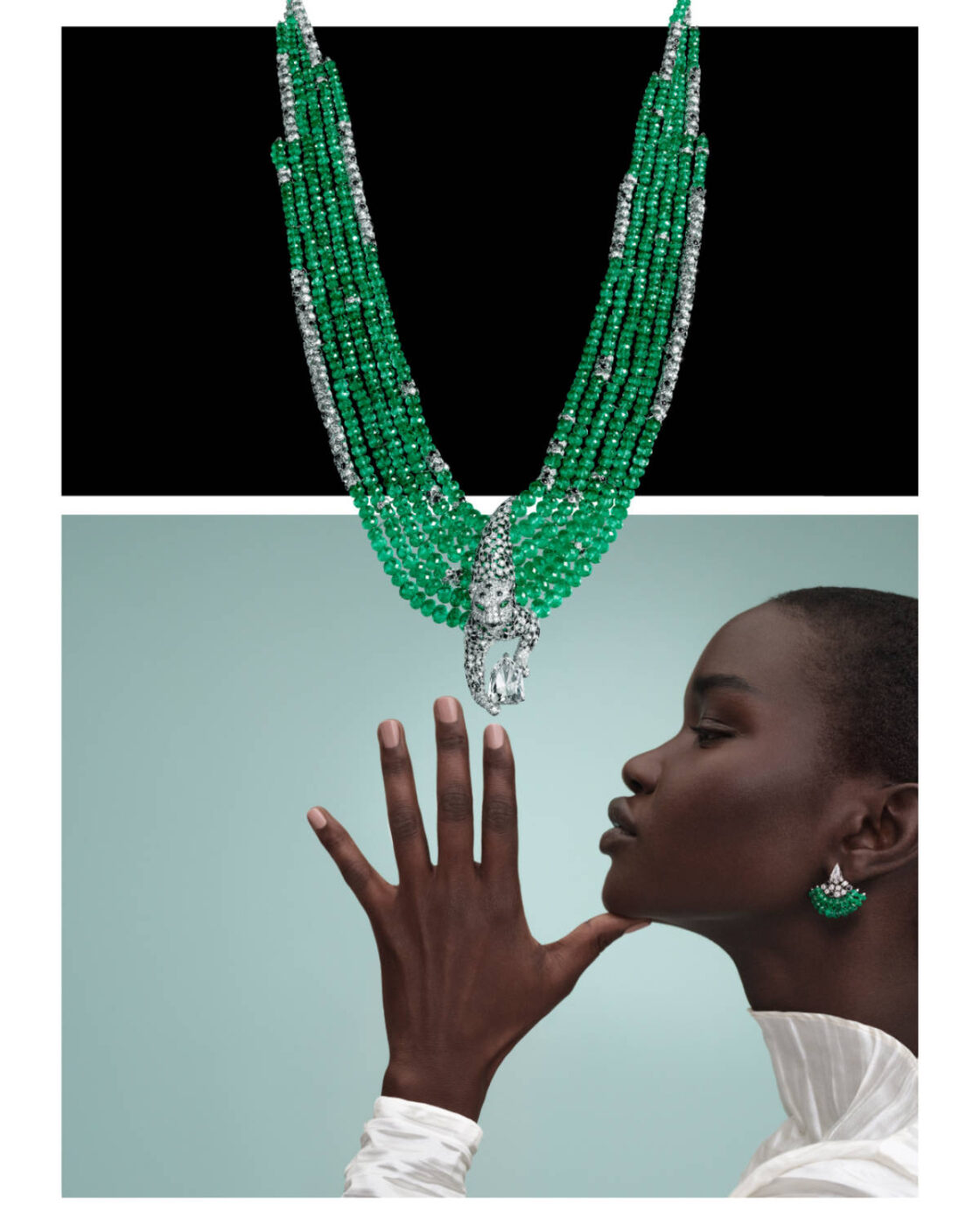
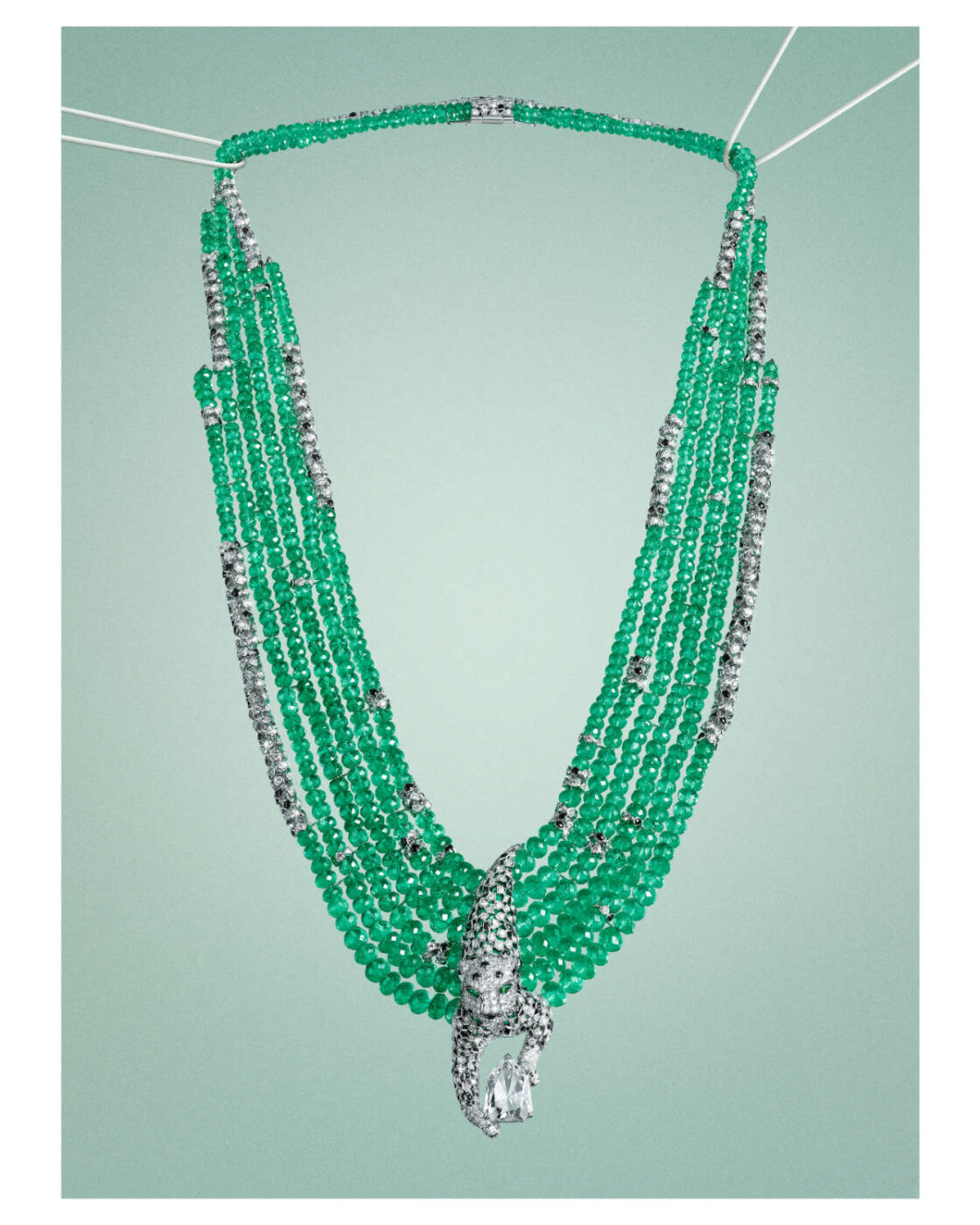
Cartier’s animalier language can easily dominate any collection, but En Équilibre uses animals as tests of restraint. Panthère Dentelée is not a heavy panther jewel. It is a panther translated into lace, onyx spots, diamonds and openwork. The animal remains unmistakable, yet the body is lightened until the expertise becomes almost architectural.
Tsagaan takes the snow leopard in another direction. Its subject is rarity and near-invisibility. The necklace relies on trompe-l’oeil, full and empty spaces, and geometric diamond cuts enhanced by onyx. The feline appears and disappears according to the eye’s position. In that sense, Tsagaan is not only an animal jewel; it is a study of perception.
Panthère Orbitale adds a stronger chromatic and sculptural note. The panther is perched on a coral cabochon, with amethyst, emeralds, onyx and diamonds creating a high-colour field. It is bolder, but still built on equilibrium: volume is balanced by line, realism by abstraction, colour density by the panther’s precise presence.
Lightness, transformation and the invisible
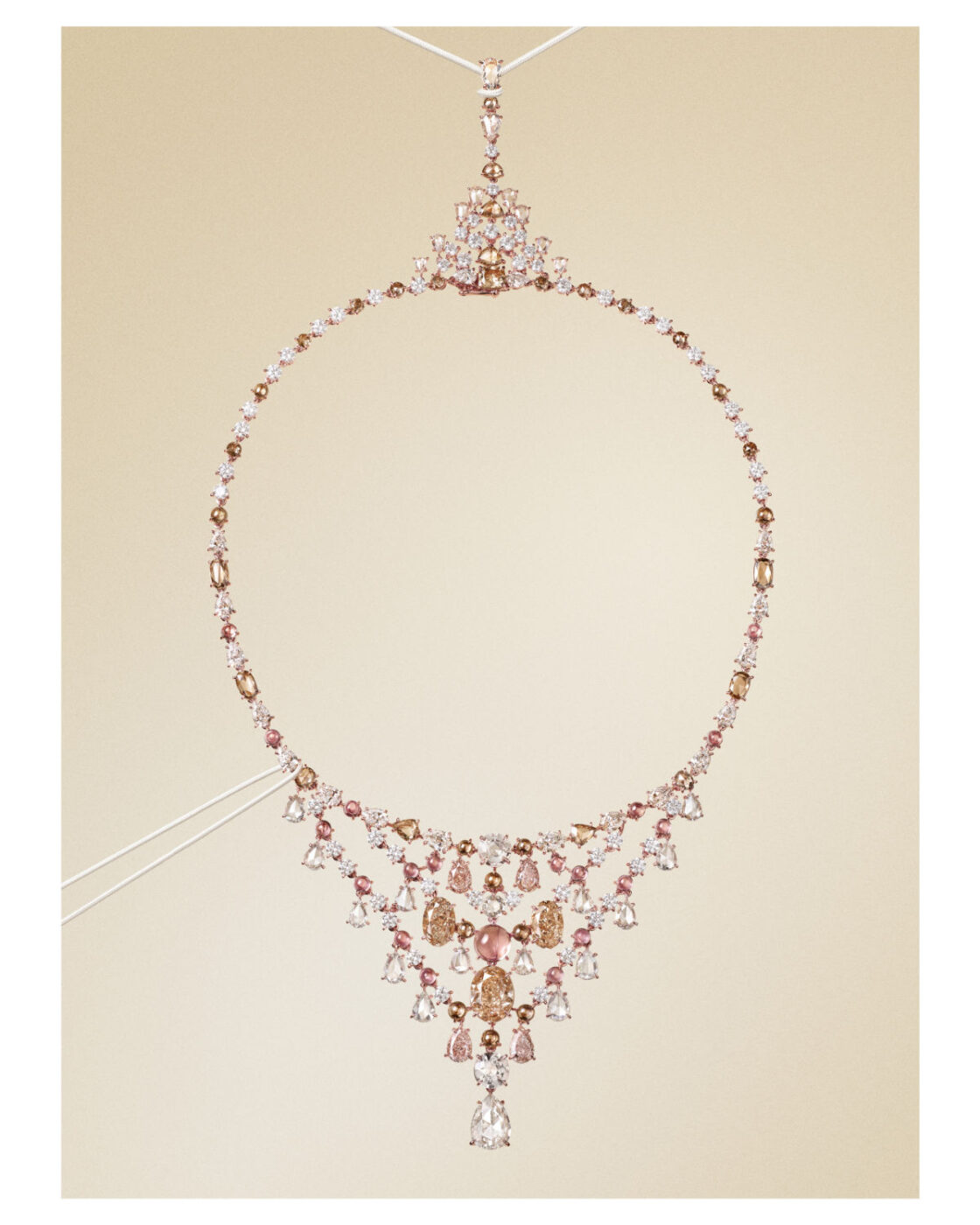
Hyala is one of the most revealing creations because its ambition is almost paradoxical: a necklace that appears as light as a veil over the skin. Rose gold, diamonds and coloured sapphires are worked so delicately that the setting nearly disappears. The result is not visual emptiness, but a different kind of luxury: the invisible structure becomes part of the value.
Pavocelle shows the same intelligence at a more spectacular scale. A 58.08-carat sapphire cabochon inspires a peacock necklace whose openwork motifs recall the bird’s tail. The centre stone and its support can become a collar brooch, while a pear-shaped diamond in the clasp can be added as a pendant. Transformation here is not a trick; it is an extension of the balance between jewel, body and movement.
Summae condenses the collection’s philosophy into a black, white and green trio with troïdia-cut diamonds, onyx and emerald beads. The stated creative intention is essentiality, and that matters. In high jewellery, essential does not mean simple. It means every visible decision has survived the discipline of removal.
Collector relevance
For collectors, En Équilibre is important because it offers Cartier signatures without reducing the collection to a catalogue of icons. The panther appears, but it is not the only subject. Emeralds, sapphires, opals, coral, onyx, openwork, calibrated stones and transformable mechanisms all contribute to the same thesis: Cartier’s authority lies in composing opposites.
The most desirable pieces are therefore not necessarily the loudest. A jewel like Shito has power because its asymmetry feels resolved. Hyala has power because it makes technical difficulty disappear. Panthère Dentelée has power because animal presence is achieved through lightness rather than mass. Pavocelle has power because transformation feels inseparable from the design.
Key En Équilibre references
| Creation | Central signal | Design reading | TheTimeo view |
|---|---|---|---|
| Vetrata | 8.15-carat rectangular-cut diamond | Art Deco symmetry, onyx accents, diamond architecture | Balance as line and proportion. |
| Byzas | 11.70-carat Ceylon sapphire with Zambian emeralds | Blue-green chromatic accord controlled by geometry | Colour made architectural. |
| Haliade | 41.85-carat Madagascar sapphire | Supple sapphire and diamond waves | Volume held in rhythm. |
| Shito | Two 49.37-carat Zambian emerald drops | Asymmetry, precision and emerald line | Restraint with monumental stones. |
| Panthère Dentelée | Emeralds, onyx and diamonds | Panther body translated into openwork lace | Animalier made light. |
| Pavocelle | 58.08-carat sapphire cabochon | Peacock structure with transformable brooch function | Spectacle disciplined by transformability. |
TheTimeo view
En Équilibre succeeds because it makes balance feel active. Cartier is not smoothing away tension; it is staging it. The collection works because each opposition remains visible: full and empty, symmetry and asymmetry, animal and architecture, weight and lightness, coloured stones and disciplined line.
That is why the collection feels unmistakably Cartier. It is not dependent on one emblem. It is a grammar of control, and control is often the highest form of luxury.