High Jewellery Atelier
Bridal
Cartier Trinity and Solitaire 1895: A Ring That Cannot Be Worn Alone, and a Setting Built on Four Words
A TheTimeo bridal reading of two Cartier icons with opposite logics — the Trinity ring, created by Louis Cartier in 1924 as three interlocking bands that move as one, and the Solitaire 1895, Cartier’s first solitaire design, where a single stone is held by four claws in pursuit of nothing but simplicity and purity.
In brief
Why this creation matters
Trinity asks a question most rings never have to answer: can three things be inseparable without any one of them being in charge? The Solitaire 1895 asks the opposite question: what is the smallest number of decisions a setting can make before it simply becomes the diamond's frame, and nothing more? Both represent quietly radical ideas in bridal jewellery.
can three things be inseparable without any one of them being in charge?
TheTimeo editorial desk
Object first
A closer reading of the creation
Editorial dossier
Two icons, two philosophies of commitment
Cartier's bridal language contains few ideas as enduring, or as structurally different from one another, as Trinity and the Solitaire 1895. Trinity, created in 1924, is built on multiplicity, while the Solitaire 1895, first appearing in archives in 1895, is built on extreme reduction.
Atelier reading
Trinity: Defying visual hierarchy
Created individually and meticulously joined, the three gold bands move fluidly, with no fixed hierarchy. Worn on the hand, they continuously reorder themselves without ever coming apart.
Atelier reading
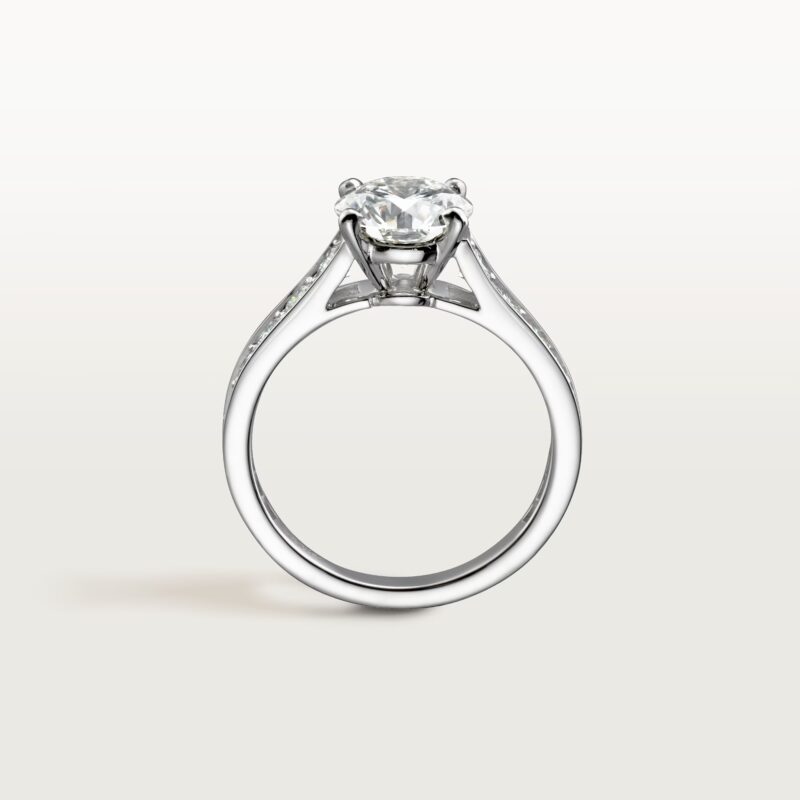
Solitaire 1895: Four-claw geometry
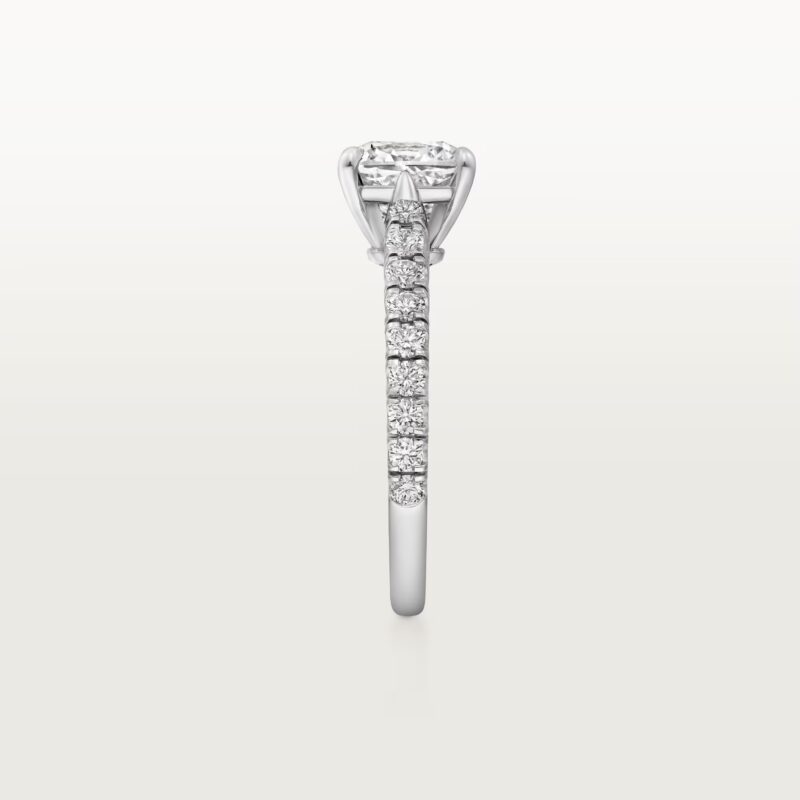
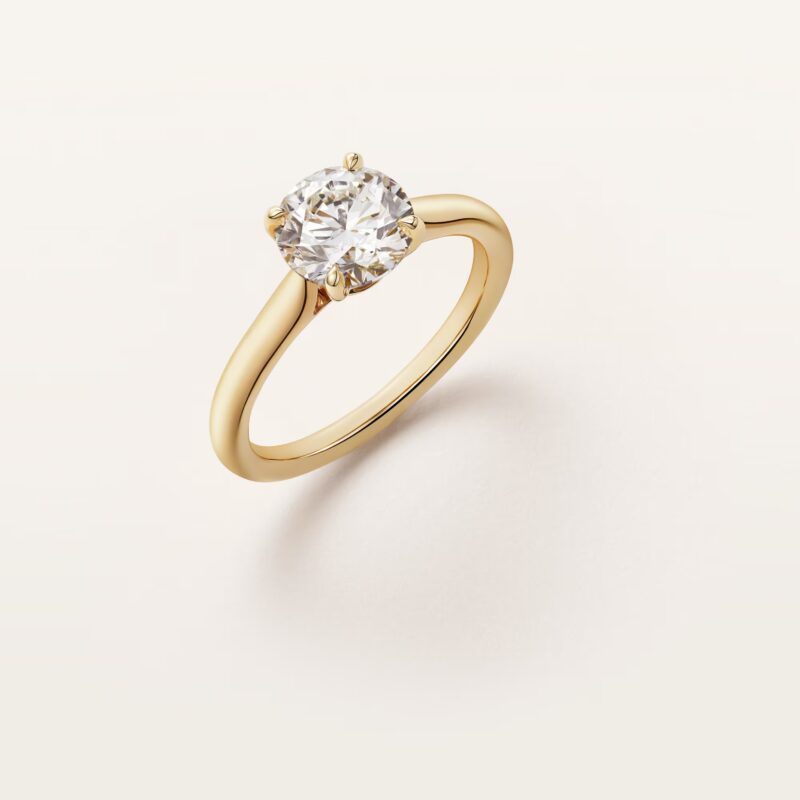
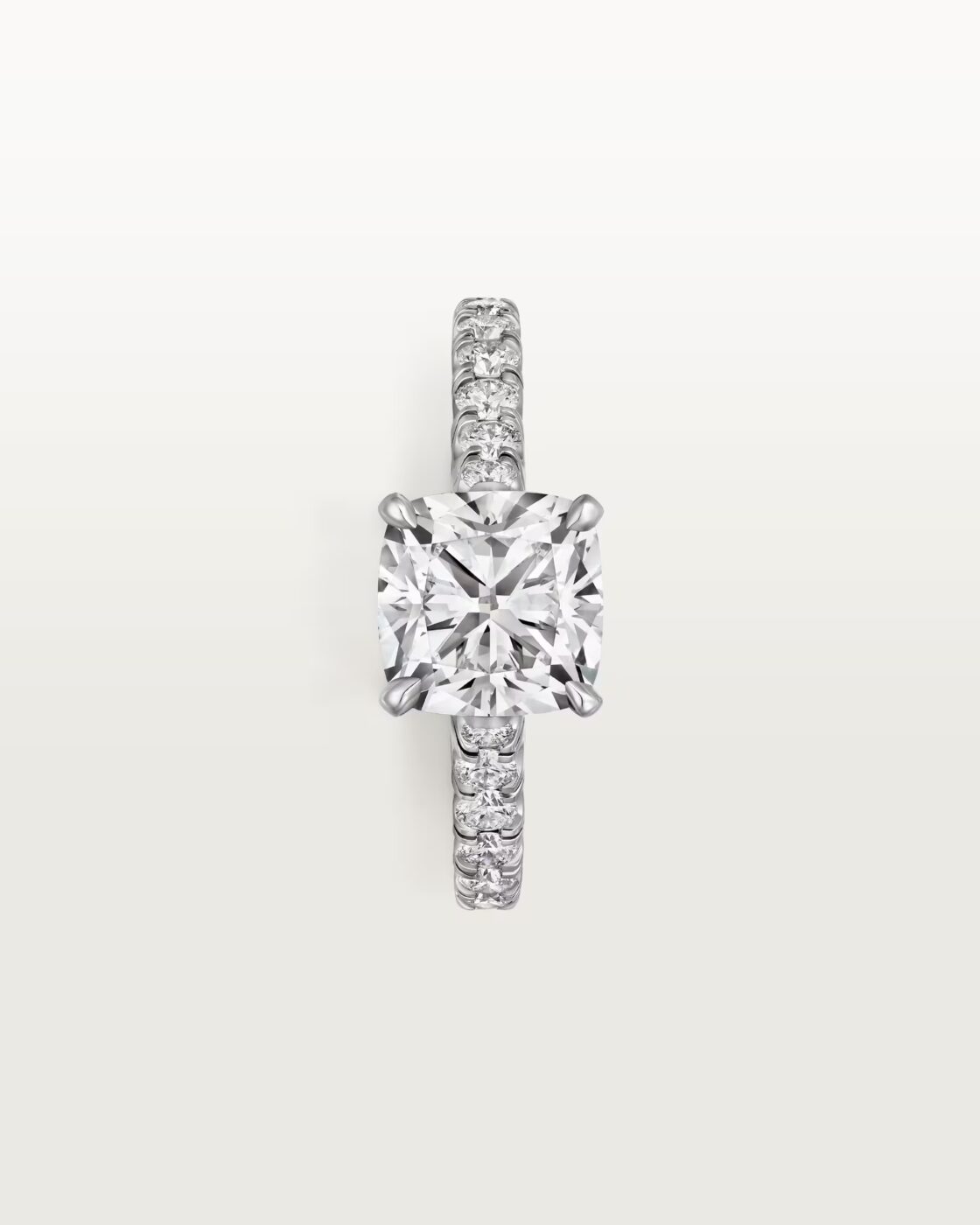
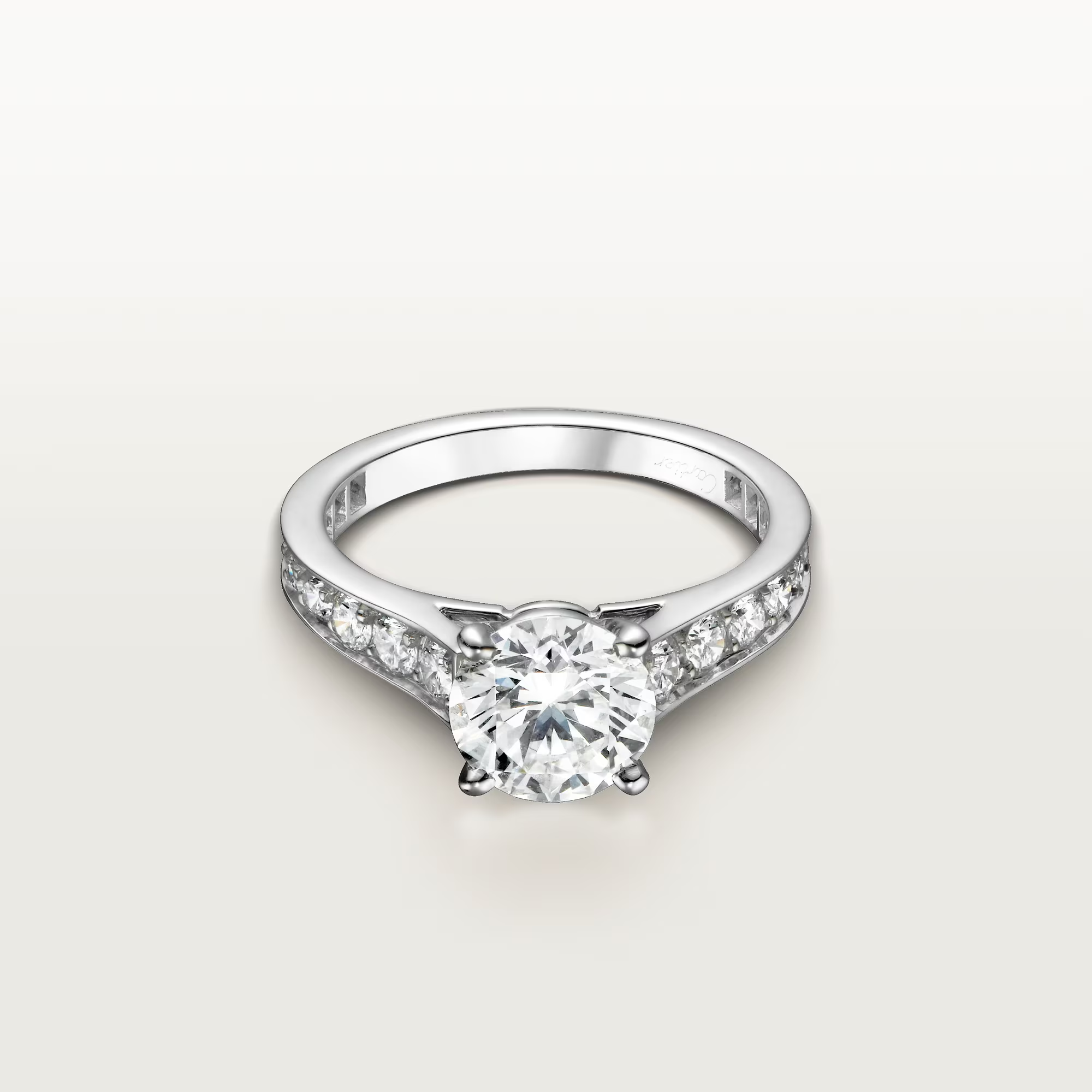
By concentrating security across four claws rather than six, Cartier creates an architectural silhouette that aligns with the geometry of brilliant and fancy-cut stones.
Atelier reading
Bridal compatibility
Cartier offers 1895 wedding bands in rose gold, yellow gold, and platinum. Designed for stacking, they complete the solitaire's narrative with matching elegance.
Visual dossier
The image sequence behind the story
In brief — Two icons, two philosophies of commitment
Cartier’s bridal language contains few ideas as enduring, or as structurally different from one another, as Trinity and the Solitaire 1895. Trinity, created by Louis Cartier in 1924, is built on multiplicity — three bands in three golds, interlocked so that “none of the three bands sits above the others, yet each is both above and below another,” a ring that, as one historian put it, “seems to defy logic.” The Solitaire 1895 is built on reduction — a single stone, held by four claws, in a design Cartier describes simply as “where simplicity and purity meet.”
Both ideas have proven extraordinarily durable. Trinity has been worn by Grace Kelly and Princess Diana, adopted by Jean Cocteau as a personal talisman stacked on his little finger, and continues, over a century after its creation, to be offered as wedding bands, anniversary gifts, and tokens of friendship — its meaning deliberately left open enough that “while fashion trends evolve,” as one account observed, the ring itself “leaves room for individual stories.” The Solitaire 1895 takes its name from the year “the first solitaire ring appears in the Cartier archives” — and the four-claw setting it established has remained, with only the most minimal evolution, Cartier’s answer to the question of how to present a diamond with nothing standing between the stone and the eye.
Trinity — 1924, three bands, and an equilibrium that defies logic
The creation — Louis Cartier and “the rule of threes”
Trinity was created in 1924, the same year a bracelet using the same three-band, three-colour-of-gold principle was also produced — establishing from the outset that the interlocking-bands concept was conceived as a design language rather than a single object. The ring’s structure rests on what one account calls “the rule of threes, or visual hierarchy”: where one element is singular and two create contrast, three creates balance. “In 1924, Cartier captured that equilibrium in Trinity — a design where three interlocking bands move as one, forming an enduring icon that has lasted for over 100 years.”
The phrase “move as one” is not incidental description — it is the entire technical achievement of the design. Each of the three bands is “created individually and then meticulously joined in a seamless way to create the iconic interlocking design,” a process that “requires expert craftsmanship and precision to ensure the bands… move fluidly while maintaining the integrity of the overall design.” The result is a ring with no fixed hierarchy among its components: the three bands are linked such that “none of the three bands sits above the others, yet each is both above and below another” — a structure that, worn on the hand, shifts and resettles with movement, the three colours of gold continuously reordering themselves relative to one another without the ring ever coming apart or losing its overall form.
This was, for jewellery of the early 20th century, “technically advanced” in a way that is easy to underestimate from a contemporary vantage point, where interlocking and articulated jewellery designs are far more common. In 1924, a ring that was simultaneously three separate objects and one continuous object — that had no “front” band and no “back” band, no component that read as primary and others as supporting — represented a genuine departure from the hierarchical logic (a centre stone, a setting, a band) that had defined ring design up to that point.
The symbolism — Deliberately, productively ambiguous
The three bands of Trinity are conventionally described as representing love, fidelity, and friendship — a triad that Cartier’s own materials describe in terms of “never-ending connections” and “love, friendship and diversity.” But what makes Trinity’s symbolism so enduring is less the specific triad assigned to it than the fact that the ring’s structure — three equal, interlocked, hierarchy-free elements — supports almost any triad a wearer wishes to assign.
Interlocking elegance.
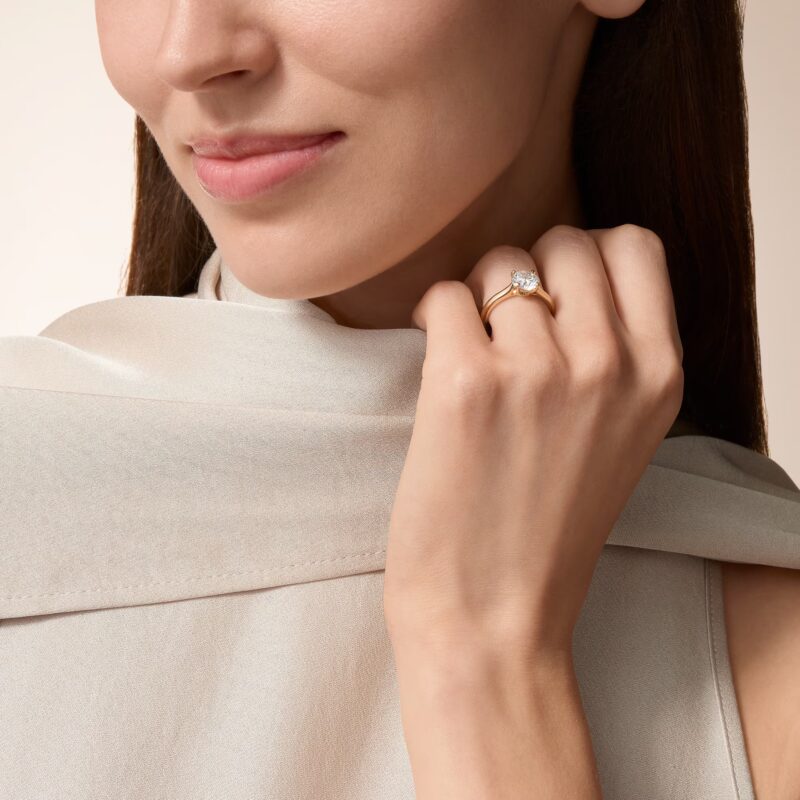
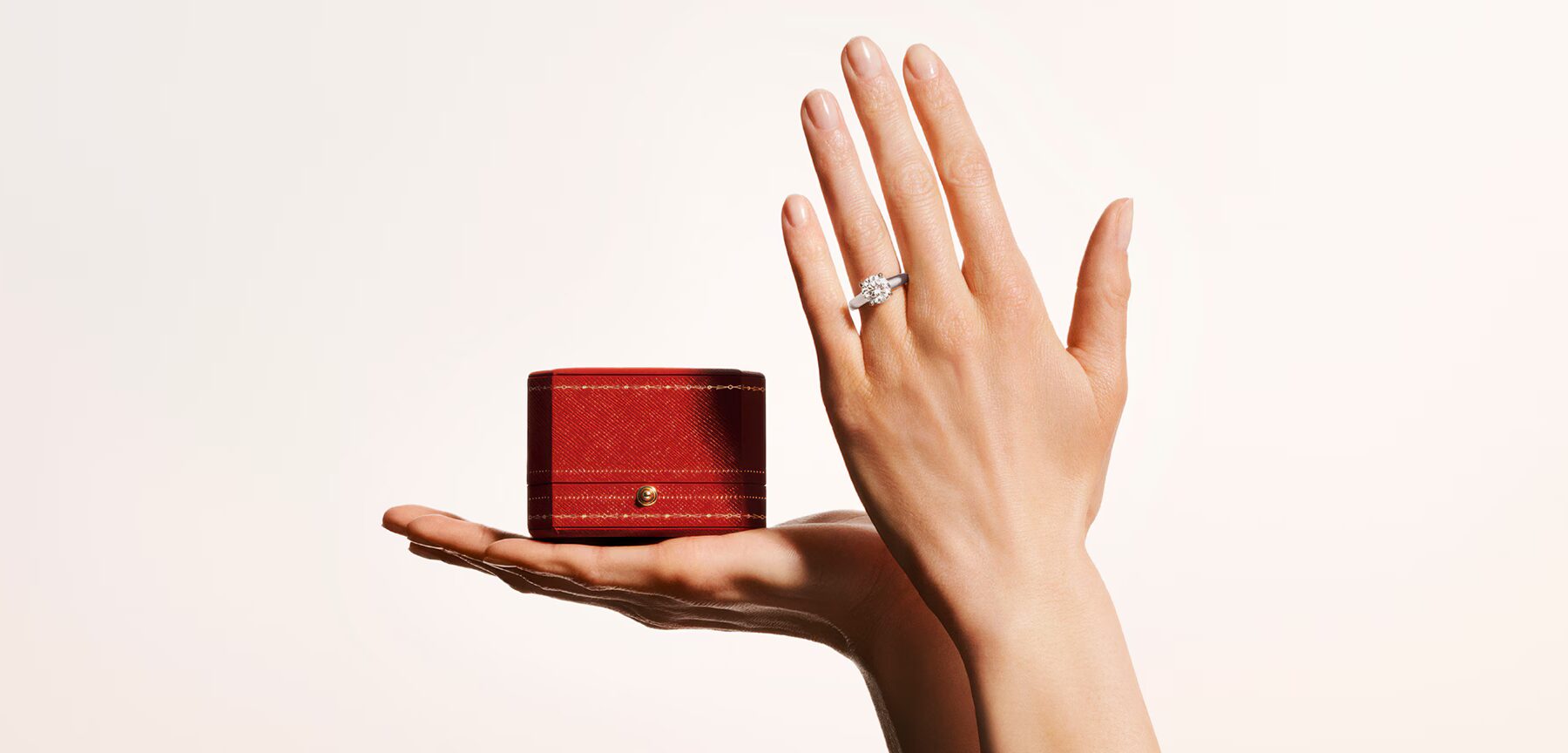
The Trinity ring on a model’s hand. The interlocking bands slide smoothly over one another, shifting color order with every movement while remaining inextricably bound together.
One account notes that “other interpretations of this type of ring claim that it dates back to Celtic origins or that the design is a reference to Russian wedding rings — neither can be scientifically supported,” while “a more mainstream interpretation” holds that “the rose gold band represents love, the white gold one friendship and the yellow gold loyalty,” and that “some people claim they stand for the past, the present and the future.” Cartier itself, by this account, “never officially referred to” any explicitly religious meaning (a connection some have drawn to the Christian Holy Trinity), though the ambiguity itself — an “ethereal meaning” that “cannot harm” — appears to be by design rather than oversight.
This deliberate openness is precisely why Trinity has been able to function across such a wide range of occasions: “gifted to children stepping into adulthood, an exchange between partners to signify commitment, or offered after the birth of a child,” serving as “a promise ring, a wedding band, and a personal talisman.” A ring whose symbolism was rigidly fixed to a single meaning could not occupy all of these roles. Trinity’s three-part structure provides just enough symbolic scaffolding — three of something, interlocked, equal — for the wearer to supply the specific meaning that fits their own relationship, without the ring itself ever needing to specify which interpretation is correct.
The cultural lineage — Grace Kelly, Cocteau, and “gender-fluid” appeal
Trinity’s adoption by significant cultural figures throughout the 20th century reinforced its identity as a ring whose meaning travels with the wearer rather than being fixed by the object. Grace Kelly wore the Cartier Trinity ring during the period of her transition from Hollywood actress to Princess of Monaco — a biographical arc (American film star becoming European royalty) that the ring, in retrospect, seems to bridge without contradiction, equally at home in either context. Gary Cooper was also among the Trinity ring’s “Old Hollywood” wearers.
Perhaps the most striking adoption came from Jean Cocteau, the French poet, who “from the late 1930s onwards… wears two of them, one on top of the other, on his little finger” — a usage that one contemporary account describes as “showcasing its gender-fluid appeal—a testament to its timeless style.” Cartier’s own description of the ring’s meaning includes “diversity” explicitly, and the ring’s structure — three equal bands, no hierarchy, no single dominant element — has made it, across a century, a design that multiple accounts describe as “transcen[ding] gender norms,” worn by figures “from iconic figures like Grace Kelly and Princess Diana to modern trendsetters like Kylie Jenner.”
Practical considerations — Sizing and the “rolling” wear
One detail worth noting for any bridal buyer considering Trinity: because of “the interlinked nature of the bands,” Cartier recommends selecting a size smaller than the wearer’s usual ring size, specifically to minimise the risk of the ring slipping on the finger. This is a direct consequence of the ring’s core mechanism — three bands that move relative to one another will, over time and with hand movement, tend to rotate and resettle, and a ring sized too loosely will be more prone to this rotation extending into actual slippage off the finger. For a ring whose entire appeal rests on its bands moving fluidly against one another, getting the sizing right is not a minor fitting detail but central to the ring functioning as intended — moving, but not leaving.
Solitaire 1895 — The year simplicity became Cartier’s archive
“1895” as a date, not a design name
Unlike Trinity, which takes its identity from a creator (Louis Cartier) and a year of creation (1924) for a specific design, “1895” refers to something more foundational: “the year in which the first solitaire ring appears in the Cartier archives.” This framing matters. The 1895 collection is not a recreation of a specific historical ring from that year, in the way a “reissue” or “heritage reproduction” might work — it is a contemporary collection that takes its name from, and positions itself as paying “tribute to Cartier’s first solitaire,” a foundational moment in the Maison’s history rather than a specific historical object being reproduced.
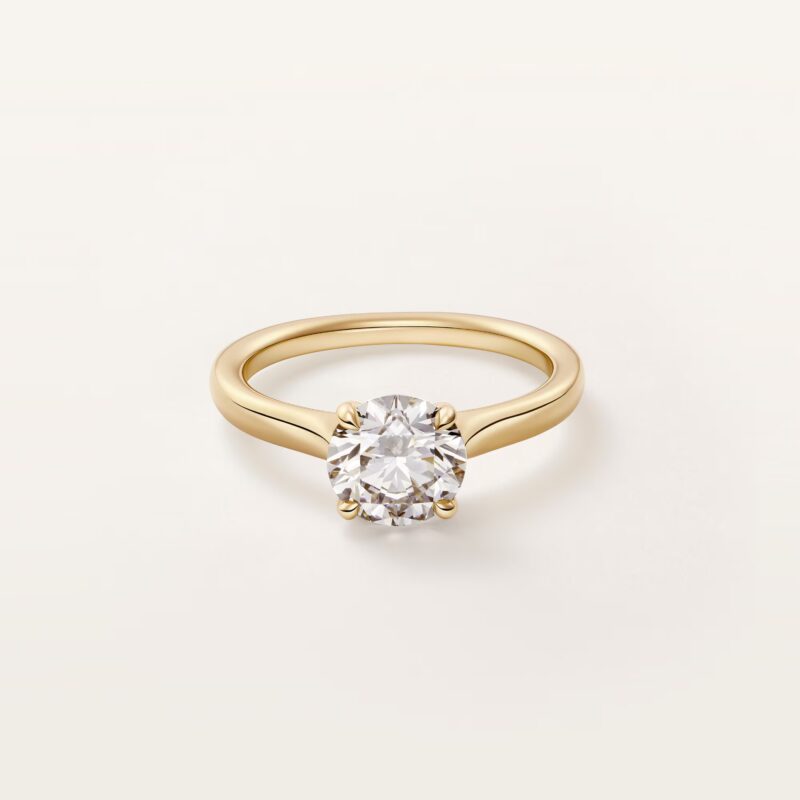
What that foundational moment established, and what the 2026 Solitaire 1895 collection continues, is a specific setting logic: “a centre stone held in place by four claws to create a timeless ring where simplicity and purity meet, celebrating the bonds of love.” Four claws — rather than the six-prong configuration that defines, for instance, the Tiffany Setting — represents a different point on the same underlying spectrum: how much metal does a setting need, at minimum, to hold a diamond securely while exposing as much of its surface to light as possible?
Four claws versus six prongs — A genuine design difference, not just a number
The choice between a four-claw and a six-prong setting is not arbitrary, and it produces a meaningfully different visual result. A six-prong setting distributes the diamond’s security across six points, allowing each individual prong to be smaller and less visually prominent, while still achieving robust security through the larger total number of contact points. A four-claw setting concentrates the same security function across fewer points — meaning each claw, individually, typically needs to be slightly more substantial to provide equivalent holding security, but the total number of points where metal meets the diamond’s surface is reduced by a third.
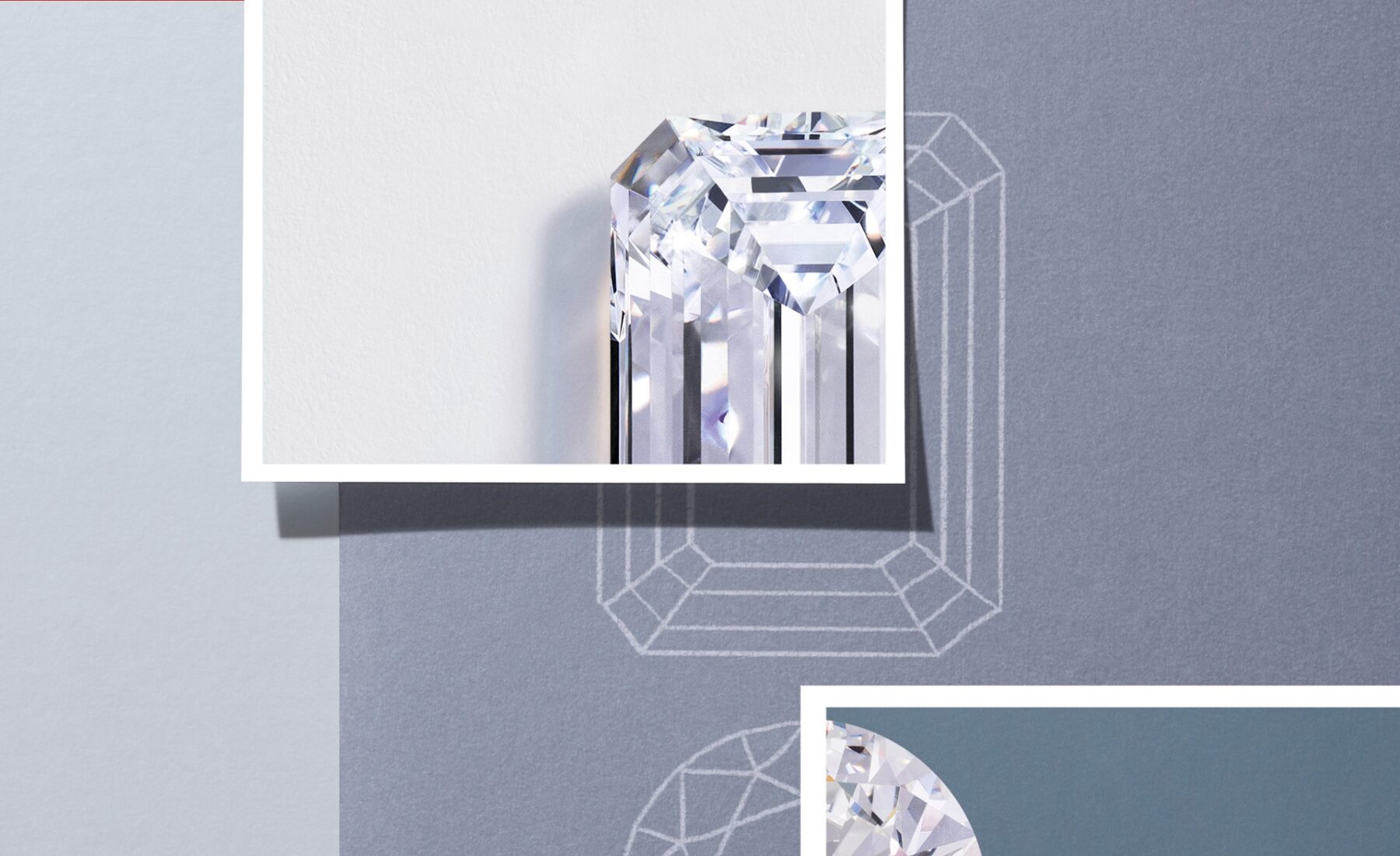
The visual consequence is a setting that reads as marginally more “architectural” — four distinct points of structure, often positioned to align with or emphasise the geometry of the stone’s shape (particularly relevant for the cushion, emerald, oval, and pear-shaped diamonds the 1895 Solitaire collection offers alongside brilliant-cut round diamonds) — versus a six-prong setting’s tendency to read as a more continuous, evenly-distributed “halo” of support around the stone’s circumference. Neither approach is objectively superior; they represent different answers to the same engineering question, and the choice between them is, for many buyers, as much about the resulting silhouette — four-claw’s slightly more geometric, structural presence versus six-prong’s more continuous, surrounding presence — as about any functional difference in security.
The range — From brilliant-cut diamonds to coloured stones
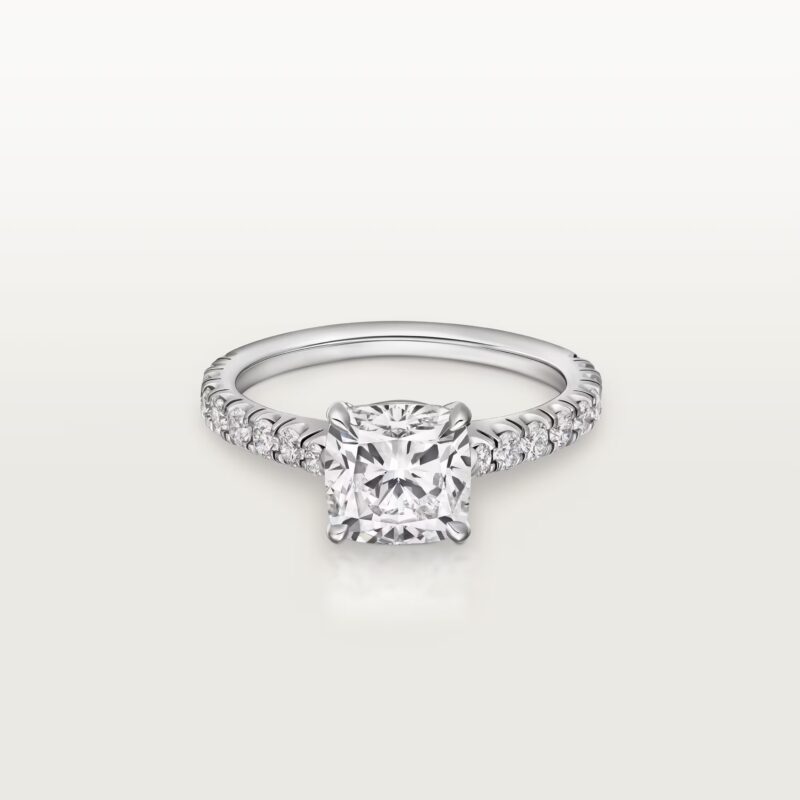
The 2026 Solitaire 1895 collection extends considerably beyond a single diamond shape and metal combination. Available configurations include brilliant-cut diamonds in yellow gold, rose gold, and platinum; oval, cushion, emerald, and pear-shaped diamonds, in both paved and non-paved configurations; and, notably, coloured stone options including oval-cut rubies, cushion-cut and emerald-cut emeralds, and cushion-cut and oval-cut sapphires — each paired with platinum and diamond accents.
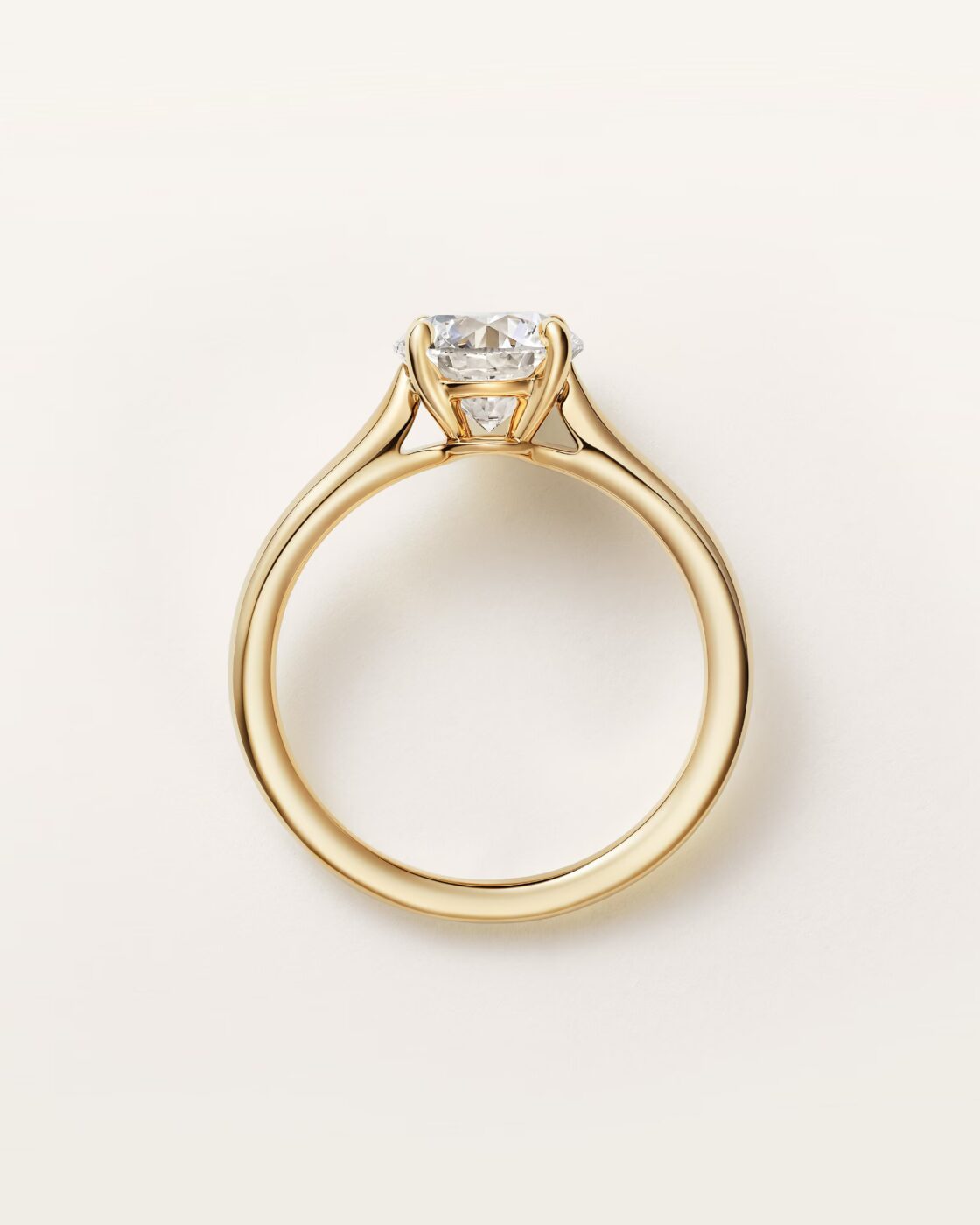
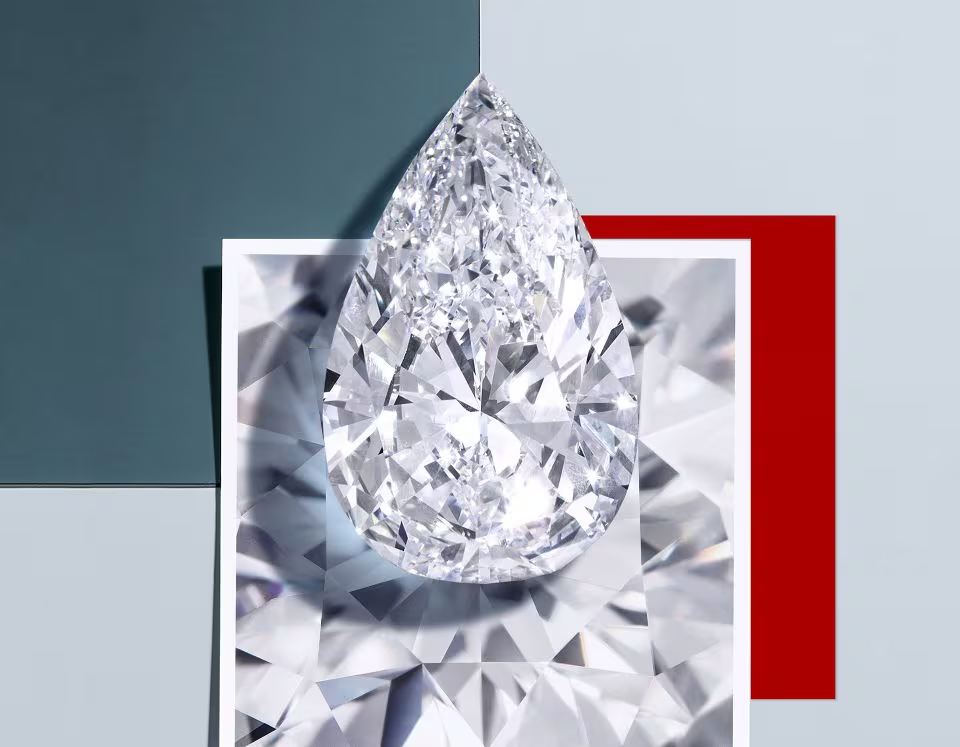
Architectural purity.
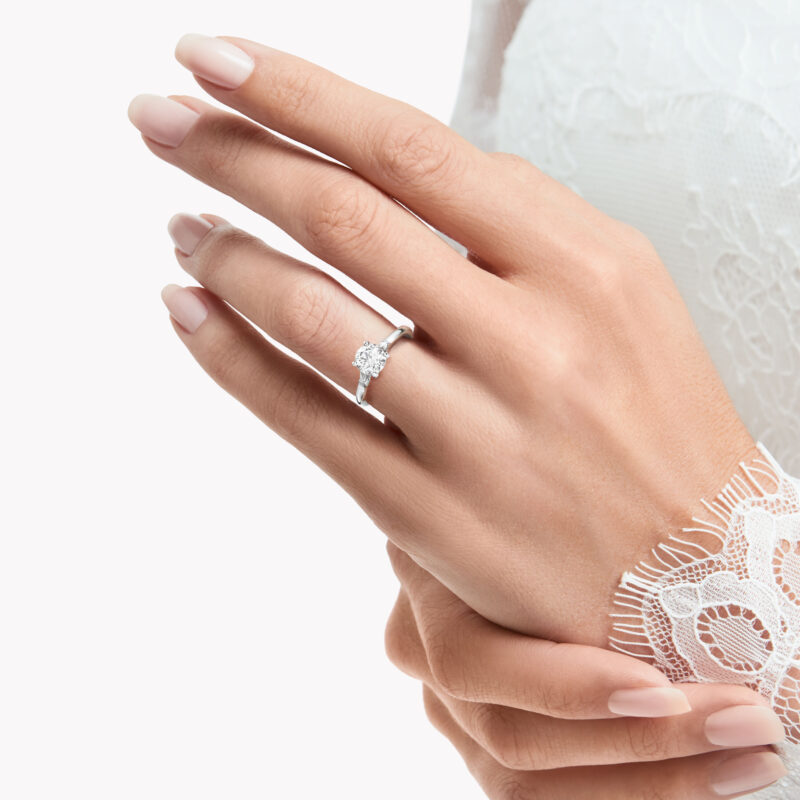
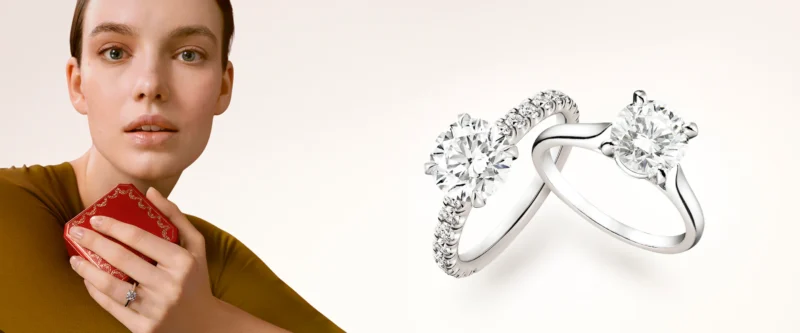
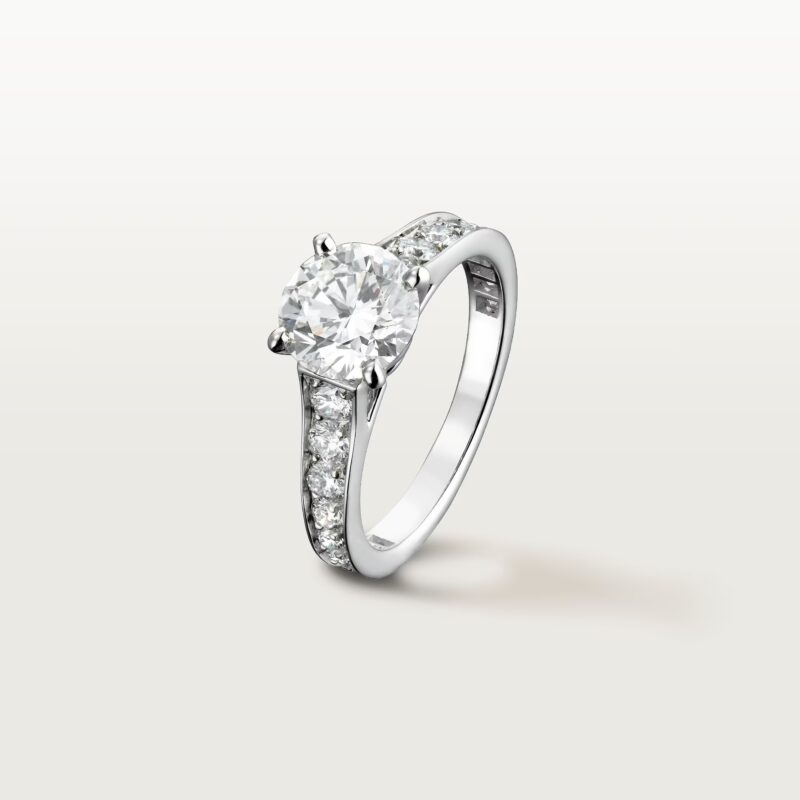
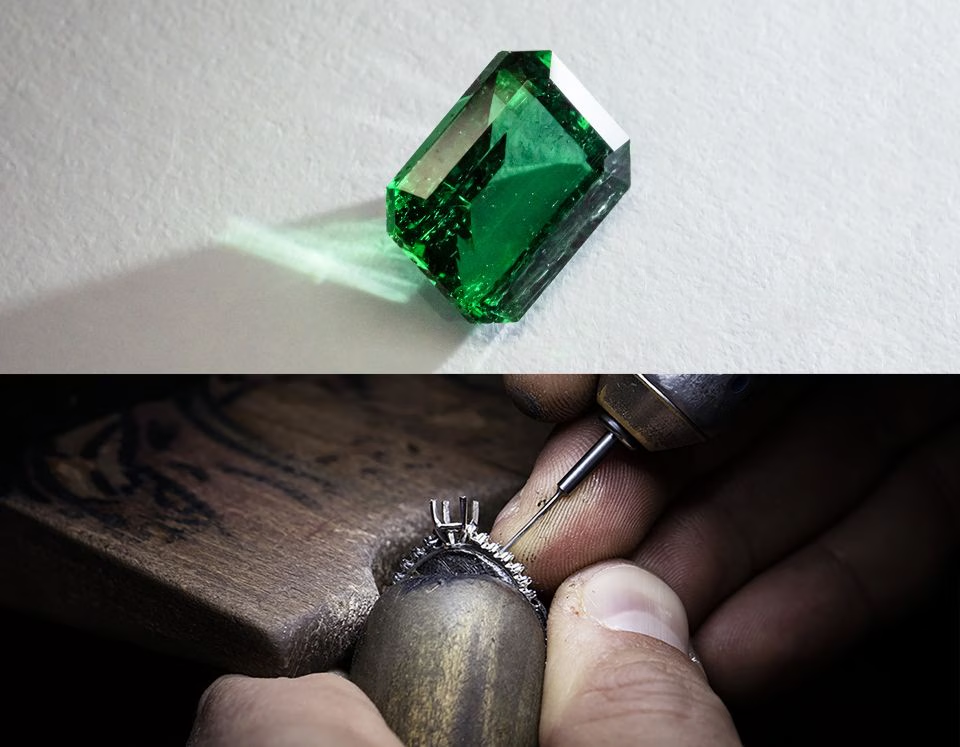
Left: The Solitaire 1895 with a paved diamond band in profile. Right: Cartier’s rigorous selection process ensures that only stones with perfect optical properties are chosen, maximizing light performance.
This breadth situates the 1895 Solitaire as a collection built around a setting philosophy — four-claw, simplicity-focused — rather than around a single signature stone or colour combination. A buyer drawn to the 1895 Solitaire’s four-claw logic but who wants a sapphire or emerald rather than a diamond as the centre stone is not choosing a different collection or a compromise; the four-claw philosophy extends across all of these options, with the “simplicity and purity” the setting is built around applying as much to a cushion-cut emerald as to a brilliant-cut diamond.
The 1895 wedding bands — Where the name completes its meaning
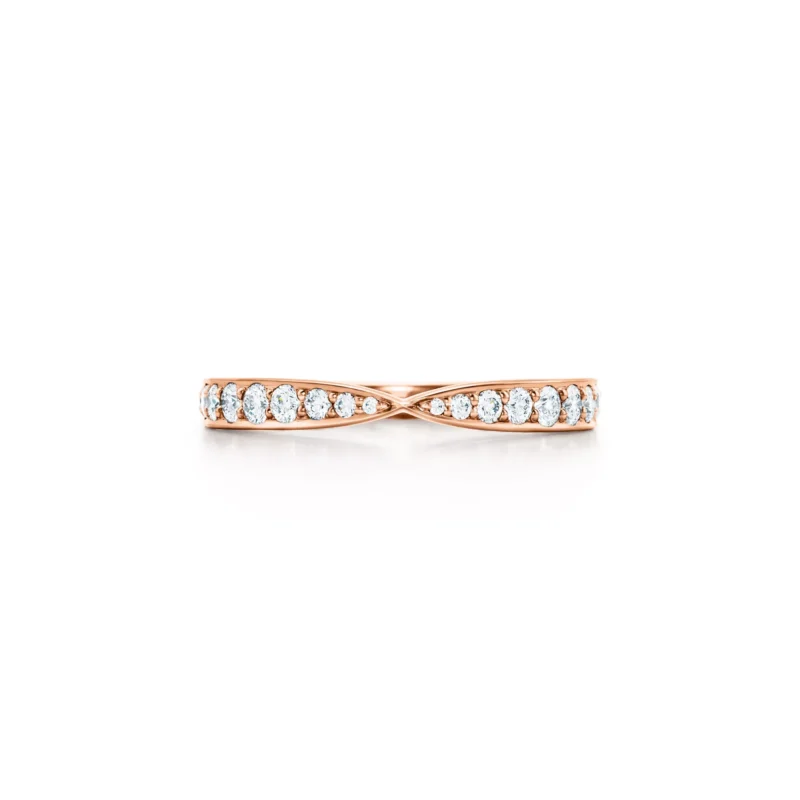
Alongside the engagement ring collection, Cartier offers 1895 wedding bands — specialty rings designed to pair with the solitaire, available in rose gold, yellow gold, and platinum, in non-paved and semi-paved configurations, starting from $940 for a 2.5mm yellow gold band. This is where the “1895” name’s meaning becomes most legible as a complete bridal concept: the wedding band does not attempt to replicate the solitaire’s four-claw centrepiece — instead, it carries the same name, the same “timeless design and universal message,” as a companion piece, a band whose role is to sit alongside the solitaire rather than to repeat its central idea.
For a couple choosing both an 1895 Solitaire engagement ring and an 1895 wedding band, the pairing represents a coherent bridal narrative under a single name and a single founding reference point — 1895, the year simplicity entered Cartier’s archive as a solitaire, extended across both the ring that proposes and the rings that are exchanged.
Reading together — Two answers to “what does a wedding ring mean?”
Placed side by side, Trinity and the Solitaire 1895 represent two genuinely different — and, for a magazine serving a bridal audience, genuinely useful — philosophies about what a ring exchanged in marriage, or worn to signify commitment, should communicate.
Trinity’s answer is structural multiplicity with deliberate symbolic openness: three elements, interlocked, equal, whose meaning is left for the wearer to define — love, fidelity, friendship; past, present, future; or simply “us,” however that gets defined by the two people involved. Its century of adoption by figures whose own lives didn’t fit conventional categories — Cocteau’s gender-fluid stacking, Grace Kelly’s transatlantic transformation — suggests a ring that has always worked best for people whose relationships, identities, or life stories resist being reduced to a single, simple narrative.
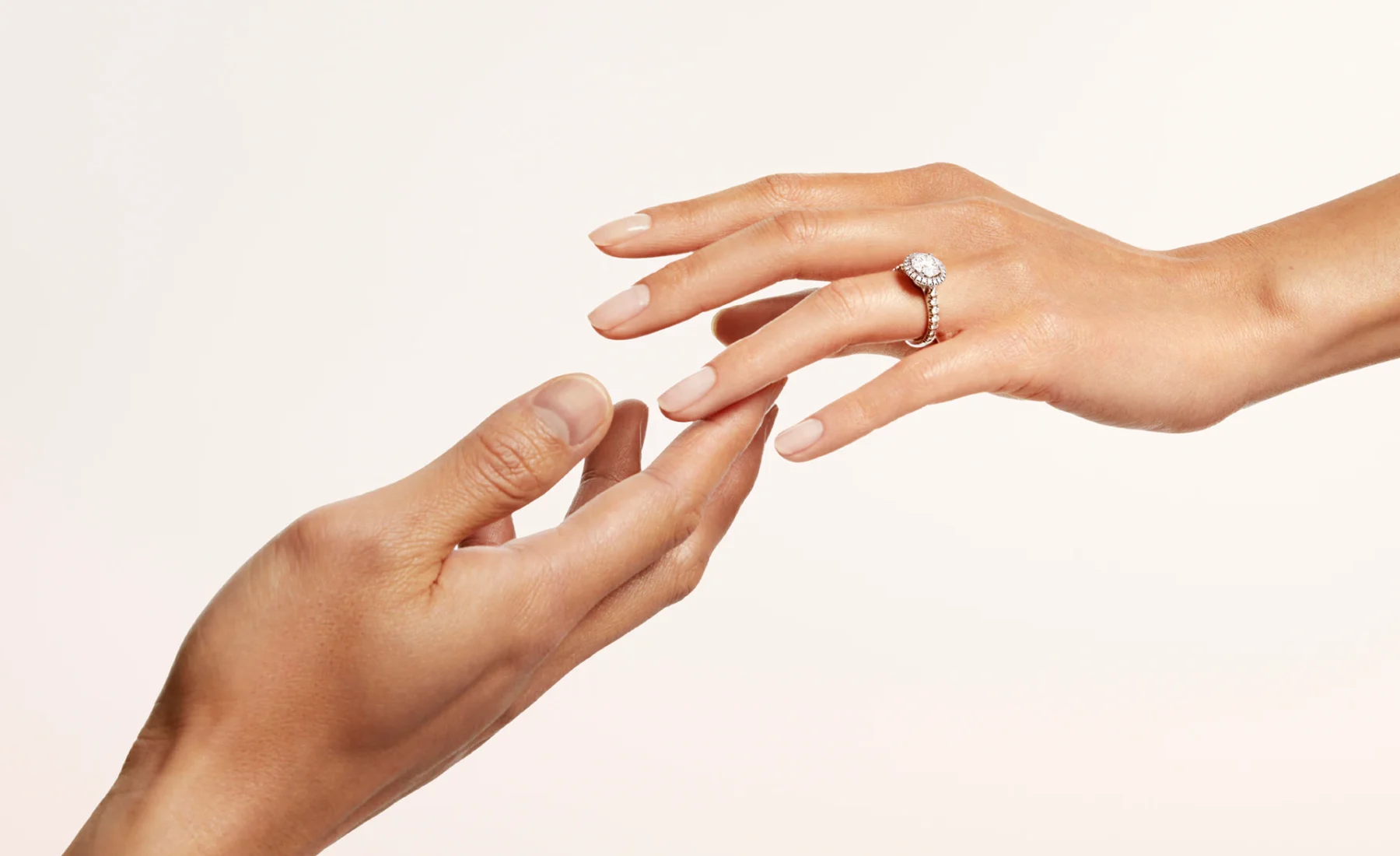
The Solitaire 1895’s answer is the opposite: reduction to the point where the setting itself nearly disappears, leaving “simplicity and purity” as the entire statement. Where Trinity says “our relationship contains multitudes, interlocked,” the 1895 Solitaire says “here is one thing, held as simply and securely as possible, with nothing extraneous.” Both are, in their own registers, profound statements about commitment — but they are aimed at different sensibilities, and a couple choosing between them is making a real choice about which of these two ideas — multiplicity held together, or singularity held simply — better represents what they’re trying to say.
Specifications — Reference table
Explore the comparison
| Specification | Trinity | Solitaire 1895 |
|---|---|---|
| Origin | 1924, Louis Cartier | 1895, first solitaire in Cartier archives |
| Structure | Three interlocking bands, move independently | Single centre stone, four-claw setting |
| Materials | Yellow gold, white gold, rose gold (combined) | Platinum, yellow gold, or rose gold |
| Stone options (1895) | — | Brilliant, oval, cushion, emerald, pear-cut diamonds; ruby, emerald, sapphire |
| Symbolism | Love, fidelity, friendship (open to interpretation) | Simplicity and purity |
| Sizing note | Size down from usual size (interlinked bands) | Standard sizing |
| Wedding band entry price | Varies by width/paving | From $940 (2.5mm yellow gold) |
TheTimeo view
Cartier’s bridal archive contains many designs, but Trinity and the Solitaire 1895 occupy a special position because each represents, in its own way, a complete idea — neither needs elaboration to make its point, and neither has needed significant revision in the century-plus since its origin to remain exactly as relevant as it was when first conceived. Trinity’s three bands still move as one; the 1895 Solitaire’s four claws still hold a stone with nothing to spare.
What makes both designs genuinely useful as bridal reference points — rather than simply old and famous — is that each makes an argument that remains legible regardless of when it’s encountered. Trinity argues that commitment can be plural, equal, and open to interpretation, without ever becoming unstable. The Solitaire 1895 argues that the most honest way to present something precious is to put as little as possible between it and the person looking at it. Neither argument has aged, because neither argument was ever really about its era — both are about what it means to hold something, or someone, in a way that lasts. Cartier happened to find two different, equally durable ways of saying that with metal and stone, twenty-nine years apart, and has spent the century since proving that durability was never really about the materials at all.
Sources & credits
Official sources
- Explore the official Cartier Trinity collection.
- Browse Cartier Solitaire 1895 engagement rings.
- Read about Cartier 1895 wedding bands.