
TheTimeo / Maisons & Heritage
HIDDEN GARDEN:
the archive, alive
Hidden Garden treats Jean Schlumberger’s archive as a living design language, translating flora, birds, ribbons, colour and movement into a new high-jewellery collection.
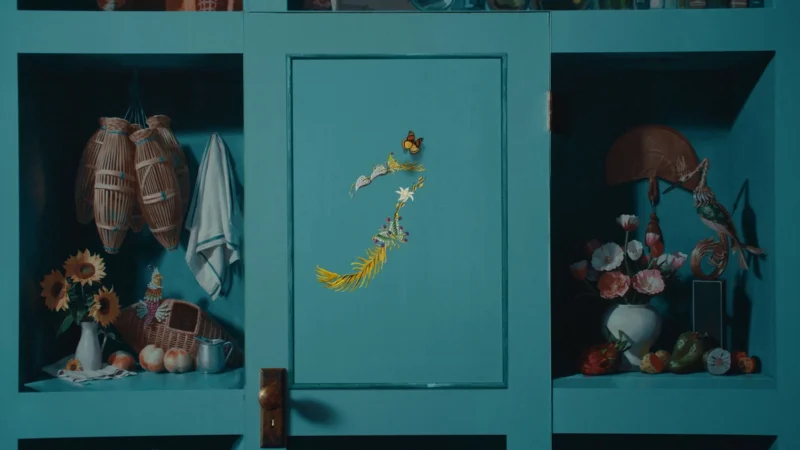
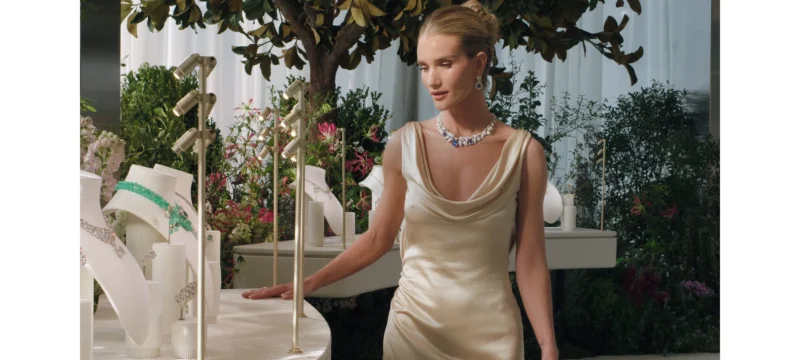
Hidden Garden opens as a complete world before its individual motifs come into focus. Courtesy of Tiffany & Co..
Explore the story
Key facts
- Blue Book 2026: Hidden Garden is designed by Nathalie Verdeille, Tiffany & Co.’s Senior Vice President and Chief Artistic Officer, alongside the Tiffany Design Studio.
- Tiffany describes the collection as a reinterpretation of Jean Schlumberger’s flora and fauna vocabulary.
- The collection is being released in three phases: spring, summer and fall.
- The spring presentation includes Butterfly, Jasmine and Monarch, alongside further high-jewellery expressions including Bird on a Rock, Palm and Twin Bud.
- The summer expression, unveiled on 1 June 2026, adds Paradise Bird, Daisy, Raffia, Blossom and Petals.
- Schlumberger joined Tiffany in 1956. His documented design signatures at the House include flora and fauna, textile-derived ropes and ribbons, vivid coloured stones, gold, platinum and enamel.
- Bird on a Rock was introduced in 1965 and remains one of the clearest examples of Tiffany treating a Schlumberger design as a living design system rather than a fixed historical object.
- Tiffany’s current public material still presents Blue Book 2026 as a three-part programme. As of 7 September 2026, the summer expression is the latest dedicated Hidden Garden release in the House press newsroom; the fall phase is therefore not treated here as published fact.
A jewellery house with a famous archive has two easy options. It can ignore the archive and risk severing itself from the codes that made the name matter. Or it can reproduce the archive too faithfully and turn history into a catalogue of approved shapes.
Tiffany & Co. has been testing a third route under Nathalie Verdeille: keep the old grammar, then change the sentence.
Blue Book 2026: Hidden Garden makes that approach unusually easy to see. Jean Schlumberger is not a background reference that needs to be explained away in a paragraph of heritage copy. His birds, butterflies, vines, ribbons, twisted gold and appetite for coloured stones are visible across the collection. Yet the most convincing pieces do something more difficult than quotation. They preserve a way of thinking about jewellery while allowing the objects themselves to move on.
That distinction matters. An archival motif can be recognizable and still be newly authored. A house code can survive even when the proportions, gemstone choices and mechanics have changed. Hidden Garden is at its best when it proves exactly that.
The archive is a language, not a display case
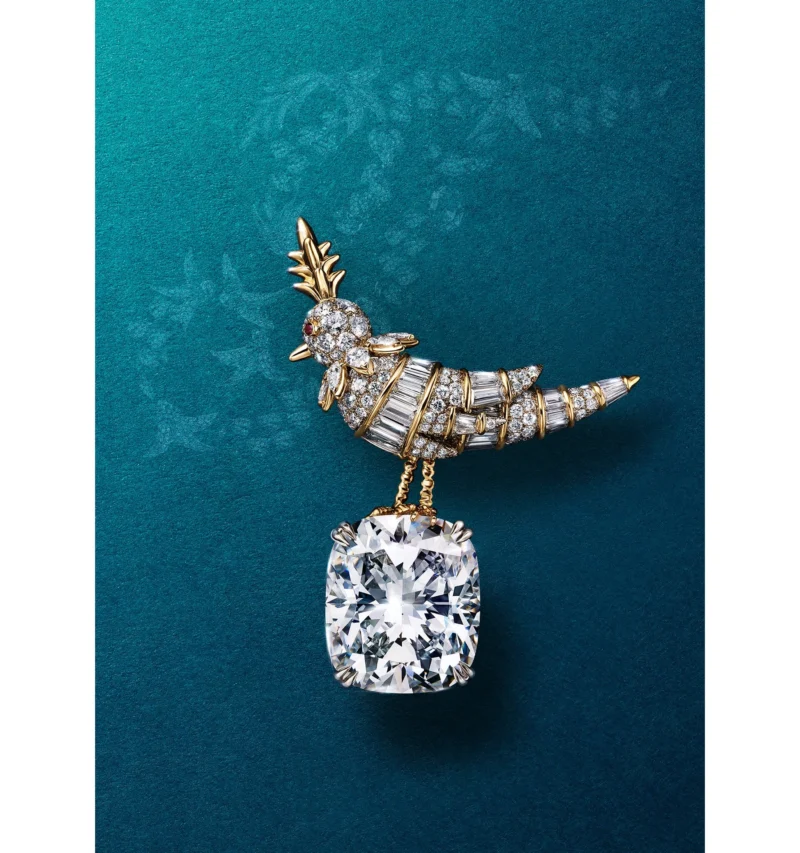
Schlumberger’s flora and fauna established a vocabulary that Tiffany continues to reinterpret. Courtesy of Tiffany & Co..
Schlumberger joined Tiffany in 1956. The House’s own account of his work identifies several recurring signatures: flora and fauna, textile-derived forms, rope and ribbon structures, vivid gemstones, enamel, three-dimensional construction and a taste for mixing precious metals in ways that gave jewellery volume rather than flatness.
Those categories are broad enough to be dangerous. “Nature” can become a meaningless theme in high jewellery because almost every major house has flowers, birds, leaves or insects somewhere in its history. What made Schlumberger distinctive was not the subject alone. It was the transformation of the subject.
A bird could become a character. A ribbon could become architecture. A plant form could carry the tension of a spring. Gold could be twisted, crossed or woven until the metal seemed to behave like textile. Colour was rarely passive. It helped the object feel animated.
That is the useful inheritance in Hidden Garden. The current collection does not need to duplicate every original silhouette because Schlumberger’s deeper contribution was a method: observe a natural form, exaggerate the part that gives it life, and let jewellery construction intensify the effect.
This is why the phrase “inspired by the archive” is too weak for what Tiffany is attempting. Hidden Garden often treats the archive as a set of structural instructions.
Butterfly: the motif survives because the treatment changes
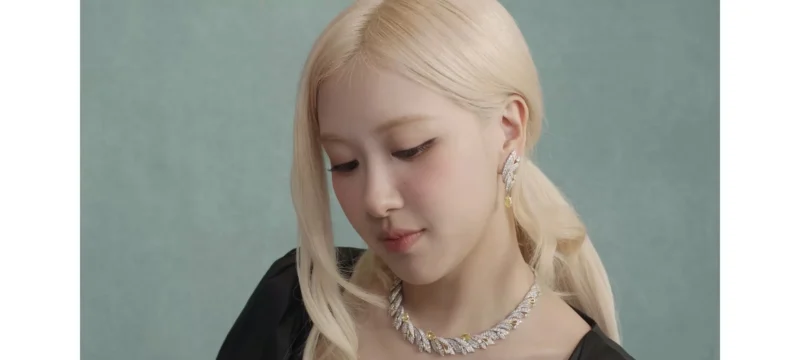
Butterfly keeps the motif recognisable while changing its scale, colour and rhythm. Courtesy of Tiffany & Co..
The Butterfly chapter is the clearest place to start because the butterfly is already one of jewellery’s most overused subjects. There is no novelty in choosing it. The question is whether the object can escape the familiar shorthand of symmetrical wings and pavé.
Tiffany’s spring material presents both literal and abstract interpretations. White diamonds, Fancy Vivid Yellow diamonds and coloured stones including padparadscha sapphires are used to suggest movement, light and the shifting colour of wings.
That range matters more than the species itself. A literal butterfly can preserve the insect’s recognizable anatomy, while an abstract version can reduce the idea to feathered arcs, segmented movement or the impression of a wing opening. The archive gives Tiffany permission to use the motif. The design work determines whether it feels alive in 2026.
One of the useful tests with any archival revival is to imagine the house name removed. Would the piece still contain enough tension, proportion or material intelligence to justify itself? The strongest Butterfly designs pass that test because the motif is not doing all the work. Stone choice, articulation and the rhythm of the setting carry equal weight.
There is also a wider point. Schlumberger’s nature was never polite botanical documentation. It was stylized, sometimes strange and often slightly theatrical. Hidden Garden works when it remembers that. A butterfly that behaves like a graphic structure is closer to his spirit than a perfectly correct insect made expensive.
Jasmine: one historic idea, two material systems
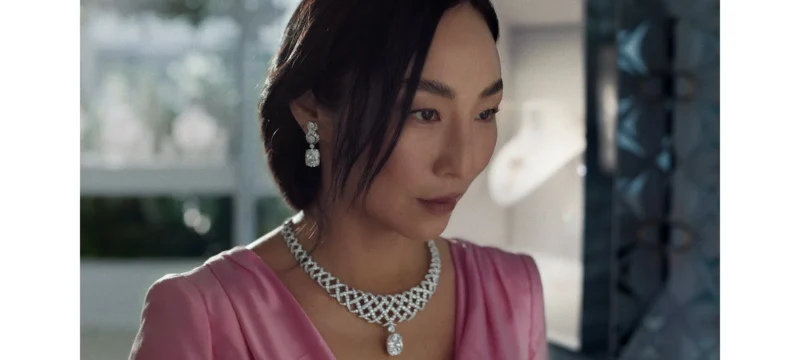
Jasmine turns an archival idea into a new material and structural system. Courtesy of Tiffany & Co..
Jasmine shows a different kind of reinterpretation. Tiffany explicitly links the chapter to Schlumberger’s historic Jasmine necklace, then divides the 2026 story into two suites.
The first uses platinum silhouettes to lift diamonds. The second combines platinum with 18k yellow gold around vivid kunzites. That split is a smart curatorial decision because it demonstrates that heritage does not have to be communicated by repeating one material recipe.
The all-diamond reading is cool, controlled and architectural. The kunzite version changes the emotional temperature immediately. Yellow gold introduces warmth; the lilac-pink stones turn the composition from a study of outline into a study of colour and volume.
Kunzite also belongs to Tiffany’s own gemmological history. Tiffany describes it as one of its legacy gemstones; the stone was named in 1902 in honour of George Frederick Kunz, the gemmologist whose career became central to the House’s coloured-stone identity. That history gives the choice a second layer. Jasmine connects Schlumberger’s design archive to Tiffany’s gemstone archive without needing to reproduce an old jewel literally.
This is one of Hidden Garden’s strongest moves. It understands that a house archive is not made only of drawings. It also contains materials, techniques, gemmological preferences and habits of contrast.
Monarch and Twin Bud: keeping the syntax, changing the sentence
Monarch shows how movement can survive without literal repetition. Courtesy of Tiffany & Co..
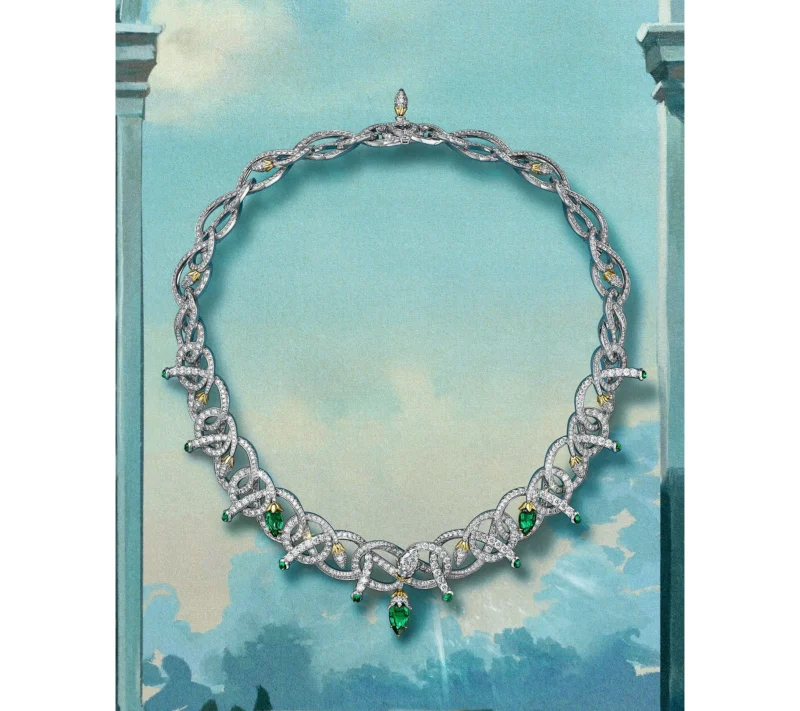
Twin Bud gives the collection a vivid emerald centre. Courtesy of Tiffany & Co..
The Monarch chapter starts from an archival Schlumberger necklace in which a monarch butterfly is concealed among twisting vines and sculpted foliage. Tiffany’s description of the 2026 version is deliberately less about copying the old jewel than about retaining those organic forms and reframing them.
The important word here is concealed. The butterfly is not treated as a logo placed on top of a necklace. It is part of a larger field of growth. That gives the design a narrative quality without requiring any story copy: you find the insect after you read the foliage.
Twin Bud uses another archival plant idea. In 2026, sculptural platinum vines support diamonds and vivid Zambian emeralds conceived as buds held at the point just before opening.
Again, the value is in the timing of the form. A fully open flower would be an image. A bud is an action waiting to happen. That small difference is very Schlumberger: nature is most interesting when it appears to be caught between states.
This is also where Verdeille’s authorship becomes clearer. The archive establishes the vocabulary of twisting vines and botanical tension. The current design decides which gemstones carry the visual weight, how much metal remains visible and how the object sits on the body.
Archive and authorship are not competing forces here. One gives the work continuity; the other keeps it from freezing.
Bird on a Rock is the control experiment
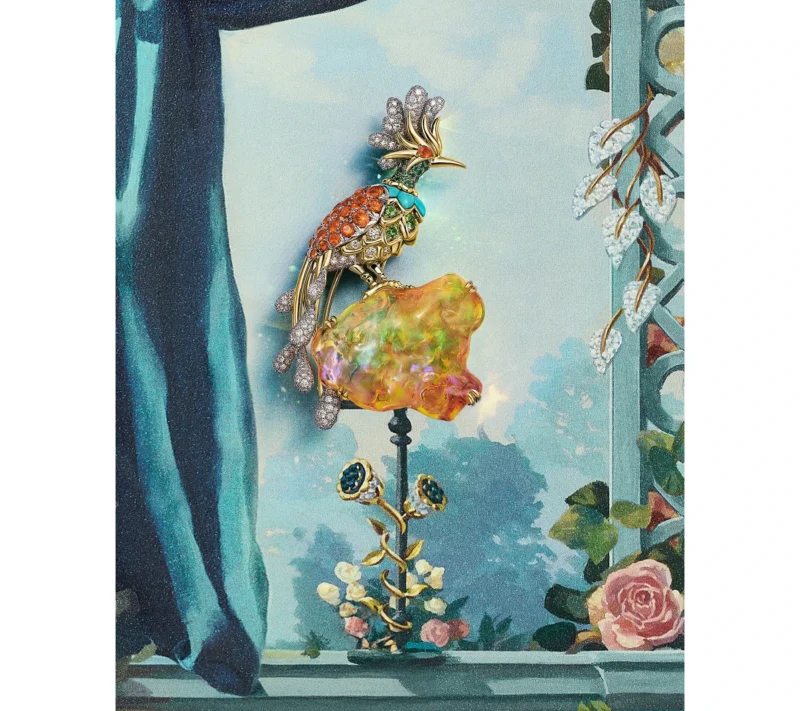
Paradise Bird places the familiar avian language on an unexpected opal ground. Courtesy of Tiffany & Co..
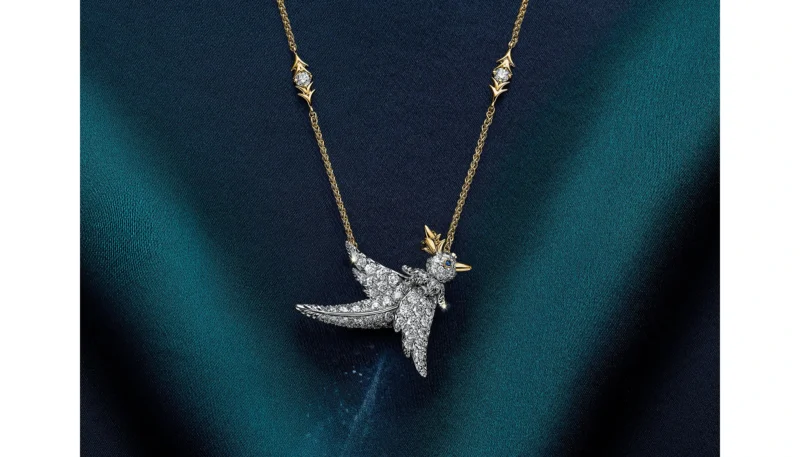
Bird on a Rock remains the clearest test of how far an icon can be transformed. Courtesy of Tiffany & Co..
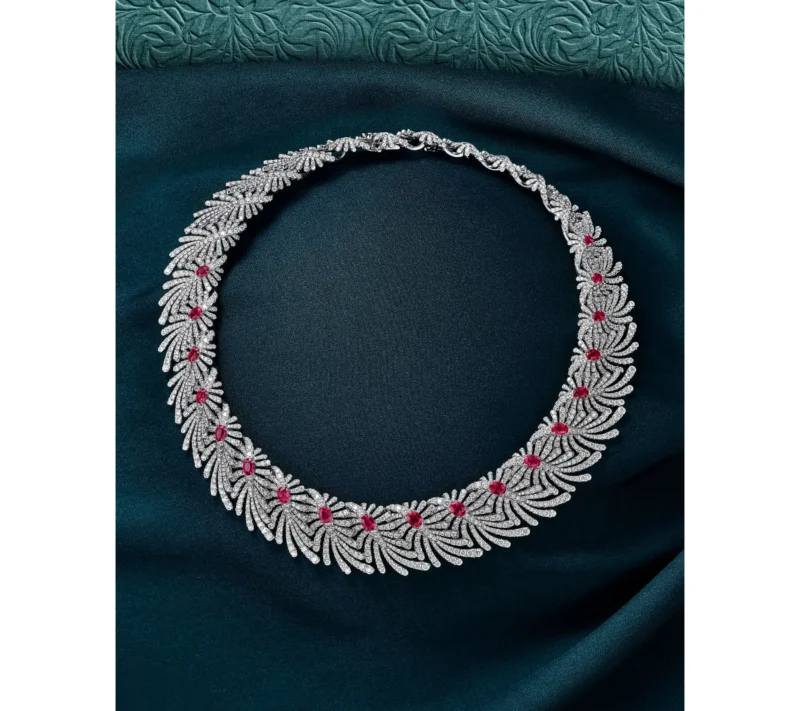
Palm uses saturated ruby colour to give the archival vocabulary a different temperature. Courtesy of Tiffany & Co..
No Schlumberger motif creates a tougher test for Tiffany than Bird on a Rock.
The brooch was introduced in 1965. Its basic idea is so familiar now that the danger is obvious: every return risks becoming another version of the same bird perched on another extraordinary stone. Rarity can keep the object commercially compelling, but rarity alone cannot keep a design intellectually fresh.
Hidden Garden avoids that problem by letting the bird migrate across formats and degrees of abstraction.
One spring statement necklace places diamond birds around a Santa Maria-hued aquamarine from Brazil of approximately 22 carats. The visual logic is no longer a solitary creature perched on a single “rock”. The birds become a group and the gemstone becomes part of a wider scene.
The summer Paradise Bird chapter pushes further. Tiffany describes fantastical birds perched on Australian boulder opals and chrysoprase, American chrysocolla, Namibian purple chalcedony and Nigerian spessartine. Feathers are built from pointillist arrangements of coloured stones, with combinations that can include emeralds, turquoise, tourmalines, paillonné enamel, faceted gems and diamonds.
The result is not subtle, and it should not be. Schlumberger’s best creatures were never exercises in restraint for its own sake. They worked because jewellery allowed fantasy to become physical.
The current Bird on a Rock programme also shows another strategy: reduction. Tiffany has been distilling the bird into the wing itself, creating jewellery that retains the motion and layering of plumage without carrying the entire figurative bird. That is archival development at its most legible. The house code survives after the mascot disappears.
This is why Bird on a Rock matters beyond its fame. It provides a control experiment for the entire Hidden Garden thesis. If Tiffany can keep its most recognizable Schlumberger object moving, it can do the same with less famous motifs.
Raffia: textile memory becomes construction
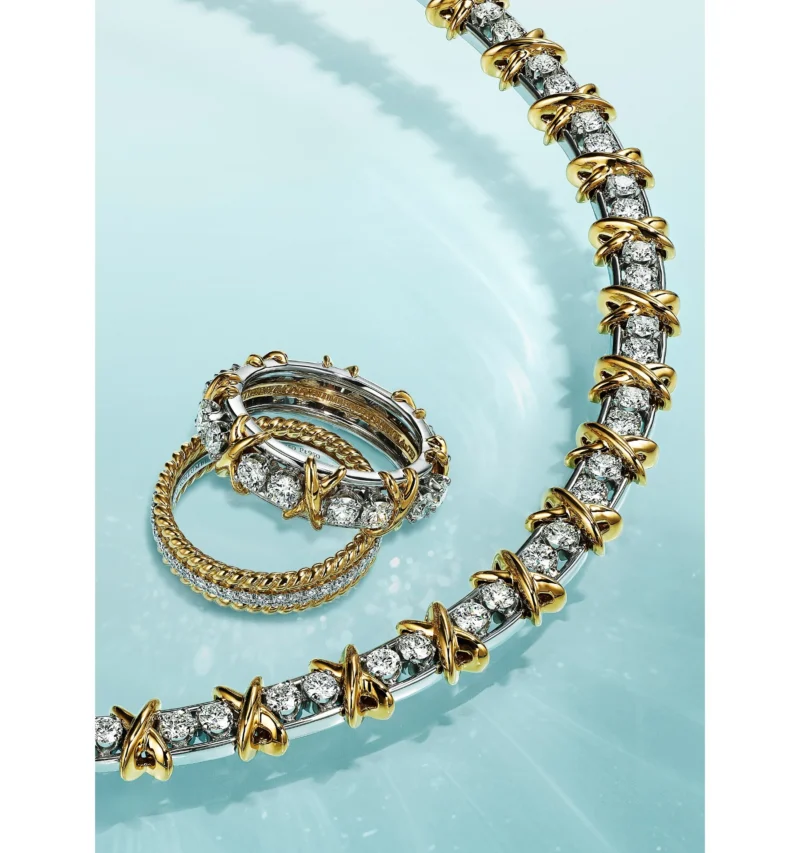
Rope and textile references become construction rather than surface decoration. Courtesy of Tiffany & Co..
Raffia may be the most revealing summer chapter because it reaches back to a Schlumberger signature that is less immediately recognizable to a general audience: textiles.
Schlumberger came from a family of textile manufacturers, and Tiffany’s own archive material repeatedly identifies ropes, tassels, ribbons and woven gold as part of his design language. The 2026 Raffia chapter takes that memory and turns it into an interlaced system of platinum and 18k yellow gold.
Sugarloaf tanzanites sit at the centre of the designs, interrupted by rubies and diamonds. Rope-like chains pass through the pieces. The reference to Schlumberger is therefore not a reproduced historic object. It is a construction principle: metal behaves like fibre.
That distinction makes Raffia particularly important. It demonstrates that an archive can be inherited through technique and spatial logic rather than silhouette.
The tanzanite adds another Tiffany-specific layer. The House introduced tanzanite to the market in 1968 after the blue-violet stone was discovered near Mount Kilimanjaro. In Hidden Garden, that gemmological history is folded into a design story that already refers to Schlumberger’s textile heritage.
Two archives meet in one object: one of design and one of stones.
This is the sort of continuity a house cannot manufacture quickly. It only works because the references are specific enough to be checked.
Daisy, Blossom and Petals: movement without mechanics
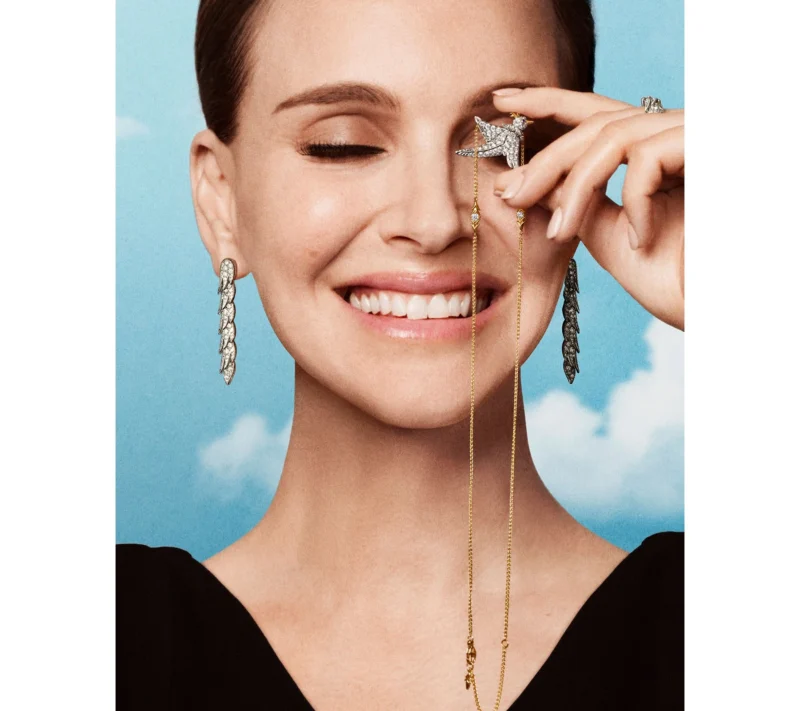
A contemporary Bird on a Rock makes the continuity—and the change—visible. Courtesy of Tiffany & Co..
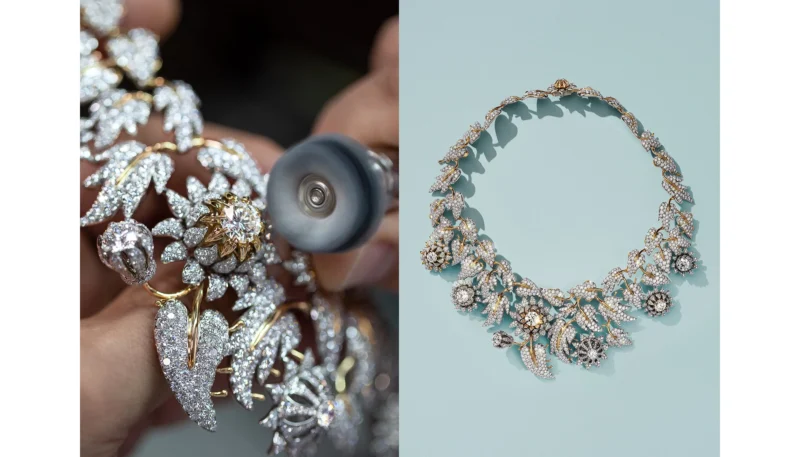
Craft is the bridge between an archival reference and a convincing contemporary jewel. Courtesy of Tiffany & Co..
High jewellery often talks about movement when what it really means is visual asymmetry. The summer flower chapters are more interesting when they are read as exercises in how static components can imply motion.
Daisy uses emerald-cut blue zircons against emerald cabochons. Tiffany describes a fluid mesh construction in which the petals are individually shaped rather than mechanically repeated. The point is not perfect radial symmetry. Slight variations in curvature make the flower feel less diagrammed.
Blossom builds volume differently. Cabochon and oval rubellites become the dense centres of flowers, surrounded by gold and platinum petals set with diamonds. The colour mass is concentrated rather than scattered, so the gem reads as the visual heart of the object.
Petals is lighter in mood but structurally useful. Cushion-cut peridots are held by diamond-set ribbons derived from Schlumberger’s archival language of ribbons and buds. The historical reference sits in the curve of the metal rather than in a copied flower.
These chapters show why Hidden Garden is strongest when “nature” is treated as a problem of behaviour. Petals can lift, flowers can sway, vines can tighten, wings can open. The jewellery does not move like an automaton, but its construction suggests the next instant.
That is a much more productive way to use naturalism than simply making expensive botanical specimens.
Colour is doing archival work
The collection’s stone palette deserves attention because it is carrying part of the historical argument.
Schlumberger used colour with unusual confidence. Tiffany’s own account of his work emphasizes coloured gemstones, enamel and the collision of vivid hues with diamonds, yellow gold and platinum. Hidden Garden keeps that appetite but updates the specific materials.
Padparadscha sapphires appear in Butterfly. Kunzites shift Jasmine into lilac-pink. Zambian emeralds turn Twin Bud into a study of concentrated green. Paradise Bird moves through opal, chrysoprase, chrysocolla, purple chalcedony and spessartine. Raffia combines tanzanite and ruby. Daisy pairs blue zircon and emerald. Blossom uses rubellite. Petals centres peridot.
That breadth could easily become a gemstone parade. The more convincing chapters avoid it because the stone is given a structural role. Colour separates layers, creates a centre of gravity or replaces line with mass.
The difference is important for collectors. A rare stone is not automatically a strong design brief. In Hidden Garden, the best pieces are those in which the material choice changes the way the motif has to be built.
What Verdeille is actually changing
It is easy to describe Nathalie Verdeille’s role as “reinterpreting Schlumberger”, but the phrase becomes useful only when the changes are named.
The first is scale. Motifs that once existed as a brooch or necklace can now be expanded, reduced or distributed across the body.
The second is abstraction. Bird on a Rock can become a wing. Butterfly can move between identifiable insect and graphic rhythm.
The third is gemstone emphasis. Historic botanical ideas are rebuilt around stones that carry their own Tiffany history, including kunzite and tanzanite.
The fourth is material contrast. Platinum and yellow gold are used not simply because Schlumberger used them, but because their temperature and weight separate layers within a design.
The fifth is movement. Vines, mesh petals, ribbons and feathers are shaped to make the object look as though it is still changing.
Those five operations explain why Hidden Garden does not feel like a retrospective. The references are historical, but the decisions are current.
A collection that is still in motion
There is one practical limit to any assessment of Blue Book 2026 in early September: Tiffany says Hidden Garden is a three-phase programme, released across spring, summer and fall.
The summer expression debuted on 1 June 2026. Tiffany’s current press newsroom still lists that release as the latest dedicated Hidden Garden announcement. That means the collection should not yet be discussed as though every 2026 chapter has been publicly presented.
This matters editorially because Blue Book collections are often judged from a few spectacular launch images and then treated as complete. Hidden Garden is more useful to read as an evolving body of work.
The spring material establishes the direct archival dialogue through Butterfly, Jasmine and Monarch. Summer broadens the language into Paradise Bird, Daisy, Raffia, Blossom and Petals. If the fall phase follows the same logic, the real test will be whether it adds another method of reinterpretation rather than another set of botanical nouns.
For now, the pattern is already clear enough to evaluate.
The risk of living in a great archive
Tiffany’s reliance on Schlumberger is a strength, but it is not automatically safe.
A great archive can become a form of creative insurance. Bird on a Rock is recognized. Schlumberger’s name carries authority. Flora and fauna photograph beautifully. There is always a temptation to let recognition do the difficult work of design.
Hidden Garden is strongest when it resists that temptation.
Raffia succeeds because the historical reference is structural. Jasmine succeeds because the same motif is split into materially different systems. Bird on a Rock becomes more interesting when it is reduced to wings or multiplied into a scene. Paradise Bird works when the stones and colour combinations make each creature feel invented rather than issued.
The weaker route would be easy to identify: a famous historic outline, refreshed with a different centre stone and presented as evolution.
That is why the phrase “rewriting the archive” is more than a marketing angle here. It is a standard by which the collection can be judged. The closer a piece gets to literal repetition, the less interesting it becomes. The more it translates Schlumberger’s habits into new construction, the more convincing the continuity feels.
The point of Hidden Garden
Blue Book 2026 is not trying to make Jean Schlumberger contemporary by smoothing away his eccentricity. That would destroy the reason to return to him.
The useful move is the opposite: identify what still feels alive in his work and give those qualities new physical problems to solve.
A wing can become an abstract curve. A ribbon can become the support for a peridot. A textile memory can become an interlaced bracelet. A 1965 bird can leave its rock, multiply across a necklace or dissolve into feathers. A historic flower can move from diamond architecture to kunzite and gold without losing its identity.
That is how a house language stays coherent over decades. Recognition comes from the grammar, not from repeating the same sentence.
Hidden Garden is still unfinished as a 2026 programme, but the spring and summer chapters already make the central proposition visible. Tiffany is using Schlumberger as a source of rules to work with, rather than shapes to reproduce.
For a house with one of high jewellery’s most recognizable archives, that is the harder choice. It is also the one with more future in it.
The Edit
Maisons & Heritage stories
Selected stories from the same editorial universe.
Putting Turner on 2 cm²: What Jaeger-LeCoultre’s Reverso Tribute Enamel “Turner Series” Actually Demands
Four Venetian paintings, four enamel and guilloché solutions, and one difficult question: how much

The Art of Complications: Understanding Patek Philippe’s Grand Complication Masterpieces
Patek Philippe stands as a beacon of horological excellence, largely due to its mastery
Jewelry Titans: How Luxury Brands Like Cartier and Bulgari Shape Modern Design
The world of luxury jewelry is defined by creativity, innovation, and meticulous craftsmanship. Among

The Heritage of Haute Horlogerie: A Deep Dive into Iconic Watch Maisons
The world of haute horlogerie is a fascinating blend of art, precision, and tradition.

The Oyster Perpetual: Rolex’s Groundbreaking Self-Winding Technology
The Rolex Oyster Perpetual represents one of the most significant milestones in the history

From the Santos to Panthère: How Cartier Redefined Jewelry and Watches
Cartier has long been a name synonymous with luxury, crafting some of the world’s