
TheTimeo / Maisons & Heritage
12 Vendôme:
memory and making.
At Chaumet’s 12 Place Vendôme, boutique, heritage salons and High Jewellery workshop share one address. The interest lies in what that proximity does to jewellery.
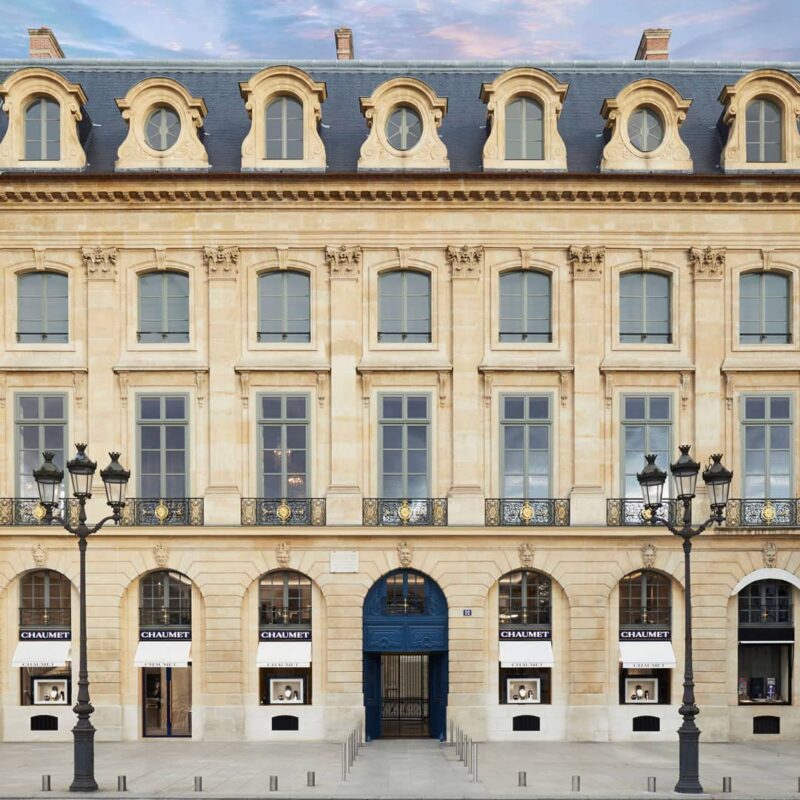
Chaumet has occupied 12 Place Vendôme since 1907.
Explore the story
At 12 Place Vendôme, jewellery appears in more than one state. It can be encountered as something to choose in the boutique, as something remembered through the Maison's heritage salons and models, and as something still being made in the High Jewellery workshop. That coexistence is what makes the address interesting. Chaumet has occupied No. 12 since 1907, but the point is not the prestige of a Paris postcode. It is the way one building brings presentation, memory and making into unusually close contact.
For a jewellery house, an address can become a logo in stone. 12 Vendôme is more useful than that. It helps explain how Chaumet wants its past to remain visible without treating the archive as a sealed room, and how its present still depends on hands working inside the same institutional core.
Where jewellery meets its audience
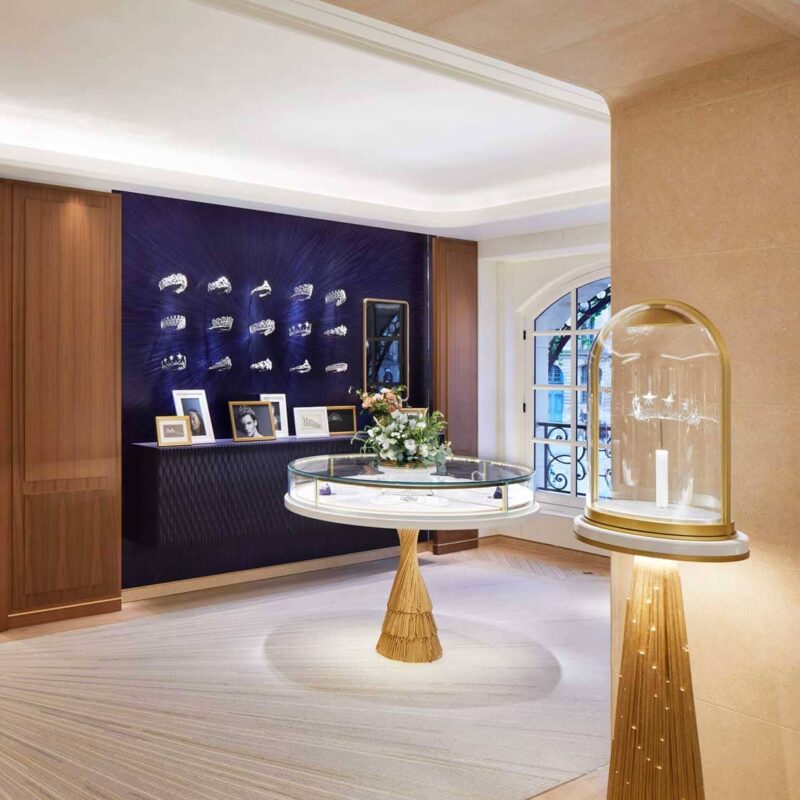
The boutique is the public-facing part of an address shared with heritage salons and the High Jewellery workshop.
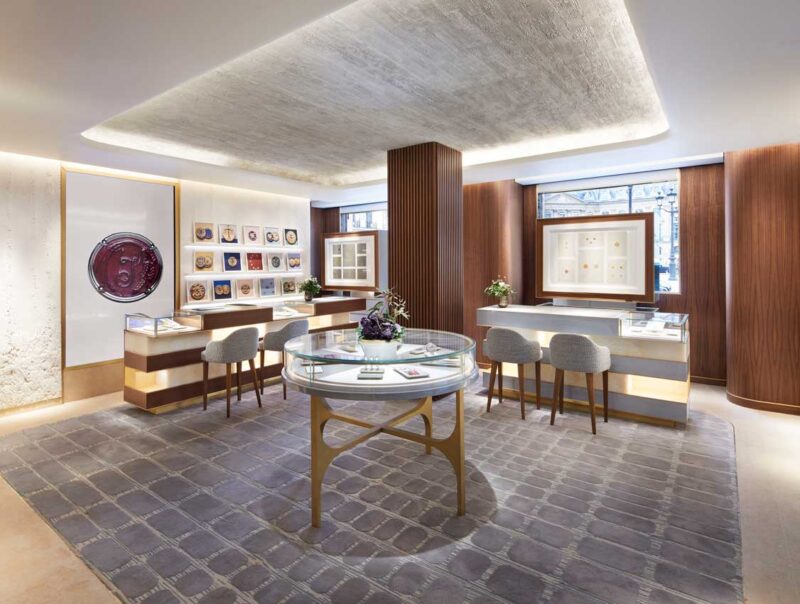
Today's L'Arcade is dedicated to personalising Chaumet jewellery and watches and recalls the Maison's 1970 space of the same name.
The boutique and today’s L’Arcade give jewellery two settings for encounter and choice.
An address with three lives
Chaumet's relationship with Place Vendôme predates No. 12. The Maison records that it became the first jeweller to establish itself on the square in 1812, then at No. 15. Joseph Chaumet chose No. 12 as the house's address in 1907.
Today, Chaumet describes the building through a three-part vocation: a boutique, salons devoted to culture and heritage, and the High Jewellery workshop. That is a better starting point than a conventional chronology because each part gives jewellery a different kind of presence.
The boutique is where the object enters public life. The salons place current creations beside a longer design memory. The workshop is where High Jewellery remains an active practice rather than a historical idea. None of those functions is especially unusual on its own. Their concentration at one address is what gives 12 Vendôme its particular significance.
The building itself is the Hôtel Baudard de Saint-James. France's Ministry of Culture records it at 12 Place Vendôme, with a first-floor salon protected in 1927 and the façades and roofs classified in 1930. Frédéric Chopin is also listed as a figure associated with the building. Those facts matter here only because they establish that Chaumet's working address contains a history larger than the Maison's own occupation. The jewellery story has been inserted into an older place rather than built on a blank stage.
Explore the comparison
| Space | Function | The jewellery relationship |
|---|---|---|
| Boutique and L’Arcade | Encounter and choice | Creations are presented; L’Arcade is dedicated to personalising jewellery and watches. |
| Heritage salons | Memory and form | Heritage pieces and models keep earlier design thinking visible. |
| High Jewellery workshop | Making | Jewellers, setters and polishers work on High Jewellery creations. |
The boutique is not merely the front door
Today's L'Arcade is dedicated to personalising Chaumet jewellery and watches and recalls the Maison's 1970 space of the same name.
A house of jewellery is often easiest to understand through the objects behind the glass. At 12 Vendôme, the way those objects are presented has its own history.
The current L'Arcade is dedicated to personalising Chaumet jewellery and watches. Its seventies-inflected character is an explicit homage to an earlier space of the same name. That distinction is important. The present room is not being passed off as an untouched survivor from 1970. It is a contemporary interpretation of a retail idea that once tried to loosen the conventions around Parisian jewellery.
Chaumet's own historical account dates the inauguration of the original L'Arcade to 17 June 1970. The Maison had asked Agence Bernard Cognard to give the space an identity separate from the historic shop. Displays could move, mirrors multiplied the room, art objects sat beside jewellery, and an audiovisual presentation showed contemporary pieces in close-up and on models. The language was experimental for its setting: jewellery was being treated as something to look at from several angles, to place in relation to art and to imagine on the body.
The experiment also crossed into watchmaking. Chaumet records that, in 1973, L'Arcade was lightly modified to accommodate Les Temporelles, a space dedicated to wristwatches, table clocks and precious timepieces.
That history gives today's L'Arcade more meaning than a retro reference. The continuity lies in the question, not in an unchanged interior: how should a jewellery house make its objects feel immediate rather than remote?
Memory becomes useful when it has a shape
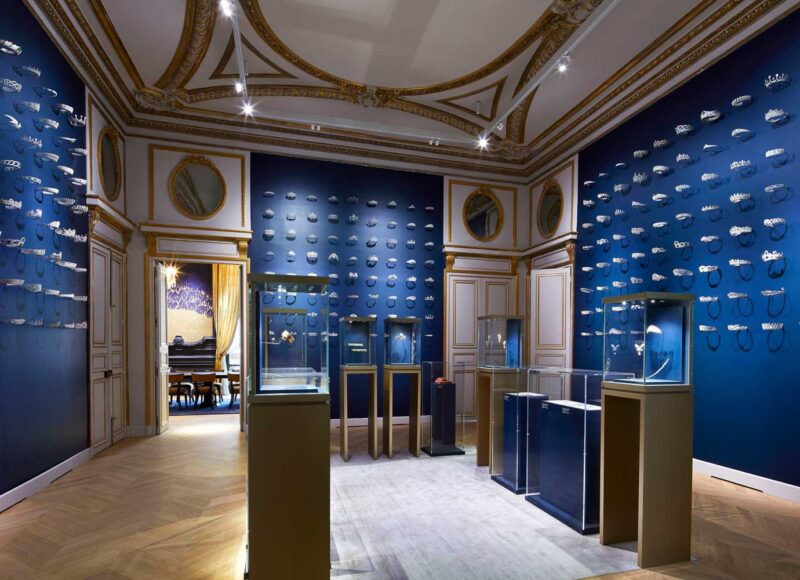
Chaumet keeps historical models at 12 Vendôme, where past forms can be read as design material.
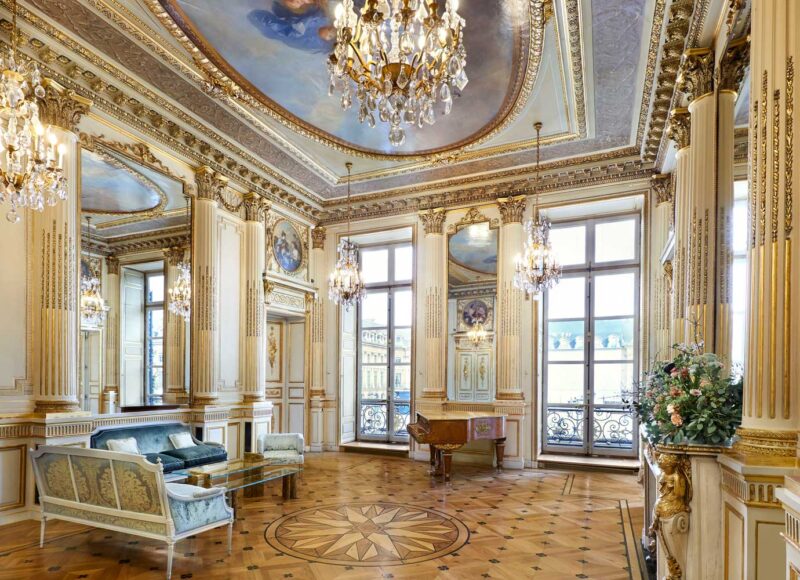
The Salon Chopin belongs to the grand salons at 12 Vendôme.
The grand salons change the pace. Chaumet says they were restored and reconsidered to house part of the Maison's heritage collection. The Salon Chopin belongs to that sequence, as does a room looking towards the Vendôme column where exceptional pieces can be presented and special orders imagined.
The most revealing heritage device, however, may be smaller than the rooms themselves. In its account of the art of the tiara, Chaumet identifies a historical collection of maquettes in the Salon des Diadèmes. The Maison uses those models to trace how its creations changed across periods and styles.
A maquette is compelling because it sits between idea and jewel. It carries proportion, silhouette and rhythm without pretending to be the final precious object. Seen in that context, heritage is not simply a list of famous clients or dates. It becomes a store of shapes.
That is particularly apt for Chaumet, where the tiara has long been a recurring design language. The interest is not that every contemporary piece copies a historic tiara. It is that an archive of forms can remain close enough to the present to be studied, abstracted and transformed. A curve can migrate. A vertical emphasis can become the profile of a ring. A motif once designed for the head can return at another scale.
The models at 12 Vendôme therefore do more than prove age. They make design memory visible.
The workshop keeps the address in the present tense
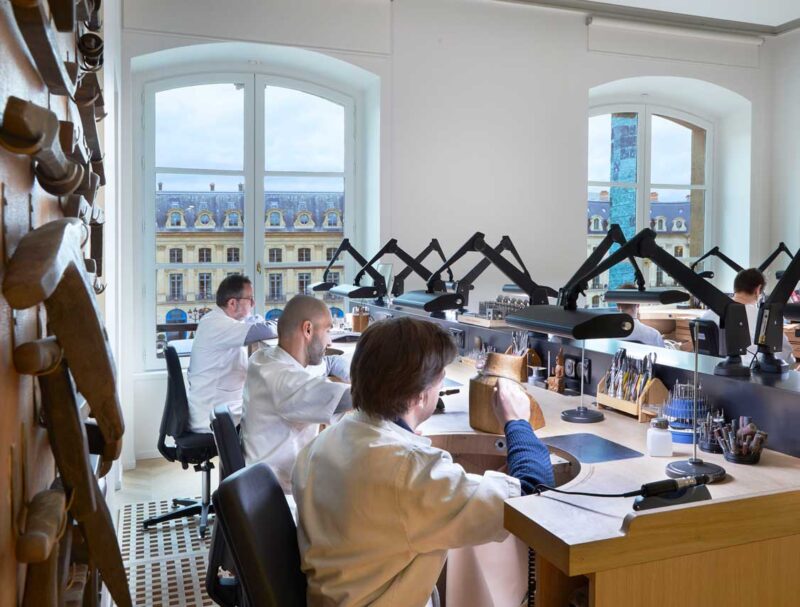
Chaumet identifies 12 Vendôme as the home of its High Jewellery workshop, where jewellers, setters and polishers work.
A heritage address can easily become theatrical, especially when the rooms are beautiful and the archive is rich. The High Jewellery workshop prevents 12 Vendôme from ending there.
Chaumet identifies the workshop at this address as a place where jewellers, setters and polishers work on High Jewellery creations. That active function matters because the heritage rooms do not stand apart from contemporary making: memory and craft remain part of the same institutional address.
The workshop also changes how the other rooms read. The maquettes belong to a living design culture rather than an isolated display of the past. Within the same address, historical forms remain visible while High Jewellery is still shaped by jewellers, setters and polishers.
That proximity gives the house a productive tension. A place associated with continuity is also a place where new decisions are made about line, volume, setting and polish. The archive can keep a vocabulary of forms close at hand, but each new creation still has to turn that inheritance into something present.
The present interior is part of the story, not evidence of an untouched past
In 2020, Chaumet unveiled a redesigned 12 Vendôme. The Maison's own chronology describes the project as a renewal of the historic address and restates its threefold role: store, cultural salons and High Jewellery workshop.
The 2020 redesign makes clear that the rooms visible today are not a frozen image of 1907. L'Arcade makes the point elegantly because today's space openly refers to a 1970 predecessor while remaining contemporary.
This is a more interesting form of continuity. Instead of pretending that everything has survived unchanged, 12 Vendôme allows the Maison to keep certain functions and questions alive while the physical expression evolves.
How should jewellery be presented? Which parts of an archive deserve to remain visible? How can a historical form be studied without simply being reproduced? What does it mean for craft to continue at an address whose public rooms have been renewed more than once?
The building does not answer those questions by itself. The objects and work inside it do.
Reading a Maison through one address
There is a temptation, with Place Vendôme, to let the square do the talking. The name already carries enough associations with Paris, jewellery and luxury to make almost any historic address sound important. For Chaumet, that would miss the more specific point.
No. 12 matters because it organises the Maison's jewellery culture. At street level, the boutique and L'Arcade concern encounter and choice. In the heritage rooms, models and objects make earlier design thinking available to the present. In the High Jewellery workshop, making remains an active discipline.
Seen in that sequence, the address becomes less a monument than a living structure of the Maison: encounter, memory and making held close together.
It also offers a better way to read heritage. Longevity alone does not explain why a house remains recognisable. What matters is what it chooses to keep close: certain forms, certain techniques, certain objects, certain ways of showing them. The archive has value when it sharpens the eye for the next piece.
At 12 Vendôme, Chaumet keeps those layers near one another. That proximity is the story. The boutique gives jewellery a public face. The salons give it memory. The workshop gives it a future tense.
Sources & further reading
The Edit
Maisons & Heritage stories
Selected stories from the same editorial universe.
Tiffany Blue Book 2026: How Hidden Garden Rewrites Schlumberger
Hidden Garden treats Jean Schlumberger’s archive as a living design language, translating flora, birds,
Putting Turner on 2 cm²: What Jaeger-LeCoultre’s Reverso Tribute Enamel “Turner Series” Actually Demands
Four Venetian paintings, four enamel and guilloché solutions, and one difficult question: how much
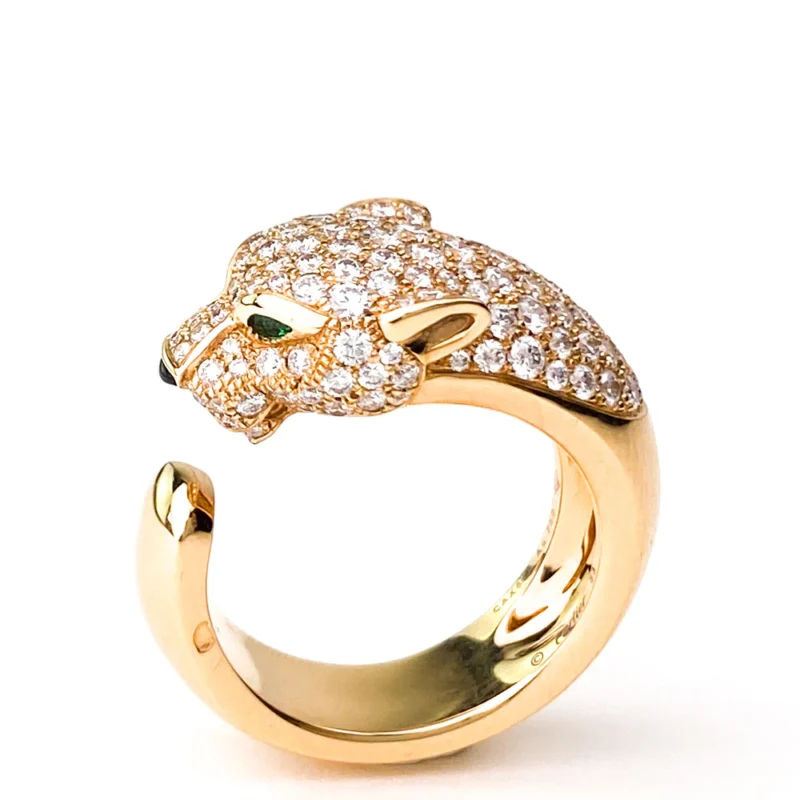
Jewelry Titans: How Luxury Brands Like Cartier and Bulgari Shape Modern Design
The world of luxury jewelry is defined by creativity, innovation, and meticulous craftsmanship. Among

How a Watch Maison Builds Memory: Patek Philippe, Rolex and Audemars Piguet
Three different systems of continuity: Patek Philippe through archives and complications, Rolex through controlled

The Oyster Perpetual: Rolex’s Groundbreaking Self-Winding Technology
The Rolex Oyster Perpetual represents one of the most significant milestones in the history
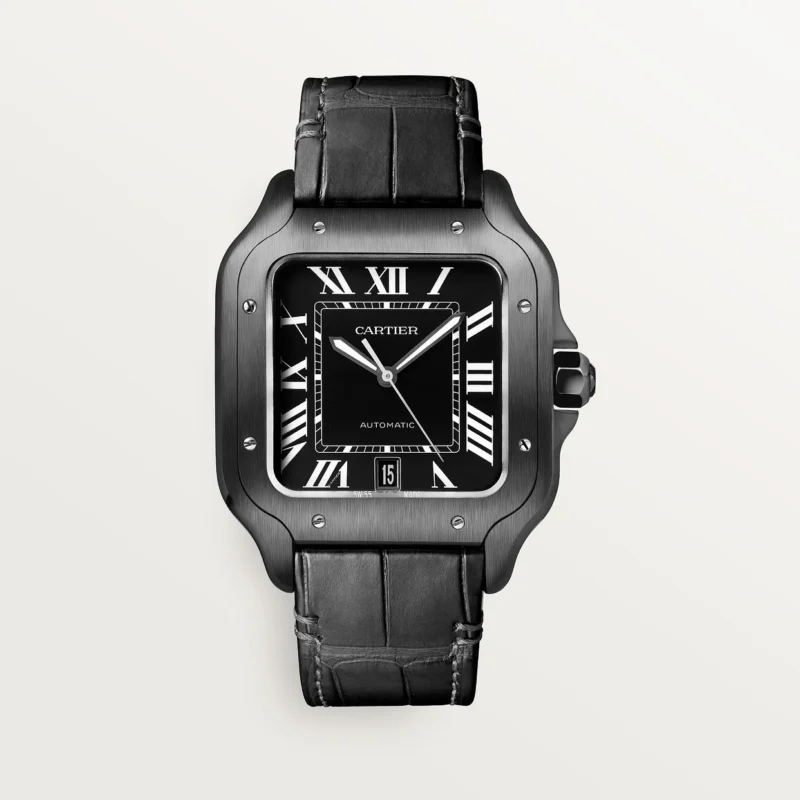
From the Santos to Panthère: How Cartier Redefined Jewelry and Watches
Cartier has long been a name synonymous with luxury, crafting some of the world’s