
TheTimeo / Maisons & Heritage
TURNER IN 2 CM²:
light, held in enamel
Four Venetian paintings, four enamel and guilloché solutions, and one difficult question: how much of Turner’s unstable light can survive on a Reverso caseback of roughly 2 cm²?
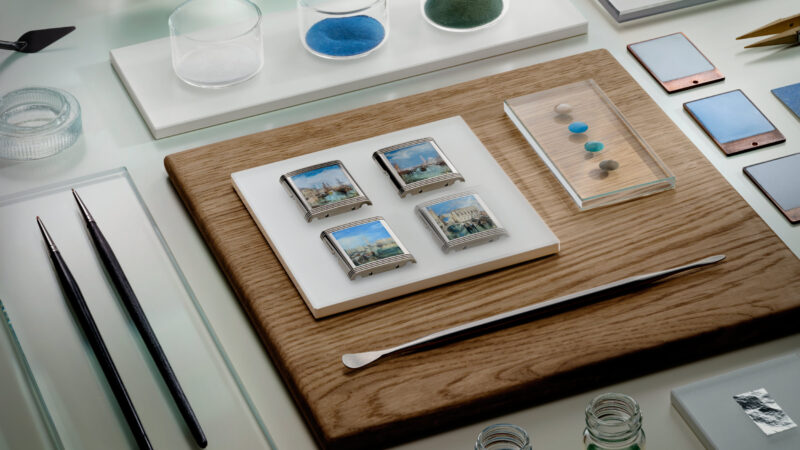
Four Venetian miniatures share one workbench while retaining distinct light, colour and composition. Courtesy of Jaeger-LeCoultre.
Explore the story
There are watch launches that are easy to summarise and hard to care about. Then there are launches that ask a much better question. In this case the question is simple: how do you translate Turner, of all painters, onto the back of a Reverso without reducing him to decoration?
That is what makes the new Reverso Tribute Enamel “Turner Series” worth slowing down for. On paper, the formula is familiar. Jaeger-LeCoultre takes the reversible case that has long served as a blank canvas, commissions four miniature enamel reproductions of paintings, and pairs each with a hand-finished front dial. In practice, the exercise is much tougher than that summary suggests. Turner is not a painter of neat outlines. He is a painter of atmosphere, moisture, unstable light, glowing haze and reflections that seem to dissolve as you look at them. Reproducing that on a flat metal surface smaller than a postage stamp is not a matter of skill alone. It is a matter of choosing the right limits, and knowing how far to push them.
Key facts
- Four references in white gold, each limited to 10 pieces.
- Launch date: 28 August 2026.
- Current context: presented in connection with Jaeger-LeCoultre’s participation at Homo Faber 2026 in Venice.
- Paintings referenced: Venice, the Dogana and San Giorgio Maggiore (1834), Venice, from the Porch of Madonna della Salute (1835), Bridge of Sighs, Ducal Palace & Custom House, Venice (1833), and Venice, the Bridge of Sighs (1840).
- Decorative crafts combined: miniature enamel painting, paillonage, hand-guilloché and Grand Feu enamel.
- Approximate work for each miniature: 80 hours.
- Enamel build: at least 14 layers, each fired at 800°C.
- Case size: 45.6 x 27.4 mm; thickness 8.51 mm.
- Movement: manually wound calibre 822, 42-hour power reserve, 3 Hz.
Why this series matters now
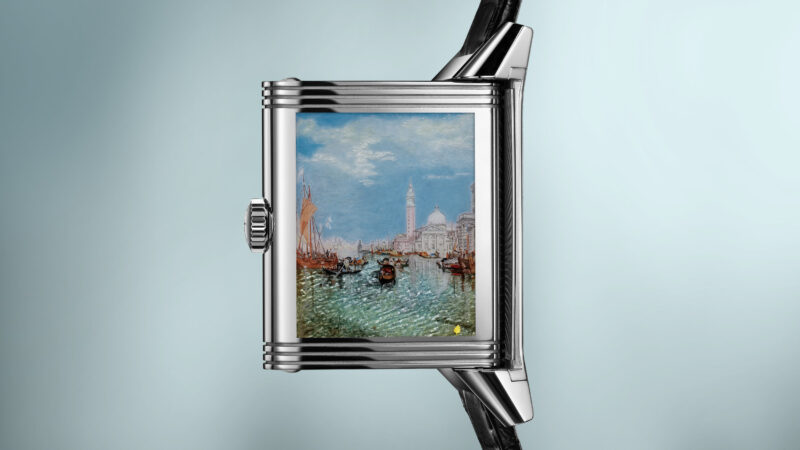
The Dogana and San Giorgio Maggiore survive the reduction through atmosphere rather than hard outline. Courtesy of Jaeger-LeCoultre.
Jaeger-LeCoultre presented the Turner series on 28 August 2026, a timing that was not accidental. The watches arrive as the Maison returns to Homo Faber in Venice this September, and Venice is the point that holds the project together. The city is not a loose source of inspiration here. It is the subject, the setting and, in many ways, the technical problem.
Turner’s Venetian paintings are not really about architecture in the narrow sense. Buildings are present, of course, but what stays in the mind is light bouncing off water, haze that softens distance, clouds that seem to hover between solidity and dissolution, and colour that keeps slipping away from fixed edges. Jaeger-LeCoultre understood that if those qualities were lost, the project would collapse into tasteful souvenir-making. So the watches are built around the effort to keep that instability alive.
That is also why the Reverso remains such a persuasive format for this kind of work. The front and back can speak to one another without repeating one another. One side carries time. The other carries image. The success of the Turner series lies in the fact that the dialogue is specific. Each dial is not just “colour-matched” to a caseback painting. It is constructed to echo a different visual logic from the work on the reverse.
Four paintings, four different solutions
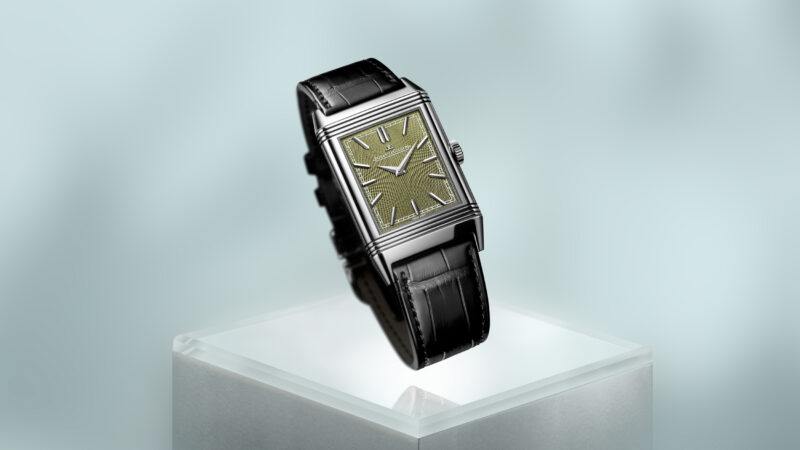
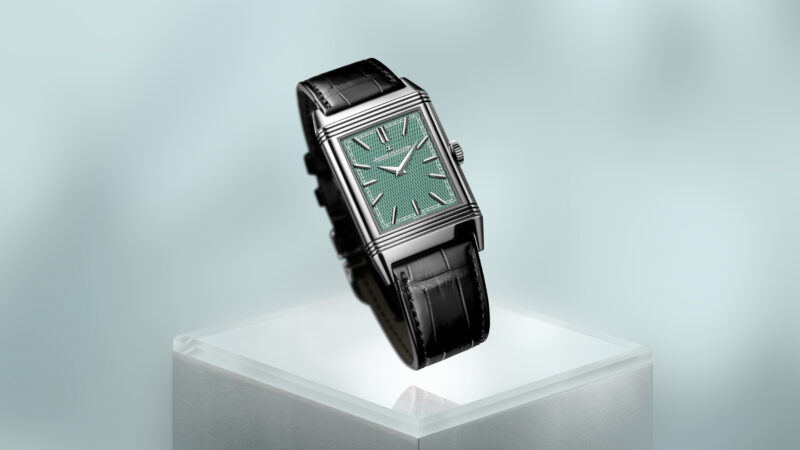
The first reference pairs green Grand Feu enamel with a soleil croisé guilloché. Courtesy of Jaeger-LeCoultre.
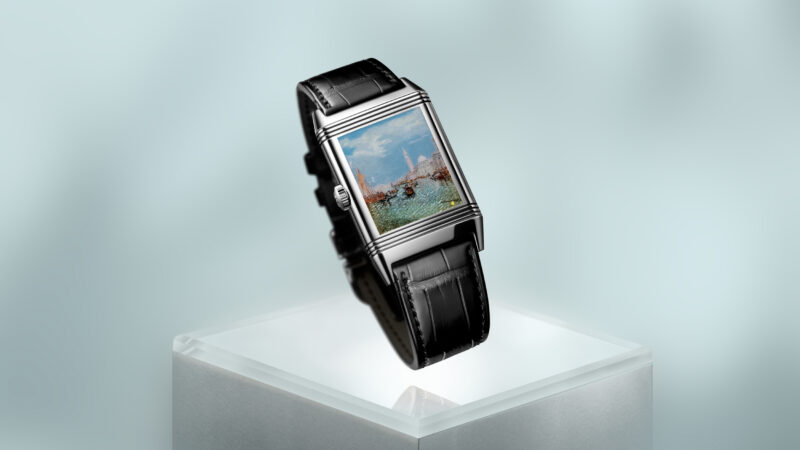
Turner’s view of the Dogana and San Giorgio Maggiore occupies the reverse. Courtesy of Jaeger-LeCoultre.
A rice-grain guilloché gives the second green dial a more granular field of light. Courtesy of Jaeger-LeCoultre.
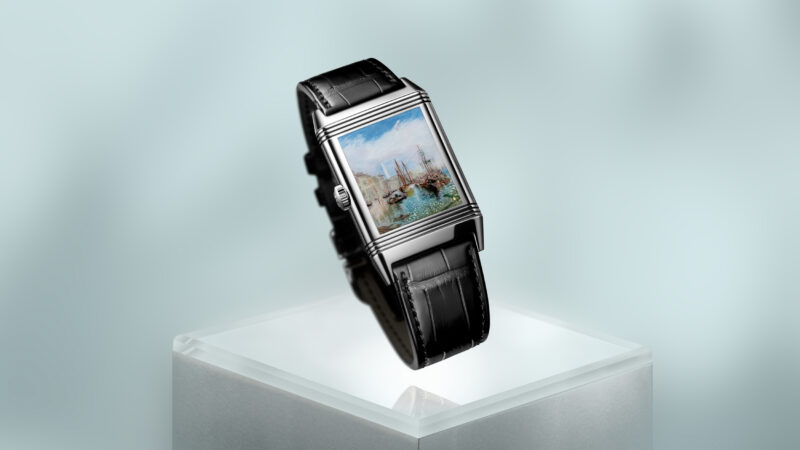
The second miniature lets architecture and reflection recede into Venetian haze. Courtesy of Jaeger-LeCoultre.
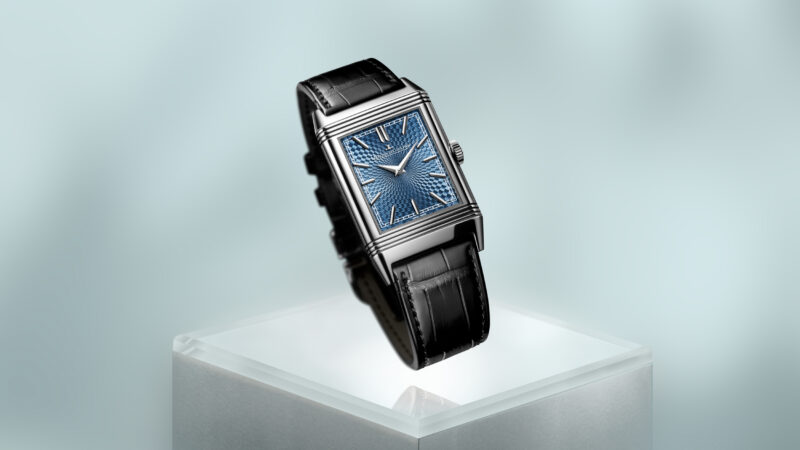
Blue Grand Feu enamel translates the cooler register of the third painting. Courtesy of Jaeger-LeCoultre.
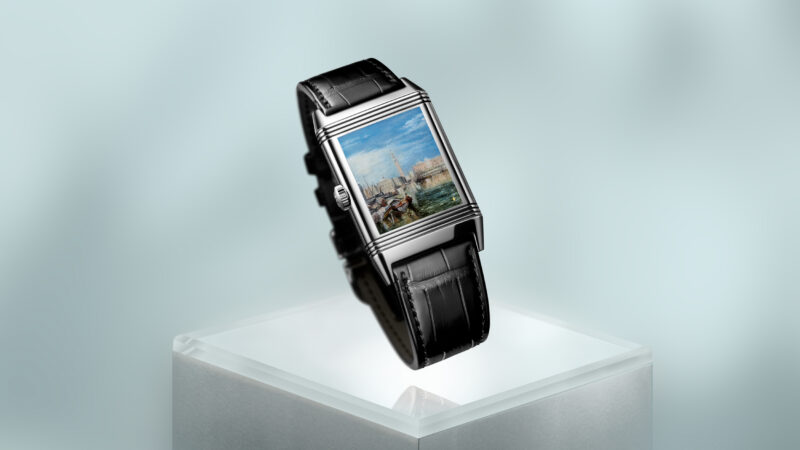
The Doge’s Palace and Bridge of Sighs are held inside a two-square-centimetre composition. Courtesy of Jaeger-LeCoultre.

The plum-violet dial shifts the quartet towards Turner’s duskier Venetian mood. Courtesy of Jaeger-LeCoultre.
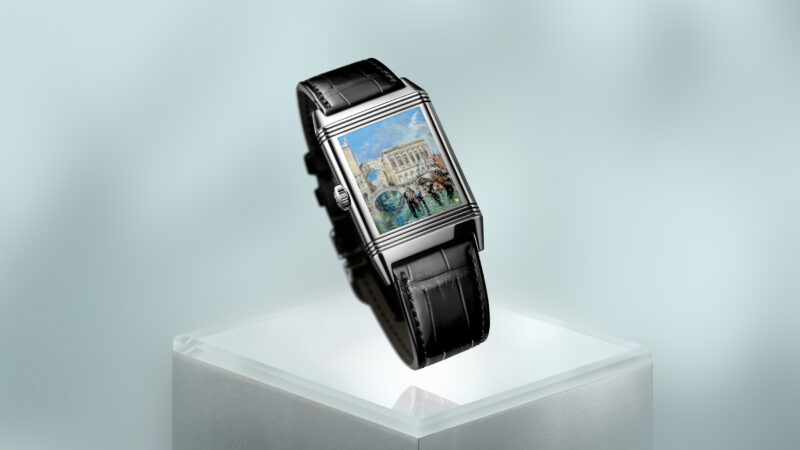
The fourth reverse balances a darker foreground against a luminous city. Courtesy of Jaeger-LeCoultre.
All four references share the same architectural base: a white-gold Reverso Tribute case, a manually wound calibre 822, applied hour markers, Dauphine hands, a black alligator strap, and production limited to 10 pieces per model. What changes is the visual argument.
1) Q39334W1: Venice, the Dogana and San Giorgio Maggiore
This first reference takes its cue from Turner’s 1834 view of San Giorgio Maggiore across the lagoon. The image is anchored by the pale church façade, but the sensation comes from the watery field around it: reflections, traffic on the lagoon, and a city that appears to recede into light rather than into hard perspective.
Jaeger-LeCoultre answers that on the dial with a green Grand Feu enamel surface over a “soleil croisé” guilloché pattern. The pattern is not there to provide decoration for decoration’s sake. It creates a flicker under the enamel that keeps the dial alive as the wrist moves. According to the Maison, this dial requires 180 engraved lines, each executed in six passages on the rose-engine lathe, for a total of 1,080 passages devoted to the guilloché alone.
The watch works because the front does not try to mimic the painting. It captures the part of the painting that matters most: the movement of reflected light across water.
2) Q39334W2: Venice, from the Porch of Madonna della Salute
If the first watch is about openness and reflection, the second is about atmosphere and depth. Turner’s 1835 From the Porch of Madonna della Salute lets forms drift into light. Buildings and their reflections nearly merge. It is one of those views where solidity seems temporary.
For this reference, Jaeger-LeCoultre keeps to a green family on the dial, but changes the texture completely. Here the Grand Feu enamel sits over a rice-grain guilloché pattern that produces shifting light and shade rather than broad radiance. The Maison describes 70 precisely engraved lines, each requiring six passages of the rose engine, for 420 operations in total.
That difference matters. The front of Q39334W2 feels more granular, more veiled, and closer in spirit to Turner’s soft recession of form. It is arguably the most atmospheric watch of the four.
3) Q39334W3: Bridge of Sighs, Ducal Palace & Custom House, Venice
This reference may be the cleanest example of how the series uses the dial as interpretation rather than duplication. The caseback draws on Turner’s 1833 Bridge of Sighs, Ducal Palace & Custom House, Venice, a view in which the Doge’s Palace, the green of the water and the blue of the sky sit in a delicate, hazy balance.
The dial shifts to blue Grand Feu enamel and a hand-guilloché pattern composed of 46 engraved lines, each executed in six successive passages. Jaeger-LeCoultre describes the effect as a shimmering blue field that catches the light in dialogue with the sky on the reverse. The result is cooler and more architectural than the two green-dialled references, yet it still avoids any frozen, overly graphic feel.
This is also the reference that may appeal most immediately to traditional watch collectors, because the blue front has an obvious wrist presence even before the case is turned over.
4) Q39334W4: Venice, the Bridge of Sighs
The fourth watch moves the mood again. Turner’s 1840 Venice, the Bridge of Sighs is a more melancholy work, with darker foreground elements set against a luminous city. Jaeger-LeCoultre responds with a subtle lavender-plum Grand Feu dial over a wavy guilloché motif meant to evoke rippling light on Venetian canals.
This guilloché uses 41 engraved lines, each requiring nine passes, for a total of 369 passages. It is the most explicitly fluid pattern in the series and probably the one that most clearly telegraphs the idea of water in motion.
The lavender choice is particularly smart. It would have been easy to stay within safer blue-green territory across all four pieces. Instead, Jaeger-LeCoultre allows the final watch to carry the duskier emotional register of the painting.
The real story is on the back, but not for the obvious reason
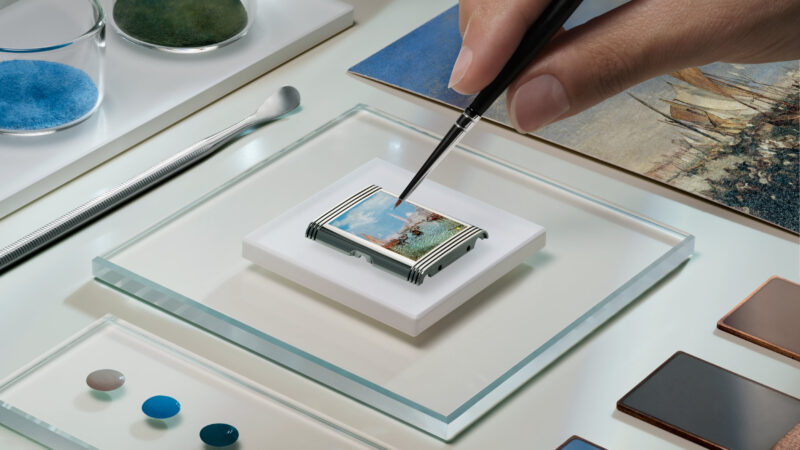
A fine brush builds the miniature through repeated layers rather than a single painted surface. Courtesy of Jaeger-LeCoultre.
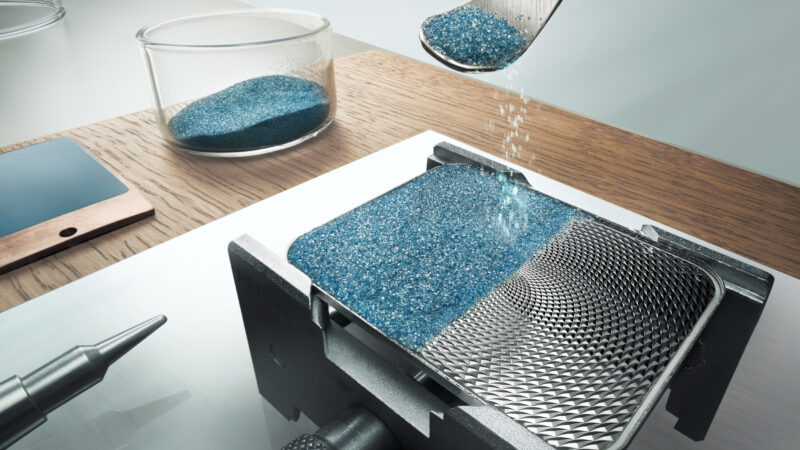
The rose-engine pattern remains visible beneath the blue enamel as a moving field of light. Courtesy of Jaeger-LeCoultre.
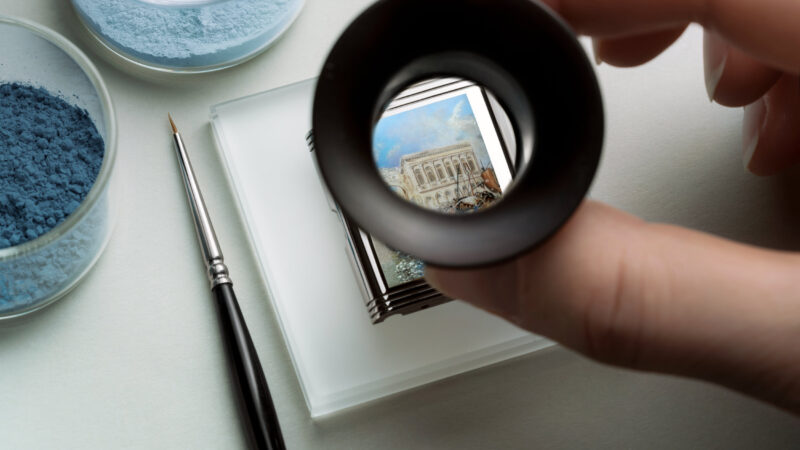
Inspection through a loupe reveals the scale at which colour, firing and detail must remain controlled. Courtesy of Jaeger-LeCoultre.
Most coverage of watches like these stops at the easy line: art on a watch. That misses the point. The real interest is not that famous paintings appear on the caseback. It is how the Maison’s Métiers Rares atelier deals with the physical behaviour of enamel in order to keep Turner’s pictorial language intact.
Each miniature is executed using the Geneva technique and requires approximately 80 hours of work. The paintings are built with at least 14 layers of enamel, each fired at 800°C. That figure alone sounds impressive, but it becomes more meaningful once you consider what those layers are doing.
Turner’s clouds and haze are not flat colour zones. They need depth. Jaeger-LeCoultre explains that the enameller first paints the clouds as part of the miniature composition, then adds translucent enamel layers over selected areas, repaints, and adds further translucent layers again. Water areas gain additional brilliance through paillonage, where silver leaf is laid under the enamel to intensify reflections and shimmer.
This is where the Turner choice becomes genuinely demanding. Reproducing a more linear or more sharply contoured painting would still be difficult, but the task would be different. Turner requires the artisan to build atmosphere. You are not only painting objects. You are constructing a field of light.
There is another difficulty. The originals are not made for a vertical rectangular watch case. Jaeger-LeCoultre had to crop each work so that it would fit the portrait proportions of the Reverso without losing the emotional centre of the composition. That is a curatorial decision as much as a technical one. The crop determines what kind of painting survives the transition from canvas to enamel.
A final touch that could easily be overlooked is the hidden gold-leaf paillon signature discreetly integrated into each image. It is a quiet detail, but it says something important about the project. These are not anonymous reproductions. They are handmade objects that carry the trace of the specific artisan who completed them.
Dials that do more than fill the other side
The dials deserve equal credit because they keep the series from becoming one-sided. In many art-backed watches, the front is treated as a necessary restraint, something polite and generic so as not to distract from the reverse. Here, the front is active.
After the guilloché is cut by hand on a manually operated rose engine, each dial undergoes eight to nine hours of enamelling, with up to five enamel layers and six or seven firings at 800°C. Only then are the faceted hour markers applied, which introduces yet another risk: tiny holes must be drilled through the enamel without cracking it.
This is why the Turner series feels coherent rather than split in two. The front is not a neutral face. It is the abstract half of the same argument. The back gives you Turner in miniature. The front gives you the corresponding sensation of light, texture or movement.
What stays constant: the Reverso architecture and calibre 822
All four watches are housed in an 18-carat white-gold Reverso Tribute case measuring 45.6 x 27.4 mm and 8.51 mm thick, with water resistance rated to 3 bar. Inside is Jaeger-LeCoultre’s manually wound calibre 822, the long-running rectangular movement that has become a natural fit for time-only Reverso Tribute models.
This movement runs at 21,600 vibrations per hour, offers a 42-hour power reserve, and is built from 108 components with 19 jewels. None of that is radical by 2026 standards, and that is perfectly fine. A more complicated movement would not necessarily have improved the project. The strength of calibre 822 here is that it stays slim, appropriate and visually consistent with the restraint of the Reverso form.
In fact, restraint is part of the appeal. This is not a watch trying to prove itself through complication count. It is using a familiar, dependable mechanical base to support something else: the conversion of decorative watchmaking into a serious interpretive craft.
What Jaeger-LeCoultre got right
The best thing about the Turner series is that it avoids two common traps.
The first trap is obvious sentimentality. There is no need to over-explain Turner’s greatness or to turn Venice into a generic fantasy. The watches work because they stay focused on specific visual problems: reflections, haze, clouds, recession, water and light.
The second trap is technical exhibitionism for its own sake. Jaeger-LeCoultre provides plenty of process detail, and rightly so, but the watches do not read like demonstrations of technique detached from feeling. The process remains tied to a pictorial result. That is harder to achieve than it sounds.
There is also a quieter success here. The four references are close enough to feel like a set, yet different enough to reward comparison. The project would have been weaker had Jaeger-LeCoultre simply rotated four paintings through an unchanged watch design. Instead, each reference has its own dial language and its own emotional temperature.
Final take
The easiest way to misunderstand the Reverso Tribute Enamel “Turner Series” is to see it as a prestige crossover between fine art and fine watchmaking. That description is not false, but it is too thin.
What Jaeger-LeCoultre has really done is much more interesting. It has used the Reverso as a testing ground for translation. How much of Turner survives when the image is compressed to 2 cm²? Which parts must be rebuilt through translucent enamel rather than simply painted? How should the front dial respond without becoming illustrative? And how much technical discipline does it take to make light feel unstable on a surface that is, materially speaking, anything but unstable?
Those are good questions, and the Turner series gives convincing answers. Not loud ones. Not theatrical ones. Precise ones.
That is why this release deserves more than novelty coverage. It shows Jaeger-LeCoultre doing what it tends to do best when it is fully engaged: taking an old format, respecting its limits, and using craft to make those limits productive.
Sources & further reading
The Edit
Maisons & Heritage stories
Selected stories from the same editorial universe.
12 Vendôme: Where Chaumet Keeps Memory and Making Together
At Chaumet’s 12 Place Vendôme, boutique, heritage salons and High Jewellery workshop share one
Tiffany Blue Book 2026: How Hidden Garden Rewrites Schlumberger
Hidden Garden treats Jean Schlumberger’s archive as a living design language, translating flora, birds,

Art and Precision: How Jaeger-LeCoultre Balances Aesthetic Design with Technical Mastery
Jaeger-LeCoultre has long been celebrated for its ability to fuse art and engineering in

Jaeger-LeCoultre’s Legacy of Precision: A Journey Through 180 Years of Watchmaking
For nearly two centuries, Jaeger-LeCoultre has been at the forefront of fine watchmaking, blending

Mastering Complications: Jaeger-LeCoultre’s Contributions to High Watchmaking
Jaeger-LeCoultre has long been revered as one of the most innovative and technically advanced

The Reverso: Jaeger-LeCoultre’s Iconic Timepiece That Blends Elegance and Innovation
Few timepieces in the world of haute horlogerie can claim the iconic status of