Watches
Cartier Roadster 2026: The Return of the Watch That Remembered Who Cartier Was
A TheTimeo collector reading of the Cartier Roadster 2026 relaunch: seven references, two sizes, three materials and the return of one of Cartier’s most characterful shaped watches.

A shaped Cartier with speed in its architecture
The 2026 Roadster relaunch matters because Cartier has brought back a watch with genuine personality: a tonneau case, a conical crown, a headlight-like date magnifier and the kind of automotive memory that makes the object recognisable before the specification begins.
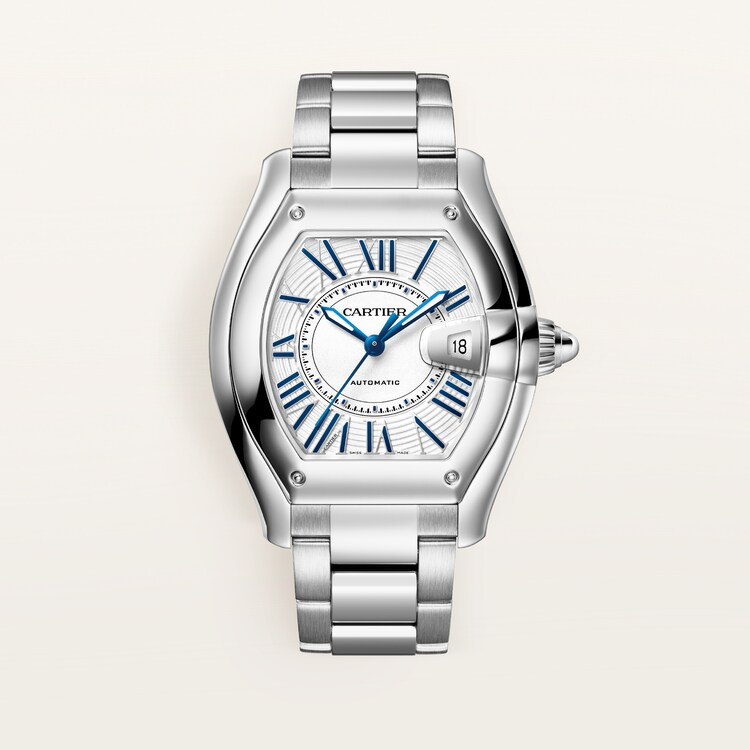


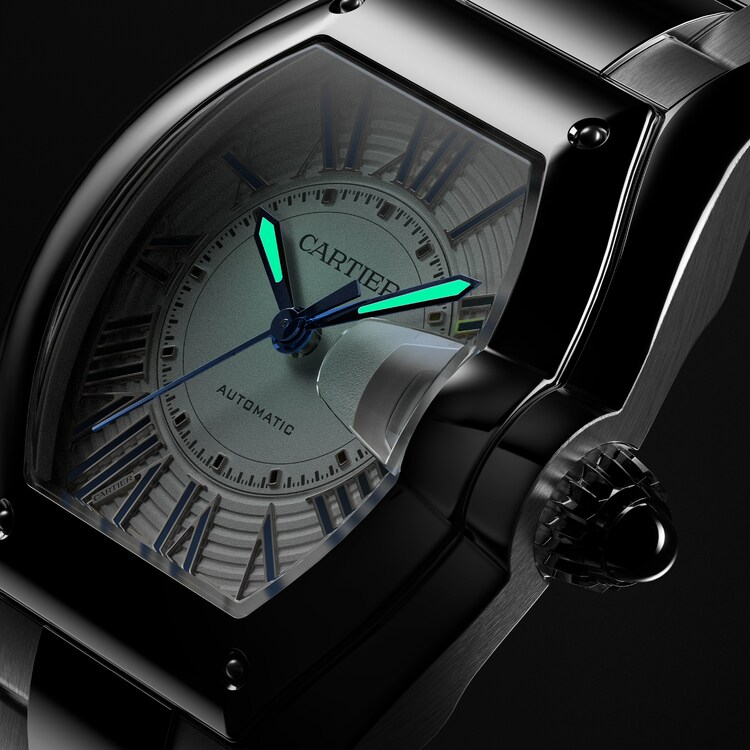
The Roadster returns as Cartier’s most extroverted shaped watch: not a Tank, not a Santos, not a quiet exercise in restraint, but a muscular tonneau with automotive memory and unmistakable wrist presence.
The Cartier Roadster disappeared from production around 2012 without ceremony. It was not discontinued because it had failed; it was discontinued because the direction of the luxury watch market was moving toward restraint, toward the Tank, toward the Santos, toward the dress-casual proposition that Cartier does with unmatched authority.
The Roadster was a different proposition: automotive, muscular, conical-crowned, speedometer-dialled. It stayed dormant for 14 years. In 2026, it returns with seven references, two sizes, three materials, updated manufacture movements, a reworked bracelet and the QuickSwitch strap system. The architecture is recognisable. The personality is intact.
The Roadster was never Cartier’s most elegant watch. It was Cartier’s most honest one. Its return is not nostalgia. It is Cartier remembering that personality is a competitive advantage.
Design reading
Automotive memory, Cartier geometry
The original Roadster arrived in 2002 with a visual language rooted in 1950s sports car culture: tonneau case, conical crown, headlight-like date magnifier and a dial pattern that reads like a speedometer. The 2026 generation keeps those codes and sharpens their execution.
- Case language
- Curved tonneau with pronounced crown-side volume
- Signature
- Conical crown and date magnifier at 3 o’clock
- Water resistance
- 100 metres across the line
The origin: 2002, and a watch ahead of its time
The first Roadster was designed as an explicit tribute to sports car culture: not the anonymous modern supercar, but the bodywork of a Ferrari 250, the curves of a Jaguar XK120 and the cockpit aesthetics of Le Mans in its golden decade. It borrowed the visual grammar of that world and converted it into a Cartier object.
The tonneau case suggested a car body viewed from above. The oversized conical crown read as a gear shift knob. The date magnifier recalled a headlight or windshield. The concentric dial pattern echoed a speedometer face. It was a watch with a point of view, and that remains its strength.
Wrist presence
Not restrained, but resolved
The Roadster works because it does not try to become a neutral Cartier. Its personality is the object: the curve, the crown, the date lens, the polished case flank and the sense of speed even when the watch is still.
In 2026, that confidence feels less like a revival than a correction. Cartier has enough authority in quiet elegance. The Roadster brings back the part of the maison that enjoys being seen.
The 2026 redesign: what changed and what stayed
Cartier’s brief for the second-generation Roadster is precise: preserve the identity, refine the execution, bring the movement architecture in-house and update the ergonomics for a contemporary wrist without softening the character.
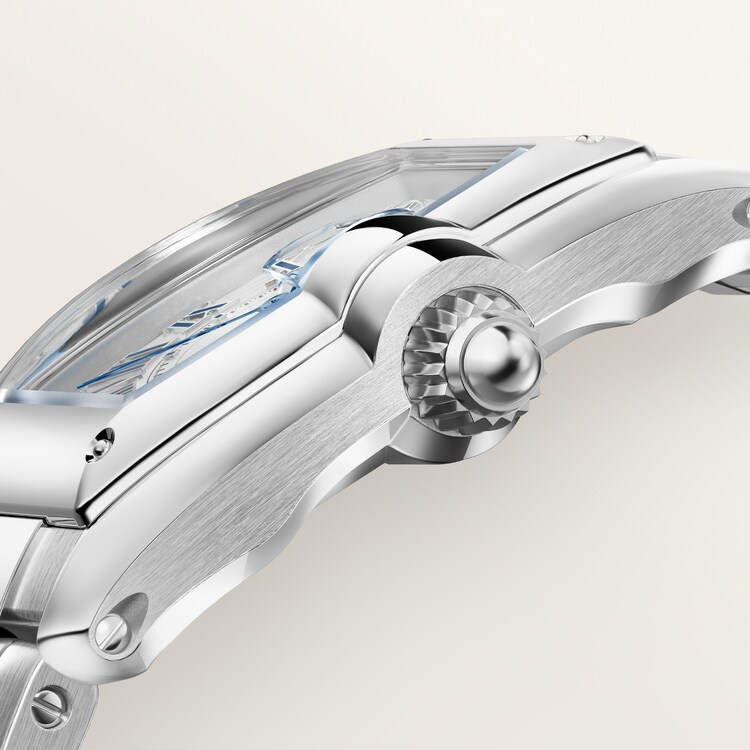
The conical crown
The oversized screw-down crown remains the Roadster’s most immediate signature, giving the case its automotive force and making the watch recognisable from the side.
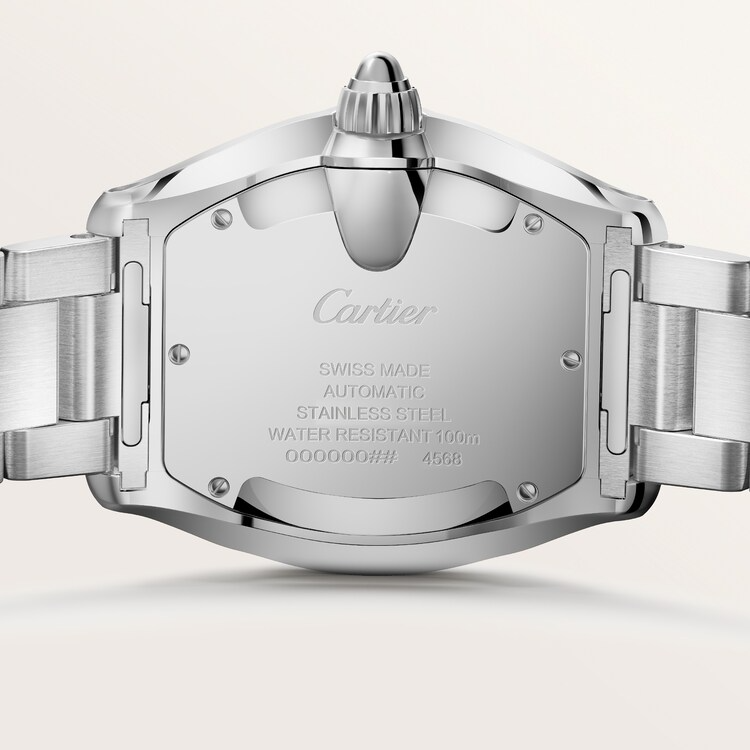
The bracelet system
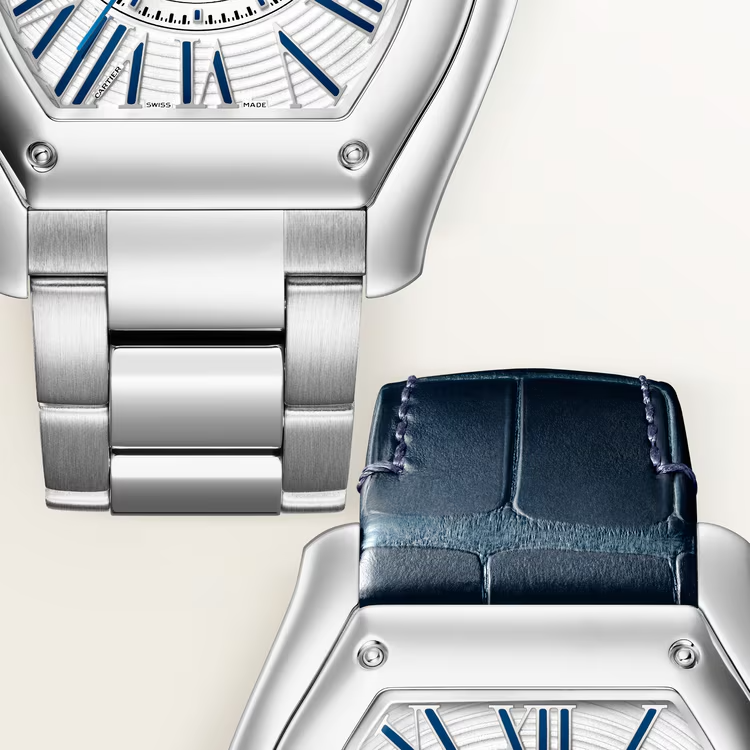
The integrated bracelet has been reworked with shorter, more ergonomic links and Cartier’s QuickSwitch system for fast changes between bracelet and strap.
The dial architecture
The concentric dial remains central to the Roadster reading. Roman numerals, sword hands and the framed date give the watch its Cartier identity inside the automotive shell.
The seven-reference line-up
The Roadster returns with enough structure to feel like a real collection rather than a single nostalgic reissue: steel, steel-and-gold and full yellow gold, each with a different emotional temperature.
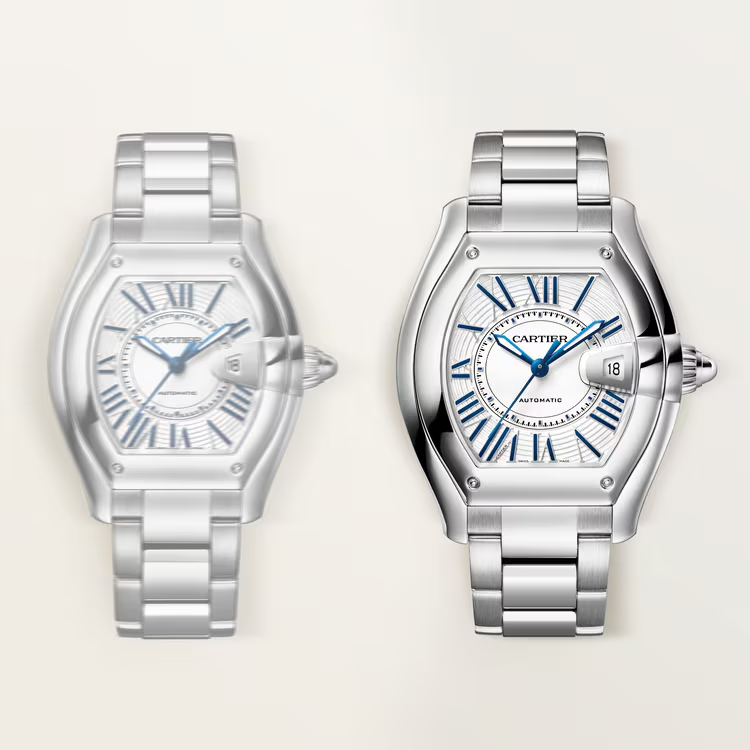
Steel
The cleanest entry into the collection: silvered opaline dial, blue Roman numerals, steel bracelet and a Roadster profile that feels instantly legible.
- Refs.
- WSRD0019, WSRD0020, WSRD0014
- Sizes
- Medium and large
- From
- EUR 7,600
Steel and yellow gold
The natural Roadster register. Steel gives the architecture; yellow gold brings warmth, memory and the strongest link to the first generation’s character.
- Refs.
- W2RD0009, W2RD0010
- Material
- Steel and 18k yellow gold
- From
- EUR 13,600
Full yellow gold
The Roadster at its most declarative: case as jewellery, crown as sculpture, bracelet as a goldsmith’s object rather than a purely technical component.
- Refs.
- WGRD0011, WGRD0012
- Material
- 18k yellow gold
- From
- EUR 37,800
Steel: the entry point and the statement
The medium steel reference WSRD0019 is the most direct entry into the Roadster world. At 42.5 x 34.9mm and 9.7mm thick, it reads as a shaped Cartier with real daily utility rather than a collector-only object. The large steel WSRD0020 expands the case to 47.2 x 38.8mm and carries the automotive proportions more fully.
The blue dial large steel WSRD0014 is the most contemporary-feeling reference in the line. The rubber strap option gives it a sports-watch register without losing the shaped-case authority that makes it Cartier.
Two-tone: the Roadster’s natural register
The two-tone references W2RD0009 and W2RD0010 are where the Roadster’s character is most fully expressed. The first-generation Roadster is remembered strongly in steel and yellow gold, and the second generation benefits from the same warmth. The steel keeps the architecture sharp; the gold gives the watch its period memory and its glamour.
For a collector choosing one Roadster, this is the emotional centre of the collection. It is sportive without becoming cold, precious without becoming formal, and recognisably Cartier without depending on restraint.
Full gold: the Roadster at its most declarative
The full yellow gold references WGRD0011 and WGRD0012 transform the Roadster into a luxury sports object without qualification. The tonneau curves read as jewellery; the conical crown becomes sculptural; the polished and brushed surfaces take on the presence of a goldsmith’s object.
This is not simply the more expensive version of the steel watch. It is a different statement, and for Cartier that distinction matters. The maison has always understood that a shaped watch can become jewellery without surrendering its watchmaking identity.
The Cartier argument in 2026
Shaped authority
No manufacture has a deeper relationship with shaped watches. The Roadster extends that authority beyond the Tank and Santos into a more kinetic, automotive vocabulary.
Movement identity
The second generation uses Cartier manufacture calibres: 1847 MC for the large format and 1899 MC for the medium, bringing the collection into the maison’s current technical language.
Wearability
At 9.7mm to 10.06mm thick, with 100m water resistance and strap interchangeability, the Roadster returns as a personality watch that can still be worn every day.
The movement upgrade
The most important technical difference between the first-generation Roadster and the 2026 relaunch is the adoption of Cartier manufacture calibres throughout the line. The large format uses Calibre 1847 MC, an automatic movement with 4Hz frequency and approximately 42 hours of power reserve. The medium format uses Calibre 1899 MC, also automatic, with approximately 38 to 40 hours of power reserve.
These are not showpiece movements in the way a skeletonised Cartier calibre might be. They are solid, brand-correct automatic movements that give the Roadster the manufacture identity it did not fully possess in its first generation.
Reference guide
WSRD0019
Medium, 42.5 x 34.9mm, stainless steel, silvered opaline dial, Calibre 1899 MC, EUR 7,600.
WSRD0020
Large, 47.2 x 38.8mm, stainless steel, silvered opaline dial, Calibre 1847 MC, EUR 8,300.
WSRD0014
Large, dark blue dial, stainless steel bracelet with navy rubber strap, Calibre 1847 MC, EUR 8,300.
W2RD0009 / W2RD0010
Medium and large, steel with 18k yellow gold details, silvered opaline dial, from EUR 13,600.
WGRD0011 / WGRD0012
Medium and large, 18k yellow gold, silvered opaline dial, from EUR 37,800.
TheTimeo view
The Cartier Roadster’s return in 2026 is not a nostalgia exercise. It is a competitive argument. Cartier is reminding the watch market that its design authority extends beyond restraint: beyond the Tank, beyond the Santos, beyond the architectural perfection that has defined so much of the maison’s modern identity.
The Roadster is the part of Cartier that borrowed from car culture, exaggerated a crown, shaped a date magnifier like a piece of bodywork and made a tonneau case feel fast. That part of Cartier did not disappear between 2012 and 2026. It was waiting.
At seven references across two sizes and three metals, the second generation gives every collector a point of view. The correct answer to “which Roadster?” depends on who you are. But the correct answer to “should Cartier have brought it back?” is simple: yes.
The Roadster works because it refuses neutrality: it is shaped, visible, slightly theatrical and unmistakably Cartier.
TheTimeo editorial desk